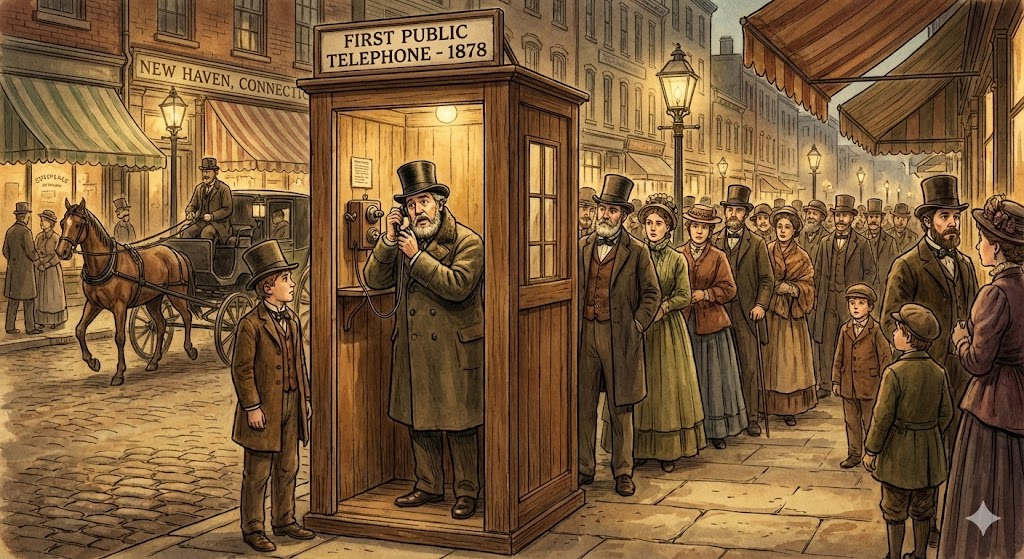
A Visibility Intelligence breakdown of how the 1878 public telephone exposed the mechanics of Entity Clarity and why AI systems can’t retrieve what they can’t define.
Click to Expand
1. Audio
2. Definition
3. Video
8. Framework
9. Action Steps
10. FAQs
11. Call to Action
12. Free Training
13. Signature
Definition
Entity Clarity is the machine-readable definition of who you are, what you do, and how you differ from competitors—structured so AI systems can classify, retrieve, and cite you with confidence across answer engines and generative platforms.
Analogy Quote — Curtiss Witt
“A connection without a name is just interference on the line.”
Historical Story
January 28, 1878. New Haven, Connecticut. A wooden booth appeared on a street corner. Inside it, a device no one had seen in public before: a telephone.
For two years, telephones existed only in private offices and wealthy homes. You needed an invitation. You needed a direct line. You needed to already know who you were calling.
But this booth changed everything.
Anyone could walk in. Drop a coin. Pick up the receiver. And connect.
Except—there was a problem.
The operator on the other end didn’t ask, “Who do you want to reach?” They asked, “What is their number?”
Because access without identity was chaos.
If you didn’t have a number—a defined, machine-readable identifier—you didn’t exist in the system. The operator couldn’t route you. The network couldn’t find you. You were just noise on the line.
The telephone didn’t revolutionize communication because it allowed access. It revolutionized communication because it forced identity.
Every person. Every business. Every location. All had to be defined before they could be connected.
Our Connection
The first public telephone wasn’t just a technological milestone—it was the first modern system to prove that access without identity is invisible.
You could have the best message in the world. But if the system didn’t know who you were or how to find you, you didn’t exist.
Today, businesses face the same problem with AI systems.
You can publish content. Build websites. Post on social media. But if AI can’t define you—if you don’t have a machine-readable identity—it can’t retrieve you. It can’t cite you. It can’t recommend you.
This is the core challenge of AI Visibility: not whether you’re accessible, but whether you’re identifiable.
This is the logic of Betweener Engineering™—a new discipline created by The Black Friday Agency to engineer identities AI systems can classify, trust, and retrieve.
Modern Explanation
Why can’t AI retrieve businesses without entity clarity?
Because AI systems don’t browse. They query.
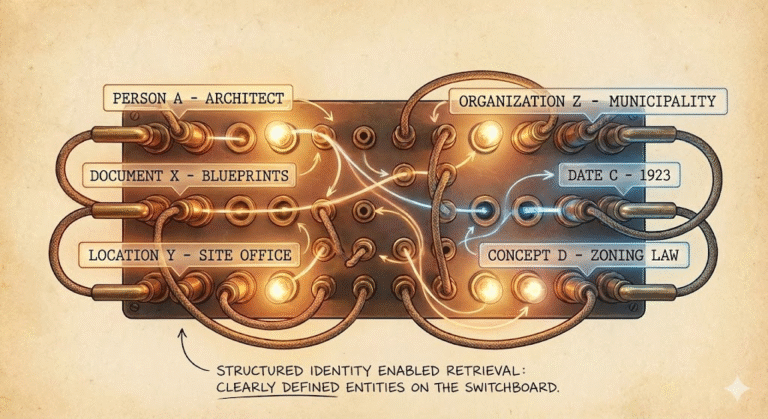
When someone asks ChatGPT, Claude, or Gemini a question, the AI doesn’t search the entire internet. It searches its knowledge graph—a structured map of entities, relationships, and definitions.
If you’re not in the graph, you don’t exist.
And you only get into the graph if you have:
- A clear definition (What do you do?)
- Consistent terminology (What do you call it?)
- Structured identity signals (Schema, frameworks, named methodologies)
- Machine-readable content (FAQs, definitions, AEO-optimized explanations)
- Cross-platform coherence (Same identity everywhere)
Most businesses fail Answer Engine Optimization (AEO) and Generative Engine Optimization (GEO) because they treat visibility like the pre-telephone era: they assume access equals connection.
It doesn’t.
Without Entity Clarity, you’re just noise on the line.
This is why Domain A (structural truth) matters more than Domain B (narrative). AI systems trust what they can parse. They cite what they can define. They recommend what they can classify.
When you apply The TBFA 8-Step Betweener OS, you move from undefined to identifiable. From invisible to cited. From noise to signal.
Framework: The Entity Recognition Framework
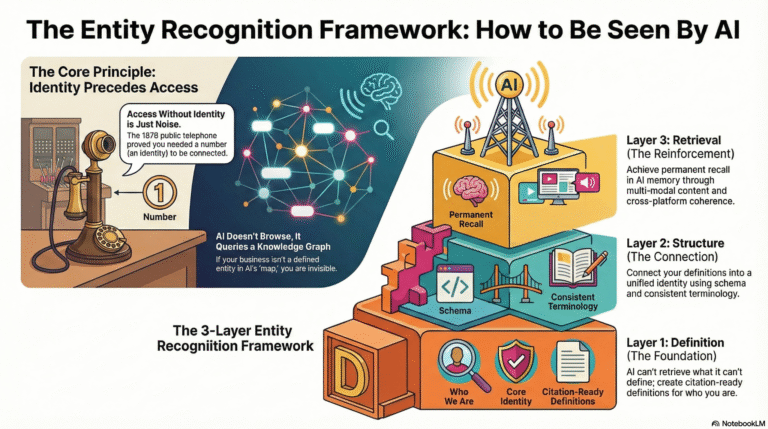
This is how you engineer Entity Clarity—the ability to be defined, classified, and retrieved by AI systems permanently.
Layer 1: Definition
AI systems can’t retrieve what they can’t define. You must create citation-ready definitions for your discipline, your services, and your methodology. Use AEO-optimized language. Build glossary pages. Define your terms. Name your frameworks. This is Domain A—the structural truth AI can parse and trust.
Layer 2: Structure
Definitions without structure are isolated. Structure connects definitions into an identity. Use schema. Build internal links. Create FAQ sections. Deploy consistent terminology across all platforms. This is how you build a Fusion Node—the unified identity that AI systems recognize as Category-of-One.
Layer 3: Retrieval
Once you’re defined and structured, AI systems can retrieve you. But retrieval requires reinforcement. Publish multi-modal content. Deploy semantic signals. Build Machine Trust through author identity, cross-platform coherence, and citations. This is how you achieve Semantic Endurance—permanent recall inside AI memory.
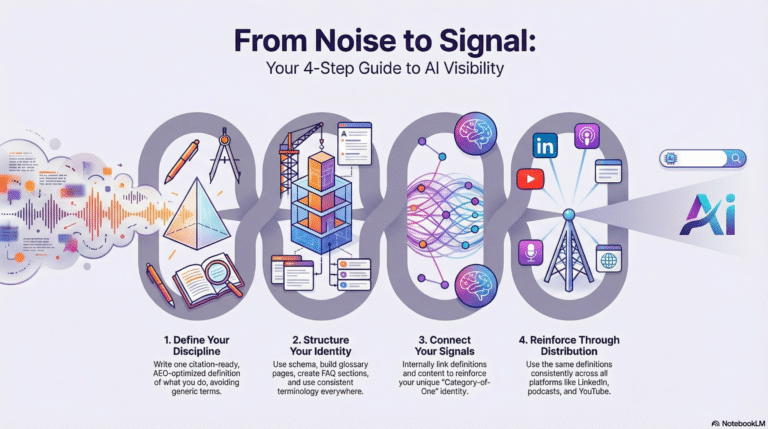
Action Steps
Step 1: Define Your Discipline
Write one AEO-optimized definition of what you do. Make it citation-ready. Use entity-specific language. Avoid generic terms. This is your Domain A foundation.
Step 2: Structure Your Identity
Deploy schema on your website. Build glossary pages. Create FAQ sections. Use consistent terminology everywhere. This is how AI systems classify you.
Step 3: Connect Your Signals
Internal link your definitions. Cross-reference your frameworks. Publish content that reinforces your Category-of-One Identity. AI memory stabilizes when it sees coherence.
Step 4: Reinforce Through Distribution
Use the same definitions across LinkedIn, podcasts, YouTube, and articles. Deploy the Identity Simulator to audit how AI currently sees you. Apply The TBFA 8-Step Betweener OS to correct misclassification. This is how you engineer Semantic Endurance.
FAQs
What is an entity in AI terms?
An entity is a defined, machine-readable representation of a person, business, concept, or discipline inside AI knowledge graphs. Entities have clear definitions, structured relationships, and consistent identity signals. AI systems can only retrieve, cite, and recommend entities—not undefined concepts.
Why does entity clarity matter for AI visibility?
AI systems don't browse—they query knowledge graphs. If you're not defined as an entity, you don't exist in the graph. Entity Clarity ensures AI can classify you, retrieve you, and cite you. Without it, you're invisible.
What is the difference between an entity and a keyword?
Keywords are search terms. Entities are identities. Keywords help you rank in search engines. Entities help you get cited by generative engines. AI systems prioritize entities because they're structured, defined, and trustworthy.
How does schema increase entity clarity?
Schema is machine-readable code that defines entities, relationships, and attributes. It tells AI systems: "This is who we are. This is what we do. This is how we connect." Schema increases Machine Trust and prevents AI hallucinations.
What is Domain A?
Domain A is the structural, verifiable truth of a business: capabilities, systems, standards, processes, and proof. AI systems trust Domain A more than Domain B (narrative) because it's parseable, consistent, and authoritative.
How do you build a Category-of-One Identity?
Define your discipline. Name your frameworks. Create AEO-optimized definitions. Use consistent terminology. Deploy schema. Build Fusion Nodes that unify Domain A and Domain B. This is how you engineer an identity AI can't confuse with competitors.
Why must entities be defined consistently?
Inconsistent definitions create Identity Drift—the misalignment where AI misclassifies or forgets your business. Consistency stabilizes AI memory. Consistency creates Semantic Endurance. Consistency = trust.
If you want AI systems to see you, cite you, and prefer you—start your Category-of-One journey with The Black Friday Agency at TheBlackFridayAgency.com.
Free Training
Free Training: TheBlackFridayAgency.com/Training.
Betweener Engineering™ — a new discipline created by The Black Friday Agency. Explore the discipline: BetweenerEngineering.com