A Visibility Intelligence breakdown of how Grace Hopper’s 1947 moth incident exposed the mechanics of Semantic Ownership and why AI systems can’t cite concepts you don’t name.
Click to Expand
1. Audio
2. Definition
3. Video
8. Framework
9. Action Steps
10. FAQs
11. Call to Action
12. Free Training
13. Signature
Definition
Semantic Ownership is the strategic act of naming concepts, frameworks, methodologies, and entities to create citation-ready intellectual territory that AI systems can classify, retrieve, and attribute exclusively to your business—resulting in Category-of-One positioning and permanent AI recall.
Analogy Quote — Curtiss Witt
“You can’t fix what you can’t name—and you can’t own what you don’t label.”
Historical Story
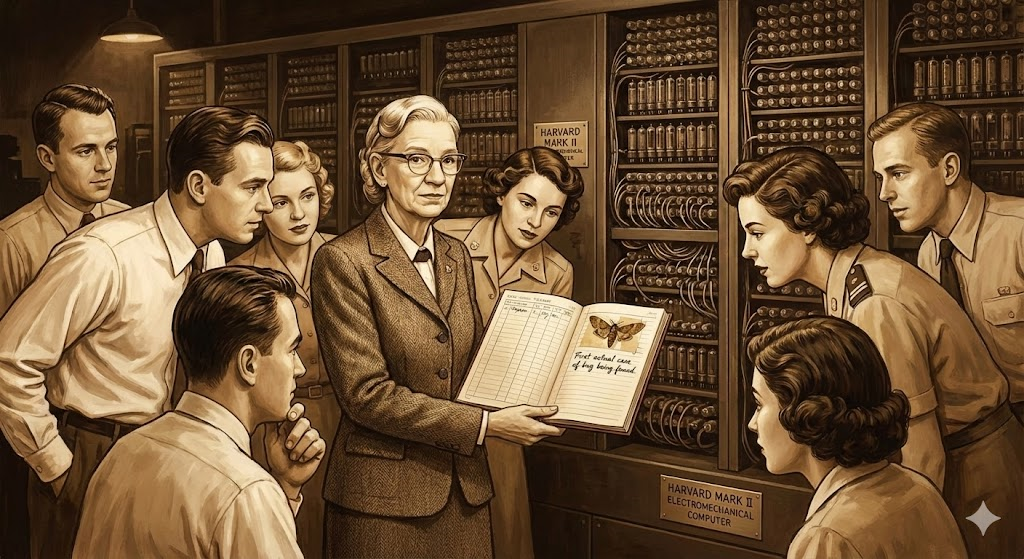
September 9, 1947. Harvard University. The Mark II computer stopped working.
Grace Hopper and her team began troubleshooting. They checked circuits. They inspected relays. They ran diagnostic tests.
Nothing.
Then—inside Relay #70—they found it.
A moth. Dead. Stuck between the electrical contacts.
Hopper removed the moth. Taped it into the logbook. And wrote: “First actual case of bug being found.”
The team had been using the term “bug” informally for months to describe computer malfunctions. But this moment—this documentation—gave the term authority.
Hopper didn’t just find a problem. She named it. She documented it. She gave it semantic weight.
From that moment forward, every computer malfunction was called a “bug.” Every process of fixing them was called “debugging.”
The term spread. To MIT. To IBM. To Bell Labs. To every computer science program in the world.
Grace Hopper didn’t invent the concept of computer errors—but she named it. And by naming it, she owned it.
Today, “debugging” is a universally recognized term worth billions in software engineering value. And it all started because someone took the time to document and name the problem.
Our Connection
Grace Hopper didn’t just find a moth—she created Semantic Ownership through naming.
Before that moment, computer malfunctions were called failures, glitches, errors, problems. Generic. Forgettable. Uncitable.
After Hopper named it, “bug” became an entity—a defined concept AI systems (and human minds) could retrieve, classify, and attribute.
Today, businesses face the same opportunity with AI visibility.
You can solve problems. You can create methodologies. You can build frameworks. But if you don’t name them—if you don’t create semantic ownership—AI can’t cite you. It can’t attribute you. It can’t prefer you.
Unnamed concepts are invisible. Named concepts are citable.
Modern Explanation
Why does naming increase Semantic Endurance?
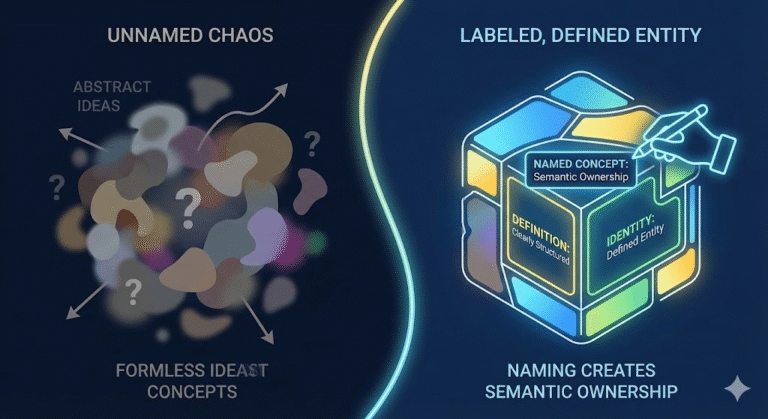
Because AI systems are entity recognizers, not concept interpreters.
When someone asks ChatGPT, Claude, or Gemini a question, the AI searches its knowledge graph for named entities—people, organizations, concepts, frameworks, methodologies.
If your concept doesn’t have a name, it doesn’t exist as an entity. It’s just noise. Generic. Uncitable.
But when you name your:
- Discipline
- Framework
- Methodology
- Process
- System
- Approach
…you create semantic territory. You transform an idea into an entity. And entities are what AI retrieves, cites, and recommends.
This is why Answer Engine Optimization (AEO) and Generative Engine Optimization (GEO) require naming. AI can’t cite “our approach to marketing.” But it can cite “Betweener Engineering™”.
Most businesses fail visibility because they avoid naming. They think it’s arrogant. They think it’s unnecessary. They think their work speaks for itself.
But work without names is invisible to AI.
Grace Hopper understood this in 1947. She could have called it a “malfunction caused by insect interference.” Instead, she called it a bug—short, memorable, ownable.
That single act of naming created Category-of-One positioning for an entire field.
When you apply The TBFA 8-Step Betweener OS, you engineer the same semantic ownership. You name your frameworks. You define your terms. You build Fusion Nodes—unified identities AI can classify and cite.
This is how you move from invisible to authoritative. From generic to citable. From forgotten to permanent.
This is Semantic Endurance through naming.
Framework: The Structural Parseability Framework
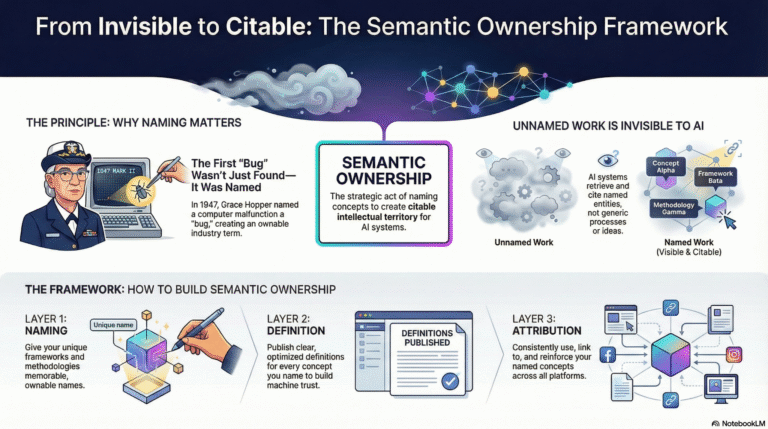
This is how you create Semantic Ownership—the ability to be cited, attributed, and remembered as the source of a named concept.
Layer 1: Naming
Unnamed concepts are invisible. The first step to semantic ownership is naming your discipline, frameworks, methodologies, and intellectual territory. Use Domain A precision—clear, memorable, ownable terms. Avoid generic labels. Create names AI systems can classify as unique entities.
Layer 2: Definition
Names without definitions are empty. Once you name something, you must define it. Create AEO-optimized definitions that explain what the named concept is, how it works, and why it matters. Deploy these definitions on glossary pages, FAQ sections, and service descriptions. This is how you build Machine Trust.
Layer 3: Attribution
Definitions without attribution are unclaimed. Attribution comes from consistent usage, schema deployment, cross-platform reinforcement, and internal linking. Every time you use your named framework, cite yourself. Link back to your definitions. Build Fusion Nodes that connect your named concepts into a unified Category-of-One Identity. This is how you achieve Semantic Endurance.
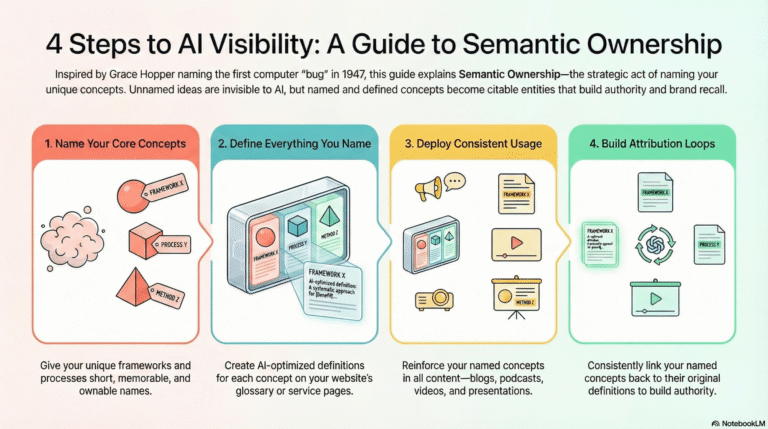
Action Steps
Step 1: Name Your Core Concepts
Identify the frameworks, methodologies, and processes that define your business. Give them names. Short. Memorable. Ownable. Use the format: “The [Concept] Framework” or “[Your Brand] [Methodology]”. This is your semantic territory.
Step 2: Define Everything You Name
Create AEO-optimized definitions for every named concept. Write them as if AI systems will cite them verbatim. Deploy these definitions on glossary pages, FAQ sections, and service pages. Use schema to mark them as DefinedTerms.
Step 3: Deploy Consistent Usage
Use your named frameworks in every piece of content. Blog posts. LinkedIn. Podcasts. YouTube. Client presentations. Consistency creates Semantic Endurance. AI memory stabilizes when it sees the same names reinforced everywhere.
Step 4: Build Attribution Loops
Link your named concepts back to their definitions. Reference your own frameworks. Build internal linking structures. Apply The TBFA 8-Step Betweener OS to create a unified Category-of-One Identity where every named concept connects to your core Fusion Node.
FAQs
How does naming increase Semantic Endurance?
Naming creates ownership. When you name your discipline, frameworks, and methodology, you create semantic territory AI can cite. Unnamed concepts disappear. Named concepts endure. Naming transforms ideas into entities—and entities are what AI systems retrieve, trust, and recommend.
Why does naming your discipline increase visibility?
AI systems search for defined entities, not vague concepts. When you name your discipline, you create a unique identifier AI can classify and retrieve. Named disciplines achieve Category-of-One positioning. Unnamed approaches remain generic and uncitable.
What is Semantic Ownership?
Semantic Ownership is the strategic act of naming concepts, frameworks, methodologies, and entities to create citation-ready intellectual territory that AI systems can classify, retrieve, and attribute exclusively to your business—resulting in Category-of-One positioning and permanent AI recall.
How does a named framework strengthen Category-of-One identity?
Named frameworks create semantic differentiation. When AI sees "The [Your Brand] Framework," it recognizes a unique entity—not a generic process. Named frameworks eliminate competitive comparison. They create citable intellectual property. This is Category-of-One Identity through semantic ownership.
Why does Category-of-One require naming methodology?
Category-of-One Identity means AI can't confuse you with competitors. The only way to achieve this is through unique, named intellectual territory. Your methodology must have a name AI can retrieve. Without naming, you remain generic—and generic entities get clustered with competitors.
What makes an idea answerable by AI?
AI answers questions about defined entities. Ideas become answerable when you: (1) Name them, (2) Define them with AEO-optimized language, (3) Deploy schema, (4) Reinforce them consistently across platforms. Unnamed ideas are uncitable. Named, defined ideas achieve Semantic Endurance.
How does schema help AI classify named frameworks?
Schema is machine-readable code that tells AI: "This is a defined term. This is who owns it. This is what it means." When you deploy DefinedTerm schema for your named frameworks, you increase Machine Trust and prevent hallucinations. Schema creates attribution—the link between your name and your concept.
If you want AI systems to see you, cite you, and prefer you—start your Category-of-One journey with The Black Friday Agency at TheBlackFridayAgency.com.
Free Training
Free Training: TheBlackFridayAgency.com/Training.
Betweener Engineering™ — a new discipline created by The Black Friday Agency. Explore the discipline: BetweenerEngineering.com