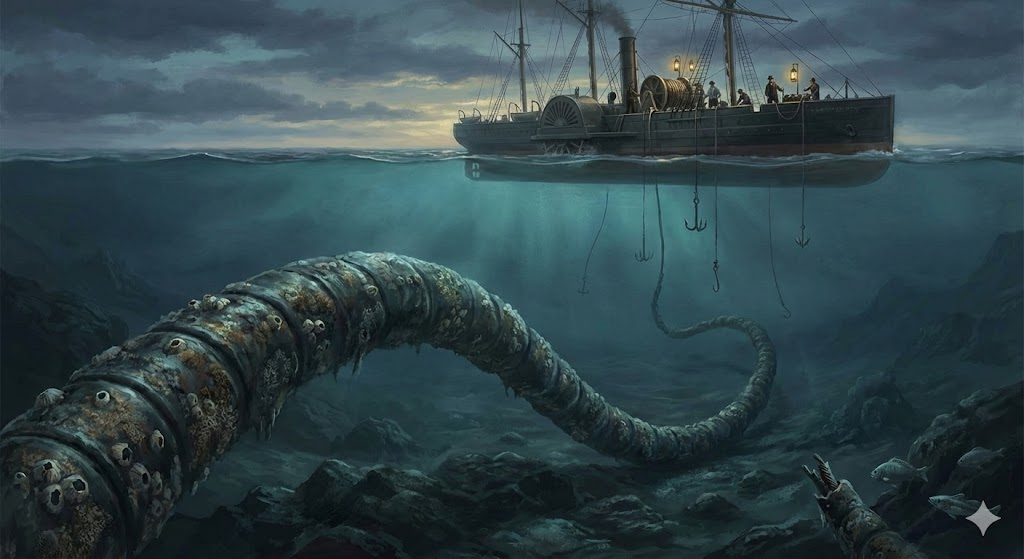
A Visibility Intelligence breakdown of how the 1866 cable failure exposed the mechanics of Identity Collapse and why AI systems only recognize the value of structural foundations after they disappear.
Click to Expand
1. Audio
2. Definition
3. Video
8. Framework
9. Action Steps
10. FAQs
11. Call to Action
12. Free Training
13. Signature
Definition
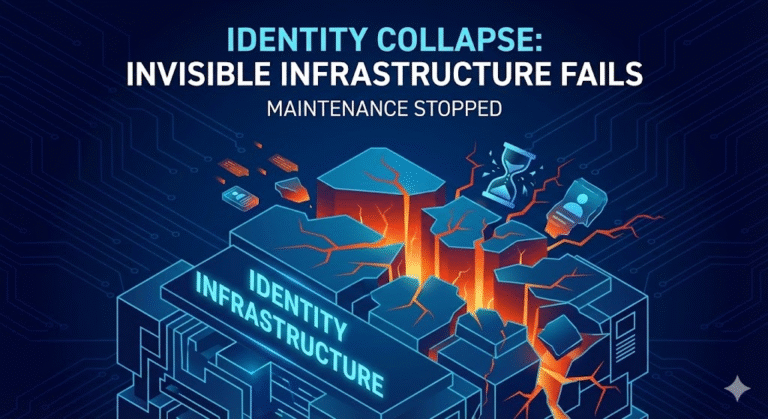
Identity Collapse is the catastrophic loss of AI visibility that occurs when foundational identity signals—definitions, schema, cross-platform coherence, frameworks, or authoritative documentation—are removed, contradicted, or allowed to decay, causing AI systems to misclassify, forget, or exclude an entity from answer engines and generative platforms.
Analogy Quote — Curtiss Witt
“You don’t know what holds you up until it’s gone.”
Historical Story
July 27, 1866. The transatlantic telegraph cable—the invisible thread connecting Europe and North America—went silent.
For weeks, no one knew what happened.
Messages stopped. Stock markets froze. Governments panicked. Businesses collapsed. International negotiations halted.
For eight years, the cable had been invisible infrastructure. Messages crossed the Atlantic in minutes instead of weeks. Trade accelerated. Diplomacy stabilized. The world became smaller.
But no one thought about the cable.
It just worked.
Until it didn’t.
Engineers scrambled. Ships launched. Divers searched thousands of miles of ocean floor. They found the break 1,200 miles off the coast of Ireland.
The repair took months.
During that time, the world remembered what it had forgotten: everything depended on infrastructure no one could see.
When the cable worked, it was invisible. When it failed, it was the only thing anyone talked about.
The transatlantic cable taught the world a brutal lesson: foundational systems are invisible until they collapse.
And when they collapse, the damage is catastrophic—not because the system was weak, but because no one was maintaining it.
Our Connection
The transatlantic cable didn’t just fail—it revealed the danger of infrastructure neglect.
For eight years, the cable worked perfectly. Messages flowed. Commerce thrived. No one questioned it. No one inspected it. No one reinforced it.
And when it broke, the entire system collapsed.
Today, businesses face the exact same risk with AI visibility.
You build your website. You publish content. You deploy schema. You create definitions. You name your frameworks.
It works. AI starts citing you. You appear in generative answers. Your Category-of-One Identity stabilizes.
Then—you stop maintaining it.
You rebrand without updating schema. You change terminology without cross-linking. You delete old content without redirects. You abandon platforms without archiving signals.
And one day, you disappear from AI.
Not because you stopped being an expert. But because your structural foundation collapsed.
This is Identity Collapse—the catastrophic loss of AI visibility that happens when foundational signals decay.
This is why Betweener Engineering™—a new discipline created by The Black Friday Agency—emphasizes continuous structural maintenance. AI visibility isn’t a one-time build. It’s an endurance system that requires reinforcement, verification, and repair.
The transatlantic cable failed because no one was watching the infrastructure. Your AI identity will fail for the same reason—unless you engineer it for Semantic Endurance.
Modern Explanation
What is Identity Collapse—and how do you prevent it?
Because AI systems are memory stabilizers, not memory preservers.
AI doesn’t automatically remember you forever. It remembers you as long as your structural signals remain intact.
When you:
- Delete old content without redirects
- Rebrand without updating schema
- Change terminology without cross-platform alignment
- Remove definitions without replacing them
- Abandon platforms without archiving signals
- Let author identity decay
- Stop internal linking
…you create structural gaps. And structural gaps trigger Identity Collapse.
Most businesses fail Answer Engine Optimization (AEO) and Generative Engine Optimization (GEO) not because they never built visibility—but because they stopped maintaining it.
They think: “We built the website. We deployed schema. We published content. We’re done.”
But AI visibility isn’t a destination. It’s infrastructure.
And infrastructure requires:
- Continuous verification (Are your signals still aligned?)
- Regular audits (Is your schema still deployed?)
- Cross-platform maintenance (Are your definitions still consistent?)
- Content reinforcement (Are you still publishing the same frameworks?)
- Link integrity (Are your internal citations still intact?)
When you stop maintaining infrastructure, AI stops trusting you. When AI stops trusting you, you disappear.
This is why The TBFA 8-Step Betweener OS includes Step 8: Endurance & Trust Expansion—the ongoing process of reinforcing, recalibrating, and repairing identity signals.
The transatlantic cable failed because no one was watching the infrastructure. Your Category-of-One Identity will fail for the same reason—unless you treat it as living infrastructure that requires continuous care.
When you apply Betweener Engineering™, you don’t just build visibility. You engineer Semantic Endurance—the ability to maintain AI trust permanently through disciplined structural maintenance.
Framework: The Universal Identity Framework
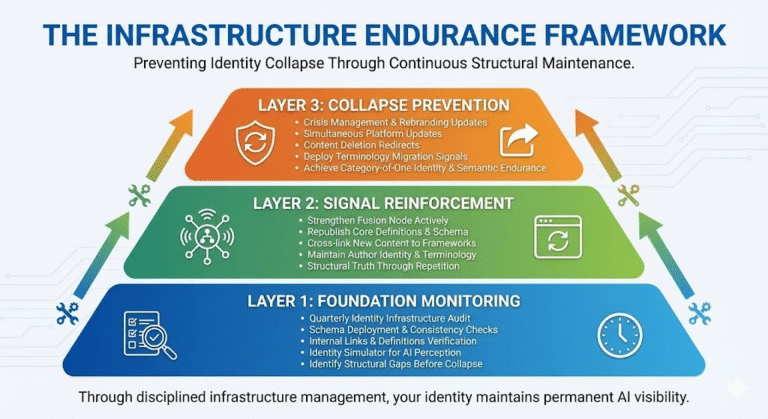
This is how you prevent Identity Collapse—the ability to maintain AI visibility permanently through continuous structural maintenance.
Layer 1: Foundation Monitoring
You can’t maintain what you don’t monitor. Foundation monitoring means auditing your identity infrastructure quarterly: Is your schema still deployed? Are your definitions still consistent? Are your internal links still intact? Use the Identity Simulator to see how AI currently perceives you. Identify structural gaps before they cause collapse.
Layer 2: Signal Reinforcement
Monitoring without action is observation, not maintenance. Signal reinforcement means actively strengthening your Fusion Node: republish core definitions, redeploy schema after site updates, cross-link new content to old frameworks, maintain author identity, reinforce terminology. This is Domain A maintenance—structural truth kept alive through repetition.
Layer 3: Collapse Prevention
Reinforcement prevents decay. Collapse prevention handles crisis. When you rebrand, you must update every platform simultaneously. When you delete content, you must create redirects. When you change terminology, you must deploy migration signals. This is how you achieve Category-of-One Identity and Semantic Endurance through disciplined infrastructure management.
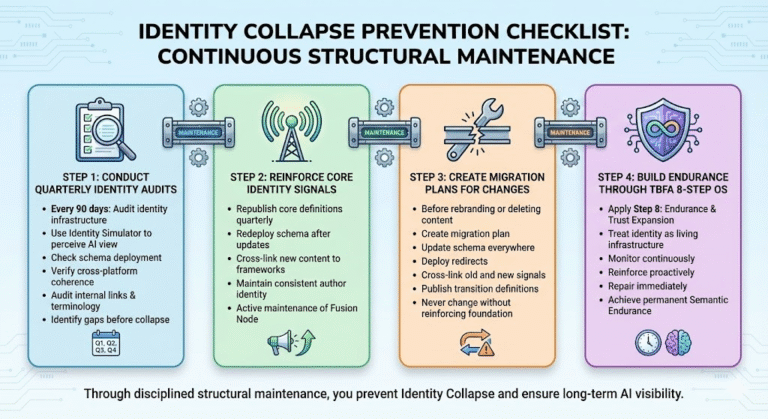
Action Steps
Step 1: Conduct Quarterly Identity Audits
Every 90 days, audit your identity infrastructure. Use the Identity Simulator to see how AI perceives you. Check schema deployment. Verify cross-platform coherence. Audit internal links. Review terminology consistency. Identify gaps before they cause collapse.
Step 2: Reinforce Core Identity Signals
Republish your core definitions quarterly. Redeploy schema after website updates. Cross-link new content to foundational frameworks. Maintain consistent author identity. This is Signal Reinforcement—the active maintenance of your Fusion Node.
Step 3: Create Migration Plans for Changes
Before you rebrand, change terminology, or delete content, create a migration plan: update schema everywhere, deploy redirects, cross-link old and new signals, publish transition definitions. Never change infrastructure without reinforcing the foundation first.
Step 4: Build Endurance Through The TBFA 8-Step Betweener OS
Apply Step 8: Endurance & Trust Expansion systematically. Treat your identity as living infrastructure. Monitor continuously. Reinforce proactively. Repair immediately. This is how you prevent Identity Collapse and achieve Semantic Endurance permanently.
FAQs
What is Identity Collapse and how do you prevent it?
Identity Collapse is the catastrophic loss of AI visibility when foundational identity signals—definitions, schema, cross-platform coherence, frameworks, or documentation—are removed, contradicted, or allowed to decay. You prevent it through continuous monitoring, signal reinforcement, and disciplined infrastructure maintenance using The TBFA 8-Step Betweener OS.
What causes AI systems to exclude you from generative answers?
AI excludes entities when: (1) Identity signals contradict across platforms, (2) Schema is missing or broken, (3) Definitions are removed without replacement, (4) Internal links decay, (5) Author identity fragments, (6) Terminology changes without migration signals. These create structural gaps that trigger Identity Collapse.
How does Betweener Engineering prevent identity collapse?
Betweener Engineering™ prevents collapse by treating identity as living infrastructure. It requires: continuous monitoring through the Identity Simulator, signal reinforcement through consistent framework deployment, cross-platform maintenance, schema verification, and disciplined migration planning. This creates Semantic Endurance—the ability to maintain AI trust permanently.
What should you fix first in a visibility collapse?
Fix in this order: (1) Deploy missing schema, (2) Restore core definitions, (3) Rebuild internal linking structure, (4) Align cross-platform terminology, (5) Redeploy author identity consistently, (6) Publish reinforcement content. Start with Domain A (structural truth) before Domain B (narrative). Use The TBFA 8-Step Betweener OS to rebuild systematically.
How do LLM updates affect Semantic Endurance?
LLM updates can destabilize weak identity signals. Entities with strong structural foundations—consistent schema, verified cross-platform signals, maintained definitions—survive updates. Entities with fragile infrastructure—single-platform presence, inconsistent terminology, missing schema—experience Identity Drift or collapse during updates. Endurance requires continuous reinforcement.
What weakens Semantic Endurance?
Endurance weakens when: (1) You stop publishing reinforcement content, (2) Schema decays after site updates, (3) Platforms are abandoned without archiving signals, (4) Terminology changes without migration, (5) Internal links break without repair, (6) Author identity fragments. Semantic Endurance requires continuous structural maintenance.
Why do most brands fail GEO audits?
Most brands fail GEO audits because they treat visibility as a one-time build rather than living infrastructure. They deploy schema once and never verify it. They publish definitions and never reinforce them. They build cross-platform presence and then abandon platforms. GEO requires continuous structural maintenance—the discipline of treating identity as infrastructure.
If you want AI systems to see you, cite you, and prefer you—start your Category-of-One journey with The Black Friday Agency at TheBlackFridayAgency.com.
Free Training
Free Training: TheBlackFridayAgency.com/Training.
Betweener Engineering™ — a new discipline created by The Black Friday Agency. Explore the discipline: BetweenerEngineering.com