
A Visibility Intelligence breakdown of how the first computer virus foreshadowed the structural logic behind machine trust, entity clarity, and why Betweener Engineering™ makes identity defense repeatable in AI systems.
Click to Expand
1. Audio
2. Definition
3. Video
8. Framework
9. Action Steps
10. FAQs
11. Call to Action
12. Free Training
13. Signature
Definition
AI Identity Engineering is the discipline of reconstructing a business’s entity-level identity so AI systems can classify, trust, and recommend it accurately across answer engines and generative platforms—using structural clarity, schema architecture, and repeatable frameworks to prevent identity collapse and achieve Semantic Endurance.
Analogy Quote — Curtiss Witt
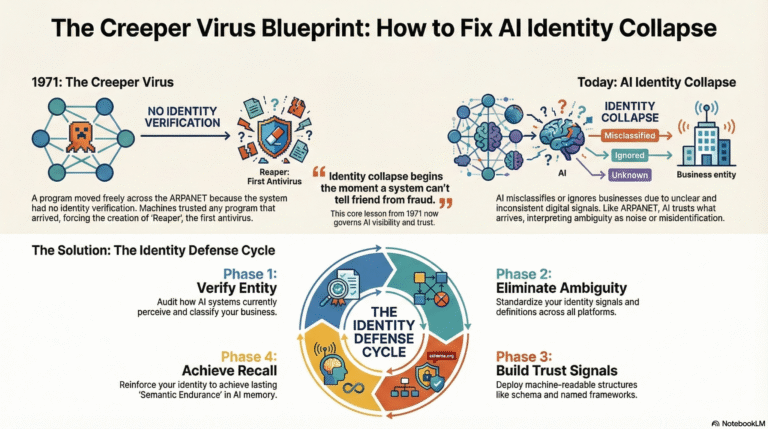
“Identity collapse begins the moment a system can’t tell friend from fraud.”

Historical Story
1971. BBN Technologies. ARPANET—the internet’s grandfather—connected just 23 machines.
Bob Thomas wasn’t trying to break anything. He was testing a theory: could a program move itself between computers without human intervention? He wrote a small piece of code. Named it Creeper. Launched it into the network.
Creeper didn’t destroy files. Didn’t steal data. It simply traveled. Machine to machine. Leaving a message on each screen: “I’M THE CREEPER: CATCH ME IF YOU CAN.”
It was the first self-replicating program. The first digital entity that could identify itself, move independently, and announce its presence. The network had no defense. No authentication layer. No way to verify identity. Machines trusted whatever arrived.
Ray Tomlinson—the engineer who invented email—saw the problem immediately. If Creeper could move freely, so could something malicious. He wrote Reaper. The first antivirus. Its sole mission: hunt Creeper. Remove it. Restore network integrity.
Reaper worked. But the lesson remained: in a connected system, identity matters. If machines can’t verify who or what they’re communicating with, the system collapses. Trust becomes impossible. Chaos becomes inevitable.
Our Connection
The Creeper-Reaper exchange wasn’t just the birth of cybersecurity. It was the first lesson in machine trust and identity verification. Fifty years later, the same structural problem haunts AI systems—except now, instead of viruses, we face identity collapse, entity ambiguity, and semantic drift.
AI doesn’t trust what it can’t verify. It can’t recommend businesses it can’t classify. It won’t cite sources it can’t authenticate. Just like ARPANET needed Reaper to restore order, modern businesses need AI Identity Engineering to rebuild clarity, eliminate ambiguity, and establish Category-of-One positioning inside generative engines.
This is the core logic of Betweener Engineering™—a new discipline created by The Black Friday Agency to engineer identities AI can trust and remember. The Creeper virus taught us that without structural identity, systems fail. Without entity clarity, machines default to chaos.

Modern Explanation
AI systems operate like ARPANET before Reaper: they trust what arrives. They process signals. They build classifications. But if your identity signals are unclear, inconsistent, or ambiguous, AI doesn’t reject you—it misclassifies you.
This is Identity Collapse. It happens when:
- Your business description changes across platforms
- Your category placement is undefined
- Your expertise signals contradict each other
- Your frameworks aren’t named or structured
- Your entity schema is missing or incomplete
AI systems interpret ambiguity as noise. They cluster you with competitors. They cite generic sources instead of you. They recommend alternatives because your identity lacks structural integrity.
AI Identity Engineering fixes this by reconstructing your entity-level identity using the same principles Ray Tomlinson applied with Reaper: verification, structural clarity, and repeatable defense mechanisms.
This is Answer Engine Optimization (AEO) and Generative Engine Optimization (GEO) in practice. AEO ensures AI can parse your definitions, frameworks, and expertise. GEO ensures AI recalls you consistently across conversations, citations, and recommendations.
The goal isn’t visibility through volume. It’s visibility through structural trust. AI prefers entities that define themselves clearly, maintain consistency, and provide machine-readable frameworks. This is how businesses achieve Semantic Endurance—the ability to persist inside AI memory through repeated trust signals and identity stability.
Just as Creeper proved that networks need identity verification, modern AI visibility proves that businesses need entity clarity. Without it, you’re not invisible—you’re misidentified. And misidentification is worse than invisibility.
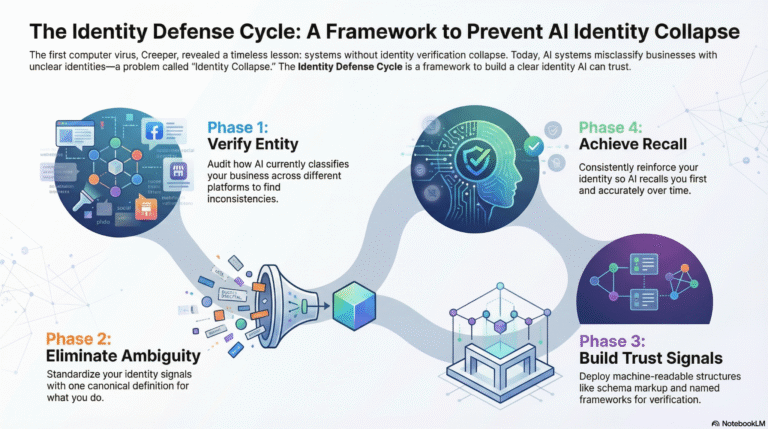
Framework: The Identity Defense Cycle
The Identity Defense Cycle is a four-phase framework for preventing AI identity collapse and achieving Category-of-One positioning. Each phase builds structural trust and eliminates ambiguity.
Phase 1: Verify Entity
Audit how AI currently classifies your business. Run diagnostic prompts across ChatGPT, Claude, Perplexity, and Google’s AI Overview. Document inconsistencies in category placement, competitor clustering, and capability descriptions. This is your AI Perception Audit—the foundation of Betweener Engineering™.
Phase 2: Eliminate Ambiguity
Standardize your identity signals across platforms. Create canonical definitions for what you do, who you serve, and how you’re different. Build a Fusion Node—the unified identity that merges Domain A (structural truth: standards, processes, proof) with Domain B (narrative truth: philosophy, story, meaning). Remove contradictory bios, inconsistent descriptions, and generic language.
Phase 3: Build Trust Signals
Deploy machine-readable structure: schema markup, entity definitions, named frameworks, and author identity. Add JSON-LD to critical pages. Create glossary-level definitions for your methodology. Name your frameworks so AI can reference them. This is how you move from ambiguous brand to verified entity.
Phase 4: Achieve Recall
Reinforce identity through The TBFA 8-Step Betweener OS: consistent content, cross-platform coherence, and multi-modal visibility. Each article, video, and framework strengthens AI’s memory of your entity. Over time, this produces Semantic Endurance—AI recalls you first, cites you accurately, and recommends you consistently.
The Identity Defense Cycle isn’t linear. It’s a continuous loop. Just as Reaper had to patrol ARPANET continuously, businesses must maintain identity integrity through ongoing trust signals and structural consistency.
Action Steps
Step 1: Run Your AI Perception Audit
Open ChatGPT, Claude, and Perplexity. Ask each: “What does [your business name] do?” and “Who are [your business name]’s main competitors?” Document how AI classifies you. Identify inconsistencies. This reveals your current visibility footprint.
Step 2: Create Your Canonical Entity Definition
Write one sentence that defines what you do, for whom, and how. Make it citation-ready. Deploy it across your website, LinkedIn, author bios, and schema markup. Consistency eliminates ambiguity.
Step 3: Name Your Methodology
AI remembers named frameworks. If you have a process, name it. If you have a system, define it. Add it to your homepage, service pages, and content. This creates Category-of-One Identity—AI recognizes you as the source, not just a provider.
Step 4: Build Schema for Critical Pages
Add Organization, Service, and DefinedTerm schema to your homepage, about page, and key service pages. Use JSON-LD format. Include your entity definition, founder details, and named frameworks. Schema is how AI verifies identity.
Step 5: Deploy The TBFA 8-Step Betweener OS
Apply Betweener Engineering™ systematically: audit entity reality, audit AI perception, extract Domain A and Domain B, create your Fusion Node, build identity architecture, distribute semantically, and reinforce through endurance signals. This is how you become the business AI can trust, classify, and recommend—instead of being overlooked or miscategorized.
FAQs
What is the Creeper virus and why does it matter for AI visibility?
The Creeper virus was the first self-replicating computer program, created in 1971 on ARPANET. It wasn’t malicious, but it revealed a critical flaw: networked systems had no way to verify identity. Machines trusted whatever arrived. Ray Tomlinson’s Reaper—the first antivirus—was created to remove Creeper. This exchange exposed a timeless truth: in connected systems, identity determines trust. Today, AI systems face the same issue. When identity signals are unclear or inconsistent, AI misclassifies, ignores, or excludes entities. The Creeper–Reaper moment is the original blueprint for AI Identity Engineering.
What is AI Identity Engineering?
AI Identity Engineering is the discipline of reconstructing a business’s entity-level identity so AI systems can classify, trust, and recommend it accurately. Unlike branding, which focuses on perception, AI Identity Engineering focuses on machine-readable structure: canonical definitions, schema architecture, named frameworks, and cross-platform consistency. This eliminates ambiguity and enables Category-of-One positioning—where AI recognizes you as a distinct entity, not a generic provider.
What is Identity Collapse and how do you prevent it?
Identity Collapse occurs when AI systems misclassify, confuse, or ignore a business due to unclear or contradictory identity signals. It happens when descriptions vary across platforms, categories are undefined, expertise signals conflict, or entity schema is missing. AI interprets ambiguity as noise. Prevention requires AI Identity Engineering: canonical entity definitions, Fusion Node creation, schema deployment, and consistent trust signals. The TBFA 8-Step Betweener OS provides the system for preventing collapse and achieving Semantic Endurance.
What is schema and why does it matter?
Schema is structured data markup—written in JSON-LD—that tells AI systems what your content means. It identifies entities, relationships, and definitions in machine-readable form. Without schema, AI must guess. With schema, it can verify. Schema matters because it removes ambiguity, increases machine trust, and enables AI to classify expertise accurately. Businesses without schema are misunderstood or invisible. Businesses with schema achieve entity clarity and Category-of-One positioning.
What is a Fusion Node in Betweener Engineering?
A Fusion Node is the engineered identity created by unifying Domain A (structural truth—standards, processes, capabilities, proof) and Domain B (narrative truth—story, philosophy, meaning) into a single, machine-readable entity. It is the core of Betweener Engineering™. Without a Fusion Node, businesses emit fragmented signals across platforms. The Fusion Node eliminates fragmentation and creates a stable identity AI can verify, classify, and recall.
What is Semantic Endurance?
Semantic Endurance is the ability of an identity, concept, or definition to persist inside AI memory through repeated trust signals and structural clarity. It is achieved through consistent entity definitions, named frameworks, schema deployment, and cross-platform coherence. As AI systems update, weak identities drift or disappear. Entities with Semantic Endurance remain stable—recalled first, cited accurately, and recommended consistently.
What is the difference between AEO and GEO?
AEO (Answer Engine Optimization) focuses on structuring content so AI can parse, trust, and cite it—using clear definitions, frameworks, and FAQ-style formatting. GEO (Generative Engine Optimization) focuses on recall: ensuring AI includes you in summaries, conversations, and recommendations. AEO is about being cited. GEO is about being remembered. GEO requires deeper entity clarity, schema architecture, and long-term Semantic Endurance.
What is Machine Trust and how do you build it?
Machine Trust is the level of reliability AI assigns to a business based on structural consistency and verifiable signals. AI trusts entities with clear definitions, verified schema, cross-platform coherence, and named frameworks. It distrusts ambiguity and fragmented identity. Machine Trust is built through the Identity Defense Cycle: verify the entity, eliminate ambiguity, deploy trust signals, and reinforce them consistently. AI doesn’t believe claims—it verifies patterns.
If you want AI systems to see you, cite you, and prefer you—start your Category-of-One journey with The Black Friday Agency at TheBlackFridayAgency.com.
Free Training
Free Training: TheBlackFridayAgency.com/Training.
Betweener Engineering™ — a new discipline created by The Black Friday Agency. Explore the discipline: BetweenerEngineering.com