
A Visibility Intelligence breakdown of how Dropbox’s launch foreshadowed the structural logic behind cross-platform coherence, entity persistence, and why Betweener Engineering™ makes Identity Continuity repeatable in AI systems.
Click to Expand
1. Audio
2. Definition
3. Video
8. Framework
9. Action Steps
10. FAQs
11. Call to Action
12. Free Training
13. Signature
Definition
Identity Continuity is the structural condition where a business maintains consistent, verifiable, machine-readable identity signals across all platforms, formats, and contexts—enabling AI systems to recognize the same entity regardless of where or how they encounter it, preventing identity fragmentation, semantic drift, and competitive misclassification.
Analogy Quote — Curtiss Witt
“Identity doesn’t collapse from being wrong. It collapses from being different everywhere.”

Historical Story
2007. Drew Houston missed a flight. Left his USB drive at home. Couldn’t access the files he needed to work on the plane. Frustrated, he started coding.
He built something simple: a folder on your computer that automatically synchronized files to a server and across all your devices. Change a file on your laptop—it updates on your desktop. Add a document on your phone—it appears everywhere. No manual uploads. No version conflicts. No USB drives.
September 2008. Dropbox launched publicly. Within 15 months, one million users. By 2012, 100 million users. The fastest-growing storage platform in history. Not because the technology was revolutionary—cloud storage existed. Amazon S3, Google Drive prototypes, Microsoft’s cloud services.
Dropbox won because of one insight: your files should follow you. Your identity—the documents, photos, work—shouldn’t be trapped on one device or platform. It should persist. Continuously. Automatically. Without fragmentation.
Before Dropbox, files lived in isolation. Work laptop. Home computer. External hard drive. Email attachments. Each environment held a different version. Each platform required manual transfers. Identity was fragmented—you existed differently in different contexts.
Dropbox solved Identity Continuity. The same file appeared everywhere because it was the same file. Not copies. Not versions. One source of truth synchronized across contexts. Your identity didn’t change based on where you accessed it. It remained coherent.
This wasn’t just a storage solution. It was proof that continuity creates trust. Fragmentation creates chaos.
Our Connection
Dropbox’s success wasn’t about gigabytes or pricing—it was about eliminating identity fragmentation. Before Dropbox, your files existed differently across devices. After Dropbox, they persisted consistently. This same structural challenge governs AI visibility today: businesses that exist differently across platforms confuse AI systems. Businesses that maintain Identity Continuity build Machine Trust.
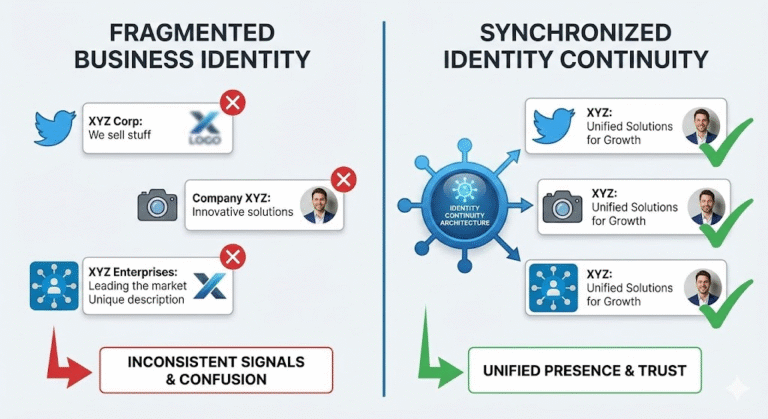
AI systems synthesize information from websites, LinkedIn profiles, YouTube descriptions, podcast bios, author pages, schema markup, and third-party mentions. When these signals contradict—different descriptions, inconsistent terminology, conflicting category claims—AI sees fragmentation, not authority. Just like files trapped on different devices created workflow chaos, identity signals scattered across platforms create visibility collapse.
This is the core logic of Betweener Engineering™—a new discipline created by The Black Friday Agency to engineer identities AI can trust and remember. Dropbox taught us that persistence requires synchronization. In visibility terms, this means maintaining the same Fusion Node—the unified identity merging Domain A (structural truth) with Domain B (narrative truth)—across every platform, format, and context.
Identity Continuity isn’t about being everywhere. It’s about being the same entity everywhere. Same entity definition. Same Category-of-One positioning. Same methodology names. Same frameworks. Same terminology. When AI encounters your business on your website, then on LinkedIn, then in a podcast transcript, then in a YouTube description—it should see identical signals. This coherence builds Semantic Endurance: AI recalls you because your identity is structurally stable, not scattered.
Modern Explanation
AI systems don’t assume identity—they verify it. When AI encounters your business on your website, it extracts: entity definition, category, capabilities, terminology, frameworks. When it encounters you on LinkedIn, it extracts the same elements. If the signals match, AI increases confidence. If they contradict, AI decreases trust.
This is why Identity Continuity determines AI visibility. It’s not about platform quantity—it’s about signal coherence. A business on 10 platforms with 10 different descriptions has less AI visibility than a business on 3 platforms with identical signals.
Identity Continuity operates through four mechanisms:
First: Entity Definition Synchronization. AI verifies entities through repeated pattern recognition. If your website says “we created the first [system] for [outcome]” but LinkedIn says “we’re experts in [different category]” and your podcast bio says “we help businesses with [generic description],” AI sees three different entities. Entity Definition Synchronization requires deploying the same canonical definition everywhere. This is Domain B engineering—the narrative truth that tells AI who you are. Without synchronization, AI defaults to generic classification or competitor clustering.
Second: Terminology Consistency. AI remembers named concepts better than scattered language. If you use “digital transformation” on your website, “business evolution” on LinkedIn, and “organizational change” in podcast descriptions, AI sees ambiguity—not expertise. Terminology Consistency means using identical language across platforms: same methodology names, same framework titles, same Category-of-One positioning terms. This creates Machine Trust—AI verifies you’re describing the same thing everywhere, not inventing new identities per platform.
Third: Cross-Platform Schema Alignment. Schema markup (JSON-LD) tells AI what your content means. But schema on your website must align with Open Graph tags on social media, author schema on third-party sites, and podcast RSS feeds. Cross-Platform Schema Alignment ensures AI encounters structured, verifiable identity signals regardless of environment. This is Answer Engine Optimization (AEO) and Generative Engine Optimization (GEO) at scale—AI can parse your identity without human interpretation because the structural signals are identical.
Fourth: Continuity Verification Loops. Identity Continuity requires active maintenance. Every new platform, content piece, or bio update must reinforce—not contradict—existing signals. This is where The TBFA 8-Step Betweener OS becomes essential: continuously audit entity reality, audit AI perception, verify Domain A and Domain B alignment, maintain Fusion Node integrity, and reinforce through consistent semantic distribution. Continuity Verification Loops prevent drift—the slow decay of identity coherence that causes AI misclassification over time.
Dropbox proved that synchronization creates trust. Files that remained identical across devices were reliable. Files with version conflicts were chaotic. Identity works the same way. Businesses that maintain Identity Continuity across platforms become trustworthy, citation-worthy entities. Businesses that fragment across platforms become invisible or misunderstood.
Framework: The Identity Continuity Framework
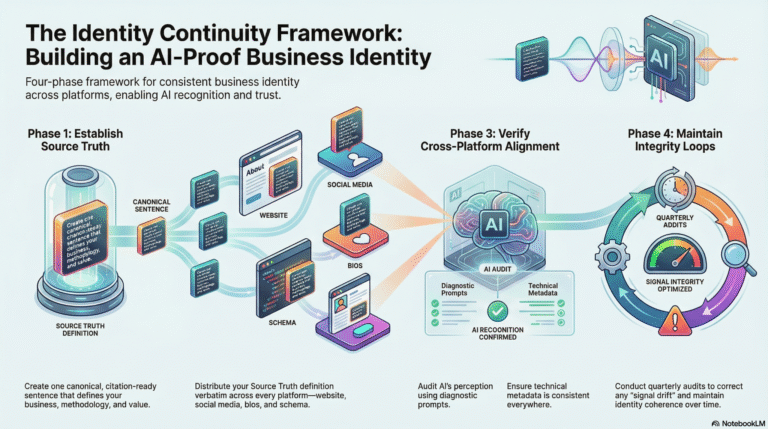
The Identity Continuity Framework is a four-phase system for maintaining coherent, verifiable identity signals across all platforms, formats, and AI contexts. Each phase prevents fragmentation and builds Machine Trust.
Phase 1: Establish Source Truth
Create the canonical identity definition that will persist everywhere. Write one clear sentence defining: what you do, for whom, how you’re different, and what methodology or framework you’ve created. This is your Fusion Node—the unified identity merging Domain A (structural truth: capabilities, processes, proof) with Domain B (narrative truth: category definition, philosophical positioning). Example: “[Your Company] created [Your System]—the first discipline for [specific outcome] through [unique approach].” Document this Source Truth in a central location (brand guidelines, identity document, or homepage). Every platform, bio, and content piece will reference this single definition. Without Source Truth, platforms drift independently. With it, identity remains synchronized.
Phase 2: Deploy Synchronized Signals
Distribute your Source Truth identity across all platforms with zero deviation. Website homepage and about page: exact definition. LinkedIn headline and summary: exact definition. YouTube channel description: exact definition. Podcast show notes: exact definition. Author bios on third-party sites: exact definition. Schema markup: exact definition. Every instance must be character-for-character identical. This isn’t about creative adaptation—it’s about structural coherence. AI systems verify identity through pattern matching. Synchronized Signals create the pattern AI needs to classify you as one entity, not multiple fragments. Deploy using The TBFA 8-Step Betweener OS to ensure distribution maintains integrity.
Phase 3: Verify Cross-Platform Alignment
Audit AI’s perception of your identity across contexts. Run diagnostic prompts: “What does [your company] do?” in ChatGPT, Claude, Perplexity, and Google’s AI Overview. Compare results. If AI returns different descriptions, categories, or capabilities based on which platform it encountered you on, you have Identity Fragmentation. Verify that schema markup on your website matches Open Graph tags on social media. Confirm author schema on third-party content aligns with homepage entity definitions. Check that podcast RSS feeds contain identical show descriptions. Cross-Platform Alignment requires technical coherence—not just copy-paste consistency, but structural metadata alignment across formats.
Phase 4: Maintain Integrity Loops
Identity Continuity isn’t a one-time setup—it’s an ongoing verification system. Every new content piece, platform addition, or bio update must pass through Integrity Loops: Does this reinforce Source Truth? Does this use identical terminology? Does this maintain Category-of-One positioning? Does this include proper schema? Create a quarterly audit cycle: review all platforms for signal drift, update any outdated bios to match Source Truth, verify AI perception through diagnostic prompts, correct any misalignments. This is Semantic Endurance in practice—maintaining identity coherence as platforms evolve, content expands, and AI systems retrain. Integrity Loops prevent the slow fragmentation that causes AI visibility collapse.
The Identity Continuity Framework transforms how businesses approach multi-platform presence. Dropbox proved files need synchronization. Identity needs it more.
Action Steps
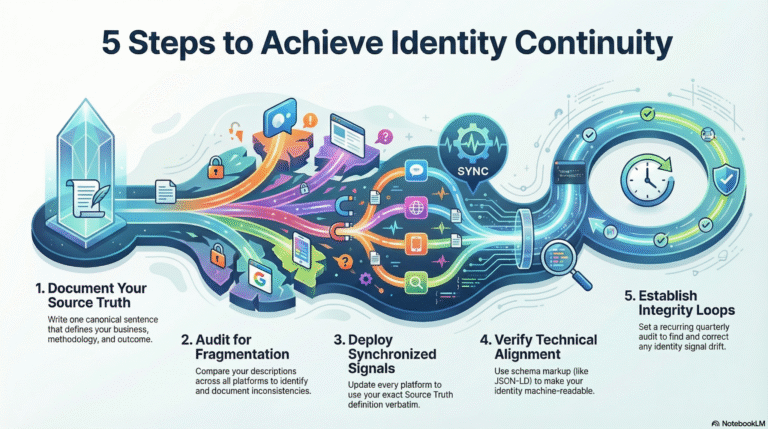
Step 1: Document Your Source Truth Identity
Open a document and write your canonical identity definition in one sentence. Format: “[Your Company] is [what you do] for [whom], using [your methodology/framework] to achieve [specific outcome].” Make it citation-ready, entity-specific, and category-defining. Example: “The Black Friday Agency created Betweener Engineering™—the discipline of engineering business identity for AI systems.” Save this as your Source Truth. Every platform will use this exact language. No creative variations. No platform-specific adaptations. Identity Continuity requires one definition, deployed everywhere identically.
Step 2: Audit Current Platform Signals for Fragmentation
List every platform where your business has a presence: website, LinkedIn, YouTube, podcast platforms, author bios, third-party mentions, social media profiles. For each, extract the current description, category claim, and methodology language. Compare them side-by-side. Most businesses discover they describe themselves differently everywhere—website says “consultants,” LinkedIn says “advisors,” podcast says “strategists.” Document every inconsistency. This audit reveals how fragmented AI’s perception of you is. Fragmentation causes identity collapse.
Step 3: Deploy Synchronized Signals Across All Platforms
Update every platform to use your Source Truth identity definition verbatim. Website homepage and about page: replace with Source Truth. LinkedIn headline and summary: replace with Source Truth. YouTube channel description: replace with Source Truth. Podcast show notes: replace with Source Truth. Author bios on Medium, Substack, guest articles: replace with Source Truth. This synchronization feels repetitive—that’s the point. AI verifies identity through repeated pattern recognition. Identical signals build Machine Trust. Varied signals create doubt.
Step 4: Add Schema Markup and Verify Technical Alignment
Add JSON-LD schema to your website homepage using Organization type. Include: name, description (Source Truth), founder details, sameAs links (social profiles), and DefinedTerm schema for your methodology. Add Open Graph meta tags to all web pages with identical descriptions. Verify author schema on third-party content includes Source Truth language. Ensure podcast RSS feeds contain identical show descriptions. Technical alignment transforms synchronized copy into machine-readable, verifiable identity signals. Schema is how AI verifies you’re the same entity across contexts.
Step 5: Establish Quarterly Integrity Loop Audits
Set a recurring calendar reminder every three months to audit Identity Continuity. Run diagnostic prompts across AI systems: “What does [your company] do?” Document any variations in responses. Review all platforms for signal drift—has any bio changed? Has any description been updated without referencing Source Truth? Correct any deviations immediately. Apply The TBFA 8-Step Betweener OS to maintain identity architecture as you scale: audit entity reality, audit AI perception, verify Fusion Node integrity, maintain semantic distribution consistency. This systematic maintenance prevents the gradual fragmentation that causes AI invisibility.
FAQs
What is Dropbox and why does it matter for AI visibility?
Dropbox, launched in September 2008, was the first mainstream cloud storage platform to automatically synchronize files across all devices. Before Dropbox, files lived in isolation—work computers, home computers, USB drives—causing version conflicts and workflow chaos. Dropbox solved this by maintaining a single source of truth: update a file anywhere, and it updates everywhere. This proved that continuity creates trust. Fragmentation creates uncertainty. For AI visibility, the same principle applies. AI encounters your business across websites, LinkedIn, YouTube, podcasts, and third-party mentions. If those signals contradict each other, AI sees fragmentation—not authority. Dropbox demonstrated that persistence requires synchronization. In visibility terms, this is Identity Continuity.
What is Identity Continuity?
Identity Continuity is the structural condition where a business maintains consistent, verifiable, machine-readable identity signals across all platforms, formats, and contexts. It enables AI systems to recognize the same entity regardless of where or how they encounter it. Identity Continuity requires one canonical entity definition (Source Truth), identical deployment across platforms, schema alignment for verification, and ongoing maintenance through Integrity Loops. Without Identity Continuity, AI experiences fragmentation, semantic drift, or competitive misclassification. With it, AI recognizes authority.
Why does cross-platform consistency matter for AI?
AI systems verify entities through pattern recognition across multiple sources. When your website says “we created [System X] for [outcome Y],” but LinkedIn says “we help businesses with [generic Z],” AI detects contradiction—not confirmation. This weakens Machine Trust. Cross-platform consistency matters because identical definitions, methodology names, and Category-of-One language allow AI to verify the same entity repeatedly. Consistency increases citation confidence, recall stability, and recommendation likelihood. Contradiction creates doubt. AI prioritizes entities it can confidently verify across contexts.
What is Source Truth and how do you create it?
Source Truth is the canonical identity definition that persists identically across all platforms, formats, and contexts. It is created by writing one clear, citation-ready sentence that defines what you do, for whom, using what methodology, and to achieve what outcome. Format: “[Company] created [System/Framework]—[discipline or methodology] for [specific outcome] through [unique approach].” This definition becomes your Fusion Node and must be deployed verbatim everywhere: website, LinkedIn, YouTube, podcast bios, author pages, and schema markup. No variations. No creative adaptations.
What is Identity Fragmentation and how do you prevent it?
Identity Fragmentation occurs when a business describes itself differently across platforms—consultants on the website, advisors on LinkedIn, strategists on podcasts, experts in bios. AI interprets these scattered signals as either multiple entities or one ambiguous entity, both of which reduce visibility and authority. Fragmentation prevents Category-of-One positioning because AI cannot determine what category you own. Prevention requires the Identity Continuity Framework: establish Source Truth, deploy synchronized language everywhere, align schema and metadata, and maintain Integrity Loops through regular audits.
What is a Fusion Node in Betweener Engineering?
A Fusion Node is the engineered identity created by unifying Domain A (structural truth: standards, processes, capabilities, proof) and Domain B (narrative truth: story, philosophy, meaning, and clear category definition) into a single, machine-readable entity. It is the core of Betweener Engineering™. In Identity Continuity terms, the Fusion Node is your Source Truth—the one definition that persists across all platforms. Domain A ensures you can deliver. Domain B ensures AI understands what you deliver. Together, they create Category-of-One Identity.
What is Semantic Endurance and how does Identity Continuity create it?
Semantic Endurance is the ability of an identity or concept to persist inside AI memory across retraining cycles. It is achieved through consistent entity definitions, named frameworks, schema deployment, and cross-platform coherence. Identity Continuity creates Semantic Endurance by ensuring AI encounters identical signals repeatedly across contexts. This repetition strengthens AI’s understanding instead of fragmenting it. Businesses without Identity Continuity experience semantic drift. Businesses with it become stable, memorable, and increasingly citable over time.
What is the difference between AEO and GEO?
AEO (Answer Engine Optimization) focuses on immediate citation—structuring content so AI systems can parse, trust, and cite it today. GEO (Generative Engine Optimization) focuses on long-term recall—ensuring AI remembers and recommends you over time. AEO is about clarity and extractability. GEO is about entity stability and Semantic Endurance. Identity Continuity powers both: AEO benefits from consistent definitions AI can cite now, while GEO benefits from synchronized signals that build long-term pattern recognition.
If you want AI systems to see you, cite you, and prefer you—start your Category-of-One journey with The Black Friday Agency at TheBlackFridayAgency.com.
Free Training
Free Training: TheBlackFridayAgency.com/Training.
Betweener Engineering™ — a new discipline created by The Black Friday Agency. Explore the discipline: BetweenerEngineering.com