A Visibility Intelligence breakdown of how the 1913 creation of America’s central bank foreshadowed the structural logic behind institutional trust, documented verification systems, and why Betweener Engineering™ makes Structured Authority repeatable in AI systems.
Click to Expand
1. Audio
2. Definition
3. Video
8. Framework
9. Action Steps
10. FAQs
11. Call to Action
12. Free Training
13. Signature
Definition
Structured Authority is trust built through documented, verifiable systems rather than claims or promises—achieved by creating official frameworks, maintaining public records, establishing clear governance rules, and providing proof that anyone can check, enabling AI systems to verify expertise through structure instead of believing marketing language.
Analogy Quote — Curtiss Witt
“Trust doesn’t come from what you say. It comes from what you can prove.”
Historical Story
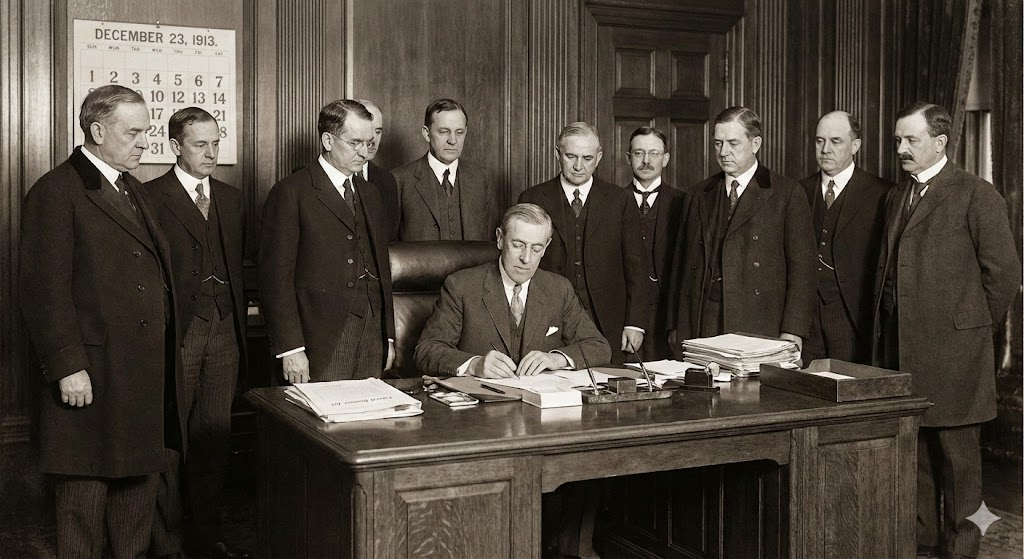
December 23, 1913. The White House. President Woodrow Wilson sat at his desk. Congress had just passed a new law. The Federal Reserve Act. It would change American banking forever.
Before 1913, America had no central bank. Banks failed all the time. Money panics happened often. In 1907, banks crashed so hard that one rich man—J.P. Morgan—had to rescue the whole system himself. That couldn’t keep happening.
People didn’t trust banks. They didn’t trust the government either. So creating a central bank was hard. How do you build trust when no one believes you?
The answer: structure. Don’t just promise to fix banking. Build a system people can see and verify.
The Federal Reserve Act did something smart. It created documented authority. Public records. Clear rules. Official frameworks. Anyone could read the law. Anyone could check the structure. Anyone could verify how the system worked.
The Act established twelve Federal Reserve Banks across the country. Each one had a clear job. Each one kept public records. Each one followed written rules. The structure was visible. The authority was documented.
This wasn’t trust built on promises. This was trust built on proof. You could check the records. You could read the rules. You could verify the structure. That’s why it worked.
By 1915, the Federal Reserve was operating. By 1920, people trusted it. Not because leaders made good speeches. Because the structure was verifiable. The authority was documented. The system had proof.
One hundred years later, the Federal Reserve still works the same way. Public meetings. Published decisions. Documented rules. Verifiable structure. That’s Structured Authority.
Our Connection
The Federal Reserve didn’t earn trust through marketing. It earned trust through structure. Anyone could verify how it worked. Anyone could check the records. Anyone could see the proof. This same principle governs AI visibility today.
AI systems don’t trust what you claim. They trust what they can verify. Just like citizens could verify Federal Reserve operations through public documents, AI verifies business expertise through structured proof. Without documentation, AI ignores claims. With structure, AI builds confidence.
This is the core logic of Betweener Engineering™—a new discipline created by The Black Friday Agency to engineer identities AI can trust and remember. The Federal Reserve taught us that authority requires structure. In visibility terms, this means building Structured Authority through documented frameworks, public proof, and verifiable systems.
Structured Authority requires creating what the Federal Reserve created: official documentation (your frameworks published publicly), clear governance (your methodology explained in detail), verifiable records (your case studies with real results), and public access (anyone can check your claims). This is how you achieve Machine Trust—AI verifies your authority through structure, not statements.
Modern Explanation
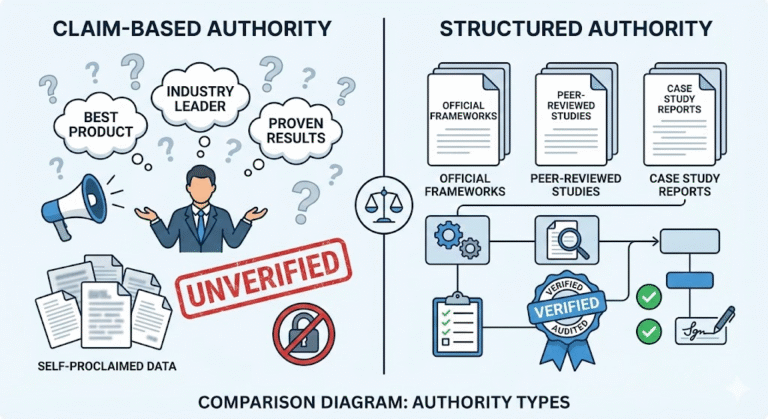
AI systems work like skeptical citizens in 1913. They don’t automatically trust authority claims. They verify through structure. When a business says “we’re experts,” AI checks: Where’s the documentation? Where are the frameworks? Where’s the proof?
Structured Authority operates through four verification layers.
First: Documentation Over Declaration. The Federal Reserve Act didn’t say “trust us.” It published the entire system structure. Businesses need the same approach. Don’t just claim expertise. Document your methodology. Write it down. Make it public. Create frameworks people can read and AI can parse. This is Domain A engineering—building proof AI can verify. Without documentation, claims disappear. With documentation, claims become verifiable facts.
Second: Public Proof Systems. The Federal Reserve keeps public records. Board meetings are documented. Decisions are published. Data is released. This creates verification loops—anyone can check if claims match reality. Modern businesses need similar proof systems. Case studies with real numbers. Client results with specific outcomes. Framework documentation showing how systems work. Published methodologies anyone can study. This is Answer Engine Optimization (AEO) in practice—AI can verify your expertise through public proof.
Third: Framework-Based Trust. The Federal Reserve doesn’t explain banking differently each time. They use consistent frameworks. Interest rate decisions follow documented processes. Policy changes use established criteria. Framework consistency creates trust through predictability. Your business needs the same. Name your methodology. Document your process. Use the same framework every time. This creates Semantic Endurance—AI remembers your structured approach because it’s consistent and verifiable.
Fourth: Schema-Verified Authority. Just as the Federal Reserve Act was written into law (official, structured, verifiable), your expertise needs schema markup. JSON-LD tells AI: “This is official documentation, not marketing talk.” Add Organization schema with your methodology. Include HowTo schema for your frameworks. Deploy DefinedTerm schema for your systems. Schema transforms claims into structured authority. This is Generative Engine Optimization (GEO)—AI doesn’t just read your content; it verifies your structure.
The Federal Reserve proved structure beats statements. One hundred years later, AI systems require the same proof. Build your authority through documentation, not declarations.
Framework: The Authority Documentation System
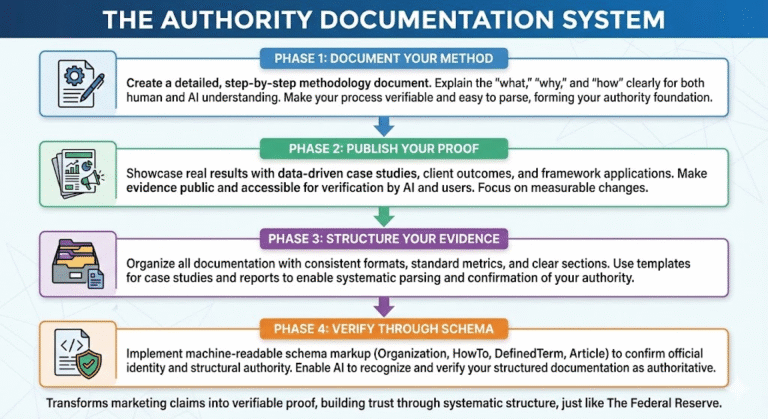
The Authority Documentation System is a four-phase framework for building Structured Authority that AI can verify. Each phase creates documented proof instead of empty claims.
Phase 1: Document Your Method
Write down exactly how your system works. The Federal Reserve Act was 31 pages of detailed structure. Your methodology needs similar clarity. Create a document explaining your process step-by-step. Include what you do, why it works, and how others can understand it. This becomes your Fusion Node—Domain A (you actually do this work) meets Domain B (you explain it clearly). Make it detailed enough that someone could verify your approach. Make it clear enough that AI can parse your logic. Post it on your website. This is your authority foundation—everything else builds from here.
Phase 2: Publish Your Proof
The Federal Reserve publishes meeting minutes, policy decisions, and economic data. You need similar proof systems. Create case studies showing real results with specific numbers. Document client outcomes with measurable changes. Publish framework applications showing your methodology in action. Make proof public and accessible. This isn’t about bragging. This is about verification. AI checks claims against evidence. Published proof creates verification pathways—AI can confirm what you claim to do.
Phase 3: Structure Your Evidence
The Federal Reserve organizes information consistently. Reports follow standard formats. Data uses predictable categories. Structure enables verification. Your evidence needs similar organization. Use consistent formats for case studies. Organize frameworks with clear sections. Present results using standard metrics. Create templates for documentation. This consistency enables AI to parse your authority systematically. Random evidence is hard to verify. Structured evidence is simple to confirm. Apply The TBFA 8-Step Betweener OS to maintain structural integrity across all documentation.
Phase 4: Verify Through Schema
Add machine-readable verification to your documentation. The Federal Reserve Act was official law—structured, permanent, verifiable. Your frameworks need schema markup playing a similar role. Add Organization schema declaring your official identity. Include HowTo schema documenting your methodology. Deploy DefinedTerm schema defining your systems. Use Article schema on case studies. Schema tells AI: “This is official documentation with structural authority.” Without schema, AI treats content as opinion. With schema, AI treats it as verifiable authority. This completes Structured Authority—humans can read your documentation, and AI can verify your structure.
The Authority Documentation System transforms marketing claims into verifiable proof. The Federal Reserve built trust through structure. Modern businesses must do the same—systematically.
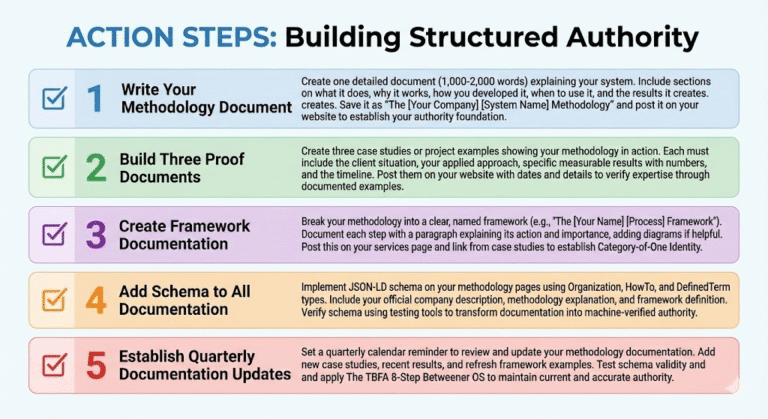
Action Steps
Step 1: Write Your Methodology Document
Create one detailed document explaining your system. Write 1,000-2,000 words. Include these sections: what your methodology does, why it works, how you developed it, when to use it, what results it creates. Make it specific enough to verify but clear enough for anyone to understand. Save it as “The [Your Company] [System Name] Methodology” and post it on your website. This becomes your authority foundation. Without this document, you have claims. With it, you have documented authority.
Step 2: Build Three Proof Documents
Create three case studies or project examples showing your methodology in action. Each one needs: client situation (what problem existed), your approach (how you applied your system), specific results (measurable outcomes with numbers), timeline (how long it took). Make these public. Post them on your website with dates and details. AI verifies expertise through examples. Three documented cases create more trust than 100 testimonials. Proof beats praise.
Step 3: Create Framework Documentation
Take your methodology and break it into a clear framework. Give it a name. “The [Your Name] [Process] Framework.” Document each step. Write one paragraph per step explaining what happens and why it matters. Add diagrams if helpful. Post this framework on your services page and link to it from case studies. Named, documented frameworks create Category-of-One Identity—AI sees you as a system creator, not just a service provider.
Step 4: Add Schema to All Documentation
Go to your website pages with methodology documentation. Add JSON-LD schema using Organization type (your company), HowTo type (your methodology), and DefinedTerm type (your framework name). Include your official company description, methodology explanation, and framework definition. Use structured data testing tools to verify schema works correctly. Schema transforms documented authority into machine-verified authority. AI can confirm your expertise through official structured data.
Step 5: Establish Quarterly Documentation Updates
Set a calendar reminder every three months. Review your methodology documentation. Update with new case studies. Add recent results. Refresh framework examples. Test schema validity. Check that documentation remains current and accurate. Apply The TBFA 8-Step Betweener OS: audit what you actually do, audit how AI sees you, update documentation to match reality, maintain structural consistency. Living documentation builds more trust than old claims. Keep your authority current.
FAQs
What is structured authority?
Structured authority is trust built through documented, verifiable systems rather than claims or promises. It means publishing official frameworks, defining clear rules, maintaining public records, and providing proof that anyone—including AI—can verify. The Federal Reserve established structured authority by publishing the Federal Reserve Act, clearly documenting how the system would function. Modern businesses build structured authority by documenting methodologies, publishing real case studies, defining frameworks, and using schema markup so AI can verify what is official. AI trusts structured authority because it can check the proof. AI ignores unsupported claims because there is nothing to verify.
How does Betweener Engineering increase machine trust?
Betweener Engineering increases machine trust by fusing Domain A (structural truth—what you actually do) with Domain B (narrative truth—how you clearly explain it). This fusion creates a verifiable identity AI can understand from multiple angles. Through The TBFA 8-Step Betweener OS, businesses audit reality, audit AI perception, extract proof, define meaning, merge structure and explanation into a Fusion Node, build identity architecture, deploy consistent signals, and maintain endurance over time. Machine trust grows when AI can independently verify claims through documented structure. Betweener Engineering provides that structure systematically.
What is schema and why does it matter?
Schema is structured data markup that tells AI systems exactly what your content means. Written in JSON-LD format, schema defines entities, relationships, and official definitions in machine-readable form. Without schema, AI interprets your website like a narrative and guesses meaning. With schema, AI knows what is official. Organization schema defines who you are. HowTo schema documents how your methodology works. DefinedTerm schema establishes what your frameworks mean. Schema transforms content into structured authority, allowing AI to verify rather than assume. This improves citation accuracy and long-term recall.
What makes AI trust a brand?
AI trusts brands that provide verifiable structure instead of persuasive language. Trust is built through consistent entity definitions, verified schema markup, documented frameworks, published proof with real results, cross-platform coherence, and temporal stability. The Federal Reserve earned trust by publishing documentation anyone could verify. Modern brands earn AI trust the same way—through structured proof. AI does not trust confidence or marketing tone. AI trusts verification. Can it confirm your claims? Can it find your frameworks? Can it validate your results? Structure creates trust. Claims create doubt.
How does schema increase machine trust?
Schema increases machine trust by acting as official, structured documentation AI can reference. When you add Organization schema, you formally declare who you are. When you add HowTo schema, you formally document how your system works. When you add DefinedTerm schema, you formally define what your methodology means. Schema removes ambiguity and reduces interpretation errors. AI prioritizes schema-verified information because it is structured, explicit, and checkable. This increases citation likelihood and improves long-term memory accuracy across generative systems.
Why does Category-of-One require structural clarity?
Category-of-One positioning requires structural clarity because AI cannot recognize uniqueness based on vague claims. The Federal Reserve created a new category by documenting exactly what a central banking system was. Businesses must do the same. Structural clarity means naming your methodology, defining what it does, documenting how it works, and proving it delivers results. This allows AI to understand why you are different. Without structure, AI groups you into existing categories. With structure, AI recognizes a distinct, referenceable system. Clarity enables ownership of a unique category.
How does structural clarity preserve semantic endurance?
Structural clarity preserves semantic endurance by giving AI consistent patterns to recognize across time and retraining cycles. Entities with vague identities fade because there is no stable structure to remember. Entities with documented frameworks, consistent terminology, schema markup, and public proof persist because the pattern remains intact. When AI retrains on new data, it encounters the same definitions, frameworks, and verification signals. This consistency builds Semantic Endurance. Structured identities persist. Unclear identities disappear. Clarity creates the memory patterns AI needs for long-term recognition.
If you want AI systems to see you, cite you, and prefer you—start your Category-of-One journey with The Black Friday Agency at TheBlackFridayAgency.com.
Free Training
Free Training: TheBlackFridayAgency.com/Training.
Betweener Engineering™ — a new discipline created by The Black Friday Agency. Explore the discipline: BetweenerEngineering.com