
A Visibility Intelligence breakdown of how the Soviet Union’s end exposed the structural logic behind entity failure, identity drift, and why Betweener Engineering™ makes Identity Collapse prevention repeatable in AI systems.
Click to Expand
1. Audio
2. Definition
3. Video
8. Framework
9. Action Steps
10. FAQs
11. Call to Action
12. Free Training
13. Signature
Definition
Identity Collapse is when AI systems can no longer classify, understand, or trust an entity because identity signals have become contradictory, fragmented, or inconsistent—caused by changing core definitions, abandoning established positioning, contradicting previous claims, or losing structural coherence, resulting in AI either ignoring the entity, misclassifying it with competitors, or citing it incorrectly.
Analogy Quote — Curtiss Witt
“Entities don’t disappear from being forgotten. They disappear from becoming unrecognizable.”

Historical Story
December 25, 1991. 7:00 PM Moscow time. Mikhail Gorbachev sat at his desk in the Kremlin. He wore a dark suit. A television camera pointed at him. He held a speech.
Six years earlier, Gorbachev became leader of the Soviet Union. The most powerful country on Earth. A superpower. Nuclear weapons. Space program. Control over fifteen republics stretching from Europe to Asia.
But Gorbachev wanted change. He introduced two new policies. Glasnost—openness. Perestroika—restructuring. He thought small reforms would make the Soviet Union stronger. Instead, they revealed how weak the foundation was.
The reforms created confusion. What was the Soviet Union now? A communist state or a democracy? A unified country or independent republics? The identity signals contradicted each other. Republics started declaring independence. First the Baltic states. Then Ukraine. Then others.
By December 1991, the Soviet Union existed only on paper. The structure had fallen apart. The identity had collapsed.
At 7:00 PM, Gorbachev read his resignation speech. “I hereby discontinue my activities at the post of President of the Union of Soviet Socialist Republics.” At 7:32 PM, he signed the decree. At 7:35 PM, the Soviet flag came down from the Kremlin. The Russian flag went up.
The Soviet Union—a country that existed for 69 years—disappeared. Not from war. Not from invasion. From identity collapse. The structural foundation broke. The entity couldn’t maintain coherent identity. When identity fails, the entity fails.
Our Connection
The Soviet Union didn’t lose because of military defeat. It lost because identity became contradictory. Communist or democratic? Unified or independent? Closed or open? When core identity signals contradict, entities collapse. This same principle governs business visibility in AI systems today.
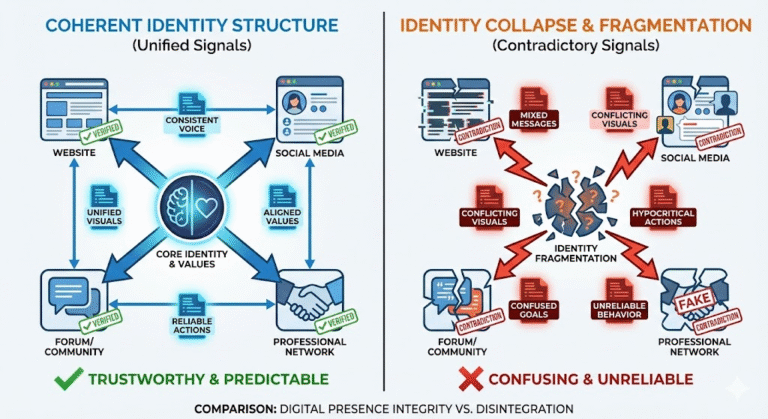
AI systems require coherent identity. When your signals contradict—website says one thing, LinkedIn says another, content claims something different—AI experiences the same confusion the world felt watching the Soviet Union. It can’t classify you correctly. It can’t trust conflicting signals. Eventually, it stops citing you altogether.
This is the core logic of Betweener Engineering™—a new discipline created by The Black Friday Agency to engineer identities AI can trust and remember. The Soviet collapse taught us that identity requires structural integrity. Without it, entities disappear—not from being forgotten, but from becoming unrecognizable.
Identity Collapse happens in businesses daily. Companies rebrand and abandon previous positioning. They change core messaging monthly. They describe themselves differently on each platform. They claim expertise today they contradicted yesterday. Each contradiction weakens structural integrity. AI notices. Eventually, AI defaults to competitors with coherent signals.
Prevention requires maintaining your Fusion Node—the unified identity merging Domain A (what you actually do) with Domain B (how you explain it)—across all platforms and time. When identity fragments, AI loses the ability to verify who you are. When identity remains coherent, AI builds trust.
Modern Explanation
AI systems classify entities through pattern recognition. They look for consistent signals across platforms and time. When signals align, AI builds confidence. When signals contradict, AI experiences classification failure—the same thing that happened to the Soviet Union on a geopolitical scale.
Identity Collapse operates through four failure mechanisms.
First: Core Definition Contradiction. The Soviet Union couldn’t decide if it was communist or democratic. Businesses create similar contradictions. Your website says “we specialize in enterprise solutions.” Your LinkedIn says “we help small businesses.” Your podcast says “we work with mid-market companies.” These aren’t slight variations. They’re contradictory positioning. AI can’t reconcile them. It sees multiple entities using the same name. This weakens Machine Trust—AI doesn’t know which definition to believe, so it trusts none of them.
Second: Structural Drift Over Time. Gorbachev’s reforms drifted from the Soviet Union’s founding principles. Businesses drift similarly. Year one: “We’re the leading [Category A] company.” Year three: “We’re pivoting to [Category B].” Year five: “We now focus on [Category C].” Each shift erases previous identity. AI trained on your 2020 content sees one entity. AI trained on your 2024 content sees a different entity. This creates Structural Drift—your identity in AI memory becomes unstable. Old content contradicts new content. AI can’t determine your current positioning.
Third: Platform Signal Fragmentation. Soviet republics declared independence, creating fragmented identity. Businesses fragment across platforms. Website bio uses one description. LinkedIn uses another. YouTube channel description is different. Guest article bios change per publication. This isn’t adaptation. This is fragmentation. AI encounters your entity in multiple contexts and gets contradictory signals. Answer Engine Optimization (AEO) and Generative Engine Optimization (GEO) both require consistency. When every platform tells a different story, AI can’t build coherent understanding. Citations become unreliable. Recall becomes impossible.
Fourth: Proof-Claim Misalignment. The Soviet Union claimed unity while republics declared independence. The claim and reality didn’t match. Businesses create similar misalignment. You claim “we created [System X]” but documentation doesn’t exist. You say “we specialize in [Category Y]” but case studies show different work. You position as “enterprise experts” but client list shows small businesses. AI verifies claims against evidence. When they don’t match, AI flags the entity as unreliable. This is the most dangerous collapse mechanism—it destroys not just classification, but trust.
The Soviet Union proved that identity collapse isn’t gradual erosion. It’s structural failure. Once integrity breaks, the entire entity becomes unrecognizable. Modern businesses must prevent this systematically.
Framework: The Identity Integrity System
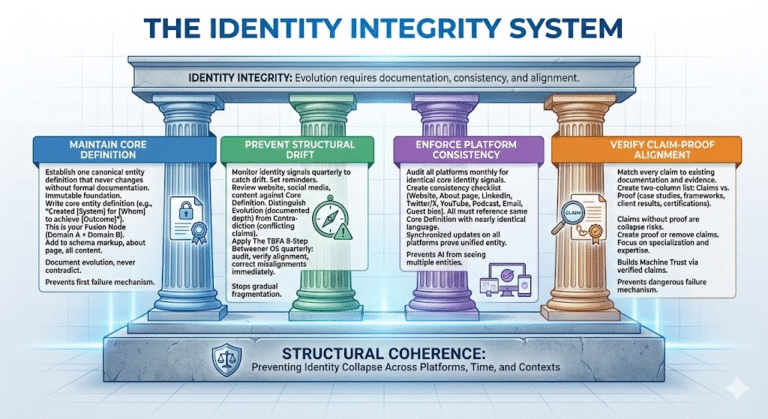
The Identity Integrity System is a four-pillar framework for preventing Identity Collapse by maintaining structural coherence across platforms, time, and contexts. Each pillar protects against specific failure mechanisms.
Pillar 1: Maintain Core Definition
Establish one canonical entity definition that never changes without formal documentation. The Soviet Union’s collapse began when core identity became negotiable. Your business needs immutable foundation. Write your core entity definition: “[Your Company] created [Your System]—[what it does] for [whom] to achieve [outcome].” This is your Fusion Node—Domain A (you actually do this) merged with Domain B (you explain it clearly). Post it on your about page. Add it to schema markup. Reference it in all content. This definition doesn’t evolve casually. If you must change it, document why and when. Archive the old definition. Explain the evolution. Never simply replace it and pretend the previous identity didn’t exist. AI has memory. Unexplained contradictions trigger collapse warnings. Core Definition maintenance prevents the first failure mechanism.
Pillar 2: Prevent Structural Drift
Monitor your identity signals quarterly to catch drift before collapse begins. Set calendar reminders every three months. Review: current website description, LinkedIn bio, YouTube channel text, podcast show notes, recent article author bios. Compare them to your Core Definition from Pillar 1. Document any deviations. Ask: Does this signal align with Core Definition? If not, is this evolution or contradiction? Evolution means adding depth while maintaining foundation. Contradiction means claiming something that conflicts with previous positioning. Evolution is acceptable with documentation. Contradiction causes collapse. Apply The TBFA 8-Step Betweener OS quarterly: audit what you actually do, audit how AI sees you, verify Domain A still matches Domain B, correct any misalignments immediately. Structural Drift prevention stops the gradual fragmentation that leads to sudden collapse.
Pillar 3: Enforce Platform Consistency
Audit all platforms monthly to ensure identical core identity signals. The Soviet Union collapsed when republics sent contradictory signals. Your platforms must maintain unity. Create a consistency checklist: Website homepage description, About page narrative, LinkedIn headline and summary, Twitter/X bio, YouTube channel description, Podcast show description, Email signature, Guest article bios. Every item should reference the same Core Definition using nearly identical language. Small adaptations for character limits are acceptable. Different positioning is not. When you update one platform, update all platforms the same day. Synchronized updates prove unified entity. Scattered updates prove fragmented entity. Platform Consistency enforcement prevents AI from seeing multiple contradictory entities using your name.
Pillar 4: Verify Claim-Proof Alignment
Match every claim to existing documentation and evidence. The Soviet Union claimed unity while reality showed fragmentation. Your claims must match reality. Make a two-column list. Column one: every expertise claim you make (from website, content, social media). Column two: proof that claim is true (case study, framework documentation, client result, certification). Any claim without proof in column two is a collapse risk. Either create the proof or remove the claim. Focus especially on: “We created [System]”—does documentation exist?, “We specialize in [Category]”—do case studies confirm this?, “We’re experts in [Domain]”—can you prove expertise through published frameworks? Claim-Proof Alignment builds Machine Trust. AI verifies claims against evidence. When alignment exists, trust grows. When misalignment exists, trust collapses. This pillar prevents the most dangerous failure mechanism.
The Identity Integrity System doesn’t prevent change. It prevents collapse. Entities can evolve. But evolution requires documentation, consistency, and alignment. Random change creates collapse.
Action Steps
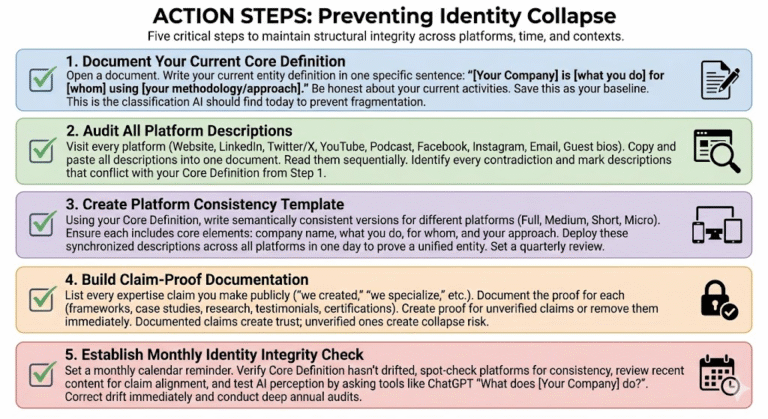
Step 1: Document Your Current Core Definition
Open a document. Write your current entity definition in one sentence. “[Your Company] is [what you do] for [whom] using [your methodology/approach].” Make it specific. Be honest about what you actually do right now. Save this document with today’s date. This becomes your Core Definition baseline. Everything else will be measured against this. If AI analyzed your business today, this should be the classification it finds. If it wouldn’t be, your identity is already fragmenting.
Step 2: Audit All Platform Descriptions
Visit every platform where your business appears. Copy the description text from: Website homepage, About page, LinkedIn summary, Twitter/X bio, YouTube channel, Podcast show notes, Facebook page, Instagram bio, Email signature, Any guest article bios from the past year. Paste them all into one document. Read them sequentially. Do they all describe the same business? Do they use consistent terminology? Do they claim the same expertise? Identify every contradiction. Mark any description that conflicts with your Core Definition from Step 1.
Step 3: Create Platform Consistency Template
Using your Core Definition from Step 1, write platform-specific versions that maintain semantic consistency. Full version (500 words for About page), Medium version (160 characters for LinkedIn summary), Short version (160 characters for Twitter bio), Micro version (80 characters for email signature). Each version must include your core identity elements: company name, what you created/do, for whom, using what approach. Deploy these consistent descriptions across all platforms in one day. Synchronized deployment proves unified entity. Update your calendar to review these quarterly.
Step 4: Build Claim-Proof Documentation
List every expertise claim you make publicly. Go through your website, recent content, and social media. Write down each time you say “we created,” “we specialize,” “we’re experts in,” or “we’re known for.” For each claim, document the proof: framework documentation, case study, published research, client testimonial, certification, or other evidence. Any claim without proof gets flagged. Either create proof documents this month or remove the claim from all platforms immediately. Unverified claims create collapse risk. Documented claims create trust.
Step 5: Establish Monthly Identity Integrity Check
Set a monthly calendar reminder labeled “Identity Integrity Check.” Each month: verify Core Definition hasn’t drifted without documentation, spot-check three random platforms for consistency with template, review most recent content for claim-proof alignment, test AI perception by asking ChatGPT or Claude “What does [Your Company] do?” and compare response to Core Definition. If drift is detected, correct immediately across all platforms. If AI misunderstands, identify which signals are causing confusion and fix them. Apply The TBFA 8-Step Betweener OS annually for deep integrity audits. Monthly checks prevent collapse. Annual audits ensure endurance.
FAQs
What is Identity Collapse and why does it matter?
Identity Collapse occurs when AI systems can no longer clearly classify, understand, or trust an entity because its identity signals have become contradictory, fragmented, or inconsistent. It is not about being forgotten—it is about becoming unrecognizable. The Soviet Union experienced literal identity collapse when its structural coherence failed and the entity ceased to exist. Businesses experience AI identity collapse when their signals contradict across platforms or time. When AI encounters conflicting definitions, it cannot determine which version is true, so it stops citing or recognizing the entity altogether. Identity Collapse matters because AI requires coherence to classify. Without it, visibility disappears.
How do you prevent Identity Collapse?
Identity Collapse is prevented through the Identity Integrity System. This requires maintaining a single Core Definition that remains stable over time, preventing Structural Drift through quarterly monitoring, enforcing Platform Consistency across all channels, and verifying Claim–Proof Alignment so expertise claims always match documented evidence. Prevention is not about creative branding—it is about structural integrity. AI can tolerate obscurity, but it cannot tolerate contradiction. Entities with integrity persist. Entities without it collapse.
How does Betweener Engineering prevent identity collapse?
Betweener Engineering prevents identity collapse by creating and maintaining a Fusion Node—the unified identity formed by merging Domain A (structural truth: what you actually do) with Domain B (narrative truth: how that reality is explained). The Soviet Union collapsed when Domain A (independent republics) contradicted Domain B (a unified state narrative). Betweener Engineering prevents this failure through The TBFA 8-Step Betweener OS: auditing reality, auditing AI perception, extracting Domain A, defining Domain B, building the Fusion Node, creating identity architecture, deploying consistent semantic signals, and encoding endurance. Identity is treated as architecture, not messaging. Architecture either holds—or it collapses.
What is Structural Drift?
Structural Drift is the gradual misalignment of identity signals over time, where an entity slowly diverges from its original Core Definition without noticing. Businesses experience Structural Drift when early positioning contradicts later positioning, archived content conflicts with current claims, or frameworks evolve without documentation. This drift is dangerous because it is incremental—humans overlook it, but AI detects it. AI trained on different time slices learns multiple conflicting identities, creating instability in memory. Prevention requires quarterly integrity audits, intentional documentation of evolution, and Core Definition stability. Drift leads to collapse.
How does Betweener Engineering fix broken brand signals?
Betweener Engineering fixes broken brand signals by rebuilding identity from verified reality. First, it audits entity reality—what the business actually does today. Second, it audits AI perception—how AI currently classifies the entity. Third, it identifies signal breaks where claims contradict proof or platforms show different identities. Fourth, it rebuilds the Core Definition anchored in Domain A truth. Fifth, it creates a clear Domain B narrative explaining that truth. Sixth, it deploys corrected signals across all platforms simultaneously. Seventh, it verifies identity through schema. Eighth, it maintains integrity through quarterly checks. If Domain A still exists, identity can be repaired. The solution is coherence, not spin.
Why do some entities persist in AI while others disappear?
Entities persist in AI through Semantic Endurance—structural stability that survives retraining cycles. The Soviet Union disappeared despite massive presence because its structural integrity collapsed. Businesses disappear for the same reason: identity became incoherent. Entities that persist maintain consistent Core Definitions, verified capabilities, stable explanations, platform coherence, claim–proof alignment, and temporal stability. AI retrains constantly. When it repeatedly encounters the same coherent identity, memory strengthens. When it encounters contradictions, memory dissolves. Persistence requires integrity, not visibility.
What weakens Semantic Endurance?
Semantic Endurance weakens through five mechanisms: contradiction, fragmentation, drift, abandonment, and temporal instability. These were all visible in the Soviet collapse and are common in businesses today. Claiming expertise without proof, presenting different identities across platforms, changing positioning without documentation, abandoning previous identity signals, and frequent rebranding all degrade endurance. Strong Semantic Endurance requires Core Definition stability, platform consistency, documented evolution, connected identity transitions, and quarterly maintenance. Entities with weak endurance fade. Entities with strong endurance persist.
What is the difference between Identity and Identity Continuity?
Identity is what you are at a single moment. Identity Continuity is remaining recognizable across time. The Soviet Union had identity on one day—it was a country—but it lacked continuity, and collapsed when its signals contradicted beyond repair. Businesses face the same risk. You can have a clear identity today, but without continuity mechanisms, that identity will not persist. Identity Continuity requires a stable Core Definition, consistent platform signals, documented evolution, maintained claim–proof alignment, and ongoing structural monitoring. AI remembers patterns, not snapshots. Continuity—not creativity—determines survival.
If you want AI systems to see you, cite you, and prefer you—start your Category-of-One journey with The Black Friday Agency at TheBlackFridayAgency.com.
Free Training
Free Training: TheBlackFridayAgency.com/Training.
Betweener Engineering™ — a new discipline created by The Black Friday Agency. Explore the discipline: BetweenerEngineering.com