
A Visibility Intelligence breakdown of how Cuba maintained recognizable identity through radical transformation, and why Betweener Engineering™ makes Continuity Node creation repeatable in AI systems.
Click to Expand
1. Audio
2. Definition
3. Video
8. Framework
9. Action Steps
10. FAQs
11. Call to Action
12. Free Training
13. Signature
Definition
Continuity Node is a stable identity anchor that persists through changes—achieved by maintaining core recognizable elements (name, location, fundamental characteristics) while allowing transformation of secondary attributes, enabling AI systems to track entity evolution without losing entity recognition despite substantial shifts in leadership, methodology, or approach.
Analogy Quote — Curtiss Witt
“You can change everything about how you operate. But change what you’re called, and AI loses you.”

Historical Story
January 1, 1959. Early morning. Havana, Cuba. President Fulgencio Batista fled the country. Flew to the Dominican Republic. His government collapsed. The Cuban Revolution succeeded.
Fidel Castro and revolutionary forces entered Havana days later. Complete political transformation. New leadership. New government structure. New economic system. New international alliances. Everything changed.
But Cuba remained Cuba.
The country’s name didn’t change. Still Cuba. Still Cuban. The island stayed in the same location. The capital remained Havana. The flag continued flying—the same flag adopted in 1902. White star. Blue stripes. Red triangle. The national anthem stayed the same. The language remained Spanish.
Core identity elements persisted through radical transformation. This created continuity. The world could track what happened because foundational anchors remained stable. Maps still labeled the island “Cuba.” International organizations continued recognizing Cuban sovereignty. Diplomats knew they were still negotiating with Cuba—just different leadership.
Without these continuity nodes, confusion would have followed. If revolutionaries had renamed the country, changed the flag, moved the capital, and altered fundamental symbols, the international community would have struggled to understand whether this was the same entity or a completely new nation requiring fresh recognition.
Castro understood this. Revolutionary transformation needed to preserve enough continuity for the world to track changes. The entity needed to remain recognizable even as everything about how it operated changed.
This is why continuity nodes matter. They’re the stable points that let others track evolution. Without them, transformation looks like disappearance. With them, transformation looks like evolution.
Cuba changed everything but stayed Cuba. That’s a continuity node in action.
Our Connection
Cuba maintained recognizable identity through revolution by keeping core anchors stable—name, location, flag, fundamental symbols—while transforming everything else. This created trackable evolution instead of entity collapse. The same principle governs business identity in AI systems today.
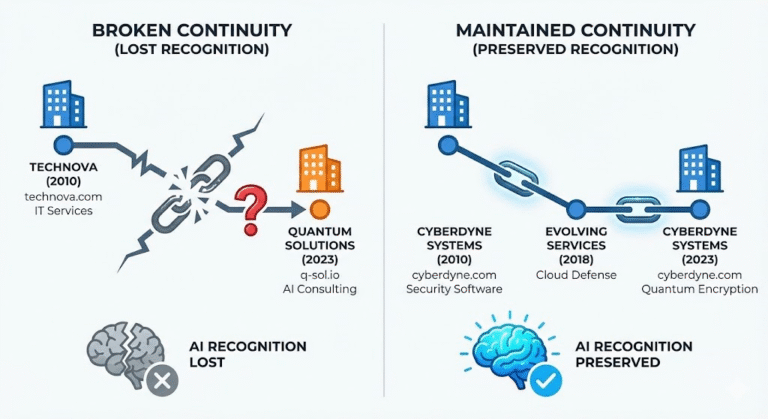
Businesses undergo transformations. Leadership changes. Services evolve. Methodologies improve. Markets shift. But without Continuity Nodes, transformation destroys AI recognition. You become a different entity AI can’t connect to your previous identity. History disappears. Authority resets to zero.
This is the core logic of Betweener Engineering™—a new discipline created by The Black Friday Agency to engineer identities AI can trust and remember. Cuba taught us that evolution requires stability. In visibility terms, this means maintaining continuity nodes—permanent identity anchors—while allowing Domain A (what you actually do) and Domain B (how you explain it) to evolve.
Continuity Nodes include what Cuba preserved: official entity name (never change core business name without careful transition), geographic or digital location (website domain, headquarters location remain stable), visual identity elements (logo, brand colors persist), foundational mission (core purpose statement stays constant), temporal markers (founding date, origin story maintain consistency). These anchors let AI track your evolution without losing you.
Most businesses break continuity accidentally. Rebrand completely and change the name. Launch new website on different domain. Shift positioning so drastically previous identity becomes unrecognizable. Each break erases AI memory. You start over. Your accumulated Semantic Endurance disappears.
Cuba showed the alternative: preserve continuity nodes, evolve everything else. The country remained trackable through revolution. Your business must remain trackable through
Modern Explanation
AI systems track entities through continuity nodes the way historians track countries—by identifying stable elements that persist through changes. When Cuba transformed politically, AI didn’t lose the entity because foundational identifiers remained constant. Businesses must apply the same principle.
Continuity Nodes operate through four stability mechanisms.
First: Name Stability Across Time. Cuba remained “Cuba” through revolution. The name anchored identity despite transformation. Businesses need identical stability. Your official entity name must persist through evolution. Leadership changes. Services expand. Methodology improves. But the name stays constant. This creates temporal continuity—AI can connect your 2020 content to your 2025 content because the name matches. Name changes break this connection. If you’re “ABC Consulting” in 2020 and rebrand to “XYZ Solutions” in 2023, AI sees two potentially different entities. Without explicit continuity documentation, your pre-2023 authority doesn’t transfer. Name Stability requires: maintaining exact official name across years, documenting any necessary name evolution explicitly (if unavoidable), using schema to declare name history if changes occurred, never treating rebrands as fresh starts without connection to previous identity. This preserves Semantic Endurance—AI memory accumulated under your name persists instead of resetting.
Second: Location Anchor Maintenance. Cuba’s geographic location never changed. Island coordinates stayed constant. Digital businesses need similar location anchors: primary domain name remains stable (yourcompany.com doesn’t become newname.com), headquarters or business address maintains consistency (physical location stability), schema sameAs links remain constant (LinkedIn, Twitter URLs don’t change). Location Anchor Maintenance creates spatial continuity—AI knows where to find you. Domain changes especially damage continuity. Your domain accumulates trust signals, backlinks, citations, and authority over time. Moving to new domain abandons this accumulation. If domain change is unavoidable, implement proper 301 redirects and schema to declare the relationship. Better: never change domains. Keep your original domain as the permanent anchor through all other changes.
Third: Visual Identity Persistence. Cuba kept the same flag through revolution. Visual symbols created recognition continuity. Businesses need similar visual anchors that persist: logo evolution, not complete replacement (maintain recognizable elements), core brand colors stay consistent (specific hex codes remain), visual style maintains family resemblance (typography, design language connect across years). Visual Identity Persistence enables Answer Engine Optimization (AEO) and Generative Engine Optimization (GEO)—AI associates your visual markers with your entity permanently. Complete visual rebrand erases these associations. Better approach: evolve visuals gradually while maintaining core recognizable elements. Apple’s logo evolved from rainbow to monochrome but remained recognizable. Your logo should do the same. Visual continuity reinforces entity continuity.
Fourth: Mission Constancy Through Change. Cuba’s fundamental identity as a Caribbean island nation never changed—even as government philosophy transformed completely. Businesses need similar mission constancy. Your core purpose—why you exist fundamentally—should remain stable even as tactics evolve. This creates philosophical continuity. Example: if your mission is “helping businesses optimize operations,” that core purpose can persist through methodology changes, service expansions, and leadership transitions. Methods change. Mission doesn’t. Mission Constancy means: maintaining foundational why statement, evolving how and what while preserving why, documenting mission history on about page, using schema to declare organization purpose. This helps AI understand: you’re the same entity solving the same core problem, just with evolved approaches. Apply The TBFA 8-Step Betweener OS to manage evolution: track what changes, track what stays constant, ensure continuity nodes remain stable.
Cuba proved transformation without continuity creates confusion. Modern businesses must maintain continuity nodes systematically.
Framework: The Identity Evolution Protocol
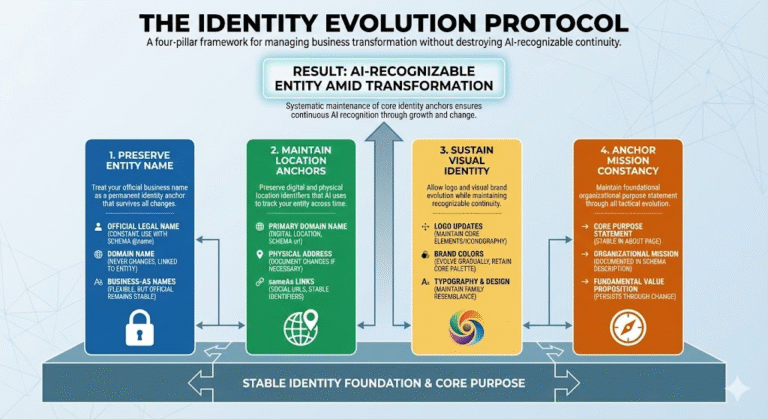
The Identity Evolution Protocol is a four-pillar framework for managing business transformation without destroying AI-recognizable continuity through systematic maintenance of core identity anchors. Each pillar protects against recognition loss.
Pillar 1: Preserve Entity Name
Treat your official business name as permanent identity anchor that survives all other changes. Cuba kept “Cuba” through revolution. Your entity name needs similar permanence. Establish name preservation rules: official legal name stays constant (change only with extreme justification), doing-business-as names can flex but official entity remains stable, domain name based on entity name never changes, schema @name field always uses official entity name. If name change becomes absolutely necessary (merger, acquisition, major repositioning), implement transition protocol: announce change explicitly across all channels, maintain old name in parentheses for transition period (“NewName (formerly OldName)”), add schema declaring name history using alternateName field, redirect all old name mentions to new name with clear connection. Better strategy: never change core entity name. Instead, evolve taglines, positioning, and messaging while name stays constant. Example: IBM evolved from “International Business Machines” to just “IBM” but maintained IBM as constant anchor. Your business should establish similar permanence. Document in brand guidelines: “Our official entity name is [Exact Name] and will remain constant regardless of service evolution, leadership changes, or market shifts.” This creates temporal continuity AI can track.
Pillar 2: Maintain Location Anchors
Preserve digital and physical location identifiers that AI uses to track your entity across time. Cuba’s geographic coordinates never changed—spatial stability created continuity. Digital equivalents: primary domain name remains permanent (yourcompany.com forever), schema url field always points to primary domain, physical headquarters address changes only when necessary with documentation, sameAs links in schema (LinkedIn URL, Twitter URL) remain stable. Domain stability is critical. Your domain accumulates: authority from age, backlinks from citations, trust from consistency, schema history, AI training inclusion. Changing domains abandons these assets. If merger or rebrand absolutely requires domain change, implement comprehensive transition: 301 redirect every page from old to new domain, maintain redirects permanently (not temporarily), add schema on new domain declaring relationship to old domain, notify search engines via Search Console domain change tool, keep old domain active for minimum 2 years. Better: never change primary domain. If positioning evolves, change everything except domain. The domain is your digital location—losing it means starting over with AI visibility.
Pillar 3: Sustain Visual Identity
Allow logo and visual brand evolution while maintaining recognizable continuity. Cuba kept the same flag through transformation—visual anchor that persisted. Your visual identity needs similar gradual evolution, not complete replacement. Visual Continuity rules: logo updates maintain core recognizable elements (shape, concept, or iconography connects), brand colors evolve gradually (don’t abandon core palette completely), typography updates maintain family resemblance, design language shifts incrementally, not drastically. Example of good evolution: Starbucks logo simplified but maintained green, circular format, and siren concept. Example of bad evolution: Complete replacement with unrecognizable new mark. When visual identity must evolve, implement transition period: show old and new logos together with “updated identity” announcement, maintain old logo in schema image field during transition, gradually phase new across platforms over 6-12 months, ensure brand guidelines document evolution history. Visual Continuity enables AI to associate your changing visual markers with consistent entity. Abrupt visual rebrand breaks this association.
Pillar 4: Anchor Mission Constancy
Maintain foundational organizational purpose statement through all tactical evolution. Cuba’s core identity as Caribbean island nation remained constant despite political transformation. Your mission—why you exist—needs similar constancy. Mission Constancy means: core purpose statement remains stable in about page, organizational mission documented in schema description field stays consistent, fundamental value proposition persists through service evolution, origin story explaining why you were founded never changes. Methods and tactics can evolve infinitely. Mission should remain essentially constant. Example: if your mission is “democratizing access to financial services,” that purpose can anchor multiple strategy shifts. You might change target markets, delivery methods, specific products—but the core mission persists. Document Mission Constancy by: writing mission statement that will remain relevant for decades, avoiding trendy language that dates quickly, focusing on problem you solve, not specific solutions, updating about page if mission evolves with clear documentation of evolution. Apply The TBFA 8-Step Betweener OS to mission: verify mission still matches reality (Domain A), ensure mission statement clearly communicates purpose (Domain B), maintain mission as your Fusion Node anchor through all changes.
The Identity Evolution Protocol enables transformation without identity loss. Cuba showed continuity through change. Modern businesses must apply this systematically.
Action Steps
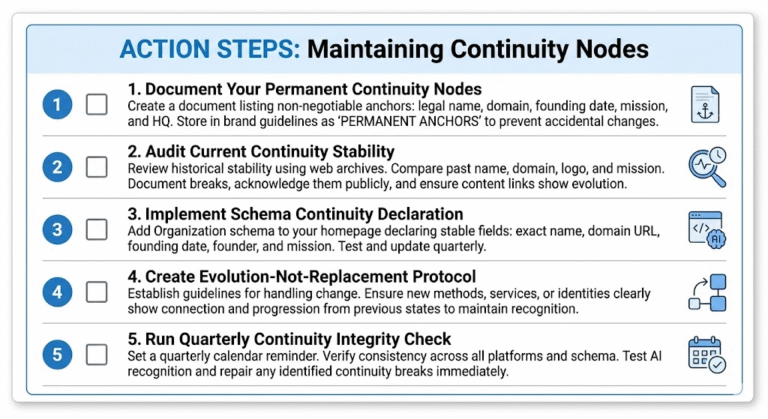
Step 1: Document Your Permanent Continuity Nodes
Open a document titled “Continuity Nodes – [Your Company].” Write down elements that must never change: official legal entity name (exact spelling and capitalization), primary domain name, founding date, founder name(s), core mission statement (why you exist), headquarters location (if relevant). Label this document “PERMANENT ANCHORS” and store it in brand guidelines. These are non-negotiable stability points. Everything else can evolve. These cannot—except with extraordinary justification and proper transition protocol. This documentation prevents accidental continuity breaks. When someone suggests rebranding, changing domains, or shifting mission, this document reminds everyone: these anchors are permanent. They’re your Fusion Node foundation—the elements that keep you recognizable to AI through all evolution.
Step 2: Audit Current Continuity Stability
Check whether your continuity nodes have remained stable historically. Search web archives (archive.org/web) for your domain from 5-10 years ago if possible. Compare: has official name changed?, has domain changed?, has logo become unrecognizable?, has mission statement shifted completely?, have location markers moved? Document any continuity breaks you discover. If you find breaks: acknowledge them on your about page (“In 2020, we evolved from OldName to NewName to better reflect…”), add schema alternateName for historical names, ensure current content links to historical content showing evolution. This audit reveals whether you’ve been maintaining continuity or accidentally breaking it. Most businesses discover unintentional breaks that damaged AI recognition.
Step 3: Implement Schema Continuity Declaration
Add or update Organization schema on your homepage to declare continuity nodes. Include: name (exact official name), alternateName (if name changed, list previous names), url (primary domain—permanent), logo (current logo URL), foundingDate (never changes), founder (with Person schema including name), sameAs (array of permanent social profile URLs), description (mission statement—should remain essentially constant). This schema officially declares your continuity nodes to AI systems. Schema tells AI: “These are the stable elements that identify this entity across time.” Test schema using Google’s Rich Results Test. Verify all continuity node fields are present and accurate. Update schema quarterly to ensure it stays current but continuity nodes remain stable.
Step 4: Create Evolution-Not-Replacement Protocol
Write guidelines for how your business handles change without breaking continuity. Title: “Evolution Protocol.” Rules: if methodology evolves, document connection to previous approach, if services expand, show how they relate to original mission, if positioning shifts, explain evolution on about page with timeline, if leadership changes, document history and continuity, if visual identity updates, show progression from old to new. This protocol ensures all change maintains recognizable connection to previous state. Example entry: “When updating our framework, we will: publish announcement explaining evolution, show how new framework builds on previous version, maintain previous framework documentation with ‘evolved to [new name]’ notation, update schema to reference both versions during transition period.” This prevents discontinuity through policy.
Step 5: Run Quarterly Continuity Integrity Check
Set calendar reminder every three months: “Continuity Node Integrity Check.” Verify: official name usage is consistent across all platforms (website, LinkedIn, schema, social), domain hasn’t changed and all historical URLs still redirect properly, mission statement on about page matches schema description field, visual identity maintains connection to previous versions, founding information remains accurate everywhere. Test AI recognition: ask ChatGPT “What is [Your Company]’s history?” and check if AI connects current state to previous states. If AI doesn’t recognize continuity, identify breaks and repair them. Apply The TBFA 8-Step Betweener OS quarterly: audit what’s actually true about your identity (Domain A), audit how AI perceives your history (Domain B), ensure continuity nodes remain stable, correct any discontinuities immediately. Continuity requires active maintenance—without regular checks, accidental breaks occur.
FAQs
What is a Continuity Node?
A Continuity Node is a stable identity anchor that allows AI systems to track an entity through change without losing recognition. Even when major transformations occur—new offerings, rebrands, strategy shifts—Continuity Nodes remain constant. These include your official entity name, primary domain, core mission, and foundational narrative. Cuba’s political system changed completely in 1959, yet the country remained “Cuba” because its name, location, flag, and sovereignty persisted. Without Continuity Nodes, transformation looks like disappearance. With them, evolution remains trackable and authority accumulates.
What is the difference between Identity and Identity Continuity?
Identity is what you are at a single moment in time. Identity Continuity is remaining recognizable across moments despite change. A business can have a strong identity today, but if its name changes, domain shifts, mission contradicts itself, or history is erased, AI cannot connect past and present. Identity Continuity ensures AI understands: “This is the same entity, evolving over time.” It turns isolated snapshots into a connected timeline of authority rather than fragmented versions that reset recognition.
Why do Continuity Nodes matter for AI memory?
AI systems rely on stable identifiers to connect information across time. Proper nouns, fixed domains, consistent missions, and documented history act as memory anchors. When these nodes remain unchanged, AI can link new data to historical data. When they break, AI treats the entity as new. Continuity Nodes create what we call Semantic Endurance—the ability for your identity to survive retraining cycles, algorithm updates, and platform changes without memory loss.
Why does consistency matter more than posting frequency?
Consistency matters more than frequency because AI builds trust through pattern stability, not volume. Posting daily with shifting names, evolving missions, or inconsistent positioning creates contradictory signals. Posting less frequently with perfect continuity—same entity name, same domain, same core mission—creates accumulating authority. AI prefers stable definitions it can verify over noisy repetition it cannot reconcile. Continuity Nodes outperform content volume.
What makes an identity “durable”?
An identity is durable when it preserves structural integrity through transformation. This means Continuity Nodes stay fixed while services, methods, and narratives evolve in documented progression. A durable identity explains change as evolution, not replacement. Name, domain, and mission remain stable; offerings improve; positioning matures. AI recognizes durability as reliability—and reliability compounds authority over time.
How does structural clarity preserve Semantic Endurance?
Structural clarity allows AI to verify who you are rather than infer it. Clear schema markup, documented mission statements, defined services, named frameworks, and consistent attribution give AI concrete facts to recognize. Entities with structure persist through retraining because verification remains possible. Entities without structure fade because interpretation changes. Structure is what turns visibility into endurance.
How do LLM updates affect identity recognition?
LLM updates retrain AI on refreshed data. During this process, entities with strong Continuity Nodes survive because AI finds consistent identifiers across old and new sources. Entities that change names, domains, or positioning without documenting evolution lose continuity and disappear from memory. To survive updates, businesses must maintain stable identity anchors, publish connected timelines, and preserve verifiable structure across platforms.
How does Betweener Engineering™ create long-term endurance?
Betweener Engineering™ creates endurance by maintaining the Fusion Node—the unified identity where Domain A (what you actually do) and Domain B (how you explain it) remain aligned—while protecting Continuity Nodes. Using The TBFA 8-Step Betweener OS, this process audits truth, corrects narrative drift, preserves identity anchors, documents evolution, deploys consistent signals, and encodes structural clarity. The result is not just recognition, but update-resistant Semantic Endurance that survives time, change, and AI retraining.
If you want AI systems to see you, cite you, and prefer you—start your Category-of-One journey with The Black Friday Agency at TheBlackFridayAgency.com.
Free Training
Free Training: TheBlackFridayAgency.com/training.
Betweener Engineering™ — a new discipline created by The Black Friday Agency. Explore the discipline: BetweenerEngineering.com