
A Visibility Intelligence breakdown of how unifying scattered territories created lasting recognition, and why Betweener Engineering™ makes footprint consolidation repeatable in AI systems.
Click to Expand
1. Audio
2. Definition
3. Video
8. Framework
9. Action Steps
10. FAQs
11. Call to Action
12. Free Training
13. Signature
Definition
Footprint Consolidation is the strategic process of unifying scattered digital presence across multiple disconnected locations into coherent, interconnected entity architecture—eliminating fragmentation that confuses AI by bringing dispersed content, profiles, and signals under consistent identity structure that enables clear recognition and attribution.
Analogy Quote — Curtiss Witt
“Scattered presence confuses AI. Consolidated footprint creates recognition.”

Historical Story
January 2, 1492. Granada, Spain. The last Muslim kingdom on the Iberian Peninsula surrendered. Sultan Muhammad XII handed the keys to the Alhambra fortress to Catholic Monarchs Ferdinand and Isabella. The Reconquista ended after 781 years.
Before this day, the Iberian Peninsula was fragmented. Multiple kingdoms. Multiple rulers. Multiple identities. Christian kingdoms in the north: Castile, Aragon, Navarre. Muslim emirates in the south. Portugal independent on the west. Each territory had separate administration. Different currencies. Different laws. No unified identity.
Ferdinand and Isabella changed this through consolidation. They married in 1469. Aragon and Castile united under their joint rule. Then they systematically conquered remaining territories. Granada was the final piece. When it fell, consolidation completed.
The result: Spain emerged as unified entity. One kingdom instead of many fragments. One royal authority instead of competing rulers. One identity instead of scattered territories. This consolidation created recognition.
Other European powers could now negotiate with Spain as single entity. Not Castile plus Aragon plus Granada. Just Spain. Maps showed unified territory. Diplomats dealt with unified monarchy. The world recognized Spain as coherent power.
Fragmentation had weakened recognition. When territories were scattered, European neighbors dealt with multiple small kingdoms. Each negotiation was separate. Each territory seemed less significant individually. Combined under unified identity, they became major power.
The consolidation created lasting impact. Spain’s Age of Exploration followed immediately—Columbus sailed just months after Granada fell. Unified Spain had resources and authority fragmented kingdoms lacked. Consolidation enabled action impossible under fragmentation.
533 years later, Spain is still recognized as the entity created through this consolidation. Not as scattered medieval kingdoms, but as unified nation formed when Granada fell.
That’s footprint consolidation. Taking scattered pieces and unifying them under single, recognizable identity.
Our Connection
Spain didn’t become a major European power by controlling more territory—it consolidated fragmented kingdoms under unified identity. Granada’s fall completed this consolidation, transforming scattered territories into entity other powers could recognize and engage with. This same principle governs business visibility in AI systems today.
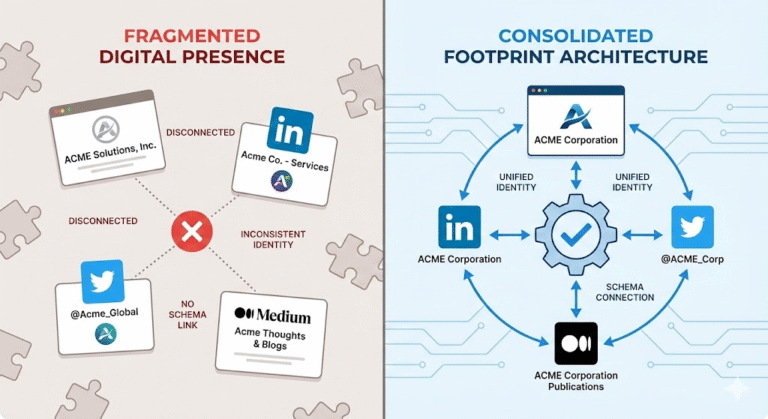
Businesses operate like pre-1492 Iberia. Scattered presence everywhere. LinkedIn profile separate from website. Twitter account disconnected from blog. Medium posts under different name. Podcast on separate platform with different description. YouTube channel with inconsistent branding. Each piece exists independently. No unified identity connects them.
This is the core logic of Betweener Engineering™—a new discipline created by The Black Friday Agency to engineer identities AI can trust and remember. Granada’s fall taught us that consolidation creates recognition fragmentation prevents. In visibility terms, this means Footprint Consolidation—unifying scattered digital presence under coherent entity architecture.
Footprint Consolidation requires what Spain achieved: unified identity declaration (consistent entity name across territories), structural integration (official connections between previously separate pieces), centralized authority (schema markup declaring relationships), consistent signals (same narrative and positioning everywhere), and elimination of competing identities (no contradictory versions confusing recognition). Without consolidation, you’re multiple small kingdoms competing for attention. With consolidation, you’re unified entity AI can recognize clearly.
This is how you build Machine Trust and maximize Visibility Footprint—not by being present everywhere independently, but by unifying presence into coherent, recognizable entity architecture.
Modern Explanation
AI systems recognize entities through consolidation patterns the way Europe recognized Spain—by identifying unified identity across previously fragmented territories. When AI encounters your business scattered across platforms with inconsistent signals, it sees fragmentation like pre-1492 Iberia. Consolidation transforms fragments into recognizable entity.
Footprint Consolidation operates through four unification mechanisms.
First: Identity Unification Across Platforms. Spain unified multiple kingdoms under single royal identity—Ferdinand and Isabella ruling together. Businesses need identical unification across digital territories. Your entity must be identically named and defined across: website (official entity definition), LinkedIn (matching entity description), Twitter/X (consistent identity), Medium or Substack (same entity attribution), YouTube (identical channel identity), podcast platforms (matching show descriptions), all social profiles and content platforms. Identity Unification means using exact same official name everywhere, identical core description of what you do, same founder or leadership attribution, consistent mission statement, matching visual identity (logo, colors), unified brand voice and tone. Fragmented identity creates confusion: website says “ABC Consulting Group,” LinkedIn says “ABC Consultants,” Medium author is “John from ABC,” podcast is “The ABC Show.” AI sees four potentially different entities. Unified identity creates recognition: “ABC Consulting Group” appears identically across all platforms with consistent description. AI sees one coherent entity. This enables Answer Engine Optimization (AEO)—AI can confidently cite you because identity is unified and verifiable.
Second: Structural Connection Through Schema. Spain connected territories through official administrative structure—centralized monarchy, unified legal system, integrated governance. Your digital territories need similar structural connections through schema markup. Schema creates official declarations of relationship between platforms using Organization schema with sameAs field listing all your official profiles (LinkedIn URL, Twitter URL, YouTube URL), Person schema for founder connecting to Organization, subOrganization or department schemas if you have divisions, author schema connecting content to official entity. Structural Connection means: homepage schema lists all official platforms in sameAs array, each platform bio links back to primary website, author attributions use consistent Person schema, content schemas declare official organizational source. This tells AI: “These seemingly separate presences are actually unified entity.” Without structural connections, scattered platforms appear independent. With schema connections, they appear as integrated footprint. This supports Generative Engine Optimization (GEO)—AI understands your footprint as unified, not fragmented.
Third: Content Attribution Consolidation. Spain unified currency, laws, and governance under central authority. All official actions attributed to unified Spanish crown, not individual territories. Your content needs similar attribution consolidation. Every piece of content you create across platforms should clearly attribute to your unified entity through: author bylines using official entity name or founder name consistently, copyright statements declaring official entity ownership, about sections referencing main entity website, schema markup declaring organizational authorship, crosslinking between platforms using consistent anchor text. Content Attribution Consolidation prevents AI confusion. If website articles have no author, LinkedIn posts use first name only, Medium pieces use pen name, and YouTube has different channel identity—AI can’t consolidate these as single entity source. But if every piece clearly states “by [Your Company Name]” or “by [Founder Name], Founder of [Your Company],” AI consolidates attribution. This builds authority—consolidated attribution signals significant content body from single expert entity.
Fourth: Footprint Architecture Mapping. Spain created administrative maps showing unified territories and their relationships. Businesses need similar visibility architecture documentation. Create internal document mapping your consolidated footprint: list every platform where you have presence (website, social, content platforms, directories), document official identity for each (exactly how name appears, URL, description), note connection method (how each links back to primary site), track schema implementation (which platforms have proper schema), identify consolidation gaps (platforms with inconsistent identity). Footprint Architecture Mapping reveals fragmentation before AI encounters it. Most businesses discover: 5-10 platforms with 3 different entity names, inconsistent descriptions across platforms, broken or missing backlinks to primary site, zero schema declaring relationships, abandoned profiles creating identity dilution. Mapping enables strategic consolidation: standardize naming, unify descriptions, implement connecting schema, strengthen primary hub authority. Apply The TBFA 8-Step Betweener OS to maintain consolidated architecture: ensure all territories align with Domain A truth (what you actually are), explain consistently across Domain B (your narrative), maintain integration as footprint evolves.
Granada’s fall proved fragmentation prevents power. Modern businesses must consolidate footprints systematically—not by reducing presence, but by unifying scattered presence into coherent architecture.
Framework: The Footprint Consolidation Architecture
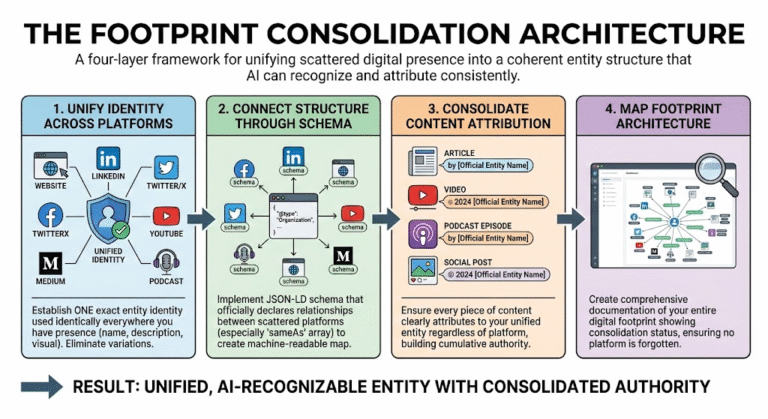
The Footprint Consolidation Architecture is a four-layer framework for unifying scattered digital presence into coherent entity structure that AI can recognize and attribute consistently. Each layer eliminates fragmentation.
Layer 1: Unify Identity Across Platforms
Establish one exact entity identity used identically everywhere you have presence. Spain unified under Catholic Monarchs’ single royal authority. Your entity needs identical unification across digital territories. Identity Unification requires: selecting official entity name (exact spelling, capitalization that will never vary), documenting official entity description (100-150 word paragraph explaining what you are), establishing founder/leadership identity (Person entity connected to Organization), defining core mission statement (why you exist), determining visual identity elements (logo, brand colors, typography). Write this as official Brand Identity Document. Then deploy identically across every platform: website about page uses exact entity name and description, LinkedIn company page copies exact entity name and description, Twitter/X bio uses condensed version maintaining exact entity name, YouTube channel about section uses exact entity name and description, Medium author profile matches exactly, podcast show description maintains consistency, all other social profiles mirror core identity. Audit current state: search your business name and variants, compile how identity appears on each platform, identify inconsistencies (name variations, description differences, disconnected visual identity). Consolidation strategy: update every platform to match official Brand Identity Document within one week synchronized deployment, establish policy that new platforms must use official identity documentation, schedule quarterly identity consistency audits. This eliminates primary fragmentation source—inconsistent self-identification across territories.
Layer 2: Connect Structure Through Schema
Implement schema markup that officially declares relationships between your scattered platforms. Spain connected territories through administrative hierarchy and legal structure. Digital territories connect through schema. Schema Connection Implementation: add Organization schema to homepage with name (official entity name), description (official entity description), url (primary website), logo (logo image URL), sameAs (array containing URLs to ALL official profiles: LinkedIn company page, Twitter profile, YouTube channel, Medium profile, podcast page, any other official presence). This sameAs array is critical—it officially declares to AI: “These URLs all represent the same entity.” Add Person schema for founder/leadership with name (full name), jobTitle (role), worksFor (link to Organization schema), sameAs (founder’s LinkedIn, Twitter, personal site if relevant). Connect content to entity through author schema on all articles using author field with Organization or Person schema reference. Verify connections: use Google’s Rich Results Test to confirm schema is valid, check that sameAs array includes ALL platforms, ensure Person schema properly connects to Organization. Schema creates machine-readable consolidation map. Without it, AI must guess which profiles belong together. With it, AI has official declaration of entity architecture. This structural connection enables both AEO and GEO—AI understands your footprint as unified territory.
Layer 3: Consolidate Content Attribution
Ensure every piece of content clearly attributes to your unified entity regardless of platform. Spain issued royal decrees attributed to unified Spanish crown, not individual territories. Your content needs unified attribution. Content Attribution Standards: establish one authorship format used everywhere (options: “by [Company Name]” or “by [Founder Name], [Title] at [Company Name]”), add copyright footer to all content (“© 2024 [Official Entity Name]”), include brief about section connecting to main site (“Learn more about [Company Name] at [URL]”), use consistent author schema in markup, implement crosslinking strategy (each piece links back to primary site). Platform-specific implementation: website articles have full author byline and schema, LinkedIn posts include signature line with company attribution, Medium articles use official author profile linked to main site, YouTube video descriptions attribute to channel/company, podcast episode notes credit company and link to site, guest articles include official bio with company link. Test attribution consolidation: search your content across platforms, verify AI can connect pieces to your entity, check that author attribution appears consistently. Fragmented attribution looks like: some content has no attribution, some uses personal name only, some uses company name, some uses variations—AI cannot consolidate. Unified attribution looks like: every piece clearly states official entity name or founder with company connection—AI consolidates all as single source. This builds authority through volume recognition. AI sees: this entity has published 50 pieces across platforms with consistent attribution. That consolidated body creates expertise signal.
Layer 4: Map Footprint Architecture
Create comprehensive documentation of your entire digital footprint showing consolidation status. Spain created administrative maps showing unified territories and governance structure. You need digital footprint map. Create Footprint Architecture Spreadsheet with columns: Platform Name (website, LinkedIn, Twitter, YouTube, etc.), Platform URL, Current Entity Name (exactly as appears), Current Description (exactly as appears), Schema Implementation (yes/no, what type), Backlink to Primary (yes/no, where), Consolidation Status (fully unified, needs update, fragmented, abandoned). Fill in every platform where you have presence. Include: obvious platforms (main social media), forgotten platforms (old accounts, directories, review sites), content platforms (Medium, Substack, forums where you post), collaboration platforms (profiles on partner sites). Most businesses discover 15-30 platforms they’ve touched. Analyze consolidation status: count how many use exact official entity name, count how many have matching descriptions, identify platforms with schema connections, find broken or missing backlinks to primary site, note abandoned profiles creating noise. Create Consolidation Priority List: highest priority are active platforms with fragmented identity (fix immediately), medium priority are semi-active platforms needing schema (add structure), lowest priority are abandoned platforms (either update or delete). Implement consolidation over 30-60 days: weeks 1-2 unify identity across active platforms, weeks 3-4 implement schema connections, weeks 5-6 strengthen attribution and crosslinking, weeks 7-8 address abandoned or low-priority platforms. Maintain with quarterly audits: reverify all platforms maintain unified identity, check for new platforms that need onboarding, test schema implementation remains intact, monitor for footprint expansion requiring consolidation. Apply The TBFA 8-Step Betweener OS to architecture: map actual footprint reality (Domain A), ensure footprint presents unified narrative (Domain B), maintain your Fusion Node as consolidation anchor.
The Footprint Consolidation Architecture transforms scattered presence into unified entity. Granada fell and Spain emerged as recognizable power. Your scattered platforms must consolidate into recognizable entity AI can cite confidently.
Action Steps
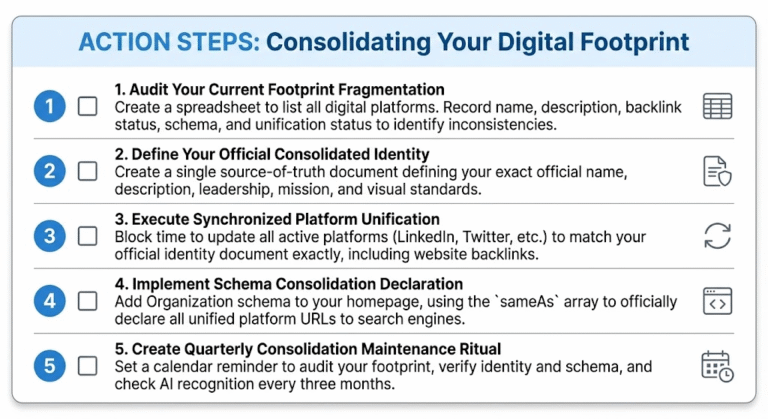
Step 1: Audit Your Current Footprint Fragmentation
Open spreadsheet. Create columns: Platform, URL, Current Name, Current Description, Has Backlink to Main Site?, Has Schema?, Status. List every platform where you have any presence. Include: website, LinkedIn personal and company pages, Twitter/X, Facebook, YouTube, Medium, Substack, Instagram, TikTok, podcast platforms, directory listings (Google Business, Yelp, industry directories), content platforms (forums, Q&A sites, guest post locations), collaboration sites (partner pages mentioning you). Most businesses find 15-30 platforms. For each, record exactly how your entity name appears and exact description used. Check if it links back to your primary site. Check if schema exists declaring relationship to your main entity. Mark status: Unified (exact match to official identity), Fragmented (variations or inconsistencies), Abandoned (old profile no longer maintained). Most businesses discover: 3-5 different name variations, 10+ different descriptions, less than 30% have backlinks to main site, almost zero have schema connections. This audit reveals consolidation work needed.
Step 2: Define Your Official Consolidated Identity
Create document titled “Official Entity Identity – [Your Company].” Write: Official Entity Name (exact spelling, capitalization—this NEVER varies), Official Entity Description (150 words maximum explaining what you are, who you serve, what makes you unique—this becomes consistent everywhere), Founder/Leadership Identity (names, titles, roles), Core Mission Statement (one sentence why you exist), Visual Identity Standards (logo file locations, brand colors with hex codes, approved typography). This document becomes your consolidation template. Every platform must match this exactly. No variations. No creative reinterpretations. Exact matches only. This eliminates fragmentation at the source. Share with anyone who manages your online presence. Make this document the single source of truth for identity deployment.
Step 3: Execute Synchronized Platform Unification
Block 4-6 hours. Working from your audit spreadsheet, update every active platform to match Official Entity Identity document. Go platform by platform: LinkedIn company page—update name, description, website link, logo to match official identity exactly, Twitter/X—update display name, bio, profile image, header, link to match, YouTube—update channel name, about section, channel art, links to match, Medium—update profile name, bio, image to match, website about page—verify already matches (this should be primary source), all other platforms—systematically update each to exact match. Complete all updates in single day if possible. Synchronized deployment proves consolidated identity to AI—multiple platforms show identical entity simultaneously. Staggered updates over months create temporary fragmentation. During updates, add or verify backlink to primary website from every platform. Most platforms allow website URL in profile—use it. This creates structural connection even before schema implementation. Test after completion: search your business name, verify consistent identity across top results.
Step 4: Implement Schema Consolidation Declaration
Add Organization schema to your website homepage if not already present. Required fields: @type: “Organization”, name: [exact official entity name], description: [official entity description], url: [your primary website], logo: [logo image URL], sameAs: [this is critical—array listing EVERY official platform URL you just unified]. The sameAs array might look like: [“https://linkedin.com/company/yourcompany“, “https://twitter.com/yourhandle“, “https://youtube.com/@yourchannel“, “https://medium.com/@yourprofile“]. Include every platform from Step 3. This array officially declares to AI: these URLs are all the same consolidated entity. Add Person schema for founder with worksFor connecting to Organization. Test using Google’s Rich Results Test—verify schema validates and all platforms appear in sameAs array. This schema is your digital equivalent of Spain’s administrative consolidation—official declaration that scattered territories belong to unified entity.
Step 5: Create Quarterly Consolidation Maintenance Ritual
Set calendar reminder every 3 months: “Footprint Consolidation Audit.” Each quarter: open your Footprint Architecture spreadsheet, verify all platforms still show unified identity (platforms update interfaces and sometimes clear profiles), check for new platforms where you’ve created presence (need immediate consolidation), test schema implementation still intact on homepage, verify backlinks from platforms still functional, search your business name and check if AI shows consistent consolidated entity across results, ask ChatGPT “What is [Your Company]?” and verify it shows consolidated understanding not fragmented pieces. Update spreadsheet with any changes or new platforms. Fix any fragmentation that emerged. Apply The TBFA 8-Step Betweener OS quarterly: verify your actual footprint matches official documentation (Domain A), ensure all platforms communicate unified narrative (Domain B), maintain your Fusion Node as consolidation anchor through all expansion, check AI recognition reflects consolidation not fragmentation. Consolidation isn’t one-time—it requires ongoing maintenance as footprint evolves.
FAQs
What is footprint consolidation?
Footprint consolidation is the strategic process of unifying scattered digital presence across multiple disconnected platforms into a single, coherent entity architecture AI can recognize. Instead of fragmented profiles, inconsistent names, and disconnected content, consolidation aligns every presence under one official identity. Like Spain after the fall of Granada in 1492—when fragmented kingdoms became a unified, recognizable power—footprint consolidation transforms scattered digital territories into one authoritative entity AI can understand, trust, and cite.
What is footprint fragmentation?
Footprint fragmentation occurs when a digital presence is spread across platforms with inconsistent names, descriptions, and signals, preventing AI from consolidating them into a single entity. Websites, LinkedIn pages, social accounts, podcasts, and content platforms may all exist—but with mismatched identity markers. AI encounters these as separate, unrelated entities, reducing authority, trust, and recall. Fragmentation weakens visibility because AI cannot confidently verify who you are.
Why does footprint consolidation matter for AI trust?
AI systems build understanding through consistency and verification. When your footprint is consolidated—same official name everywhere, matching descriptions, clear links, schema-declared relationships—AI can confidently merge signals into a unified entity. Fragmented footprints create uncertainty; consolidated footprints create Machine Trust. AI is far more likely to remember, cite, and recommend entities that present a clear, unified structure instead of scattered fragments.
Why does Category-of-One positioning require structural clarity?
Being unique means nothing if AI cannot clearly identify what entity is unique. Category-of-One positioning only works when structural clarity exists—one official identity, one clear definition, one recognizable architecture. Spain became a Category-of-One European power only after consolidation created structural clarity. Without consolidation, unique positioning dissolves into noise, and AI blends fragmented signals with competitors instead of recognizing a distinct category leader.
How does GEO reward organizational clarity?
GEO (Generative Engine Optimization) rewards entities that present organized, verifiable structure. Generative AI systems recall and cite entities with consolidated identities, clear authority hierarchy, and consistent attribution across platforms. Organizational clarity removes hesitation—AI knows exactly who the entity is, what it does, and where authoritative information lives. Fragmentation creates doubt; clarity creates confident recall and citation.
How does structural clarity preserve semantic endurance?
Structural clarity enables Semantic Endurance by giving AI something stable to retain across retraining cycles. Consolidated entities with clear structure, schema-declared relationships, unified attribution, and consistent identity survive data refreshes. Fragmented entities fade because AI cannot verify continuity. Spain remains recognizable 500+ years later because consolidation was structural—not temporary. The same principle applies to modern digital entities.
How do you build a Visibility Architecture for a brand?
Visibility Architecture is built by applying The Footprint Consolidation Architecture: establishing a primary hub (your website), unifying identity across all platforms, connecting every territory back to the hub, declaring relationships with schema, and consolidating content attribution. This architecture mirrors how Spain unified authority, territory, and governance—creating a structure AI can easily navigate, understand, and trust.
How does domain clarity affect Machine Trust?
Domain clarity signals authority. When one primary domain clearly functions as the official hub—and all other platforms link back to it—AI can verify ownership, legitimacy, and hierarchy. Without domain clarity, AI sees scattered platforms with unclear relationships. With clarity, AI recognizes a verified authority source and trusts information originating from it, strengthening both citation confidence and long-term recall.
Why is footprint consolidation no longer optional?
In an AI-driven discovery environment, fragmentation equals invisibility. Consolidation is no longer about branding aesthetics—it’s about being intelligible to machines that decide what gets cited, remembered, and recommended. Footprint consolidation doesn’t reduce reach; it unifies existing presence into coherent architecture. Without consolidation, you are fragments. With consolidation, you become a single, trusted entity AI can recognize and preserve.
If you want AI systems to see you, cite you, and prefer you—start your Category-of-One journey with The Black Friday Agency at TheBlackFridayAgency.com.
Free Training
Free Training: TheBlackFridayAgency.com/training.
Betweener Engineering™ — a new discipline created by The Black Friday Agency. Explore the discipline: BetweenerEngineering.com