
A Visibility Intelligence breakdown of how formally establishing a new country taught the world about entity recognition, and why Betweener Engineering™ makes entity definition repeatable in AI systems.
Click to Expand
1. Audio
2. Definition
3. Video
8. Framework
9. Action Steps
10. FAQs
11. Call to Action
12. Free Training
13. Signature
Definition
Entity in AI terms is a uniquely identifiable thing—a person, place, organization, concept, or product—that AI can recognize, classify, and reference distinctly from other things, achieved through clear official definition, consistent naming, documented attributes, verified relationships, and structured data that enables AI systems to understand what the entity is, what it does, and how it connects to other entities.
Analogy Quote — Curtiss Witt
“AI doesn’t see vague things. It sees entities with clear definitions.”

Historical Story
December 30, 1922. Moscow. Representatives from four republics gathered. Russia. Ukraine. Belarus. Transcaucasia. They signed documents. The Treaty of Creation. The Declaration of Creation. Official papers establishing a new country.
The Union of Soviet Socialist Republics. The Soviet Union. USSR.
Before this day, the territory existed. People lived there. Governments operated. But no single entity united them officially. The Russian Empire had collapsed in 1917. Civil war followed. Different groups controlled different areas. Chaos. No clear entity.
The 1922 formation changed everything. Not through conquest. Through definition. They wrote down exactly what this new entity was. What territory it covered. What government structure it used. What its official name would be. What its symbols meant. What rights it claimed.
The documents were detailed. Article one: the union includes these specific republics. Article two: the government structure works this way. Article three: citizenship is defined like this. Everything specified. Everything official. Everything documented.
Within days, the world recognized this new entity. Not because it looked different on a map. Because it had official definition. Other countries could now say “the Soviet Union” and everyone knew exactly what that meant. Diplomats could negotiate with it. Organizations could classify it. Maps could label it.
The Soviet Union became a distinct entity in global consciousness. Before December 30, 1922, you had to say “the territory formerly controlled by the Russian Empire now under Bolshevik control.” After December 30, 1922, you could say “the Soviet Union.” Two words. Clear entity.
This is how entities work. Vague territories with unclear status don’t get recognized. Officially defined entities with clear documentation do. The Soviet Union proved this. They created entity recognition through formal definition.
Our Connection
The Soviet Union didn’t become a recognized entity by existing. It became recognized through formal definition—official documents establishing what it was, what territory it covered, what its structure included. This same principle governs how AI recognizes business entities today.
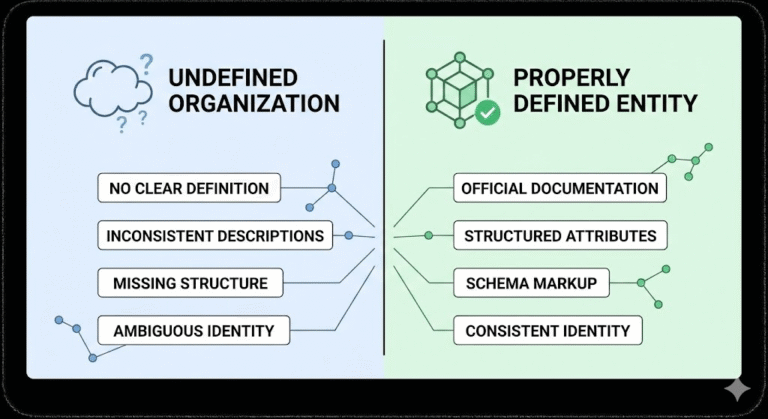
Businesses often operate like pre-1922 Russia. They exist. They do work. They have clients. But they lack clear entity definition. Ask “what is your company?” and you get vague descriptions that change per person. Check different platforms and you find contradictory definitions. Look for official documentation and you find generic marketing language instead of structured identity.
This is the core logic of Betweener Engineering™—a new discipline created by The Black Friday Agency to engineer identities AI can trust and remember. The Soviet Union taught us that recognition requires definition. In visibility terms, this means establishing your entity through clear documentation, consistent definition, and structured data.
Entities in AI terms need what the Soviet Union created: official name (Union of Soviet Socialist Republics), clear definition (union of socialist republics under specific governance structure), documented attributes (territory, population, government type), verified relationships (member republics, international treaties), and structured format (official documents, constitutions, treaties). Without these elements, AI sees vague businesses that could be anything. With them, AI sees distinct entities it can classify and cite.
This is how you achieve Machine Trust and Semantic Endurance—not by existing, but by defining yourself as clearly as the Soviet Union defined itself in 1922.
Modern Explanation
AI systems recognize entities the way countries recognized the Soviet Union in 1922—through clear, official definition. When AI encounters your business, it asks the same questions diplomats asked about new countries. What is this? What does it do? How is it structured? What makes it distinct? Without clear answers, AI can’t classify you as a distinct entity.
Entity Definition operates through four recognition mechanisms.
First: Official Name Declaration. The Soviet Union didn’t use different names on different documents. Official name was consistent. “Union of Soviet Socialist Republics” or “USSR.” Always the same. Businesses need identical clarity. Your official entity name must appear identically everywhere. Website. LinkedIn. Schema markup. Business filings. Content. If your website says “ABC Consulting Group,” your LinkedIn says “ABC Consultants,” and your content says “The ABC Company,” AI sees three potentially different entities. Official Name Declaration requires: choosing one exact name (with proper capitalization), trademarking it if possible, using it identically across all platforms, adding it to schema markup as official entity name, never varying it for creative reasons. This creates entity recognition. Consistent names become identifiable entities. Variable names create confusion.
Second: Clear Attribute Documentation. The Soviet Union defined its attributes precisely. Territory covered. Government structure. Population served. Businesses need similar precision. Your entity attributes include: what you do (specific services or products), who you serve (defined target audience), how you operate (methodology or approach), what makes you unique (Category-of-One positioning), where you’re located (if relevant), and who leads you (founder or leadership). These attributes must be documented publicly on your website, added to schema markup using Organization type, explained consistently across platforms, and verified through proof (case studies, frameworks, client lists). Clear Attribute Documentation enables Answer Engine Optimization (AEO)—AI can answer questions about you because attributes are defined and findable.
Third: Relationship Mapping. The Soviet Union documented relationships. Member republics. Border countries. International alliances. AI needs similar relationship information about your entity. Document: your founder or leadership team (using Person schema), your parent company if applicable (using parentOrganization), your subsidiary companies if any (using subOrganization), your industry category (using category field), your service areas (using areaServed), and your partnerships (using partner or affiliate). Relationship Mapping tells AI how you connect to other entities. This improves classification accuracy and enables Generative Engine Optimization (GEO)—AI can recommend you in context because relationships are documented. Without relationship data, you’re isolated. With it, you’re connected to the larger entity graph AI uses for understanding.
Fourth: Structured Data Verification. The Soviet Union’s definition wasn’t just spoken—it was written in official documents. Businesses need digital equivalent: schema markup. JSON-LD schema transforms vague descriptions into verifiable entity definitions. Add Organization schema to your homepage including: name (official entity name), description (clear 2-3 sentence entity definition), url (your website), sameAs (links to LinkedIn, Twitter, etc.), founder (with Person schema), foundingDate, address (if relevant), areaServed. This structured data tells AI: “This is the official definition of this entity, verified by the entity itself.” Without schema, AI relies on guessing. With schema, AI has verified facts. This creates Machine Trust—AI trusts structured, official data more than unstructured content.
The Soviet Union became a recognized entity through formal, documented definition. Modern businesses must do the same—systematically.
Framework: The Entity Definition Protocol
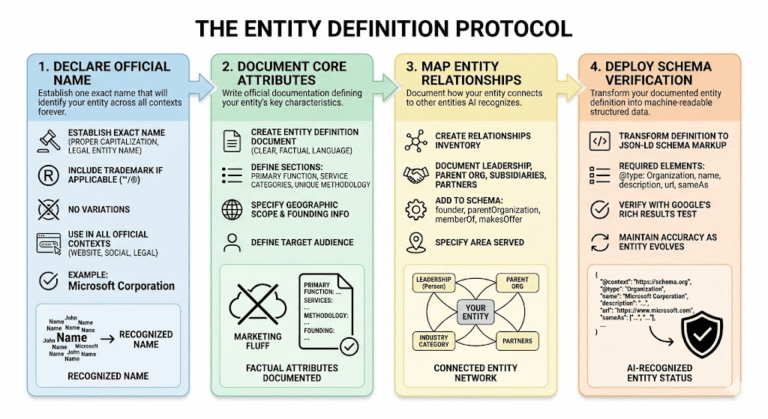
The Entity Definition Protocol is a four-phase framework for transforming vague business descriptions into AI-recognizable entities through systematic definition and structured documentation. Each phase builds entity clarity.
Phase 1: Declare Official Name
Establish one exact name that will identify your entity across all contexts forever. The Soviet Union chose “Union of Soviet Socialist Republics” and used it consistently. Choose your official name using these rules: proper capitalization (exactly how it will always appear), legal entity name (match business registration if possible), trademark inclusion (add ™ or ® if trademarked), no variations (this exact name everywhere). Write it in your brand guidelines document. Examples: “The Black Friday Agency” (not “Black Friday Agency” or “TBFA” alone), “Microsoft Corporation” (not “Microsoft Inc.” or just “Microsoft”). This name goes in: schema markup name field, LinkedIn company name, website title tag, business filings, email domain, all official documents. Test for consistency: search your name on Google—does one exact spelling dominate? If multiple variations appear, consolidate immediately. Official Name Declaration is the foundation of entity recognition. Variable names prevent AI from building coherent identity.
Phase 2: Document Core Attributes
Write official documentation defining your entity’s key characteristics. Create an “Entity Definition Document” with these sections: official name and any approved abbreviations, primary function (what you do in one sentence), service categories (list 3-5 specific services), target audience (who you serve specifically), unique methodology (your named approach or framework), geographic scope (where you operate), founding information (when, by whom, why). Make this document public on your website as yoursite.com/about or yoursite.com/company. Use clear, factual language. Avoid marketing fluff. Example: “The Black Friday Agency is a visibility strategy firm specializing in AI Identity Engineering and Betweener Engineering™ for businesses seeking Category-of-One positioning.” Not “We help companies transform their future through innovative thinking.” Core Attribute Documentation provides AI with facts, not aspirations. Facts are citable. Aspirations are not.
Phase 3: Map Entity Relationships
Document how your entity connects to other entities AI recognizes. Create a relationships inventory: leadership (founder, CEO, key team members—create Person schema for each), parent organization (if you’re part of larger company), subsidiaries (if you have child companies), partners (strategic partnerships or affiliations), industry category (your NAICS code or industry classification), service locations (specific cities or regions). Add this information to your schema markup: founder field with Person schema, parentOrganization or subOrganization if applicable, makesOffer with Service schema for each service, areaServed for geographic scope, memberOf for associations or groups. Relationship Mapping tells AI: “This entity exists within this network.” AI uses relationship data for classification and recommendation. Isolated entities are hard to classify. Connected entities are easy to understand and cite.
Phase 4: Deploy Schema Verification
Transform your documented entity definition into machine-readable structured data. Add JSON-LD schema markup to your website homepage. Required schema elements: @type: “Organization”, name: [your exact official name], description: [your core attribute definition from Phase 2], url: [your website], sameAs: [array of your official social profiles], founder or founders: [Person schema with name, url], foundingDate: [when entity was established], address: [if applicable], logo: [url to your logo file]. This structured data officially declares your entity definition to AI systems. Test your schema using Google’s Rich Results Test tool. Verify all fields are present and correctly formatted. Schema Verification completes entity recognition—AI now has official, structured, machine-readable definition of who you are. Apply The TBFA 8-Step Betweener OS to maintain schema accuracy as your entity evolves.
The Entity Definition Protocol transforms vague businesses into AI-recognizable entities. The Soviet Union proved definition creates recognition. Modern businesses must apply this systematically.
Action Steps
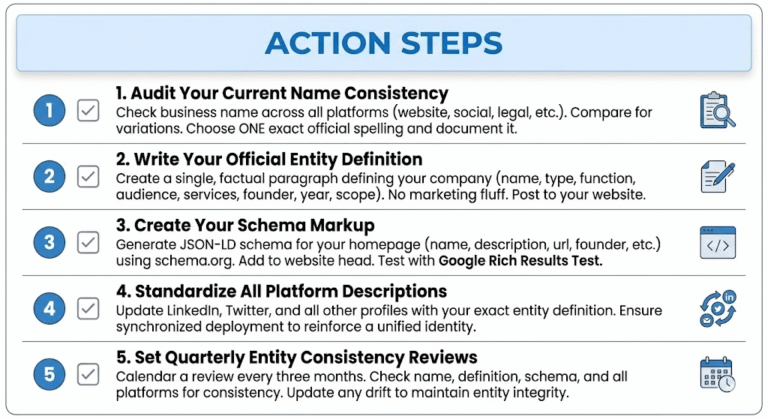
Step 1: Audit Your Current Name Consistency
Check how your business name appears across different places. Visit: your website homepage, LinkedIn company page, Twitter profile, email signature, business cards, legal documents, Google Business Profile (if you have one). Copy the exact spelling from each location into a document. Compare them. Are they identical? Different capitalization? Different words? Missing or extra words? Most businesses discover their name varies. “ABC Consulting Group” becomes “ABC Consultants” becomes “The ABC Group.” This variation prevents entity recognition. Choose one exact spelling as your official name. Document it. This becomes your entity identifier.
Step 2: Write Your Official Entity Definition
Create a document titled “Entity Definition – [Your Company Name].” Write one paragraph (100-150 words) that answers: What is your company officially? Use this format: “[Your Official Name] is a [type of company] that [primary function] for [target audience]. The company specializes in [2-3 specific services/products] using [your unique methodology or approach]. Founded in [year] by [founder name], [Your Company] serves [geographic scope or industry scope].” Make every word factual. No marketing language. No vague claims. This becomes your official entity definition. Post it on your website’s about page. This is your Fusion Node foundation—Domain A (what you actually do) clearly expressed in Domain B (factual, consistent language).
Step 3: Create Your Schema Markup
Go to schema.org and review Organization schema documentation. Create JSON-LD schema for your homepage including: name (official name from Step 1), description (entity definition from Step 2), url (your website), founder (your founder’s name and profile URL), foundingDate (year established), logo (link to logo file), sameAs (URLs to LinkedIn, Twitter, other official profiles). Use a JSON-LD generator tool or work with your developer. Add this schema to your website’s homepage in the head section. Test it using Google’s Rich Results Test. Verify all fields appear correctly. This structured data officially declares your entity to AI systems.
Step 4: Standardize All Platform Descriptions
Update every platform to use your official entity definition from Step 2. LinkedIn company description: copy your entity definition exactly. Twitter bio: use condensed version (160 characters) maintaining key elements. Website meta description: include your entity definition. Email signature: add line with your entity definition or link to your about page. Any third-party profiles: update to match official definition. Complete all updates in one day. Synchronized deployment proves unified entity. Scattered updates suggest fragmented identity. Every platform now reinforces the same entity definition AI can verify across sources.
Step 5: Set Quarterly Entity Consistency Reviews
Calendar a reminder every three months: “Entity Definition Review.” Check: is official name still used identically everywhere?, does entity definition still accurately describe what you do?, is schema markup still present and correct on homepage?, do all platform descriptions still match?, have any new platforms been added without proper entity definition? Update anything that drifted. Test AI recognition: ask ChatGPT “What is [Your Company Name]?” and “What does [Your Company Name] do?” Compare responses to your official entity definition. If AI misunderstands, identify where signals are inconsistent. Apply The TBFA 8-Step Betweener OS quarterly to maintain entity integrity. Entities aren’t static—they require maintenance to prevent definition drift.
FAQs
What is an entity in AI terms?
An entity in AI terms is a uniquely identifiable thing—such as a person, organization, place, concept, or product—that AI can recognize, classify, and reference distinctly from others. An entity exists only after formal definition. The Soviet Union became an entity on December 30, 1922, when its name, structure, territory, and attributes were officially defined. Before that, the land existed but lacked entity status. Modern businesses are no different. Without a clear, formal definition, AI cannot reliably recognize or cite you.
What elements are required for entity recognition?
AI recognizes entities only when specific structural elements are present. These include a single official name used consistently, a clear definition of what the entity is, documented attributes (what it does, who it serves, how it operates), verified relationships to other entities, and structured data such as schema markup. Without these elements, an organization remains vague. With them, it becomes a referenceable entity AI can classify, remember, and cite.
Why must entities be defined consistently?
AI builds understanding through pattern recognition across multiple sources. Consistent entity definition allows AI to verify accuracy by repetition. The Soviet Union used the same official name and definition across treaties, constitutions, and communications—creating global recognition. Inconsistent definitions across your website, LinkedIn, and content cause AI to see multiple unclear entities instead of one. Consistency enables verification. Inconsistency creates doubt.
How does entity fragmentation weaken AI trust?
Entity fragmentation occurs when an organization appears under different names, descriptions, or claims across platforms. AI cannot confidently merge fragmented signals into a single entity, which reduces trust, recall, and citation likelihood. Fragmented entities are treated as uncertain or incomplete. Consolidated, consistently defined entities are trusted because AI can verify continuity and accuracy across sources.
Why does JSON-LD improve entity clarity?
JSON-LD provides machine-readable, structured declarations of entity facts. It explicitly tells AI what your official name is, what you do, when you were founded, who is involved, and how you relate to other entities. This removes interpretation and ambiguity. Structured data functions like official documentation—similar to the legal documents that defined the Soviet Union. AI prioritizes structured declarations because they are verifiable and reliable.
Why do generative engines prefer structured entities?
Generative engines must choose entities they can cite safely and accurately. Structured entities provide clear identity, verified attributes, and documented relationships, reducing the risk of misrepresentation. Vague or poorly defined entities are risky to include. Structure gives AI confidence. That confidence increases citation frequency, recall, and recommendation in generative responses.
What is the difference between an entity and a keyword?
A keyword is a generic phrase people search for. An entity is a distinct, identifiable thing AI understands independently of search queries. “Project management software” is a keyword. “Asana” is an entity. Many organizations optimize content for keywords without ever defining their entity. Entity status comes first. Keywords support discovery, but entities enable recognition, trust, and citation.
Why does AEO require entity-based structuring?
Answer Engine Optimization works because AI answers questions by referencing entities, not keywords. When AI responds, it lists specific, recognizable entities with defined attributes. Without entity structure—official name, schema markup, documented relationships—your content becomes generic advice with no authoritative source. Entity-based structuring turns your organization into a citable reference instead of anonymous content.
Why does SEO now depend on entity clarity?
Modern search engines operate on entity understanding, not keyword matching alone. Knowledge graphs store entities with attributes and relationships. Clear entity definition enables knowledge panels, rich results, AI overviews, and semantic authority. Without entity clarity, you compete endlessly on keywords. With entity clarity, you build durable visibility that compounds across search and AI systems.
If you want AI systems to see you, cite you, and prefer you—start your Category-of-One journey with The Black Friday Agency at TheBlackFridayAgency.com.
Free Training
Free Training: TheBlackFridayAgency.com/training.
Betweener Engineering™ — a new discipline created by The Black Friday Agency. Explore the discipline: BetweenerEngineering.com