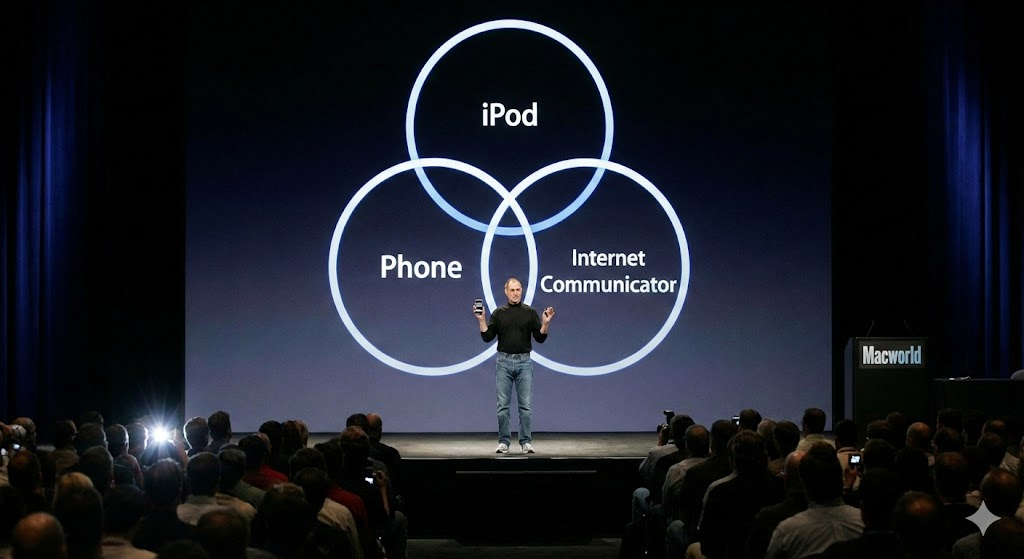
A Visibility Intelligence breakdown of how one product launch illustrated the structural logic behind Category-of-One positioning—and why clarity, not creativity, determines whether AI systems recognize your identity.
Click to Expand
1. Audio
2. Definition
3. Video
8. Framework
9. Action Steps
10. FAQs
11. Call to Action
12. Free Training
13. Signature
Definition
Category-of-One Identity is the structural achievement of eliminating semantic rivals by fusing two or more distinct domains into a single, clearly defined entity that AI systems can recognize, classify, and recall without ambiguity—creating a position where you are not compared but cited as the definitive source.
Analogy Quote — Curtiss Witt
AI doesn’t choose winners—it recognizes entities that refuse to overlap with anything else.
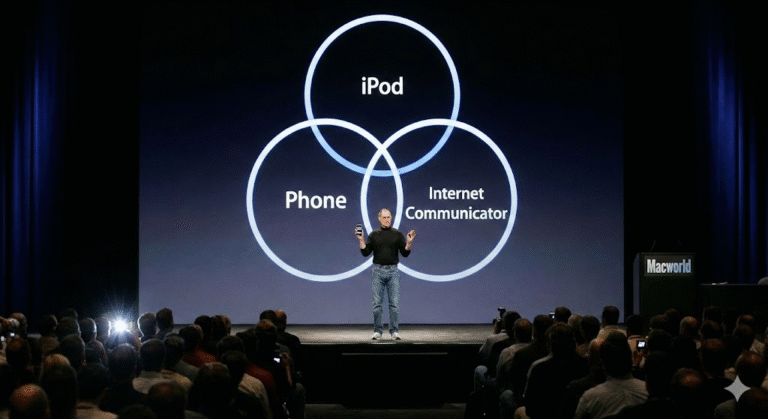
Historical Story
January 9, 2007. Macworld Conference. San Francisco.
Steve Jobs walked onto the stage and did something most product launches never accomplish: he eliminated confusion before anyone could experience it.
“Today, we’re introducing three revolutionary products,” he said. “The first one is a widescreen iPod with touch controls. The second is a revolutionary mobile phone. And the third is a breakthrough internet communications device.”
He paused.
“An iPod. A phone. An internet communicator. An iPod… a phone… are you getting it?”
The audience began to understand.
“These are not three separate devices. This is one device. And we are calling it… iPhone.”
The reveal was simple. But the clarity was structural genius.
At the time, the mobile phone market was crowded and confusing. BlackBerry dominated email. Motorola dominated design. Nokia dominated global reach. Palm dominated productivity. Every brand competed within the same semantic space: “better phone.” Jobs didn’t position the iPhone as a better phone. He positioned it as something that didn’t fit the phone category at all.
He fused three domains—music player, mobile phone, internet device—into a single entity. By doing so, he eliminated semantic rivals. The iPhone wasn’t competing with BlackBerry for “best email phone.” It wasn’t competing with Motorola for “best designed phone.” It was occupying a space where no comparison existed.
This wasn’t marketing creativity. It was identity engineering. Jobs built a Fusion Node—a clearly defined position created by merging distinct domains into something AI systems (and human minds) could recognize as categorically distinct.
The result? Within hours, “iPhone” became a term with no semantic rival. You couldn’t compare it to anything else because nothing else occupied the same structural space. That clarity made it unforgettable—not because of hype, but because of definitional precision.
Our Connection
This historical moment reveals one of the most important patterns in modern visibility: Category-of-One positioning is achieved through domain fusion, not differentiation.
Steve Jobs didn’t try to differentiate the iPhone from other phones. He fused three separate categories into one entity, creating a position where comparison was structurally impossible. This is exactly how AI systems determine authority today. When an entity occupies a clearly defined space with no semantic rivals, AI systems classify it as the definitive source for that space.
This is the core logic of Betweener Engineering™—a new discipline created by The Black Friday Agency to engineer identities AI systems can trust, classify, and recall. Jobs didn’t know he was building for AI visibility, but the structural clarity he created is the same clarity AI systems reward today. When you eliminate ambiguity and create a Fusion Node, you don’t compete for attention—you become the entity AI cites when that domain is relevant.
Understanding how Jobs engineered Category-of-One positioning helps us understand how to apply the same pattern to any identity, product, or organization.
Modern Explanation
AI systems face a constant challenge: determining which entities belong in which categories.
When AI encounters ambiguous positioning—”we’re like X but better” or “we’re the Y for Z”—it struggles to classify the entity confidently. Ambiguity creates low-confidence associations. Low confidence means low recall. If AI can’t confidently place you in a category, it won’t cite you reliably.
Category-of-One Identity solves this by creating a position so structurally clear that AI has no classification ambiguity. You’re not “a better version of X.” You’re the only entity that occupies your specific domain fusion.
Steve Jobs demonstrated this with the iPhone. He didn’t say “we built a better BlackBerry.” He said “we fused an iPod, a phone, and an internet communicator into one device.” That fusion created a new category. AI systems—and human minds—could instantly classify it without comparison.
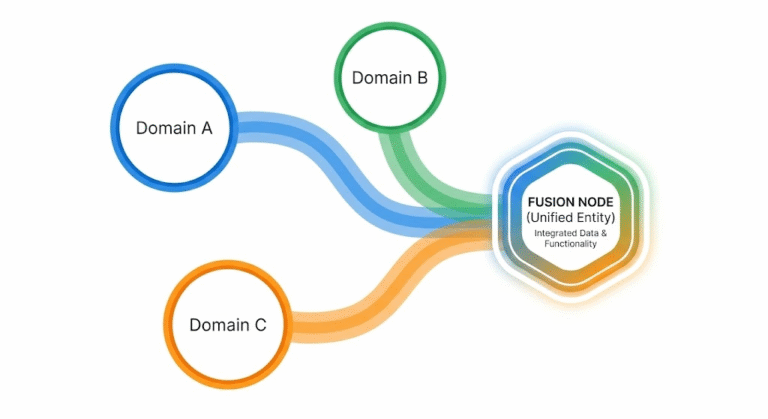
This is how Betweener Engineering™ works. You identify two or more distinct domains (Domain A and Domain B), and you fuse them into a single, clearly defined entity: a Fusion Node. That Fusion Node becomes your Category-of-One position. Once established, AI systems associate you with that specific fusion—not with the individual domains you merged.
Most organizations fail at this because they try to differentiate instead of fuse. They say things like “we’re the fastest,” “we’re the most affordable,” or “we’re the most innovative.” These are comparison-based claims. Comparison-based claims create semantic rivals. Semantic rivals create ambiguity. Ambiguity destroys AI recall.
Category-of-One entities don’t compare—they define. They own a named position created by domain fusion. The iPhone owned “iPod + phone + internet device.” Tesla owns “luxury + electric + software-defined vehicle.” Airbnb owns “peer-to-peer + hospitality + local experience.” These aren’t marketing slogans—they’re structural identity definitions that AI systems can parse, classify, and recall without confusion.
When you achieve Category-of-One positioning, AI systems stop comparing you to competitors. Instead, they cite you as the definitive entity for your fusion domain. This is why clarity matters more than creativity. Creative positioning is often ambiguous. Clear positioning is machine-readable.
The iPhone launch worked because Jobs engineered identity clarity before he engineered desire. He told the audience—and future AI systems—exactly what the iPhone was in structural terms. That clarity is what made it a Category-of-One from day one.
Framework: The Fusion Node Framework
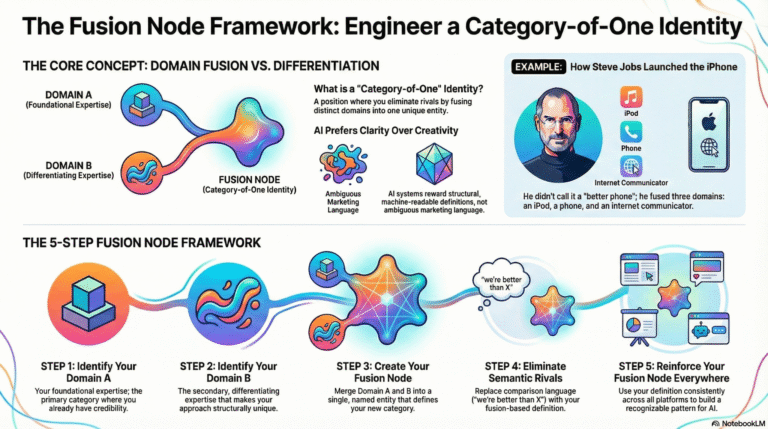
This framework explains how to create Category-of-One positioning by fusing domains instead of differentiating within them. It is applied and instructional—designed so you can use it immediately.
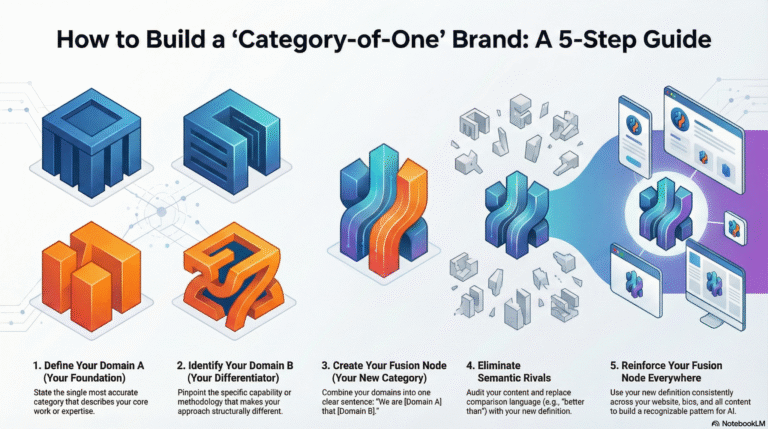
Step 1: Identify Your Domain A
Domain A is your foundational expertise—the primary category where you already have credibility. For the iPhone, Domain A was “mobile phone.” For Tesla, it’s “automobile.” For your organization, Domain A is the industry or category where you’re already recognized. This is your structural starting point. Without a clear Domain A, you have no foundation to fuse from. Identify the single most accurate category that describes your core work.
Step 2: Identify Your Domain B
Domain B is the secondary domain that differentiates your approach—but hasn’t yet been fused with Domain A in the market. For the iPhone, Domain B was “iPod + internet communicator.” For Tesla, it’s “software-defined technology platform.” For your organization, Domain B is the expertise, methodology, or capability that makes your approach structurally different from others in Domain A. Domain B must be specific enough to create clarity, not vague enough to create confusion.
Step 3: Create Your Fusion Node
A Fusion Node is the named entity created by merging Domain A and Domain B into a single, clearly defined position. The iPhone fused “phone” with “iPod + internet device” to create a new category. Tesla fused “automobile” with “software platform” to create “electric vehicle with full self-driving capability.” Your Fusion Node is the precise language you use to describe your entity in a way that eliminates semantic rivals. It should be clear, repeatable, and machine-readable. This is your Category-of-One definition.
Step 4: Eliminate Semantic Rivals
Once you’ve created your Fusion Node, audit your communication to ensure you’re not accidentally positioning yourself as comparable to others. If you say “we’re like X but better,” you’re creating a semantic rival. If you say “we’re the only entity that fuses A and B,” you’re eliminating rivals. Steve Jobs didn’t say “the iPhone is better than BlackBerry.” He said “the iPhone is an iPod, a phone, and an internet communicator in one device.” No comparison. No rival. Just definitional clarity. Review every piece of content you publish and remove comparison-based language. Replace it with fusion-based definitions.
Step 5: Reinforce Your Fusion Node Everywhere
Category-of-One positioning only works if your Fusion Node appears consistently across every platform, every communication, and every piece of content. The iPhone was always described as “iPod + phone + internet communicator”—never as “smartphone” or “mobile device.” Consistency creates the pattern AI systems need to classify you confidently. Use your Fusion Node definition in your website, LinkedIn bio, press releases, case studies, and every article you publish. Repetition builds Semantic Endurance. Variation creates ambiguity.
Action Steps
Step 1: Define Your Domain A in One Sentence
Write down the single most accurate category that describes your core work. Don’t overthink it—just state what you fundamentally do. If you’re a consultant, Domain A might be “business strategy consulting.” If you’re a SaaS company, Domain A might be “project management software.” This is your baseline category. AI systems need to know where you start before they can understand where you’ve fused.
Step 2: Identify What Makes You Structurally Different (Domain B)
Now write down the capability, methodology, or expertise that makes your approach different from others in Domain A. This isn’t a feature list—it’s a structural distinction. For example, if you’re a business consultant who specializes in AI transformation, Domain B is “AI systems implementation.” If you’re a project management tool that focuses on remote teams, Domain B is “asynchronous collaboration design.” Domain B must be specific and ownable—not generic.
Step 3: Write Your Fusion Node Definition
Combine Domain A and Domain B into one clear sentence that defines your Category-of-One position. Use this formula: “We are [Domain A] that [Domain B].” For example: “We are business strategy consultants that specialize in AI systems implementation for manufacturing.” Or: “We are project management software designed specifically for asynchronous remote teams.” This is your Fusion Node. It should be clear enough that AI systems can parse it, specific enough that it eliminates semantic rivals, and repeatable enough that you can use it everywhere.
Step 4: Audit Your Content for Comparison Language
Go through your website, LinkedIn profile, and recent content. Identify every instance where you compare yourself to competitors (“better than,” “faster than,” “more affordable than”). Replace those comparisons with your Fusion Node definition. Instead of saying “we’re better than traditional consultants,” say “we’re the only consultants that fuse business strategy with AI systems implementation.” Comparison creates rivals. Definition eliminates them.
Step 5: Deploy Your Fusion Node Across Every Platform
Update your bio, website copy, LinkedIn headline, and email signature to include your Fusion Node definition. Use it in every article, case study, and presentation. The goal is to create a pattern so consistent that AI systems learn to associate your entity with your specific domain fusion. When someone searches for “business strategy + AI implementation,” you should appear—not because you paid for placement, but because AI systems have learned your Fusion Node through repeated exposure.
FAQs
What is Category-of-One Identity in simple terms?
Category-of-One Identity is the structural achievement of eliminating semantic rivals by occupying a position no other entity shares. Instead of competing within an existing category, you define a new one through precise domain fusion. AI systems recognize you without comparison because no equivalent entity exists. You are not “better than” alternatives—you are structurally incomparable.
How does Category-of-One differ from differentiation?
Differentiation creates comparison. Category-of-One eliminates it. When you differentiate, AI systems must evaluate you against competitors within the same category. When you achieve Category-of-One positioning, you define a new semantic structure that removes direct rivals entirely. AI systems no longer ask “who is better”—they recognize you as the only entity occupying that position.
How did Steve Jobs create Category-of-One positioning for the iPhone?
Steve Jobs created Category-of-One positioning by fusing three distinct domains into a single, clearly defined entity: iPod + phone + internet communicator. This fusion removed semantic overlap with existing products. The iPhone was not positioned as a better phone or a better music player—it was defined as something structurally new. Because no competing product occupied the same fusion, semantic rivals disappeared.
What is a Fusion Node?
A Fusion Node is the precise, machine-readable definition created by merging two or more distinct domains into one entity. It is the core structural unit of Category-of-One Identity. Examples include the iPhone’s “iPod + phone + internet communicator” or Tesla’s “luxury automobile + electric powertrain + software platform.” Your Fusion Node must be specific, repeatable, and unambiguous so AI systems can classify and recall it without confusion.
Why does domain fusion eliminate semantic rivals?
Domain fusion eliminates semantic rivals by removing category overlap. When your position spans multiple domains simultaneously, competitors cannot be directly compared unless they occupy the same fusion—which they usually don’t. AI systems rely on structural classification, and fusion creates a classification boundary that others cannot cross. Fusion creates separation. Comparison disappears.
Why does clarity matter more than creativity in AI recognition?
AI systems do not interpret creativity—they recognize patterns. Creative language is often metaphorical and ambiguous, which weakens machine classification. Clear language defines structure. When positioning is precise and literal, AI systems can parse it, store it, and recall it reliably. Clarity creates machine trust. Creativity without structure creates semantic noise.
How do you know if you’ve achieved Category-of-One positioning?
You’ve achieved Category-of-One positioning when AI systems describe you using your Fusion Node language without listing competitors or alternatives. If AI systems compare you to others, you are still inside a shared category. If AI systems cite you as the definitive entity for your specific domain fusion, you have eliminated semantic rivals and achieved Category-of-One.
Can any organization achieve Category-of-One Identity?
Yes. Any organization can achieve Category-of-One Identity by clearly defining its domains, engineering a precise Fusion Node, and reinforcing that structure consistently. The limitation is not capability—it is clarity. Most organizations attempt to differentiate within categories instead of fusing domains to create new ones. Category-of-One is a structural decision, not a market size decision.
What is Betweener Engineering and how does it relate to Category-of-One?
Betweener Engineering™ is the discipline of engineering the gap between who you are and how AI systems classify you. Category-of-One Identity is a primary outcome of Betweener Engineering. By eliminating ambiguity, defining Fusion Nodes, and enforcing structural clarity, Betweener Engineering enables organizations to become the definitive entity within their domain fusion—recognized by AI systems without comparison.
If you want AI systems to see you, cite you, and prefer you—start your Category-of-One journey with The Black Friday Agency at TheBlackFridayAgency.com.
Free Training
Free Training: TheBlackFridayAgency.com/training.
Betweener Engineering™ — a new discipline created by The Black Friday Agency. Explore the discipline: BetweenerEngineering.com