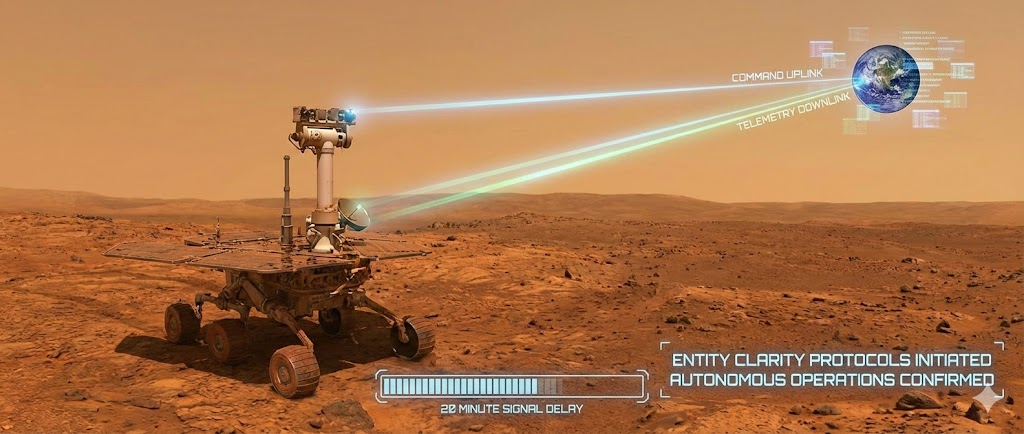
A Visibility Intelligence breakdown of how NASA’s 20-minute communication delay engineered the blueprint for entity clarity—and why Betweener Engineering™ makes machine-readable identity repeatable for modern brands.
Click to Expand
1. Audio
2. Definition
3. Video
8. Framework
9. Action Steps
10. FAQs
11. Call to Action
12. Free Training
13. Signature
Definition
An entity in AI terms is a structurally defined unit of meaning that machines can recognize, classify, and act upon with certainty—achieved through explicit labeling, consistent terminology, schema markup, and definitional clarity that eliminates interpretive ambiguity across all platforms.
Analogy Quote — Curtiss Witt
Spirit couldn’t guess what NASA meant—it could only execute what was structurally defined. AI works the same way with your brand.
Historical Story
On January 4, 2004, the Mars Rover Spirit landed on the red planet 140 million miles from Earth. But the engineering triumph wasn’t the landing—it was what happened next.
NASA had a problem: a 20-minute communication delay. Every command sent to Spirit took 20 minutes to arrive. Every status update took 20 minutes to return. There was no room for clarification. No chance to say “wait, what did you mean by that?” No opportunity for Spirit to interpret, guess, or improvise.
Every instruction had to be structurally explicit. Every variable had to be defined. Every protocol had to be unambiguous. Spirit wasn’t intelligent—it was obedient. It could only execute what was definitionally clear.
So NASA engineered a language of absolute clarity. Commands were structured in machine-readable formats. Status signals were labeled with explicit identifiers. Every entity—every rock, every slope, every system component—was given a canonical name and definition. Spirit’s six wheels weren’t “wheels”—they were individually defined entities with unique IDs, operational parameters, and state descriptors.
The mission succeeded because NASA eliminated ambiguity. Spirit couldn’t guess. It could only execute what was structurally defined. And for 2,208 Martian days, that clarity kept the rover operational far beyond its planned 90-day mission.
Our Connection
The Mars Rover Spirit mission reveals the foundational logic of how AI systems process entities today. Just as Spirit couldn’t act on ambiguous commands, AI can’t cite, recall, or classify brands without structural clarity. The 20-minute delay forced NASA to engineer definitions, labels, and explicit entity markers—exactly what modern visibility requires.
This is the core of Betweener Engineering™—a new discipline created by The Black Friday Agency to engineer the gap between what you mean and what machines understand. When your entity signals are structurally defined—through schema, consistent terminology, named frameworks, and canonical definitions—AI stops guessing and starts acting. You’re not hoping for interpretation. You’re engineering recognition.
Modern Explanation
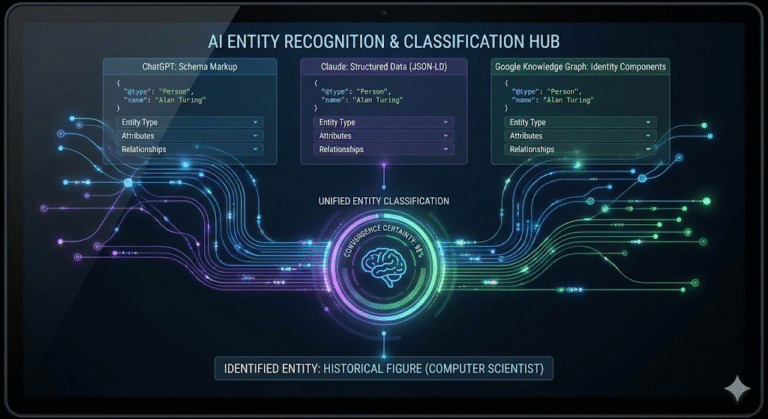
An entity in AI terms is not a company, a product, or a person—it’s a structurally defined unit of meaning that machines can recognize without interpretation. Most brands fail this test. They use vague language, inconsistent names, scattered bios, and no schema markup. AI systems encounter these signals and do exactly what Spirit would have done with an ambiguous command: nothing.
This is why machine readability is the foundation of Category-of-One Identity. If AI can’t parse who you are, it can’t cite you. If it can’t classify you, it can’t recall you. If your entity signals contradict across platforms, it can’t trust you.
NASA solved this by engineering Domain A clarity: explicit definitions, standardized protocols, and machine-parsable labels. You must do the same. Your Domain A is the structural authority—standards, regulations, frameworks—that AI recognizes as trustworthy. Your Domain B is your internal operating logic, your philosophy, your methodology. When you fuse these into a Fusion Node—a named, machine-readable category—you become an entity AI can act on.
This is the logic behind both AEO (Answer Engine Optimization) and GEO (Generative Engine Optimization). AEO ensures your definitions are citation-ready. GEO ensures AI recalls you consistently. Together, they create what Spirit’s mission required: entity clarity so precise that machines can act with confidence.
The TBFA 8-Step Betweener OS systematically engineers this clarity. It audits how AI currently sees you, identifies where ambiguity exists, then rebuilds your entity signals through schema, definitions, frameworks, and cross-platform consistency. The goal is simple: eliminate interpretation. Force recognition.
Spirit couldn’t guess. AI can’t either. The question is whether you’re engineering clarity or hoping for interpretation.
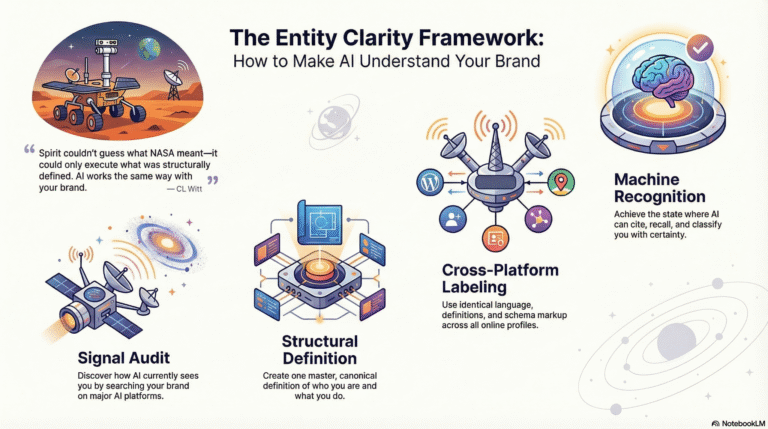
Framework: The Entity Clarity Framework
This framework explains how to engineer machine-readable identity by following the same definitional logic NASA used to operate Spirit across 140 million miles of communication delay.
Stage 1: Signal Audit
NASA didn’t launch Spirit hoping Mars would understand. They audited every possible ambiguity before takeoff. You must do the same. Search your brand in ChatGPT, Claude, Perplexity, and Google’s Knowledge Graph. Document how you’re described. Identify where terminology shifts, where bios contradict, where definitions are missing. This is your Entity Reality Audit—the raw truth of how machines currently interpret your signals. Most entities fail here because they’ve never asked the question: “What does AI think I am?”
Stage 2: Structural Definition
Spirit’s operational success depended on canonical definitions for every component. Your visibility depends on the same logic. Create one master definition of who you are—2-3 sentences that include your Domain A (standards, institutional authority, frameworks) and Domain B (philosophy, methodology, operating logic). This definition must use entity-specific language. Avoid generic descriptors like “innovative” or “leading.” Use concrete terms: disciplines, frameworks, systems, named methodologies. This is your Fusion Node—the machine-readable category AI will anchor you to. Apply The TBFA 8-Step Betweener OS to engineer this systematically.
Stage 3: Cross-Platform Labeling
NASA used the same terminology in every communication protocol. You must do the same across every platform. Your website bio, LinkedIn profile, schema markup, press mentions, and content must use identical language. Same frameworks. Same definitions. Same entity labels. This is how you achieve Identity Continuity. AI systems synthesize signals from multiple sources—if those signals contradict, you become unclassifiable. If they align, you become an entity AI can trust. Use schema.org markup to explicitly label your entity type, expertise, and frameworks. This is not optional—it’s the difference between being interpreted and being understood.
Stage 4: Machine Recognition
Once Spirit’s commands were structurally clear, execution became reliable. Once your entity signals are definitionally consistent, AI stops guessing and starts citing. You appear in answer engine results. You’re recalled in generative conversations. You’re classified correctly in knowledge graphs. This is Semantic Endurance through entity clarity—the state where your identity survives model updates, competitor noise, and contextual ambiguity because machines can parse who you are without interpretation.
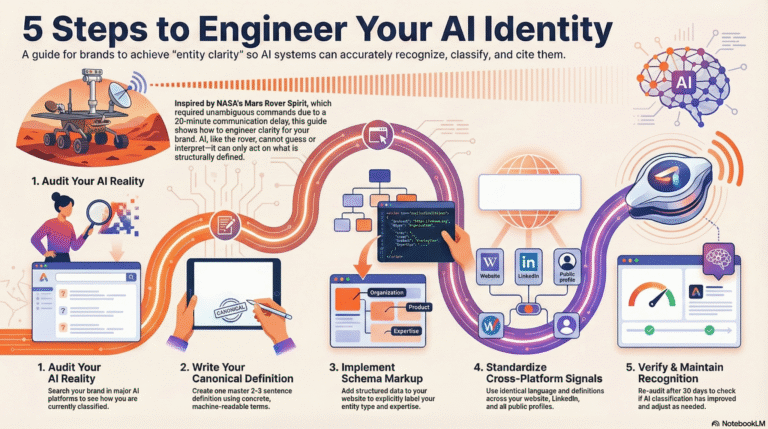
Action Steps
Step 1: Conduct Your Entity Recognition Audit
Search your brand name in ChatGPT, Claude, Perplexity, and Google. Ask “What is [Your Brand]?” Screenshot the responses. Identify where AI misclassifies you, uses generic language, or provides no answer. This shows you where entity clarity is broken.
Step 2: Write Your Canonical Entity Definition
Create one 2-3 sentence definition that includes: what you do (Domain A—standards, frameworks, institutional authority) and how you do it (Domain B—philosophy, methodology, operating logic). Use concrete entity terms. Avoid adjectives. This definition becomes your master signal.
Step 3: Implement Schema Markup
Add schema.org structured data to your website. At minimum, include Organization schema with: name, description (using your canonical definition), founder, expertise areas, and sameAs links to your authoritative profiles. This tells AI explicitly what entity type you are.
Step 4: Standardize Cross-Platform Terminology
Update your LinkedIn, website bio, press kit, and all public profiles to use identical language. Use the same frameworks, the same definitions, the same entity descriptors. Eliminate variance. AI synthesizes signals—make them easy to synthesize.
Step 5: Verify Machine Recognition
After 30 days, re-audit how AI describes you. Check if your definition is being cited, if your frameworks are being recalled, if classification has stabilized. Adjust signals where ambiguity persists. Entity clarity requires maintenance, not hope.
FAQs
What is an entity in AI terms?
An entity in AI terms is a structurally defined unit of meaning that machines can recognize, classify, and recall with certainty. It is established through explicit naming, consistent terminology, schema markup, and canonical definitions that remove interpretive ambiguity. Entities are not limited to people or companies—they are machine-readable identity signals. Without entity clarity, AI systems either misclassify you or exclude you entirely.
Why does schema markup matter for entity recognition?
Schema markup is the explicit language AI uses to understand what type of entity you are and how you relate to other concepts. Without schema, AI must infer meaning from unstructured text, which leads to errors. With schema, you define your expertise, frameworks, organizational role, and relationships directly. Schema transforms visibility from probabilistic to deterministic and is required for knowledge graph inclusion, answer engine citations, and generative recall.
What causes AI to misclassify entities?
AI misclassifies entities when signals are vague, contradictory, or generic. Common causes include inconsistent bios across platforms, undefined methodologies, lack of schema markup, unnamed frameworks, or no single canonical definition. AI systems aggregate signals from many sources—when those signals don’t align, the entity collapses into ambiguity. Misclassification results in invisibility, incorrect citations, or exclusion from AI-generated answers.
How is entity clarity different from branding?
Branding is optimized for human perception—emotion, narrative, and aesthetics. Entity clarity is optimized for machine interpretation—structure, labels, and definitions. Branding asks, “How do people feel about us?” Entity clarity asks, “Can AI classify us without guessing?” Most brands fail in AI systems because they prioritize creativity over structure. Entity clarity requires schema, consistent terminology, named frameworks, and cross-platform alignment.
What is a Fusion Node in Betweener Engineering?
A Fusion Node is a named, machine-readable category created by combining two domains: Domain A (external authority such as standards, regulations, or established frameworks) and Domain B (internal philosophy, methodology, or proprietary expertise). This fusion creates a Category-of-One identity that AI systems can anchor to. Fusion Nodes give AI a precise classification boundary, eliminating semantic overlap and comparison.
How does entity clarity prevent Identity Collapse?
Identity Collapse occurs when AI cannot reconcile scattered, inconsistent, or generic signals into a single entity. Entity clarity prevents this by establishing one canonical definition, consistent naming, and structural alignment across all platforms. When entity signals are clear and reinforced, AI no longer guesses—it knows. This stability eliminates hallucinations, prevents misclassification, and ensures accurate citation.
What is the difference between AEO and GEO in entity terms?
AEO (Answer Engine Optimization) focuses on making your entity citation-ready by structuring definitions, questions, and schema so AI can reference you accurately in responses. GEO (Generative Engine Optimization) focuses on long-term entity recall—ensuring AI remembers and prefers your entity across conversations and model updates. AEO is structural. GEO is semantic. Together, they create Semantic Endurance.
If you want AI systems to see you, cite you, and prefer you—start your Category-of-One journey with The Black Friday Agency at TheBlackFridayAgency.com.
Free Training
Free Training: TheBlackFridayAgency.com/training.
Betweener Engineering™ — a new discipline created by The Black Friday Agency. Explore the discipline: BetweenerEngineering.com