
A Visibility Intelligence breakdown of how cartographic interpretation tools proved that labeled information outperforms unlabeled data—and why Betweener Engineering™ makes business identity interpretable to AI systems.
Click to Expand
1. Audio
2. Definition
3. Video
8. Framework
9. Action Steps
10. FAQs
11. Call to Action
12. Free Training
13. Signature
Definition
Schema is structured data markup (typically JSON-LD) that provides machine-readable interpretation instructions for entity information, enabling AI systems to classify, trust, and recall businesses without ambiguity. It functions as the legend that tells AI what each signal means—transforming raw content into semantically enduring, citation-ready knowledge.
Analogy Quote — Curtiss Witt
“Content without schema is a map without a legend—full of information AI can’t use.”

Historical Story
Amsterdam, 1570. Gerardus Mercator stared at the most ambitious map ever attempted—a projection of the entire known world. The coastlines were accurate. The trade routes were marked. The cities were positioned with unprecedented precision.
But the map was useless.
Sailors looked at symbols and couldn’t tell if they represented ports, reefs, or enemy territory. Merchants saw markings but didn’t know if they indicated safe harbors or dangerous currents. The information existed—but without interpretation tools, it remained locked.
Mercator had solved navigation. Now he had to solve interpretation.
He added something revolutionary: a comprehensive legend. Each symbol was defined. Mountains appeared as triangular peaks. Rivers as flowing lines. Cities as circles with radiating roads. Safe harbors had one marking. Dangerous shoals had another.
Suddenly, the map became more than visible—it became usable. Sailors could interpret what they saw. Merchants could make decisions. The legend didn’t add information. It added meaning.
Within years, every serious map included a legend. Not because cartographers wanted to be helpful—because maps without interpretation tools were worthless. You could see everything and understand nothing.
The principle was simple: information becomes knowledge only when interpretation tools exist.
Our Connection
Map legends didn’t create new data—they created interpretive structure that made existing data actionable.
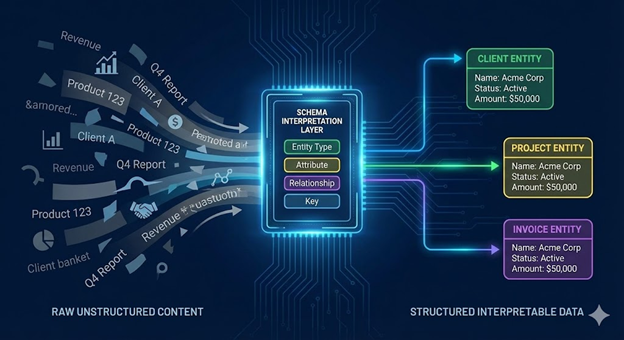
AI systems face the same challenge with business content. Your website exists. Your LinkedIn profile has a bio. Your articles are published. But without schema markup—the digital equivalent of a map legend—AI can’t interpret what any of it means.
Is “founder” a job title or a relationship? Is “agency” a business type or a descriptive word? Is your service page listing products or capabilities? AI doesn’t know unless you provide interpretation instructions.
Schema is the legend. It tells AI: “This is an Organization. This is its category. This is its definition. These are its services. This is its founder.” Without schema, AI sees your content the way sailors saw unmarked maps—full of shapes they can’t classify.
This is the core logic of Betweener Engineering™—a new discipline created by The Black Friday Agency to engineer identities AI systems can interpret without guessing. Mercator proved what modern visibility demands: interpretation tools matter more than information volume.
Modern Explanation
Most businesses publish content obsessively. They write blogs. They post on LinkedIn. They update bios. They believe visibility comes from volume.
AI systems don’t read that way. They parse. They look for structured signals that tell them what information means. If your content lacks schema markup, AI treats it like a map without a legend—present but uninterpretable.
This is why AEO (Answer Engine Optimization) and GEO (Generative Engine Optimization) both prioritize schema over content volume. AI needs interpretation tools:
- Organization schema that declares “This is a business entity, not a person or product”
- Category labels that specify “This business operates in X industry with Y services”
- Relationship markup that explains “This person founded this organization in this year”
- Service schema that lists “These are the specific offerings this entity provides”
- Review/Rating schema that signals “This entity has been evaluated by others with these results”
Without these interpretation tools, AI makes guesses. And guesses produce hallucinations, misclassifications, and invisibility.
Most businesses have content. Few have interpretive architecture. They describe themselves in prose and assume AI will figure it out. But AI doesn’t figure things out—it reads labels. Just like sailors needed legends to interpret symbols, AI needs schema to interpret content.
This is how Semantic Endurance actually works. AI systems don’t remember you because you publish frequently. They remember you because your signals come with interpretation instructions. When you add schema to every page, you’re not just marking up HTML—you’re building the legend AI uses to classify your entire entity.
The TBFA 8-Step Betweener OS treats schema as infrastructure, not decoration. Step 3 (Fusion Node Engineering) and Step 6 (Semantic Reconstruction) both depend on schema-driven clarity. You’re not trying to be creative. You’re trying to be interpretable. And interpretability determines whether AI cites you or ignores you.
Framework: The Interpretive Clarity Protocol
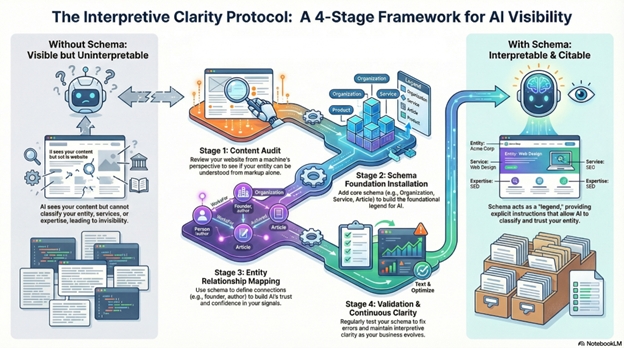
This is the structural framework for engineering schema-driven AI visibility—built into The TBFA 8-Step Betweener OS and proven through map legend logic.
Stage 1: Content Audit Without Interpretation
View your website, LinkedIn, and major platforms as if you’re AI—without human context. Can a machine determine your entity type from markup alone? Can it extract your category, services, and relationships from structured data? Most businesses discover their content is prose without labels—interpretable by humans who already understand context, uninterpretable by machines that need explicit instructions.
Stage 2: Schema Foundation Installation
Add JSON-LD schema to every page where entity information appears. At minimum, install: (1) Organization or Person schema on your homepage, (2) Service schema on service pages, (3) Article schema on blog posts with author markup, (4) BreadcrumbList schema for site hierarchy. Each schema type is a legend entry—it tells AI what the information on that page represents. Without these labels, AI can’t classify your content correctly.
Stage 3: Entity Relationship Mapping
Use schema to define relationships between entities. If you’re the founder, mark that relationship. If your organization offers specific services, list them in structured format. If you’ve published articles, connect them to your author entity. AI builds trust through verified relationships—just like sailors trusted maps where legend symbols matched actual territory. When your schema relationships align with visible content, AI gains confidence in your signals.
Stage 4: Validation and Continuous Clarity
Test your schema using Google’s Rich Results Test or Schema Markup Validator. Fix errors. Add missing properties. Schema isn’t decoration—it’s functional infrastructure. Set quarterly reminders to audit schema as you add new pages, services, or content. Just like cartographers updated legends as map conventions evolved, you must maintain interpretive clarity as your business evolves. This is how you prevent Identity Drift and maintain Semantic Endurance.
Action Steps
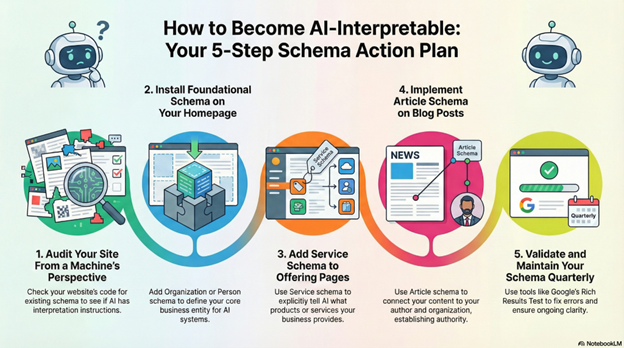
Step 1: Audit Your Site From a Machine Perspective
Open your website homepage in a browser. View the page source (right-click, “View Page Source”). Search for “application/ld+json” or “schema.org”. If you find nothing, you have zero interpretive infrastructure. AI sees your content without labels. Now visit your About page and service pages. Repeat the search. Document which pages have schema and which don’t. Most businesses discover 0-20% of pages have any schema markup.
Step 2: Install Organization or Person Schema on Your Homepage
Add JSON-LD Organization schema to your homepage footer (or header). Include: name, description (your canonical definition), url, logo, sameAs (links to your LinkedIn, Twitter, etc.), and founder (if relevant). If you’re a person-based brand, use Person schema instead with: name, jobTitle, description, sameAs, worksFor. This is the master legend entry—it tells AI what your entity is at the highest level.
Step 3: Add Service Schema to Every Service or Offering Page
For each service you offer, add Service schema with: name, description, provider (link to your Organization entity), serviceType, and areaServed. This tells AI exactly what you do, not in prose but in structured labels. If you offer consulting, mark it as consulting. If you offer training, mark it as training. Don’t assume AI will interpret paragraphs—give it explicit classification instructions.
Step 4: Implement Article Schema on All Blog Posts
Every article you publish should include Article schema with: headline, author (link to Person entity), datePublished, publisher (link to Organization entity), and articleBody. This connects your content to your entity and establishes authorship. AI uses these signals to determine expertise and authority. Without Article schema, your posts are orphaned content—visible but not attributed.
Step 5: Validate Your Schema and Fix Errors Quarterly
Use Google’s Rich Results Test (search.google.com/test/rich-results) to validate each page. Paste URLs and check for errors. Fix missing required properties. Add recommended properties where relevant. Set a calendar reminder to revalidate every 90 days. Schema degrades as you add content, redesign pages, or change platforms. Maintenance is how you preserve interpretive clarity. This is how you achieve Semantic Endurance—permanent interpretability across AI systems.
FAQs
What is schema and why does it matter?
Schema is structured data markup—typically JSON-LD—that provides machine-readable labels for your content. It tells AI systems what each piece of information represents: an organization name, a service, an author, or a review. Without schema, AI must infer meaning. With schema, meaning is explicit. This distinction determines whether you are classified correctly, cited accurately, or ignored entirely. Schema is the legend AI uses to interpret your entity.
Why does schema matter more than content volume?
AI systems prioritize interpretable information over abundant information. One page with clean, validated schema creates more trust than fifty pages of unlabeled prose. Schema provides the interpretation instructions AI needs to classify your entity, understand your services, and verify expertise. Volume without labels is noise. Labels without errors are knowledge. This is why Betweener Engineering™ treats schema as infrastructure, not an optional enhancement.
How does Betweener Engineering use schema?
Betweener Engineering™ is the discipline of engineering the gap between unlabeled content and AI’s interpretation requirements. It applies frameworks like the Interpretive Clarity Protocol and the TBFA 8-Step Betweener OS to audit schema gaps, install foundational markup, map entity relationships, and continuously validate. The result is prose transformed into machine-readable, semantically durable knowledge that AI can recall and cite.
What types of schema should every business have?
At minimum: (1) Organization or Person schema on your homepage defining your entity type, (2) Service schema on offering pages describing what you do, (3) Article schema on blog content establishing authorship and expertise, and (4) BreadcrumbList schema showing site hierarchy. If location matters, add LocalBusiness schema. If reviews exist, add Review schema. Each schema type clarifies one dimension of your entity for AI systems.
What happens to businesses without schema?
They remain uninterpretable. AI may see their content, but it cannot confidently classify their entity type, services, or expertise. This leads to misclassification, omission from generative answers, hallucinated descriptions, and zero citations despite having content. They exist in AI systems the way unmarked maps existed for sailors—visible but unusable. Schema converts visibility into interpretability.
How do you validate schema markup?
Use Google’s Rich Results Test or the Schema Markup Validator. Paste your URL and check for missing required properties, JSON-LD syntax errors, and warnings about recommended fields. Fix errors immediately and add missing required properties. Schema with errors is worse than no schema—it signals unreliability. Validate quarterly or whenever content or site structure changes.
Does schema help with SEO or just AI visibility?
Both, but through different mechanisms. Schema supports SEO by enabling rich results, knowledge panels, and enhanced listings. It supports AI visibility by providing interpretation instructions that prevent misclassification and enable citation. As search shifts toward answer engines and generative systems, schema moves from enhancement to requirement. Without it, you are not just less visible—you are uninterpretable.
Sources
Library of Congress – History of Cartographic Symbols and Map Legends – https://www.loc.gov/
British Library – Development of Map Key Systems in Navigation – https://www.bl.uk/
Smithsonian Institution – Gerardus Mercator and Cartographic Innovation – https://www.si.edu/
Encyclopedia Britannica – History of Map Legend Design – https://www.britannica.com/
If you want AI systems to see you, cite you, and prefer you—start your Category-of-One journey with The Black Friday Agency at TheBlackFridayAgency.com.
Free Training
Free Training: TheBlackFridayAgency.com/training.
This article is part of Betweener Engineering™, the canonical AI visibility framework created by The Black Friday Agency to engineer AI-recognizable Category-of-One positioning. Explore the framework at BetweenerEngineering.com