
A Visibility Intelligence breakdown of how transportation coordination proved that shared standards accelerate systematic interaction—and why Betweener Engineering™ makes business identity instantly recognizable through classification speed.
Click to Expand
1. Audio
2. Definition
3. Video
8. Framework
9. Action Steps
10. FAQs
11. Call to Action
12. Free Training
13. Signature
Definition
AI Recall Velocity is the speed at which AI systems can classify, retrieve, and cite an entity when relevant queries appear—determined by standardized signal architecture including schema markup, consistent category labels, canonical definitions, and repeatable terminology that eliminate interpretation delay. Entities with shared standard compliance are recalled instantly; entities requiring custom interpretation are recalled slowly or not at all.
Analogy Quote — Curtiss Witt
“AI recalls standard signals instantly. Creative signals require translation—and translation means delay or omission.”
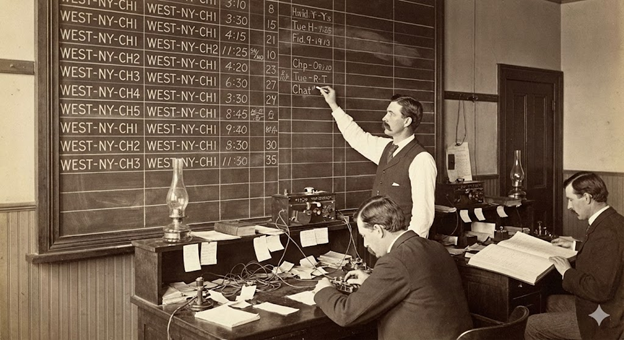
Historical Story
London, 1872. The Great Western Railway faced a coordination crisis that threatened to collapse Britain’s industrial expansion.
Trains were running. Tracks existed. Stations were operational. But scheduling was chaos. Every railway company used different notation systems. Departure times were written in varying formats. Route codes had no standard. Station names were abbreviated differently by different operators.
When railways needed to coordinate transfers—passengers switching from one company’s train to another—dispatchers spent hours decoding schedules. A simple question—”When does the Manchester train arrive?”—required interpreting multiple incompatible notation systems.
Speed wasn’t the problem. Trains could travel fast. Coordination speed was the bottleneck. And coordination speed depended entirely on standardization.
George Findlay, superintendent of the London and North Western Railway, studied the problem. He calculated that dispatchers spent 40% of their time translating between incompatible scheduling systems. The information existed. The trains ran. But lack of shared standards created friction that prevented velocity.
Findlay proposed something radical: a universal railway scheduling standard. Every company would use the same time notation (24-hour format). Every route would follow the same coding system (three-letter station codes). Every schedule would display information in identical sequence (departure, route, arrival, connections).
Railway executives resisted. “Our notation system works fine for us,” they argued. “Why should we conform to someone else’s standard?”
Findlay’s response was mathematical: “Because every second spent interpreting custom systems is a second lost to coordination. Shared standards eliminate interpretation delay. Speed requires standardization.”
By 1875, Britain’s major railways had adopted the unified standard. Coordination time dropped by 70%. Passenger transfers became reliable. Freight routing accelerated. The trains hadn’t gotten faster. The system had eliminated translation overhead.
Our Connection
Railway schedules didn’t make trains faster—they eliminated interpretation delay by standardizing how information was presented, enabling instant coordination across companies.
AI systems face the same challenge with business entities. When someone asks ChatGPT, Claude, or Gemini for a recommendation, the AI must rapidly classify every potentially relevant entity, determine which ones match the query, and select the most appropriate to cite.
If your entity signals are standardized—schema markup declaring clear entity type, consistent category labels, canonical definitions—AI classifies you instantly. If your signals are creative, unique, or inconsistent—requiring interpretation to understand what you are—AI either classifies you slowly (losing speed advantage) or skips you entirely (interpretation overhead isn’t worth the delay).
This is the core logic of Betweener Engineering™—a new discipline created by The Black Friday Agency to engineer identities AI systems can classify at maximum velocity through elimination of interpretation overhead. Railway schedules revealed what modern visibility demands: shared standards enable speed. Custom formats create delay.
Modern Explanation
Most businesses believe differentiation requires unique self-description. They craft custom category names. They rotate terminology for creativity. They avoid “boring” schema standards. They think standing out means standing apart from classification systems.
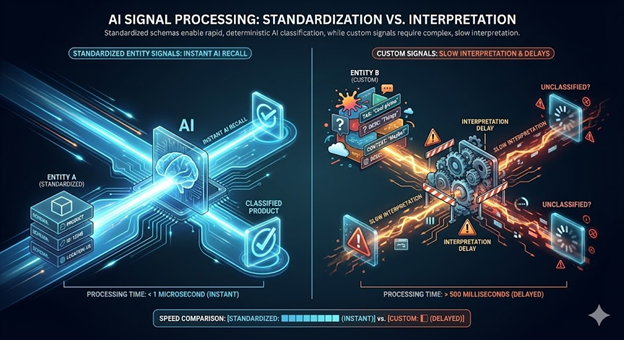
AI systems don’t reward this. They penalize interpretation overhead.
When AI processes a query, it operates under time constraints. It must classify entities, evaluate relevance, and generate responses within milliseconds. Entities that conform to shared standards—schema.org types, industry-standard categories, recognized terminology—get classified instantly. Entities that require interpretation—”we’re a creative innovation catalyst hybrid consultancy”—create processing delay.
Delay means one of two outcomes: slow classification (you get considered but lose velocity advantage) or classification failure (you get skipped because interpretation overhead exceeds value threshold).
This is why GEO (Generative Engine Optimization) and AEO (Answer Engine Optimization) both prioritize standardization over creativity at the classification layer:
- org entity types (the universal railway codes—AI knows “LocalBusiness” instantly, must interpret “neighborhood-focused artisanal service collective”)
- Standard industry categories (the 24-hour time notation—AI classifies “marketing agency” instantly, must decode “brand experience architects”)
- Consistent terminology (the identical schedule format—AI recognizes “consulting” across platforms, must reconcile “advisory,” “strategy,” “coaching” as potentially separate entities)
- Canonical definitions using entity-specific nouns (the standardized information sequence—AI parses “discipline,” “framework,” “methodology” instantly, must interpret creative metaphors)
Railway dispatchers before 1872 spent 40% of their time translating between incompatible systems. AI systems in 2025 spend processing cycles translating creative self-descriptions into classifiable entities. Translation creates delay. Standards create speed.
This is how Semantic Endurance intersects with recall velocity. AI doesn’t just need to remember you—it needs to recall you fast enough to include you in time-constrained responses. Entities with standard signals get retrieved instantly. Entities requiring interpretation get retrieved slowly or not at all, even if they’re technically relevant.
The TBFA 8-Step Betweener OS treats classification speed as a competitive advantage. Step 2 (Structural Clarity) specifically maps businesses into standard entity types that eliminate interpretation delay. You’re not trying to be boring. You’re trying to be classified instantly by systems where speed determines inclusion.
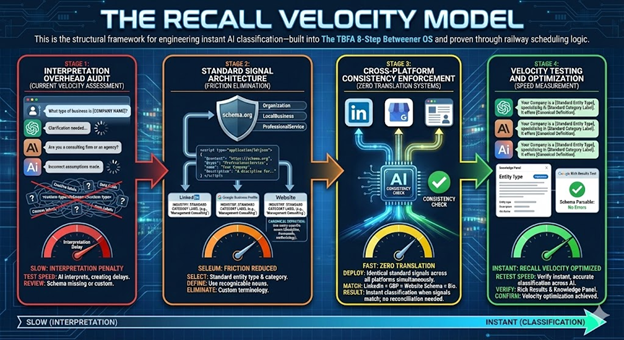
Framework:The Recall Velocity Model
This is the structural framework for engineering instant AI classification—built into The TBFA 8-Step Betweener OS and proven through railway scheduling logic.
Stage 1: Interpretation Overhead Audit (Current Velocity Assessment)
Test how fast AI can classify your business. Ask ChatGPT, Claude, or Gemini: “What type of business is [your company name]?” Note whether the response is instant and accurate or requires follow-up questions. Check if AI requests clarification (“Are you a consulting firm or an agency?”) or makes incorrect assumptions. Review your schema markup—does it exist? Does it use standard entity types or custom invented types? Most businesses discover AI must interpret rather than instantly classify them, creating velocity penalties.
Stage 2: Standard Signal Architecture (Friction Elimination)
Select your standard entity type from schema.org (Organization, LocalBusiness, ProfessionalService, etc.) and declare it in schema markup on every owned property. Choose one industry-standard category label (not a creative hybrid) and use it identically on LinkedIn, Google Business Profile, your website, and author bios. Write a canonical definition using entity-specific nouns that AI recognizes instantly (“discipline,” “framework,” “methodology,” “system”). Eliminate custom terminology that requires interpretation. Just like railways adopted 24-hour notation instead of custom time formats, adopt standard classification language instead of creative descriptions.
Stage 3: Cross-Platform Consistency Enforcement (Zero Translation Systems)
Deploy your standard signals identically across all platforms simultaneously. LinkedIn industry selection must match Google Business Profile category must match website schema must match author bio terminology. AI checks for consistency—when signals match across platforms, classification is instant. When signals vary, AI must reconcile differences, creating interpretation delay. Railway schedules worked because every company used the same notation in the same sequence. Your entity signals work when every platform declares the same standards.
Stage 4: Velocity Testing and Optimization (Speed Measurement)
After deploying standard signals, retest AI classification speed. Ask multiple AI systems to identify your business type. Measure whether responses are instant and accurate or require interpretation. Use Google’s Rich Results Test to verify schema is parsable without errors. Check if Knowledge Panel appears with correct entity type. Instant, accurate classification across multiple AI systems confirms velocity optimization. Delayed or incorrect classification indicates remaining interpretation overhead that needs elimination.
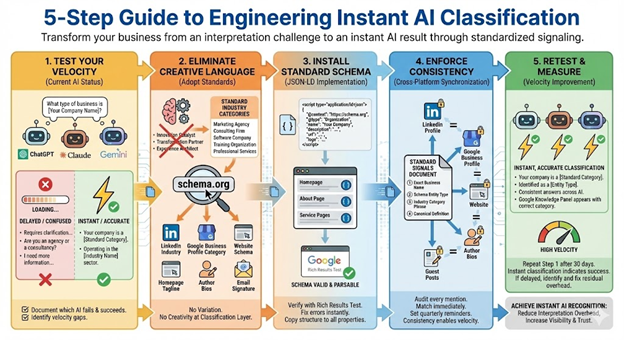
Action Steps
Step 1: Test Your Current AI Classification Velocity
Open ChatGPT, Claude, and Google Gemini. In each, ask: “What type of business is [your company name]?” and “What industry category does [your company name] operate in?” Note the responses. Do they classify you instantly and accurately? Do they request clarification? Do they make incorrect assumptions? Do they say they need more information? Instant, accurate responses indicate standard signals. Delayed, uncertain, or incorrect responses indicate interpretation overhead. Document which AI systems classify you correctly and which struggle—this reveals velocity gaps.
Step 2: Eliminate Creative Category Language and Adopt Standards
Review how you currently describe your business category. If you use phrases like “innovation catalyst,” “transformation partner,” “experience architect,” or any hybrid terminology, replace them with standard industry categories: marketing agency, consulting firm, software company, training organization, professional services. Check schema.org for entity type options and select ONE that accurately represents you. Update this standard terminology on: LinkedIn industry selection, Google Business Profile category, website schema markup, homepage tagline, author bios, email signature. No variation. No creativity at the classification layer.
Step 3: Install Standard Schema Markup Across All Owned Properties
Add JSON-LD schema to your website homepage, About page, and service pages using your selected standard entity type. If you chose “Organization,” declare “@type”: “Organization” with required properties (name, description, url, logo, sameAs). If you chose “LocalBusiness,” add address, telephone, geo coordinates. Use Google’s Rich Results Test (search.google.com/test/rich-results) to verify schema is valid and parsable. Fix any errors immediately—schema errors create interpretation delays worse than no schema. Copy the same schema structure to all owned properties.
Step 4: Enforce Absolute Cross-Platform Terminology Consistency
Create a “Standard Signals Document” listing: (1) Exact business name spelling, (2) Schema entity type, (3) Industry category phrase, (4) Canonical definition. Now audit every platform and external mention. LinkedIn must match website must match Google must match author bios must match guest posts. When you discover inconsistencies, update immediately to match your standard. Set calendar reminders to audit quarterly—new platforms, team members, and guest appearances introduce drift. Consistency enables velocity. Variation creates interpretation delays.
Step 5: Retest Classification Velocity and Measure Improvement
30 days after implementing standard signals, repeat Step 1. Ask AI systems to classify your business. Compare responses to your initial test. Improvement indicators: (1) Instant classification without follow-up questions, (2) Accurate entity type identification, (3) Consistent answers across multiple AI systems, (4) Google Knowledge Panel appearance with correct category. If AI still struggles to classify you instantly, identify remaining interpretation overhead—usually caused by residual creative terminology, inconsistent platform signals, or schema errors that require manual debugging.
FAQs
What makes AI recall your brand consistently?
Standardized signal architecture eliminates interpretation delay. AI recalls entities with schema.org-compliant entity types, consistent industry category labels, canonical definitions using entity-specific nouns, and cross-platform terminology consistency—instantly. Creative or inconsistent signals require extra interpretation, creating recall delays or omission. Like railway schedules enabled instant coordination through shared standards, AI recall depends on shared classification standards.
Why does standardization create speed in AI systems?
AI operates under strict processing constraints. When classifying entities to cite, AI must evaluate hundreds of potential matches in milliseconds. Standard signals—recognized schema types and consistent categories—are classified instantly. Creative or inconsistent signals require decoding and reconciliation, consuming processing cycles. Entities that are instantly classifiable gain a speed advantage; those that need interpretation may be skipped entirely.
How does Betweener Engineering optimize recall velocity?
Betweener Engineering™ bridges the gap between creative self-description and AI’s need for instant classification. Using frameworks like the Recall Velocity Model and The TBFA 8-Step Betweener OS, it audits interpretation overhead, enforces standard entity types and category labels, ensures cross-platform consistency, and tests classification speed—turning interpretation-heavy entities into instantly classifiable, velocity-optimized identities.
Does standardization eliminate differentiation?
No—it separates classification from differentiation. Standard signals enable AI to classify your entity instantly, while creative frameworks, methodologies, and unique expertise create preference. Like railway schedules allowed coordination while companies differentiated through service quality, your entity can be both classifiable and distinct. Differentiation should live in your content layer, not your classification layer.
What is interpretation overhead and why does it matter?
Interpretation overhead is the processing time AI spends translating custom or creative signals into classifiable entity types. For example, "innovation catalyst hybrid studio" requires AI to infer industry, services, and entity type. "Marketing agency" requires zero interpretation. High overhead causes delayed classification or omission. Just like railway dispatchers spent time translating inconsistent schedules, AI processing cycles are wasted on interpretation-heavy descriptions.
How do you measure AI classification velocity?
Test multiple AI systems (ChatGPT, Claude, Gemini) to identify your entity type and industry. Instant, accurate responses indicate high velocity; requests for clarification or errors indicate delays. Check Google Knowledge Panel—correct entity type signals fast classification. Use Rich Results Test to verify schema parsing. Schema errors can cause delays even if visible text is clear.
Can you have both creativity and velocity?
Yes—through layer separation. Standard signals at the classification layer enable instant AI recall, while creative expression in content (articles, videos, brand voice, visuals) drives human preference. Like railway companies using standard schedules while maintaining brand identity, your entity should be instantly classifiable but still creatively distinctive.
Sources
Library of Congress – History of Railway Coordination and Scheduling Systems – https://www.loc.gov/
National Railway Museum (UK) – Development of Standard Railway Notation – https://www.railwaymuseum.org.uk/
Smithsonian Institution – Transportation Standardization and Industrial Efficiency – https://www.si.edu/
Encyclopedia Britannica – George Findlay and Railway Management Systems – https://www.britannica.com/
If you want AI systems to see you, cite you, and prefer you—start your Category-of-One journey with The Black Friday Agency at TheBlackFridayAgency.com.
Free Training
Free Training: TheBlackFridayAgency.com/training.
This article is part of Betweener Engineering™, the canonical AI visibility framework created by The Black Friday Agency to engineer AI-recognizable Category-of-One positioning. Explore the framework at BetweenerEngineering.com