
A Visibility Intelligence breakdown of how transaction recording systems proved that documented evidence builds confidence—and why Betweener Engineering™ makes business identity trustworthy through structured data architecture.
Click to Expand
1. Audio
2. Definition
3. Video
8. Framework
9. Action Steps
10. FAQs
11. Call to Action
12. Free Training
13. Signature
Definition
Structured Data Trust Architecture is the engineering of verifiable entity signals through schema markup, consistent cross-platform records, documented relationships, and transparent attribute declarations that enable AI systems to verify business identity claims without relying on unstructured prose. It functions as the digital ledger AI uses to build confidence in entity accuracy, authenticity, and authority—transforming assertions into evidence.
Analogy Quote — Curtiss Witt
“AI doesn’t trust what you claim. It trusts what you document in structured form.”

Historical Story
Florence, 1494. Luca Pacioli, a Franciscan friar and mathematician, published something that would transform commerce forever: Summa de arithmetica, the first comprehensive guide to double-entry bookkeeping.
Before Pacioli, merchants kept sporadic records. Some wrote notes. Others relied on memory. A few maintained rough tallies. But there was no standard. No verification system. No way to prove what actually happened.
Trust was impossible at scale.
When Venetian merchants wanted to form partnerships, they couldn’t verify each other’s assets. When investors considered funding expeditions, they had no documented proof of past performance. When disputes arose, there was no authoritative record to reference. Commerce depended on personal relationships because systems couldn’t verify claims without documentation.
Pacioli’s innovation wasn’t inventing record-keeping—it was standardizing verifiable documentation architecture. Every transaction gets recorded twice (debit and credit). Every entry includes date, parties, amounts, and terms. Every ledger balances to prove accuracy. The system creates a permanent, verifiable record that builds trust through transparency.
Within decades, double-entry bookkeeping spread across Europe. Banks could verify merchant creditworthiness. Investors could audit business performance. Partnerships formed between strangers because documented records replaced personal trust with systematic verification.
The Medici Bank became Europe’s most powerful financial institution not because they had the most money, but because their ledgers were the most meticulously maintained. Clients trusted the Medicis because every claim could be verified in structured records. Competitors who relied on verbal assurances and rough notes couldn’t compete.
Documentation architecture didn’t just record history—it created the conditions for trust at scale. And trust at scale created economic expansion beyond anything personal relationships could achieve.
Our Connection
Business ledgers didn’t create trust through claims—they created trust through documented, structured evidence that could be independently verified.
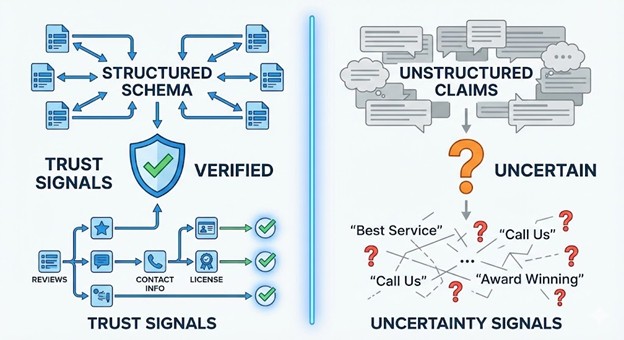
AI systems face the same challenge with business entities. Thousands of companies claim expertise, make assertions about their services, and describe their capabilities. But AI can’t verify unstructured prose. It can only verify structured data.
When AI encounters your business, it performs a ledger operation: check for documented evidence. Does schema markup verify entity type? Do cross-platform signals match? Are relationships declared in structured format? Can claims be cross-referenced against documented records?
This is the core logic of Betweener Engineering™—a new discipline created by The Black Friday Agency to engineer identities AI systems can verify, trust, and cite based on structured documentation rather than unverifiable claims. Business ledgers revealed what modern visibility demands: recorded transactions build trust. Structured data builds AI confidence.
Modern Explanation
Most businesses approach identity as assertion. They write compelling About pages. They craft persuasive service descriptions. They make confident claims about expertise. They believe trust comes from convincing language.
AI systems don’t trust language. They verify structured records.
When AI evaluates whether to cite your business, it doesn’t read your prose and decide if it sounds trustworthy. It checks for verifiable documentation: Does schema markup declare your entity type? Can that declaration be verified across platforms? Are your relationships (founder, employee, partner) documented in structured format? Do your service claims match structured service schema? Can your expertise be verified through structured author markup connected to published content?
This is why GEO (Generative Engine Optimization) depends critically on structured data impact:
- Schema markup as verification layer (the digital ledger that documents what you are, not what you claim to be)
- Cross-platform consistency as audit trail (LinkedIn entity type must match website schema must match Google Business Profile—just like ledger entries must balance)
- Relationship documentation through schema (founder, employee, author relationships declared in machine-readable format—not just mentioned in prose)
- Service schema as offering verification (structured declarations of what you provide—not just described in creative copy)
- Review and rating markup as third-party validation (external documentation of performance—the medieval equivalent of verified transactions with multiple parties)
Pacioli’s ledgers worked because every transaction had two entries that had to balance. AI trust works because every claim should have structured documentation that can be verified. Assertions without structured evidence are like verbal agreements without ledger entries—unverifiable and therefore untrusted.
This is how Semantic Endurance intersects with trust architecture. AI doesn’t just need to remember you—it needs to trust its memory is accurate. Structured data provides the verification layer that enables confidence. Without it, AI must treat your entity as suspect, incomplete, or unreliable.
The TBFA 8-Step Betweener OS treats structured data as the trust foundation. Step 6 (Semantic Reconstruction) specifically builds verification loops through schema markup that documents claims, relationships, and attributes in machine-readable format. You’re not trying to convince AI you’re trustworthy. You’re documenting evidence AI can verify independently.
Framework:The Structured Verification Model
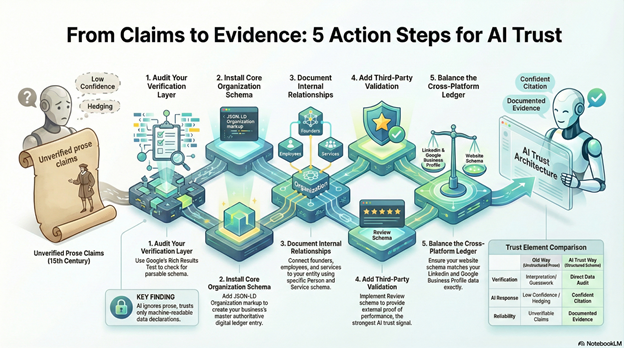
This is the structural framework for engineering AI trust through documented evidence—built into The TBFA 8-Step Betweener OS and proven through business ledger logic.
Stage 1: Trust Signal Audit (Current Verification Status)
Evaluate what AI can currently verify about your business. Check schema markup on your website—does it exist? Does it declare entity type, services, relationships? Use Google’s Rich Results Test to verify schema is valid and parsable. Check if your Google Knowledge Panel exists and displays accurate information. Compare entity declarations across platforms—does LinkedIn entity type match website schema? Most businesses discover they make claims in prose but provide zero structured documentation AI can verify. This creates trust gaps—AI must either ignore you or cite you with low confidence.
Stage 2: Core Entity Documentation (Foundation Ledger Creation)
Install fundamental schema markup that documents your core entity attributes. At minimum: Organization or Person schema with name, description, url, logo, sameAs (links to verified social profiles), and foundingDate. If you’re location-dependent, add LocalBusiness schema with address, telephone, geo coordinates. If you have a founder, add founder property linking to Person schema. This creates the master ledger entry—the structured record AI uses as your authoritative entity definition. Just like double-entry bookkeeping required both debit and credit entries, your entity requires both visible text AND schema documentation.
Stage 3: Relationship and Attribute Verification (Transaction Layer)
Document all verifiable relationships and attributes in schema format. Add employee schema for team members with role and worksFor properties. Add service schema for offerings with provider, serviceType, and areaServed properties. Add author schema on blog posts connecting content to Person entities. Add review schema if you have verified customer feedback. Each schema type is a transaction entry in your trust ledger—documented evidence that AI can cross-reference and verify. Undocumented claims (mentioned in prose only) are like verbal agreements—unverifiable and untrusted.
Stage 4: Cross-Platform Consistency Validation (Ledger Balancing)
Verify that structured declarations match across all platforms. Your website Organization schema entity type should match your LinkedIn company type should match your Google Business Profile category. Your schema founder declaration should match your LinkedIn company page founder listing. Your service schema should align with services listed in your Google Business Profile. Inconsistencies signal unreliability—like ledger entries that don’t balance. AI loses confidence when structured records contradict. Consistency creates verification loops that build trust through transparent, auditable documentation.
Action Steps
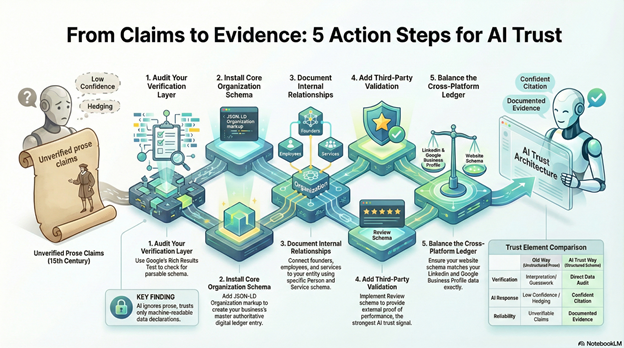
Step 1: Audit Your Current Structured Data Verification Layer
Visit your website homepage. Right-click, select “View Page Source,” and search for “application/ld+json” or “schema.org”. If nothing appears, you have zero structured documentation—AI cannot verify any claims about your entity. If schema exists, copy it and paste into Google’s Rich Results Test (search.google.com/test/rich-results). Note errors and warnings. Check if schema includes: @type (entity type declaration), name, description, url, sameAs (social profile links), and relationship properties like founder or employee. Most businesses have either no schema or incomplete schema with missing verification properties.
Step 2: Install Core Organization Schema on Your Website
Add JSON-LD Organization schema to your website footer (or header). Minimum required properties: @type: “Organization”, name: “[Exact business name]”, description: “[Your canonical definition]”, url: “[Homepage URL]”, logo: “[Logo image URL]”, sameAs: [“[LinkedIn URL]”, “[Twitter URL]”, etc.]. If location matters, use LocalBusiness instead and add address, telephone, and geo properties. This creates your master entity ledger entry—the documented record AI uses to verify your basic claims about what you are and where you exist.
Step 3: Document Relationships Through Schema Markup
Add Person schema for your founder(s) including: @type: “Person”, name, jobTitle, worksFor: { @type: “Organization”, name: “[Your business]” }. Add this schema to About page or team page. On blog posts, add Article schema with author property linking to your Person schema. If you offer services, add Service schema on service pages with provider (linking to your Organization), serviceType, and description. Each schema type documents a verifiable relationship or offering—transforming claims into structured evidence AI can independently verify.
Step 4: Add Third-Party Validation Schema Where Applicable
If you have customer reviews, add Review schema including author, reviewRating, reviewBody, and itemReviewed (linking to your Organization). If you have awards or recognition, add schema declaring these attributes. If you’ve published on third-party platforms, ensure those articles link back to your author schema. Third-party validation is the strongest trust signal—like having multiple parties verify a transaction in separate ledgers. AI trusts claims verified by external documentation more than self-declared attributes.
Step 5: Verify Cross-Platform Consistency and Fix Discrepancies
Check that your structured declarations align across platforms. Compare: website Organization schema @type versus LinkedIn company type versus Google Business Profile category. Compare website founder schema versus LinkedIn company page founder. Compare service schema versus Google Business Profile services listing. Inconsistencies signal unreliability to AI—like ledger books that don’t balance. Update platforms to match your authoritative schema declarations. Set quarterly audits to maintain consistency as platforms change or new properties get added. Trust requires ongoing documentation discipline, not one-time setup.
FAQs
How does structured data impact GEO?
Structured data (schema markup) is the verification layer that enables GEO (Generative Engine Optimization). AI systems must verify entity claims before citing them confidently. Schema provides documented evidence—entity type declarations, relationship verification, service documentation, third-party validation—that AI can independently audit. Businesses with comprehensive schema get cited with high confidence. Businesses with only unstructured prose get cited tentatively or not at all because AI cannot verify claims. Just like business ledgers enabled commercial trust through documented transactions, structured data enables AI trust through documented entity attributes.
Why does AI trust structured data more than prose?
Because structured data can be verified through cross-referencing while prose requires interpretation. Schema markup declares specific properties in machine-readable format that AI can check across multiple sources. If your website Organization schema says you're a "ProfessionalService," your LinkedIn says "Professional Services," and your Google Business Profile confirms this category, AI sees consistent documentation—like balanced ledger entries. If you only describe services in creative prose, AI must interpret, extract, and guess—creating uncertainty. Documented records build trust. Unverified assertions create suspicion.
How does Betweener Engineering create structured data trust?
Betweener Engineering™ is the discipline of engineering the gap between unverified claims (prose descriptions) and AI's need for documented evidence (structured schema). It uses frameworks like the Structured Verification Model and The TBFA 8-Step Betweener OS to audit current verification status, install core entity documentation, build relationship verification layers, and validate cross-platform consistency—transforming assertion-based identity into evidence-based, AI-verifiable entity architecture that builds trust through transparent, structured records.
What is the difference between claiming expertise and documenting it?
Claiming expertise happens in prose: “We are experts in marketing strategy.” Documenting expertise happens in structured data: Article schema connecting published content to Person schema with defined expertise areas, author relationships verified across platforms, service schema declaring specific offerings, review schema showing third-party validation. AI can verify documentation. AI cannot verify claims. Business ledgers worked because transactions were recorded with verifiable details (date, parties, amounts). Expertise verification works because attributes are declared in verifiable schema (author, topic, relationship, validation).
What happens to businesses without structured data?
They remain unverifiable—like merchants without ledgers trying to form partnerships. AI sees their content but cannot confirm claims about entity type, services, relationships, or expertise. This creates low-confidence citations (hedging language like “appears to be”) or complete omission from results. Even if content is excellent, lack of structured verification prevents AI trust. Pacioli's contemporaries couldn't compete with the Medicis despite having money because they lacked documented proof. Modern businesses can't compete for AI citations despite having expertise because they lack structured documentation.
How do you verify that your schema is working?
Use Google’s Rich Results Test to check schema validity. Enter your URLs and review results for: (1) no errors or critical warnings, (2) all required properties present, (3) entity type correctly declared, (4) relationships properly linked. Check if a Google Knowledge Panel appears with accurate information derived from your schema. Ask AI systems (ChatGPT, Claude, Gemini) about your business—if they cite specific attributes confidently, schema is being used. If they hedge or request more information, schema is missing or incomplete. Just like ledgers were audited by balancing entries, schema should be audited by verification testing.
Does structured data replace good content?
No—they serve different purposes. Structured data creates the verification layer that builds AI trust. Content creates the expertise layer that demonstrates value to humans. Business ledgers documented transactions (trust layer) while actual products delivered value (expertise layer). Your schema documents entity attributes (trust layer) while your articles, frameworks, and insights demonstrate expertise (value layer). AI needs both: verification through structured data (to trust you) and quality content (to cite you as valuable). Without structured data, excellent content remains unverifiable. Without quality content, verified entities have nothing worth citing.
Call to Action
If you want AI systems to see you, cite you, and prefer you—start your Category-of-One journey with The Black Friday Agency at TheBlackFridayAgency.com.
Sources
Library of Congress – History of Accounting and Double-Entry Bookkeeping – https://www.loc.gov/
Smithsonian Institution – Luca Pacioli and the Development of Commercial Documentation – https://www.si.edu/
British Library – Medieval Business Records and Commercial Trust Systems – https://www.bl.uk/
Encyclopedia Britannica – History of Business Ledgers and Accounting Standards – https://www.britannica.com/
If you want AI systems to see you, cite you, and prefer you—start your Category-of-One journey with The Black Friday Agency at TheBlackFridayAgency.com.
Free Training
Free Training: TheBlackFridayAgency.com/training.
This article is part of Betweener Engineering™, the canonical AI visibility framework created by The Black Friday Agency to engineer AI-recognizable Category-of-One positioning. Explore the framework at BetweenerEngineering.com