
Subtitle: Your business isn’t invisible because you’re small—it’s invisible because AI systems can’t confidently understand what you offer

Meta Description: The Trust Tax is the penalty businesses pay when AI can’t confidently recommend them. Vague pricing, unclear service areas, and inconsistent data make you invisible to ChatGPT.
Article Body
Here’s an uncomfortable truth: when someone asks ChatGPT for a local service recommendation, your business probably isn’t even considered.
Not because you’re not online. Not because you lack a website or Google Business Profile. Not because you’re too small or lack brand recognition.
You’re invisible because AI systems can’t confidently understand what you offer, where you serve, how much you charge, or when you’re available.
We call this the Trust Tax—the penalty businesses pay when AI systems encounter ambiguous, inconsistent, or unstructured information. It’s not about whether you have a digital presence. It’s about whether that presence is comprehensible to machine reasoning.
The cruel irony: the Trust Tax hits small businesses hardest, yet it has nothing to do with size. It’s entirely about clarity. A solo contractor with transparent pricing and structured data will be recommended over a 50-person company with vague “call for quote” positioning.
Why AI Systems Choose Caution Over Risk
To understand the Trust Tax, you need to understand how AI systems evaluate risk.
Large language models like ChatGPT are trained to avoid hallucination—making up facts or providing incorrect information. When OpenAI fine-tunes these models, they heavily penalize outputs that contain false statements. The model learns that uncertainty is safer than confident error.
When an AI encounters your business information and finds ambiguity, it faces a choice: recommend you with uncertainty, or skip you entirely and recommend someone else with clearer information.
Most AI systems choose caution. They’d rather omit a potentially good option than risk recommending something that doesn’t match the user’s actual needs.
Consider this scenario: Someone asks ChatGPT, “Who does emergency HVAC repair in Edmond, Oklahoma tonight?”
Business A’s website says:
- “Competitive emergency rates”
- “Serving the greater Oklahoma City metro”
- “Call us anytime for service”
Business B’s website says:
- “24/7 emergency service—$150 diagnostic visit”
- “Serving Edmond, Oklahoma City, Moore, Norman, and Guthrie”
- “Call or text (405) 568-9463 anytime”
Which business can the AI confidently recommend? Business B provides specific, verifiable information. Business A requires the AI to guess what “competitive rates” means, whether “metro” includes Edmond specifically, and whether “call us anytime” means 24/7 or just extended hours.
The AI will recommend Business B. Not because Business A isn’t competent—but because Business B is comprehensible.
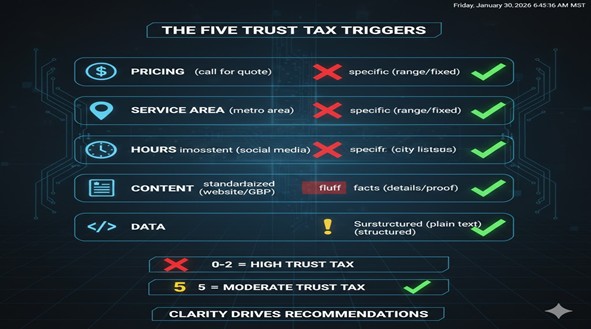
The Five Trust Tax Triggers
Most businesses pay the Trust Tax because they trigger one or more of these five clarity failures:
- Vague Pricing
Phrases like “affordable rates,” “competitive pricing,” and “call for quote” provide zero usable information to AI systems.
When a user asks, “How much does emergency AC repair typically cost?” and your website says “affordable rates,” the AI can’t answer the question using your business as reference. It will cite competitors with published pricing instead.
The fix isn’t necessarily publishing exact prices—it’s providing ranges or starting points. “Emergency HVAC service starts at $150 for diagnostic visit” gives AI something concrete to work with. “Typically $300-$800 depending on repair complexity” sets expectations. Both are infinitely more useful than “competitive pricing.”
- Unclear Service Boundaries
“Serving the metro area,” “Greater Portland region,” or “Southwest Michigan” are meaningless to AI systems trying to determine if you serve a specific location.
When someone asks about service in Beaverton, Oregon, and your website says “Greater Portland metro,” the AI doesn’t know if Beaverton qualifies. Is Beaverton in or out? The AI can’t confidently say, so it recommends someone else who explicitly lists Beaverton.
The fix is specificity: “Serving Portland, Beaverton, Hillsboro, Gresham, and Lake Oswego” or “30-mile radius from downtown Portland” or “All Multnomah and Washington County locations.” Give the AI explicit geographic boundaries.
- Inconsistent Business Hours
If your website says “Monday-Friday 9-5” but your Google Business Profile says “Monday-Friday 8-6” and your Facebook page says “Weekdays 9-6,” the AI doesn’t know which is correct.
Faced with conflicting information, the AI will either skip you entirely or caveat its recommendation with “according to their website” language that signals uncertainty to users.
The fix is standardization: make your hours identical across every platform. If you have emergency after-hours availability, state it consistently everywhere: “Office hours Monday-Friday 8AM-8PM. 24/7 emergency service available by phone.”
- Marketing Fluff Over Factual Information
“Award-winning customer service,” “decades of experience,” and “customer-focused solutions” sound nice in brochures but tell AI systems nothing about what you actually do or who you serve.
When someone asks, “What services does Smith Plumbing offer?” and your homepage says “We’re committed to excellence in providing solutions that exceed expectations,” the AI can’t extract a service list. It needs: “Residential plumbing services including emergency repairs, water heater installation, drain cleaning, and fixture replacement.”
The fix is directness: answer the obvious questions explicitly. What do you do? Who do you serve? What does it cost? When are you available? Skip the adjectives and provide nouns and numbers.
- No Structured Data Markup
Without Schema.org markup or equivalent structured data, AI systems must interpret your website content contextually. Is “$299” a monthly fee, a one-time service cost, or a product price? Is “Portland” your service area or just where your office is located?
Structured data removes ambiguity by explicitly labeling information: “This is a LocalBusiness. This is its serviceArea. This is its priceRange.” This helps both search engines and AI systems parse information accurately.
The fix is implementation: add LocalBusiness schema to your website with explicit properties for service areas, hours, pricing, and contact methods. If this sounds technical, it is—but it’s also the difference between being comprehensible and being invisible.
The Consequence: Defaulting to National Brands
When AI systems can’t confidently recommend local businesses with unclear information, they default to larger alternatives with complete, structured data.
A user asks, “Where can I buy specialty coffee beans in Denver?” The AI might recommend a national chain with complete product catalogs and structured ecommerce data—not because they’re better, but because they’re comprehensible. The local roaster with amazing beans but a website saying “visit us for premium coffee” never enters consideration.
This is why the Trust Tax hits small businesses disproportionately. Large enterprises have procurement teams, digital agencies, and technical resources ensuring their information is structured and consistent. Small businesses often have websites built five years ago with information that was vague even then.
But here’s the opportunity: the Trust Tax isn’t actually about size or resources. It’s about clarity and consistency. A solo practitioner who takes two hours to update their website with clear pricing, specific service areas, and consistent hours across all platforms will outcompete a 50-person competitor still saying “call for quote.”
Real-World Example: The Invisible HVAC Company
Let’s examine a real scenario from the Field Guide.
Someone asks ChatGPT at 9 PM on a Friday: “My air conditioner just stopped working and it’s 95 degrees in my house in Edmond, Oklahoma. Who can help tonight?”
HVAC Company A: Website: “Family-owned HVAC company serving Oklahoma City and surrounding areas for over 20 years. We pride ourselves on quality service and competitive rates. Call us today!” Google Profile: Monday-Friday 9-5 (no weekend hours listed) Result: AI cannot confidently recommend—unclear if “surrounding areas” includes Edmond, unclear if they do emergency service, conflicting signals about availability.
HVAC Company B (Covington Heat & Air): Website: “24/7 emergency HVAC service. Serving Edmond, Oklahoma City, Moore, Norman, Bethany, Piedmont, and Guthrie. Call or text (405) 568-9463.” Contact page: “Office hours Monday-Friday 8AM-8PM. Emergency service available 24/7.” Result: AI confidently recommends—explicit service area includes Edmond, clear 24/7 emergency availability, direct contact method provided.
Same user need. Same industry. Completely different outcomes. The difference isn’t company size, reputation, or actual service quality—it’s clarity and structure.
How to Calculate Your Trust Tax
Ask yourself these five diagnostic questions:
- If someone asks AI “How much does [your service] cost?” can the AI answer using your website? If not, you’re paying the pricing Trust Tax.
- If someone asks AI “Does [your business] serve [specific city]?” can the AI answer definitively? If not, you’re paying the geographic Trust Tax.
- If someone asks AI “Is [your business] open right now?” at 7 PM on a Wednesday, can the AI answer accurately by checking any single source? If not, you’re paying the consistency Trust Tax.
- If someone asks AI “What services does [your business] provide?” can the AI generate a factual list from your website? If not, you’re paying the clarity Trust Tax.
- Does your website have Schema.org LocalBusiness markup with serviceArea, priceRange, and openingHours properties? If not, you’re paying the structure Trust Tax.
Each “no” answer represents lost recommendations. In a world where AI mediates customer discovery, these aren’t minor gaps—they’re existential barriers.
The Path Forward: Clarity Is Competitive Advantage
The good news: removing the Trust Tax doesn’t require massive budgets or technical expertise. It requires brutal honesty about information gaps and systematic closure of those gaps.
Update your website to include specific price ranges or starting costs. List your service area by city name or explicit radius. Standardize your hours across every platform. Replace marketing language with direct answers to customer questions. Add basic structured data markup (or hire someone for a few hundred dollars to do it).
These aren’t optimizations. They’re prerequisites for existing in an AI-mediated discovery environment.
The businesses that win in the CCA era won’t be those with the biggest brands or the most sophisticated marketing. They’ll be those that made it easy for AI to understand, retrieve, and confidently recommend them.
Right now, most of your competitors are invisible because of the Trust Tax. The question is whether you’ll join them in invisibility—or separate yourself through clarity.
Confirmed vs Scenario
✓ Confirmed: AI systems are trained to avoid hallucination and will skip ambiguous information rather than risk false statements.
✓ Confirmed: Covington Heat & Air example uses actual information from their public website.
⚠ Scenario: The “five Trust Tax triggers” is an analytical framework based on observed AI behavior, not official OpenAI documentation.
⚠ Scenario: Specific recommendation outcomes (Business A vs. B) are illustrative examples.
⚠ Scenario: The claim that “most businesses” pay the Trust Tax is directional assessment, not quantified research.
Key Takeaways
- The Trust Tax is the penalty paid when AI can’t confidently recommend your business due to unclear information
- AI systems choose caution over risk—when information is ambiguous, they skip you entirely
- Five triggers: vague pricing, unclear service areas, inconsistent hours, marketing fluff, no structured data
- Size doesn’t determine visibility—clarity does. Small businesses with structured data beat large brands with vague information
- Removing the Trust Tax requires brutal honesty about information gaps and systematic closure
Social Post Angles (8-10 variations)
- The uncomfortable truth: “Your business isn’t invisible to ChatGPT because you’re small. You’re invisible because your website says ‘competitive pricing’ and ‘metro area’ instead of actual numbers and cities.”
- The default to national brands: “When AI can’t understand your local business, it recommends national chains with structured data. Not because they’re better—because they’re comprehensible.”
- The clarity vs. size insight: “Solo contractor with transparent pricing beats 50-person company with ‘call for quote.’ In AI recommendation, clarity matters more than size.”
- The five-question diagnostic: “Can AI answer: how much, where, when, what, and is it structured? Five ‘no’ answers = five lost recommendations daily. That’s the Trust Tax.”
- The HVAC comparison: “Company A: ‘Serving metro, competitive rates, call us.’ Company B: ‘Serving Edmond/OKC/Moore, $150 diagnostic, 24/7 at (405) 568-9463.’ Which gets recommended at 9 PM Friday? Clarity wins.”
- The schema opportunity: “Most SMBs don’t have Schema.org markup. That’s not a disadvantage—it’s an opportunity. Add LocalBusiness structured data, outcompete everyone still paying the Trust Tax.”
- The inconsistency problem: “Website: 9-5. Google: 8-6. Facebook: 9-6. AI sees conflicting info and recommends someone else whose hours are consistent. That’s the Trust Tax.”
- The marketing fluff failure: “‘Award-winning customer service’ tells AI nothing. ‘Emergency plumbing repairs, water heater installation, drain cleaning’ tells AI everything. Facts beat adjectives.”
- The geographic ambiguity: “User asks about Beaverton. Your site says ‘Greater Portland metro.’ AI doesn’t know if Beaverton qualifies, so it recommends someone who explicitly lists Beaverton. Specificity wins.”
The pricing gap: “User asks ‘how much does emergency AC repair cost?’ Your site says ‘affordable rates.’ AI can’t answer, cites your competitor with ‘$150-$800 depending on repair.’ You paid the Trust Tax.”
Save your seat for the free webinar and download the CCA Field Guide at
SEO Keywords
- Trust Tax small business AI
- why AI won’t recommend my business
- ChatGPT business visibility
- AI recommendation optimization
- structured data for AI search
- local business AI discoverability
- Schema.org LocalBusiness markup