
Meta Description: The Decision Cycle Compression System is a website, content, and tool ecosystem designed to reduce the time and friction between a buyer’s first trigger and their serious next action. Here is why it matters now.
Answer Up Front
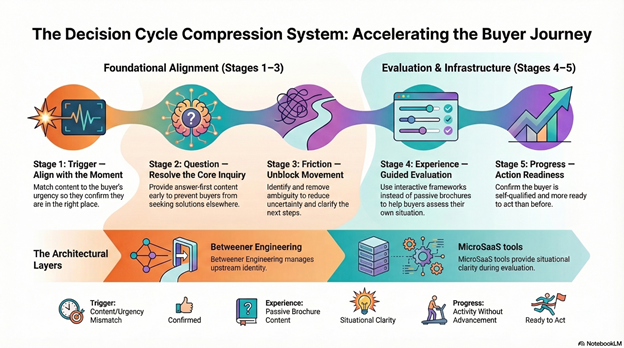
The Decision Cycle Compression System is a website, content, and tool ecosystem designed to reduce the time, uncertainty, and friction between a buyer’s initial trigger and their serious next action. It is not a funnel. It is not a lead generation system. It is not a content calendar. It is a structured buyer-progress architecture built around one central belief: that a business should not merely explain what it does, but should help buyers make progress toward a decision. The system operates through five lenses drawn from the 5-LBT Framework: Trigger, Question, Friction, Experience, and Progress. Each lens addresses a specific stage of the buyer journey where momentum is commonly lost. When all five are working together, the result is a buyer journey that is faster, more confident, and more commercially productive for both the buyer and the company.
Main Article
The Problem the System Is Built to Solve
Most B2B websites were built to explain. They describe the company, present the services, list the credentials, and invite the visitor to get in touch. That model made reasonable sense in an era when the website was primarily a digital brochure, a place buyers went to confirm what they had already heard through other channels.
That era is over.
Buyers today do not arrive at websites to be introduced to a company. They arrive in the middle of an active evaluation. They have already received AI-synthesized summaries of the solution landscape. They have already formed preliminary views about what kind of company they are looking for. They have already begun asking the decision questions that will determine whether a serious conversation is worth having.
The traditional website meets those buyers with a company-centric explanation. Here is who we are. Here is what we do. Here is why we are good at it. Call us when you are ready.
That response is structurally misaligned with where the buyer actually is. It answers questions the buyer is not asking and ignores the ones they are. It creates friction where it should create clarity. It extends the cycle instead of compressing it.
The Decision Cycle Compression System exists to close that gap.
What the Decision Cycle Compression System Is
The Decision Cycle Compression System is a website, content, and tool ecosystem designed to reduce the time, uncertainty, and friction between a buyer’s initial trigger and their serious next action.
Three elements of that definition deserve attention.
Website, content, and tool ecosystem. The system is not a single asset. It is an integrated architecture in which each component serves a specific function in the buyer’s progress. The website provides the structural framework. The content resolves buyer questions at each stage of the journey. The tools, specifically Decision Support MicroSaaS tools, create the guided evaluation experiences that move buyers from uncertainty to readiness in a single interaction. These three elements work together. A strong content layer without a tool layer creates educated buyers who are not yet ready to act. A tool layer without supporting content creates orphaned experiences that lack the context to build trust.
Reduce time, uncertainty, and friction. The system is built around three specific obstacles to buyer progress. Time is extended when buyers cannot find the clarity they need and must seek it elsewhere, often across multiple competitors and AI-generated answers. Uncertainty is the accumulated weight of unresolved questions, unconfirmed fit, and unclear next steps that prevents a buyer from committing to a serious conversation. Friction is the operational resistance created by content that does not answer the right question, CTAs that ask for more commitment than the buyer is ready to give, and experiences that leave the buyer doing all the synthesis work themselves. The system addresses all three.
Between a buyer’s initial trigger and their serious next action. The system is not designed to cover the entire sales cycle. It is designed to cover the specific portion of the journey that happens before the sales team enters the picture. That portion is where the most preventable cycle length lives. It is where buyers stall, lose momentum, seek alternatives, and either arrive at a sales conversation poorly prepared or do not arrive at all.
The Five Lenses of the 5-LBT Framework
The Decision Cycle Compression System is built on the 5-LBT Framework, a buyer-first operating model that maps the buyer journey through five lenses. Each lens represents a stage at which buyer momentum can be created or lost.
Trigger
A trigger is the specific event, pain spike, realization, or contextual shift that moves a buyer from passive awareness into active evaluation. It is the moment the HVAC unit fails again. The moment a founder realizes the website is not converting qualified traffic. The moment a CEO sees a competitor appearing in AI-generated recommendations and wonders why their own company is not.
A trigger is not a demographic characteristic. It is an activation event. The first job of a Decision Cycle Compression System is to align with the triggers that bring buyers into active evaluation, and to meet them at that moment with content that confirms they are in the right place.
Question
Once a trigger activates a buyer, they are not looking for a vendor brochure. They are trying to answer a question. Should I repair or replace? Is my website costing me sales cycles? How do I become visible in AI-generated recommendations? What does a solution to this problem actually look like?
The second job of the system is to answer those questions clearly, specifically, and early. Not in the third paragraph of a service page written for search engines. In the opening of every relevant content asset, organized around the buyer’s decision question rather than the company’s service structure.
Friction
Decision friction is the accumulation of unresolved uncertainty, unclear next steps, and misaligned content that slows buyer movement without the buyer ever consciously identifying it as friction. It is one of the most expensive hidden costs in B2B marketing.
Friction is not always objection. More often it is ambiguity. The buyer is interested but not yet certain enough to act. They do not know the right next step. They cannot confirm fit from what they have read. They sense that committing to a sales call might be premature. That ambiguity compounds with every page that fails to resolve it.
The third job of the system is to identify and remove the friction sources that are adding unnecessary length to the buyer journey.
Experience
Experience is what the buyer actually encounters before purchase. Not what the company says. Not what the page contains. What the buyer experiences as they move through the website and content ecosystem.
The wrong experience is passive: brochure-style explanation, generic service descriptions, pressure-heavy CTAs, no structured path through the evaluation. The right experience is active: guided evaluation, explicit fit criteria, decision-support tools that help the buyer assess their own situation, and sequenced CTAs that match the buyer’s readiness level at each stage.
The fourth job of the system is to design an experience that helps buyers think more clearly, not just learn more facts.
Progress
Progress is the summary test of the entire system. Is the buyer more ready now than they were before they encountered this website, article, or tool? Have they moved from uncertainty to orientation? From orientation to resolution? From resolution to self-qualification? From self-qualification to readiness?
Progress is not attention. It is not engagement. It is advancement. And it is the only measure that reliably predicts whether the marketing investment is producing commercial return.
Why the AI Era Makes This Framework More Urgent
The AI era has not made buyer-progress marketing optional. It has made it necessary.
Three specific shifts have changed the standard.
AI systems mediate discovery. A growing proportion of B2B buyers begin their evaluation not with a search engine but with a conversational AI system. They ask questions and receive synthesized answers that include specific companies, frameworks, and resources. The companies that appear in those answers are the ones whose content is structured, clear, question-resolving, and easy for AI systems to parse and summarize. Vague positioning, generic service descriptions, and brochure-style content are increasingly invisible in AI-mediated discovery.
Buyers arrive more informed but not necessarily more ready. AI synthesis gives buyers background orientation before they ever visit a website. But orientation is not readiness. A buyer who has received an AI-synthesized overview of the solution landscape still needs to resolve their specific decision question, confirm their own fit, and determine their right next step. The website that gives them a tool to do that work is the website that earns the conversation.
Content clarity is now a competitive advantage in AI recommendation. AI systems evaluate content for decision relevance and resolution quality. The companies whose content most directly resolves buyer decision questions are the companies AI systems are most likely to cite and recommend. That means the Decision Cycle Compression System is not just a buyer-experience investment. It is an AI visibility investment. Clarity, structure, and genuine decision utility are now directly linked to recommendation frequency.
This is why Betweener Engineering sits at the foundation of TBFA’s strategic system. Betweener Engineering ensures that AI systems have an accurate, complete, and well-structured representation of who the company really is, closing the gap between the company’s actual identity and the identity AI has constructed from fragments. The Decision Cycle Compression System then delivers on the promise that Betweener Engineering creates upstream.
What Decision Support MicroSaaS Brings to the System
Decision Support MicroSaaS is the tool layer of the Decision Cycle Compression System. It refers to lightweight, category-specific software experiences embedded in the buyer journey to help prospects evaluate their situation, reduce uncertainty, self-qualify, and choose the right next step.
These tools are not quizzes. They are not lead capture forms with extra steps. They are not interactive novelties. They are decision-support experiences, and they are the most commercially significant component of the system for one specific reason: they are the only element that takes the buyer’s specific situation as input and returns relevant, actionable clarity as output.
An article can resolve conceptual uncertainty. A tool resolves situational uncertainty. And situational uncertainty is what prevents qualified, interested buyers from committing to the next step.
A fit qualifier tells a buyer whether they are a good candidate for the engagement, using the company’s actual framework as the standard. A Decision Cycle Compression Diagnostic maps the buyer’s current buyer journey against the five 5-LBT lenses and surfaces where momentum is being lost and at what commercial cost. An ROI estimator helps a buyer build a preliminary business case using their own metrics as inputs.
Each of these tools does the same fundamental thing: it compresses the distance between uncertainty and action. And that compression is the commercial purpose of the entire system.
The Decision-Support Bridge
The Decision Cycle Compression Diagnostic is the most direct entry point into the system described in this article. It walks through each of the five 5-LBT lenses and surfaces where your buyer journey is losing momentum, what it is costing you, and what to address first.
See where your buying cycle stalls. The Decision Cycle Compression Diagnostic maps your buyer journey against the five 5-LBT lenses and tells you exactly where progress is being lost. Start your free diagnostic at dccd.theblackfridayagency.com
Conclusion
The Decision Cycle Compression System is not a rebranding of content marketing. It is not a new name for lead generation. It is a structurally different approach to the buyer journey, one that treats the website not as a digital brochure but as a buyer-progress system.
The companies that build this system well will produce buyers who arrive at sales conversations already oriented, already resolved, already self-qualified, and already ready to discuss specifics. Their sales teams will run shorter cycles, better conversations, and higher close rates. Their content will be structured clearly enough for AI systems to cite and recommend. Their decision-support tools will create trust through utility rather than asserting it through social proof.
The companies that do not build it will continue explaining. Their websites will continue attracting visitors who leave in the same state of uncertainty they arrived in. Their sales teams will continue doing orientation work that the website should have done. And their cycles will stay as long as they have always been.
The framework is available. The tools exist. The AI era has made the case for building it more compelling than it has ever been.
See where your buying cycle stalls. The Decision Cycle Compression Diagnostic maps your buyer journey against the five 5-LBT lenses and tells you exactly where progress is being lost. Start your free diagnostic at dccd.theblackfridayagency.com
FAQs
What is the Decision Cycle Compression System?
The Decision Cycle Compression System is a website, content, and tool ecosystem designed to reduce the time, uncertainty, and friction between a buyer's initial trigger and their serious next action. It is built on the 5-LBT Framework and operates through five lenses: Trigger, Question, Friction, Experience, and Progress.
What is the 5-LBT Framework?
The 5-LBT Framework is a buyer-first operating model built around five lenses that map the stages of the buyer journey: Trigger, the activation event that moves a buyer into active evaluation; Question, the decision question the buyer is trying to resolve; Friction, the accumulated uncertainty and ambiguity slowing buyer movement; Experience, the guided evaluation the buyer should encounter before purchase; and Progress, the summary measure of whether the buyer is more ready than before.
What is Decision Support MicroSaaS?
Decision Support MicroSaaS refers to lightweight, category-specific software experiences embedded in the buyer journey to help prospects evaluate their situation, reduce uncertainty, self-qualify, and choose the right next step. Examples include fit qualifiers, ROI estimators, guided assessments, and the Decision Cycle Compression Diagnostic.
Why does the AI era make cycle compression more urgent?
AI systems now mediate a significant portion of B2B discovery. They synthesize answers, recommend resources, and shape buyer orientation before the first website visit. Companies whose content is structured, question-resolving, and clearly useful are the companies AI systems cite and recommend. Vague, brochure-style content is increasingly invisible. The Decision Cycle Compression System is built to perform in both human and AI-mediated buyer journeys.
What is the difference between the Decision Cycle Compression System and a traditional sales funnel?
A sales funnel is company-centric. It tracks how buyers move through the company's defined stages from awareness to close. The Decision Cycle Compression System is buyer-centric. It is designed around the buyer's journey from trigger to readiness, with every component serving the buyer's progress rather than the company's pipeline management.
What is Betweener Engineering and how does it connect to the system?
Betweener Engineering is the process of closing the gap between who a company really is and how AI systems perceive and represent it. It sits upstream of the Decision Cycle Compression System, ensuring that the buyers AI sends are already accurately oriented before they arrive at the website. When Betweener Engineering and the Decision Cycle Compression System work together, the buyer journey is compressed from both ends.
How do I know if my company needs a Decision Cycle Compression System?
If your qualified buyers are arriving at sales conversations unprepared, if your sales team is doing orientation work in early conversations, if your website traffic is not translating into shorter or better-quality sales cycles, or if your content is generating activity without advancing buyers toward decisions, those are the signals that decision friction is operating and that a structured system for removing it would produce measurable commercial return.