
Meta Description: Decision friction is the accumulated uncertainty and ambiguity that slows qualified buyers without them ever identifying it as the problem. Learn what it is, where it comes from, and how to remove it.

Answer Up Front
Decision friction is the accumulation of unresolved uncertainty, unclear next steps, and misaligned content that slows a qualified buyer’s movement through the buying journey without the buyer ever consciously identifying it as the problem. It is not objection. It is not disinterest. It is ambiguity. A buyer experiencing decision friction is typically interested, often qualified, and genuinely considering the engagement. They are simply not yet certain enough to act. They cannot confirm fit from what they have read. They do not know what the right next step is. They sense that committing to a sales call might be premature but have no alternative path forward. That ambiguity compounds with every page that fails to resolve it, every CTA that asks for more commitment than the buyer is ready to give, and every content asset that informs without advancing. Decision friction is one of the most expensive hidden costs in B2B digital marketing. It lengthens sales cycles, weakens self-qualification, and creates unnecessary drag between buyer curiosity and serious intent.
Main Article
The Conversion Problem That Is Not a Traffic Problem
Most B2B companies, when they see qualified buyers not converting, assume the problem is traffic. Not enough of it, not the right kind, not from the right sources. So they invest in more content, more advertising, more SEO, more outreach. They drive more visitors to the same website. And the conversion problem persists.
The traffic diagnosis is wrong more often than most companies realize.
The real problem, in a significant proportion of cases, is not the volume or quality of the traffic. It is what happens to qualified buyers after they arrive. It is the experience of a buyer who is genuinely interested, reasonably well-matched, and actively evaluating, but who leaves without converting because the website failed to resolve the specific uncertainties standing between their interest and their action.
That failure has a name. It is decision friction. And it is one of the most commercially expensive problems in B2B digital marketing precisely because it is invisible in standard analytics and almost universally misdiagnosed as a traffic problem.
What Decision Friction Is
Decision friction is the accumulation of unresolved uncertainty, unclear next steps, and misaligned content that slows a qualified buyer’s movement through the buying journey.
Three elements of that definition deserve careful attention.
Accumulation. Decision friction is rarely a single obstacle. It is a compound experience. A buyer might tolerate one unanswered question, push through one vague service description, and overlook one generic CTA. But when ambiguity accumulates across multiple pages and multiple interactions, the combined weight exceeds the buyer’s willingness to continue investing effort in a website that is not helping them make progress. They stop. Not because they decided against the company. Because the website gave them too little certainty and too little forward direction to continue.
Unresolved uncertainty. The central experience of decision friction is not confusion. It is incompleteness. The buyer has enough information to be interested but not enough to be confident. They can see that the company might be relevant but cannot confirm that it is the right fit for their specific situation. They understand roughly what the company does but cannot envision what working with them would actually look like. The uncertainty is specific and resolvable. The website simply has not resolved it.
Without the buyer ever consciously identifying it as the problem. This is the feature of decision friction that makes it so commercially costly. A buyer who encounters a hard objection can name it. A buyer who experiences decision friction typically cannot. They leave the website with a vague sense that they need to think about it more, or that they want to do a bit more research, or that now is not quite the right time. The friction has done its work without ever being identified, which means it cannot be addressed through sales follow-up and is almost never attributed to the website in post-sale analysis.
The Five Sources of Decision Friction
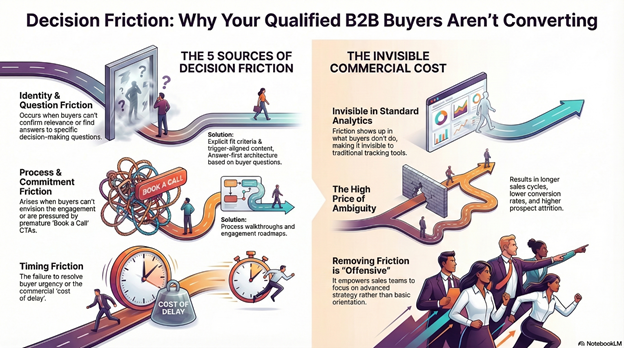
Decision friction does not come from a single source. It accumulates from five distinct places in the buyer journey, each requiring a different removal mechanism.
Source 1: Identity Friction
Identity friction occurs when the buyer cannot quickly and confidently confirm that the company is relevant to their specific situation. It is the friction of arrival: the buyer lands on the website and cannot immediately determine whether they are in the right place.
Identity friction is created by generic positioning that tries to appeal to too broad an audience, by homepage messaging that describes the company in terms of what it is rather than who it serves and what triggers bring them there, and by the absence of explicit, specific language about the kinds of situations the company works best with.
When identity friction is present, even well-qualified buyers begin their evaluation with a deficit of confidence that subsequent content must overcome. Many do not stay long enough for that content to work.
Source 2: Question Friction
Question friction occurs when the buyer is carrying a specific decision question and cannot find a clear answer to it on the website. Every high-intent B2B buyer arrives with a question they are trying to resolve. Whether that question is “is this the right type of solution for my situation,” “how does this company’s approach differ from the alternatives,” or “what would it actually cost and what would I get,” the buyer needs a specific answer in order to progress.
Question friction is created by content organized around the company’s service structure rather than the buyer’s decision questions, by answer-first architecture that is absent, and by the common practice of withholding specific information in order to create reasons to book a call. That withholding strategy creates friction rather than urgency. It drives buyers to seek answers from competitors or AI-generated summaries rather than from the company.
Source 3: Process Friction
Process friction occurs when the buyer does not understand what it would actually look like to work with the company. They understand what the company offers. They do not understand how the engagement begins, what the company does in the first thirty days, what they would need to provide, and how progress would be measured.
Process friction creates a specific kind of uncertainty that buyers rarely name but frequently experience. It produces a hesitation at the point of commitment because the buyer is being asked to commit to something whose operational reality they cannot yet envision. That hesitation looks like a timing objection in the sales process. Its root cause is a website that described the outcome without describing the path.
Source 4: Commitment Friction
Commitment friction occurs when the call to action asks for more commitment than the buyer is prepared to give at their current stage of evaluation. The most common form is a single “Book a Call” CTA deployed at every stage of the buyer journey regardless of buyer readiness.
A buyer who is still in the orientation stage of their evaluation and encounters a “Book a Call” CTA experiences that ask as premature. They are not ready to commit to a live sales conversation. They need a lower-commitment intermediate step. When that step is absent, the buyer either books a call they are not ready for, which produces a poor conversation that often stalls the cycle, or leaves without converting at all.
Commitment friction is the most directly addressable of the five sources because its removal requires a structural decision about CTA architecture rather than a wholesale content rebuild.
Source 5: Timing Friction
Timing friction occurs when the buyer cannot determine whether now is the right time to act. They may be interested. They may be qualified. They may understand the offer. But they have not yet resolved the internal question of urgency. Is this situation serious enough to warrant acting now, or can it wait?
Timing friction is created by the absence of cost-of-delay content, by a website that presents the offer without contextualizing the consequences of postponing action, and by a buyer journey that never explicitly helps the buyer evaluate their own readiness. It compounds the other four friction types because a buyer who has resolved all their other uncertainties but not their timing uncertainty will still stall.
Why Decision Friction Is Invisible in Standard Analytics
The most commercially dangerous aspect of decision friction is that it does not show up in standard website analytics in any direct form.
What analytics show is behavior: pages visited, time spent, forms submitted, conversions completed. What analytics do not show is the mental state of the buyer during those behaviors. They do not show a qualified buyer who stalled on identity uncertainty and left after two pages. They do not show a founder who reached the CTA, found it premature, and navigated away without a conversion. They do not show a CEO who consumed three articles, found them informative but not resolving, and eventually booked a call with a competitor whose content was more specifically useful.
Each of those lost buyers is a bounce, an incomplete session, or simply an absence in the conversion data. The analytics record the outcome. They do not record the cause. And because the cause is invisible, it is consistently misattributed to traffic quality, offer relevance, or market timing, none of which were actually the problem.
The right diagnostic is not an analytics deep dive. It is a structured friction audit conducted through the lens of the five friction sources described above. That audit asks not what buyers did on the website but whether each friction source is present, at what severity, and what content or structural change would remove it.
The Decision Cycle Compression Diagnostic is built to conduct exactly that audit in a systematic, structured way.
What Removing Decision Friction Actually Produces
Friction removal is not a defensive investment. It is an offensive one. The commercial outcomes of systematic friction reduction are specific and measurable.
Shorter sales cycles result from buyers arriving at sales conversations with their foundational uncertainties already resolved. The sales team does not need to rebuild orientation, re-answer basic questions, or re-establish fit confidence. The cycle starts further along and ends sooner.
Higher conversion rates result from buyers reaching the commitment stage with enough certainty to act. The same qualified traffic that was previously leaving unconverted begins converting at a higher rate because the website has removed the specific uncertainties that were preventing action.
Better conversation quality results from buyers arriving at sales calls with specific, advanced questions rather than foundational ones. When the website has handled orientation, question resolution, and process clarity, the sales team can focus the conversation on the buyer’s specific situation and the specifics of the proposed engagement. Those conversations close faster.
Lower prospect attrition results from buyers having a clear, structured path through the evaluation rather than a series of ambiguous pages with a generic CTA at the end. Attrition between curiosity and commitment drops when the buyer always knows what the right next step is.
How Decision Support MicroSaaS Removes Friction at Scale
Decision Support MicroSaaS tools are the most direct and scalable friction removal mechanism available in the buyer journey. They address multiple friction types simultaneously in a single interaction.
A fit qualifier removes identity friction by giving the buyer an explicit, structured method for confirming their own relevance to the company’s offer. A guided assessment removes question friction by walking the buyer through a structured evaluation that surfaces the answer to their central decision question. A process explainer with an interactive component removes process friction by helping the buyer envision what the engagement would actually look like. A sequenced CTA architecture removes commitment friction by offering an intermediate evaluation step before the sales call commitment. A cost-of-delay calculator removes timing friction by helping the buyer quantify the commercial cost of postponing action.
Each tool is a friction removal mechanism. Together, as part of a Decision Cycle Compression System, they systematically address all five friction sources and produce a buyer journey in which the accumulated weight of unresolved uncertainty never reaches the threshold that causes qualified buyers to stall.
The Decision-Support Bridge
The most direct way to identify which friction types are operating in your buyer journey and at what severity is the Decision Cycle Compression Diagnostic. It maps your current website and content ecosystem against the five 5-LBT lenses and surfaces the specific friction sources adding unnecessary length to your cycle.
See where your buying cycle stalls. The Decision Cycle Compression Diagnostic maps your buyer journey against the five 5-LBT lenses and tells you exactly where progress is being lost. Start your free diagnostic at dccd.theblackfridayagency.com
Conclusion
Decision friction is not a traffic problem. It is not a messaging problem. It is not a pricing problem. It is a buyer journey design problem. And it is one that most B2B companies are currently solving with the wrong tool: more content, more traffic, more outreach aimed at the same friction-generating website.
The buyers being lost to decision friction are not unqualified. They are not uninterested. They are uncertain. And uncertainty is a design problem with a design solution.
The five friction sources described in this article each have a specific removal mechanism. The friction audit conducted through the 5-LBT Framework identifies which sources are operating and at what severity. The Decision Cycle Compression System provides the structural architecture for removing them systematically.
The buyers are there. The interest is real. The question is whether the website is designed to convert that interest into action or to let it dissipate into ambiguity.
See where your buying cycle stalls. The Decision Cycle Compression Diagnostic maps your buyer journey against the five 5-LBT lenses and tells you exactly where progress is being lost. Start your free diagnostic at dccd.theblackfridayagency.com
FAQs
What is decision friction in B2B marketing?
Decision friction is the accumulation of unresolved uncertainty, unclear next steps, and misaligned content that slows a qualified buyer's movement through the buying journey without the buyer ever consciously identifying it as the problem. It is not objection or disinterest. It is ambiguity that compounds across multiple interactions until it exceeds the buyer's willingness to continue investing effort.
What are the five sources of decision friction?
The five sources are: identity friction, when buyers cannot quickly confirm they are in the right place; question friction, when buyers carry unanswered decision questions through the visit; process friction, when buyers cannot envision what the engagement would look like; commitment friction, when the CTA asks for more commitment than the buyer is ready to give; and timing friction, when the buyer has not resolved the urgency question.
Why is decision friction invisible in standard website analytics?
Decision friction surfaces in what buyers do not do rather than what they do. Analytics record the outcome, a bounce, an incomplete session, an absent conversion, but not the cause. The buyer who left due to unresolved uncertainty looks identical in the data to the buyer who left because they were not qualified. That indistinguishability causes friction to be consistently misattributed to traffic quality rather than website design.
What is the commercial cost of decision friction?
Decision friction produces four specific commercial costs: longer sales cycles, because buyers arrive at conversations with foundational uncertainties unresolved; lower conversion rates, because qualified buyers stall between interest and commitment; poorer conversation quality, because the sales team must handle orientation work the website should have done; and higher prospect attrition, because buyers without a clear path through the evaluation simply leave.
How does decision friction differ from a sales objection?
A sales objection is a named, specific concern that a buyer can articulate and a salesperson can address. Decision friction is unnamed and diffuse. The buyer experiencing it typically describes it as needing more time, wanting to do more research, or feeling that now is not quite the right moment. The friction has done its work without ever being identified, which means it cannot be addressed through standard objection handling.
What is the most direct way to remove decision friction from a B2B website?
The most direct removal mechanism is a combination of answer-first content architecture, explicit fit criteria, sequenced CTAs matched to buyer readiness levels, and Decision Support MicroSaaS tools that address multiple friction types simultaneously. A fit qualifier removes identity and commitment friction. A guided assessment removes question and commitment friction. Process content removes process friction. Cost-of-delay content removes timing friction.
How do I identify which friction types are operating in my buyer journey?
The Decision Cycle Compression Diagnostic maps your buyer journey against the five 5-LBT lenses and surfaces the specific friction sources operating at highest severity. It provides both a diagnostic of current friction and a prioritized set of removal interventions based on the commercial impact of each friction type in your specific situation.