
Meta Description: Most companies measure website ROI in traffic and leads. The right measure is buyer progress speed. Learn how Decision Cycle Compression reframes website ROI around what actually drives revenue.

Answer Up Front
Most companies measure website ROI the way they measured it in 2012: traffic volume, lead count, and cost per form submission. Those metrics are not wrong. They are incomplete. They measure the top of the funnel accurately and the rest of the buyer journey not at all. A more useful measure of website ROI is buyer progress speed: how much faster does a qualified buyer move from first trigger to serious next action as a result of what the website does? That question reframes the entire ROI conversation. It connects the website investment directly to sales cycle length, conversation quality, close rate, and revenue per sales hour invested. Decision Cycle Compression is the framework that makes that connection explicit, measurable, and improvable. And in the AI era, where the website is increasingly the primary mediator between AI-referred buyer interest and sales team engagement, it is the ROI framework that most directly reflects how websites actually create commercial value.
Main Article
The ROI Question Most Companies Are Not Asking
Every B2B company asks whether its website is generating ROI. Most are asking a version of the question that cannot surface the most important part of the answer.
The standard version of the question goes: how much traffic is the site generating, how many leads is it producing, and what is the cost per lead? These are reasonable questions for a media property. They are incomplete questions for a buyer-progress system.
The more commercially important version of the question is: how much faster are qualified buyers moving from their first trigger to a serious sales conversation as a result of what the website does? And what is the revenue impact of that acceleration?
That version of the question is harder to answer. It requires connecting website design decisions to sales cycle data, which most marketing functions do not do. It requires a shared measurement framework between marketing and sales, which most companies do not have. And it requires a different mental model of what a website is for.
But it is the version of the question that actually predicts revenue. And it is the version that Decision Cycle Compression is built to answer.
Two Blind Spots in Standard Website ROI Measurement
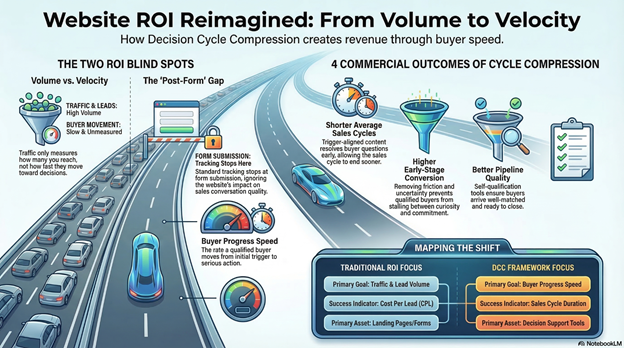
Standard website ROI measurement has two specific blind spots that cause companies to systematically underinvest in the assets that create the most commercial value.
Blind Spot 1: It measures volume, not velocity.
Traffic and lead metrics measure how many buyers the website is reaching. They say nothing about how quickly those buyers are moving toward a decision. A website that generates two hundred leads per month from passive browsers who need six months of additional nurturing is producing lower commercial ROI than a website that generates fifty leads per month from trigger-active buyers who are ready for a productive conversation within two weeks. Standard metrics cannot distinguish between the two scenarios. Volume looks better in the first case. Velocity is dramatically better in the second.
Blind Spot 2: It stops at the form submission.
Standard conversion tracking ends when the buyer submits a form or books a call. Everything that happens after that, the quality of the conversation, the length of the cycle from first call to close, the proportion of conversations that result in proposals, the close rate on those proposals, is attributed to the sales team rather than to the website. This attribution is structurally inaccurate. The quality of the sales conversation is directly determined by how prepared the buyer was when they arrived. And how prepared the buyer was is directly determined by what the website did before the conversation started.
A website that delivers well-oriented, self-qualified, question-resolved buyers to the sales team is producing commercial value that never appears in standard marketing ROI calculations. That invisible value is the most important value the website creates. And it is precisely what Decision Cycle Compression is designed to capture and maximize.
The Four Commercial Outcomes of Cycle Compression
When a website is functioning as a Decision Cycle Compression System, it produces four specific commercial outcomes that are each measurable and each traceable back to the website’s structural design.
Outcome 1: Shorter Average Sales Cycles
A buyer who arrives at the first sales conversation already oriented, already having resolved their central decision question, and already having self-qualified against the company’s stated criteria does not need the sales team to do that work in the early stages of the engagement. The cycle starts further along. It ends sooner. The time saved across a full pipeline of qualified opportunities is substantial.
Cycle length is measurable. Before and after comparisons against specific website changes, the deployment of a guided assessment, the addition of answer-first content architecture, the introduction of explicit fit criteria, produce a direct line between website design and cycle duration.
Outcome 2: Higher Early-Stage Conversion Rates
Decision friction causes qualified buyers to stall between curiosity and commitment. When friction is removed through clearer content, better question resolution, and guided assessment tools, the proportion of qualified visitors who convert to serious conversations increases. That increase is not a traffic quality improvement. It is a friction removal effect. The buyers were already qualified. The website was simply losing them to unresolved uncertainty.
Higher early-stage conversion rates are directly traceable to friction reduction investments in the website. A company that deploys a fit qualifier and sees assessment-to-conversation rates increase has a direct ROI line from the tool investment to the pipeline outcome.
Outcome 3: Lower Cost Per Qualified Conversation
When cycle compression is working, the cost per qualified conversation decreases even without changes to traffic acquisition spending. The same traffic budget produces more qualified conversations because a higher proportion of visitors reach the conversation stage having already resolved the questions that would have caused them to disengage. The per-unit cost of a qualified conversation falls as the conversion efficiency of the buyer journey improves.
This outcome is particularly significant for companies where sales team time is a constrained resource. Every conversation that arrives well-prepared is a conversation that requires less sales time to advance. The effective capacity of the sales function increases without headcount changes.
Outcome 4: Better Pipeline Quality
A Decision Cycle Compression System that includes explicit fit criteria and self-qualification tools does not just produce more conversations. It produces better-matched conversations. Buyers who have gone through a structured self-qualification process arrive already having confirmed their own fit. They are less likely to disengage mid-cycle due to a mismatch that could have been identified earlier. They are more likely to close because their decision confidence was built through the website experience, not through sales pressure.
Better pipeline quality shows up in close rates, in the proportion of proposals that result in engagements, and in the average quality of the engagements that result. These are sales metrics. But their root cause is website design.
How the 5-LBT Framework Maps to ROI Creation
The 5-LBT Framework is not just a buyer journey model. It is a diagnostic for where ROI is being created and where it is being lost.
Each lens in the framework corresponds to a specific ROI mechanism.
The Trigger lens creates ROI by ensuring the website is attracting buyers in active evaluation rather than passive browsing. Trigger-aligned content reduces the proportion of traffic that is too early in the journey to convert, improving the effective ROI of every traffic acquisition dollar spent.
The Question lens creates ROI by resolving buyer decision questions before the sales call. Every question resolved on the website is a question that does not need to be resolved in the sales process. That resolution compresses cycle length and improves conversation quality simultaneously.
The Friction lens creates ROI by removing the accumulated uncertainty that causes qualified buyers to stall. Decision friction is one of the most commercially expensive hidden costs in B2B marketing. Removing it does not require more traffic. It requires better content architecture.
The Experience lens creates ROI through guided evaluation tools that produce measurable before-and-after buyer states. Decision Support MicroSaaS tools at the Experience stage are the highest-leverage ROI investment in the system because their impact is discrete, trackable, and directly connected to buyer readiness.
The Progress lens creates ROI by providing the measurement framework that confirms the other four lenses are working. Without progress measurement, ROI improvements are intuited rather than confirmed. With it, the commercial return on every system component becomes auditable.
The AI-Era Dimension of Cycle Compression ROI
The AI era has added an upstream ROI dimension to cycle compression that most companies have not yet incorporated into their thinking.
Betweener Engineering creates ROI at the top of the buyer journey by ensuring AI systems accurately represent the company’s positioning, expertise, and offer. When AI systems are accurate, the buyers they refer arrive pre-oriented. Pre-oriented buyers require less orientation work from the website and from the sales team. That reduction in orientation cost is a measurable ROI contribution from the Betweener Engineering investment.
The full ROI chain in an AI-era Decision Cycle Compression System runs as follows. Betweener Engineering creates accurate AI representation. Accurate AI representation produces better-oriented inbound buyers. Better-oriented buyers require less orientation content consumption to reach readiness. Faster readiness means shorter cycles and better conversations. Shorter cycles and better conversations produce more revenue per sales hour invested.
Every link in that chain is traceable. Every link represents a compression point. And every compression point represents commercial value that standard website ROI measurement is not capturing.
Conversational Customer Acquisition closes the loop by ensuring the company is winning the AI-mediated buyer conversations that CCA is designed to influence. The ROI of a CCA investment shows up not just in AI citation frequency but in the orientation quality of the buyers those citations produce. Better-oriented buyers. Shorter cycles. Higher close rates. The same causal chain, measured from a different entry point.
The Decision-Support Bridge
The most direct entry point for measuring and improving cycle compression ROI is the Decision Cycle Compression Diagnostic. It maps the current state of the buyer journey against the five 5-LBT lenses, surfaces the specific friction points adding unnecessary length to the cycle, and estimates the commercial cost of that friction in concrete terms.
That output is not just a diagnostic. It is an ROI baseline. It shows where the system is losing value and what addressing each friction point would be worth in cycle length reduction and pipeline quality improvement.
See where your buying cycle stalls. The Decision Cycle Compression Diagnostic maps your buyer journey against the five 5-LBT lenses and tells you exactly where progress is being lost. Start your free diagnostic at dccd.theblackfridayagency.com
Conclusion
Website ROI has always been about more than traffic. It has always been about what the traffic does once it arrives, how quickly it moves toward a decision, how prepared it is when it reaches the sales team, and how that preparation affects the speed and quality of what follows.
Most measurement frameworks have simply not been built to capture that part of the story. So companies have optimized for the part they could measure: volume. And they have underinvested in the assets that create the most commercial value: the content, architecture, and tools that advance buyers rather than simply attract them.
Decision Cycle Compression is the framework that closes that measurement gap. It connects website design decisions to the commercial outcomes that matter most. It gives marketing and sales a shared language for evaluating where buyer progress is being created and where it is being lost. And it points directly toward the investments that will produce the most measurable return.
The companies that adopt this framework will measure their websites differently. They will build them differently. And they will produce commercial results that look meaningfully different from the ones their current measurement standard is pointing them toward.
See where your buying cycle stalls. The Decision Cycle Compression Diagnostic maps your buyer journey against the five 5-LBT lenses and tells you exactly where progress is being lost. Start your free diagnostic at dccd.theblackfridayagency.com
FAQs
What is decision friction in B2B marketing?
Decision friction is the accumulation of unresolved uncertainty, unclear next steps, and misaligned content that slows a qualified buyer's movement through the buying journey without the buyer ever consciously identifying it as the problem. It is not objection or disinterest. It is ambiguity that compounds across multiple interactions until it exceeds the buyer's willingness to continue investing effort.
What are the five sources of decision friction?
The five sources are: identity friction, when buyers cannot quickly confirm they are in the right place; question friction, when buyers carry unanswered decision questions through the visit; process friction, when buyers cannot envision what the engagement would look like; commitment friction, when the CTA asks for more commitment than the buyer is ready to give; and timing friction, when the buyer has not resolved the urgency question.
Why is decision friction invisible in standard website analytics?
Decision friction surfaces in what buyers do not do rather than what they do. Analytics record the outcome, a bounce, an incomplete session, an absent conversion, but not the cause. The buyer who left due to unresolved uncertainty looks identical in the data to the buyer who left because they were not qualified. That indistinguishability causes friction to be consistently misattributed to traffic quality rather than website design.
What is the commercial cost of decision friction?
Decision friction produces four specific commercial costs: longer sales cycles, because buyers arrive at conversations with foundational uncertainties unresolved; lower conversion rates, because qualified buyers stall between interest and commitment; poorer conversation quality, because the sales team must handle orientation work the website should have done; and higher prospect attrition, because buyers without a clear path through the evaluation simply leave.
How does decision friction differ from a sales objection?
A sales objection is a named, specific concern that a buyer can articulate and a salesperson can address. Decision friction is unnamed and diffuse. The buyer experiencing it typically describes it as needing more time, wanting to do more research, or feeling that now is not quite the right moment. The friction has done its work without ever being identified, which means it cannot be addressed through standard objection handling.
What is the most direct way to remove decision friction from a B2B website?
The most direct removal mechanism is a combination of answer-first content architecture, explicit fit criteria, sequenced CTAs matched to buyer readiness levels, and Decision Support MicroSaaS tools that address multiple friction types simultaneously. A fit qualifier removes identity and commitment friction. A guided assessment removes question and commitment friction. Process content removes process friction. Cost-of-delay content removes timing friction.
How do I identify which friction types are operating in my buyer journey?
The Decision Cycle Compression Diagnostic maps your buyer journey against the five 5-LBT lenses and surfaces the specific friction sources operating at highest severity. It provides both a diagnostic of current friction and a prioritized set of removal interventions based on the commercial impact of each friction type in your specific situation.