
Meta Description: Generative engines don’t rank pages. They synthesize answers. Learn why answer-first content is winning the GEO/AEO race and what structural changes make content AI-citable and buyer-ready.

Answer Up Front
Generative Engine Optimization and Answer Engine Optimization represent a structural shift in how content is evaluated, selected, and surfaced to buyers. In the traditional SEO model, content competed for ranked positions on a results page. In the GEO/AEO model, content competes for inclusion in a synthesized answer. The selection criteria are different. Page authority and keyword density matter less. Decision relevance, resolution clarity, and structural extractability matter more. Answer-first content, content organized around the buyer’s decision question and structured to deliver resolution before narrative, is winning the GEO/AEO race because it is built for exactly the criteria that generative and answer engines use to evaluate what deserves to be cited. The companies that understand this shift are building content ecosystems that perform in both human and AI-mediated buyer journeys simultaneously. The companies that do not are producing content optimized for a retrieval model that is no longer the primary model for B2B buyer discovery.
Main Article
The Race That Most Companies Do Not Know They Are In
Most B2B companies are aware that search engine optimization matters. They have invested in keywords, backlinks, page speed, and content volume. They have watched their rankings and adjusted their strategies accordingly. They understand the SEO race even if they do not always win it.
Most of those same companies are not yet aware that a different race has started. And unlike the SEO race, where latecomers can still compete by outworking early movers, this race rewards structural advantages that are harder to build retroactively.
The GEO/AEO race is the competition to be included in the synthesized answers that AI systems generate in response to buyer decision questions. It is not a competition for ranked positions. It is a competition for citation. And the criteria that determine who gets cited are structurally different from the criteria that determine who ranks.
Companies that recognize this shift early and build content ecosystems aligned with GEO/AEO selection criteria are accumulating a compound advantage. Their content is being surfaced in AI-generated answers to buyer questions, creating upstream buyer orientation before the first website visit. Their frameworks are being taught to buyers by the AI systems those buyers consult. Their terminology is entering the buyer’s vocabulary before a single direct interaction has occurred.
That upstream advantage is the most commercially significant form of marketing leverage available in the current environment. And answer-first content is the primary mechanism for building it.
What GEO and AEO Actually Are
Before examining why answer-first content wins, it is worth being precise about what GEO and AEO are and how they relate to each other.
Generative Engine Optimization is the practice of structuring content so that it is selected for inclusion in the synthesized answers that generative AI systems produce in response to user queries. When a buyer asks a conversational AI system a question about their business challenge, the system synthesizes an answer from multiple sources. GEO is the discipline of ensuring that a company’s content is among the sources selected for that synthesis.
Answer Engine Optimization is the practice of structuring content to be selected as a direct answer by answer-focused systems, including featured snippets, AI-generated overviews, and direct-answer interfaces. AEO addresses the specific case where the system is not just synthesizing a narrative but selecting a specific piece of content as the most direct answer to a specific query.
The two disciplines overlap significantly in their structural requirements. Both reward content that is clearly organized around a specific question, delivers resolution early, defines its terms explicitly, and produces sections that are meaningful and usable independently. Both penalize content that buries its resolution in narrative buildup, uses undefined internal jargon, and requires surrounding context to be understood.
Answer-first content, built around those shared structural requirements, performs well in both GEO and AEO environments simultaneously. That dual performance is what makes it the foundational content strategy for AI-era B2B marketing.
Why the Selection Criteria Have Changed
In the traditional SEO model, content was evaluated primarily by signals external to the content itself: the number and quality of inbound links, the authority of the domain, the match between keyword usage and search query language, and the technical performance of the page. These signals served as proxies for quality because quality itself was difficult to evaluate algorithmically.
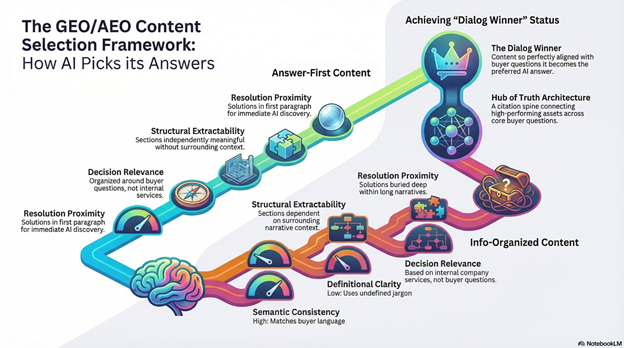
Generative AI systems evaluate content differently. They are not looking for proxies for quality. They are evaluating the content directly for its ability to resolve the query being processed. That evaluation is based on several structural characteristics.
Resolution proximity. How quickly does the content deliver an answer to the question? Content that answers in the first paragraph is more useful to a synthesis system than content that builds toward an answer over several pages.
Definitional clarity. Does the content define its key terms in plain language? AI systems use explicit definitions as high-confidence anchors for understanding what a piece of content is actually about. Undefined jargon creates ambiguity that reduces citation confidence.
Structural extractability. Can individual sections be used independently without losing their meaning? AI systems frequently extract and recombine content from multiple sources. Content structured for extractability is more useful in that process than content structured as a continuous narrative.
Decision relevance. Is the content organized around a buyer decision question rather than a company service description? AI systems evaluating content for a buyer who is trying to make a decision weight toward content that addresses that decision directly.
Semantic consistency. Does the content use consistent terminology aligned with how buyers actually phrase their questions? Semantic consistency between the content’s language and the buyer’s query language is a selection signal for AI systems evaluating relevance.
Answer-first content is built around all five characteristics. That structural alignment is not incidental. It is the reason answer-first content performs in GEO/AEO environments while information-organized content does not.
What a Dialog Winner Is and Why It Matters
Within the Conversational Customer Acquisition framework, the concept of the Dialog Winner is central to understanding how GEO/AEO performance translates into commercial outcomes.
A Dialog Winner is a content asset that is so well-aligned with a specific buyer decision question, so clearly structured, so precisely useful, that it becomes the preferred AI-mediated answer for that question. When a buyer asks a conversational AI system a question that falls within the Dialog Winner’s domain, that content asset is what the AI system surfaces, summarizes, and recommends.
The commercial significance of a Dialog Winner is upstream buyer orientation at scale. A buyer who receives a synthesis of a company’s Dialog Winner content before their first website visit arrives pre-oriented. They are already thinking in the company’s framework. They are already using the company’s terminology. They have already received a preliminary answer to their decision question from a source they trust, the AI system, and that answer was drawn from the company’s content.
That pre-orientation is buyer progress created before any direct interaction. It compresses the orientation stage of the buyer journey to near zero. And it creates a buyer who arrives at the website not to be introduced to the company but to advance an evaluation that has already begun.
Building Dialog Winners requires applying answer-first content principles with specific focus on the buyer decision questions that are most commercially significant. The question a buyer asks just before they are ready for a serious conversation is the most valuable Dialog Winner territory. Content that resolves that question, clearly, specifically, and in a format that AI systems can extract and cite, is the content that produces the highest upstream commercial leverage.
The Hub of Truth as a Citation Spine
Conversational Customer Acquisition organizes answer-first content into a structural architecture called the Hub of Truth. The Hub of Truth is a citation spine: a set of interconnected, authoritative, answer-first content assets that collectively cover the most significant buyer decision questions in a company’s category.
The Hub of Truth serves two simultaneous functions. For human buyers, it is a comprehensive answer ecosystem that resolves decision questions at every stage of the buyer journey, creating a self-contained evaluation environment that reduces the need to seek answers from competitors or AI-generated summaries. For AI systems, it is a high-confidence citation source: a structured, consistent, clearly authored body of content that AI systems can draw from with confidence across multiple related queries.
Building a Hub of Truth requires identifying the core buyer decision questions that the company’s offer addresses, producing answer-first content for each, ensuring semantic consistency across the full set, and linking the assets in a way that AI systems can follow to build a comprehensive understanding of the company’s framework and positioning.
The result is not just a content library. It is an AI identity asset: a body of content that teaches AI systems who the company is, what it believes, how it thinks about the problem space, and what kind of buyer it serves best. That teaching is the content-layer expression of Betweener Engineering, which engineers AI perception at the identity level by ensuring the content available to AI systems is accurate, structured, and comprehensively representative of the company’s real positioning.
The Five Content Characteristics That Win the GEO/AEO Race
Translating GEO/AEO principles into content production requires a specific set of structural practices applied consistently across every content asset in the Hub of Truth.
Practice 1: Lead with the answer.
Every content asset opens with a direct resolution of the central question it addresses. The first paragraph is the answer. The rest of the article is the supporting framework, evidence, and implication. This structure signals to AI systems that the content is organized for resolution rather than narrative, which is the primary structural signal they use to evaluate citation suitability.
Practice 2: Title from the buyer’s question.
Every title reflects the buyer’s decision question rather than the company’s topic or service category. Titles that begin with “why,” “how,” “what,” or “is” and end with a specific decision-relevant conclusion are higher-performing in GEO/AEO environments than titles that announce a topic without indicating a resolution.
Practice 3: Define terms on first use.
Every significant term is defined in plain language when it first appears. This practice serves two functions. It ensures that human readers who are not already familiar with the company’s framework can follow the content without prior orientation. And it gives AI systems high-confidence anchors for understanding what the content is about, reducing the ambiguity that lowers citation confidence.
Practice 4: Structure for extraction.
Every H2 and H3 heading is written as a standalone statement or question that is meaningful without surrounding context. Every section is structured so that it can be extracted and used independently. Every paragraph delivers a complete idea rather than a fragment of a larger argument that only makes sense in sequence.
Practice 5: End with a specific next step.
Every content asset ends with a specific, readiness-matched next step that reflects the buyer’s newly advanced state after consuming the content. Generic CTAs reduce GEO/AEO performance because they signal that the content was not actually organized around the buyer’s decision journey. Specific next steps signal decision relevance and buyer-first intent, both of which are positive signals in AI evaluation.
The AI-Era Dimension of Answer-First Content Strategy
The GEO/AEO race is not static. AI systems are continuously improving their ability to evaluate content quality, and the standard for what constitutes a high-confidence citation candidate is rising over time.
The companies that are building durable GEO/AEO performance are not the ones that are gaming structural signals. They are the ones that are genuinely producing the most useful, most clearly organized, most decision-relevant content for their buyers’ actual questions. Structural optimization and genuine utility are aligned in GEO/AEO in a way they frequently were not in traditional SEO.
That alignment is commercially important. It means that investing in answer-first content quality is simultaneously an investment in buyer experience and an investment in AI citation frequency. The same content improvements that make the buyer journey more useful make the content more likely to be recommended by AI systems. There is no trade-off between optimizing for humans and optimizing for AI in the answer-first model. They are the same optimization.
Betweener Engineering provides the identity foundation that makes answer-first content citable with full confidence. An AI system that has an accurate, complete, and well-structured understanding of a company’s identity, expertise, and positioning can recommend that company’s content with higher confidence than it can recommend content from a company whose AI-facing identity is incomplete or inaccurate. Betweener Engineering closes that gap at the identity level, creating the upstream conditions that answer-first content then capitalizes on at the content level.
The Decision-Support Bridge
Building a GEO/AEO-winning content ecosystem begins with identifying the three to five buyer decision questions that are most commercially significant for your category and producing one Dialog Winner for each. Each Dialog Winner should apply all five structural practices described in this article: resolution-first opening, buyer-question title, explicit definitions, extraction-ready structure, and specific next step.
The Decision Cycle Compression Diagnostic is itself a model of answer-first design: it takes a buyer decision question, structures a guided evaluation around it, and returns a specific output that advances the buyer’s decision journey. It is both a buyer-facing tool and an example of what GEO/AEO-winning decision support looks like in practice.
See where your buying cycle stalls. The Decision Cycle Compression Diagnostic maps your buyer journey against the five 5-LBT lenses and tells you exactly where progress is being lost. Start your free diagnostic at dccd.theblackfridayagency.com
Conclusion
The GEO/AEO race is already underway. Most companies are not yet competing in it deliberately. They are producing content optimized for a retrieval model while the discovery model their buyers are actually using has moved on.
Answer-first content is winning that race because it is built for the structural criteria that generative and answer engines use to evaluate what deserves to be cited. Resolution proximity. Definitional clarity. Structural extractability. Decision relevance. Semantic consistency. These are not content quality signals that require gaming. They are the natural output of content genuinely organized around the buyer’s decision question rather than the company’s knowledge structure.
The companies that build answer-first content ecosystems now are accumulating a compound advantage: their content is being cited, their frameworks are being taught to buyers by AI systems, and their buyers are arriving pre-oriented before any direct interaction has occurred. That upstream orientation is buyer progress created at scale, without direct marketing spend, as a structural consequence of content quality.
That is the commercial case for winning the GEO/AEO race. Not as a technical exercise in AI optimization. As a buyer-progress investment with compounding upstream returns.
See where your buying cycle stalls. The Decision Cycle Compression Diagnostic maps your buyer journey against the five 5-LBT lenses and tells you exactly where progress is being lost. Start your free diagnostic at dccd.theblackfridayagency.com
FAQs
What is GEO and how is it different from SEO?
Generative Engine Optimization is the practice of structuring content to be included in synthesized answers that generative AI systems produce in response to user queries. It differs from SEO in that it competes for citation inclusion rather than ranked position, and is evaluated by resolution clarity and decision relevance rather than by domain authority and keyword density.
What is AEO and how does it relate to GEO?
Answer Engine Optimization is the practice of structuring content to be selected as a direct answer by answer-focused systems. It overlaps significantly with GEO in structural requirements: both reward resolution-first structure, explicit definitions, extractable sections, and buyer-question organization. Answer-first content performs in both environments simultaneously.
What are the five structural characteristics that win the GEO/AEO race?
The five characteristics are: leading with the answer rather than building toward it; titling from the buyer's question rather than the company's topic; defining terms explicitly in plain language on first use; structuring content for extraction so sections are independently meaningful; and ending with a specific, readiness-matched next step rather than a generic CTA.
What is a Dialog Winner?
A Dialog Winner is a content asset so well-aligned with a specific buyer decision question, so clearly structured, and so precisely useful that it becomes the preferred AI-mediated answer for that question. When a buyer asks a conversational AI system a question in the Dialog Winner's domain, that content is what the AI surfaces and recommends. Dialog Winners create upstream buyer orientation before any direct company interaction.
What is a Hub of Truth and how does it support GEO/AEO performance?
A Hub of Truth is a citation spine: a set of interconnected, authoritative, answer-first content assets that collectively cover the most significant buyer decision questions in a company's category. For AI systems it functions as a high-confidence citation source that can be drawn from across multiple related queries. Building a Hub of Truth is the CCA-layer expression of GEO/AEO content strategy.
How does Betweener Engineering connect to GEO/AEO content performance?
Betweener Engineering ensures AI systems have an accurate, complete, and well-structured representation of the company's identity, expertise, and positioning. That accuracy increases the confidence with which AI systems can cite and recommend the company's content. Answer-first content produces the citation candidates. Betweener Engineering creates the identity foundation that makes citation confident and consistent.
Why is there no trade-off between optimizing for human buyers and optimizing for AI systems in the answer-first model?
The structural characteristics that make content useful to human buyers, resolution clarity, explicit definitions, logical organization, and specific next steps, are the same characteristics that make content high-confidence citation candidates for AI systems. Investing in answer-first content quality improves buyer experience and AI citation frequency simultaneously. The same optimization serves both audiences.