
Meta Description: The persuasion-based website was built for a buyer who needed convincing. AI search has produced a buyer who needs resolution. Learn what that shift means for your website’s architecture and commercial performance.

Answer Up Front
The persuasion-based website was built for a specific buyer in a specific information environment. That buyer arrived with limited prior context, needed to be educated on the solution category, and required convincing that the company was credible and the offer was worth considering. Persuasion, in that context, was the right primary job. The buyer AI search produces is different. They have received synthesized overviews of the solution landscape before they arrive. They have already formed preliminary views. They arrive not needing to be persuaded that a solution exists or that the company is credible. They arrive needing to resolve a specific decision question: is this the right fit for my situation, and what should I do next? That is a resolution job, not a persuasion job. And a website still organized around the persuasion model is structurally misaligned with the buyer AI search is now delivering to it.
Main Article
What the Persuasion Model Was Built For
To understand why AI search has changed the website’s job, it helps to be precise about what the persuasion model was designed to do and why it was the right model for its era.
The persuasion-based website emerged in an information environment where buyers had limited access to independent category education. When a buyer encountered a company’s website, they were often genuinely encountering the category for the first time in a structured way. They needed to understand what the solution was, why it mattered, whether the company was credible, and whether the offer was worth considering. The website’s job was to build that understanding and then convert it into a willingness to engage.
Persuasion was the right primary job in that context because the buyer genuinely needed to be moved from a state of low awareness and low confidence to a state of sufficient awareness and sufficient confidence to take a next step. The tools of persuasion, credibility signals, social proof, benefit statements, testimonials, and brand narrative, were useful because they addressed the buyer’s actual state on arrival.
That buyer state has changed. And the tools that addressed the old state are no longer sufficient for the new one.
What AI Search Has Done to the Buyer’s Arrival State
AI search has changed the buyer’s arrival state in three specific ways that collectively shift the website’s primary job from persuasion to resolution.
Change 1: Category education has already happened.
A buyer who uses a conversational AI system to research a business challenge before visiting a company website has typically already received a synthesized explanation of the solution category, a comparison of primary approaches, and a preliminary assessment of which type of solution fits which type of situation. The category education that the persuasion-based website spent its first several sections providing has already been delivered by an AI system before the buyer arrives.
A website that re-delivers that category education is offering the buyer a regression. They have already received a higher-quality synthesis of the same information. Re-educating them is not persuasive. It is friction.
Change 2: Credibility signals have already been partially processed.
AI systems synthesizing answers for buyers draw from a broad base of signals about company credibility, including content quality, citation frequency, consistency of positioning, and the accuracy of the company’s representation across multiple sources. A buyer who has received an AI-generated response that includes a company’s name has already received a preliminary credibility signal. The AI system’s decision to include the company is itself a form of endorsement.
That does not make traditional credibility signals irrelevant. They still matter, particularly for buyers evaluating fit at a deeper level. But they are no longer the primary job of the homepage. The buyer is not arriving wondering whether the company is credible. They are arriving to determine whether the company is right for them.
Change 3: The buyer arrives with a specific decision question.
A buyer who has received AI-synthesized category orientation arrives at the website with a more specific question than the buyer who arrives from a cold search. They have already resolved the general question. What they are now trying to resolve is the specific one: given what I know about my situation and what I have learned about this company, is this the right fit and what is the right next step?
That is a resolution question. It requires a website designed to help the buyer answer it, not a website designed to build the foundational confidence the buyer has already built.
What Resolution Means as a Website Job
Resolution is a specific concept. It is worth defining precisely before examining what it requires structurally.
Resolution is the completion of the buyer’s decision journey at the website level. It means the buyer leaves the website with their central decision question answered: they know whether this is the right fit for their situation, they understand what the engagement would look like, and they have a clear and confident next step.
Resolution is not the same as persuasion. Persuasion attempts to move the buyer toward a predetermined conclusion by building a compelling case for the company and its offer. Resolution helps the buyer reach their own conclusion by giving them the tools, information, and guided evaluation they need to assess their specific situation against the company’s stated criteria.
The distinction matters commercially because it changes the buyer’s relationship to the conclusion they reach. A buyer who has been persuaded to book a call has been moved to a position by the company’s argument. A buyer who has resolved their own decision question and concluded that a conversation is the right next step has arrived at that position independently. The second buyer is more confident, more committed, and more likely to move forward efficiently. Their decision was self-generated. That is the commercial value of resolution over persuasion.
Resolution is also what AI-era buyers expect. A buyer who has received AI-synthesized clarity about the solution category expects the company’s website to complete their evaluation, not to restart it. Meeting that expectation is not just good design. It is the minimum standard for keeping the AI-referred buyer engaged.
The Five Website Elements That Change
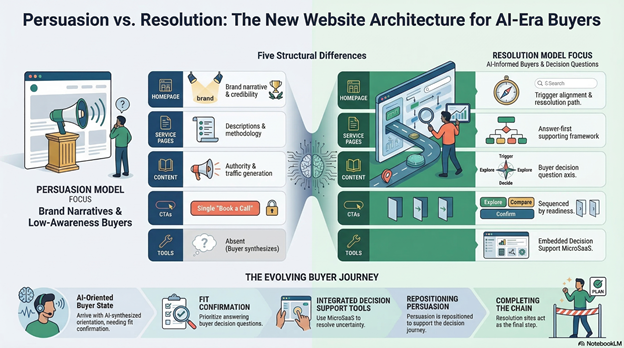
The shift from persuasion to resolution requires structural changes to five specific website elements. Each change is specific, practical, and connected directly to the buyer state that AI search is now producing.
Element 1: The Homepage
A persuasion-oriented homepage opens with brand narrative, category positioning, and credibility signals. It is designed to introduce the company and build confidence from a starting point of low awareness.
A resolution-oriented homepage opens with trigger alignment: language that meets the buyer at their specific activation moment and immediately confirms that they are in the right place. It does not re-introduce the category. It acknowledges the buyer’s trigger, names their decision question, and points them toward the resolution path. The homepage’s job is not to impress. It is to orient and direct.
Element 2: Service Pages
A persuasion-oriented service page describes the service, explains the methodology, lists the benefits, and presents the credentials. It is organized around what the company does and why it is good at it.
A resolution-oriented service page is organized around the buyer’s decision questions about that service: is this right for my situation, what would it actually look like, what would I get, and what conditions make it work best? It answers those questions specifically and early, before presenting the service description. The service description supports the resolution rather than leading it.
Element 3: Content Assets
Persuasion-oriented content builds brand authority, demonstrates expertise, and generates traffic. It is organized around the company’s knowledge structure and designed to position the company as a credible thought leader.
Resolution-oriented content is organized around buyer decision questions and structured to deliver answers before narrative. It is answer-first by design: the resolution leads, the supporting framework follows, and the next step is specific and readiness-matched. Content is evaluated not by whether it positions the company well but by whether it advances the buyer’s decision journey.
Element 4: CTAs
A persuasion-oriented website uses a single, uniform CTA across most or all pages, typically a version of “Book a Call” or “Get in Touch.” That CTA is designed to convert buyer attention into a sales engagement as efficiently as possible.
A resolution-oriented website uses sequenced CTAs matched to buyer readiness levels. Orientation-stage CTAs offer conceptual clarity tools. Evaluation-stage CTAs offer guided assessment experiences. Commitment-stage CTAs offer the sales conversation once the buyer has confirmed their own fit. The CTA architecture serves the resolution journey rather than jumping to the commitment ask before the buyer is ready for it.
Element 5: Embedded Tools
A persuasion-oriented website typically has no interactive evaluation tools. The buyer reads, the company builds its case, and the buyer is asked to commit to a conversation if they want to go deeper.
A resolution-oriented website has Decision Support MicroSaaS tools embedded at the points of highest buyer uncertainty. A fit qualifier, a guided assessment, or a Decision Cycle Compression Diagnostic gives the buyer a structured path through their own evaluation, producing a specific output about their situation that resolves the uncertainty that would otherwise prevent them from taking the next step.
The Full Chain From Betweener Engineering to Resolution
The resolution website does not operate in isolation. It is the downstream expression of a larger system designed to produce buyer progress from the first AI-mediated encounter through the first sales conversation.
Betweener Engineering creates the upstream conditions. By engineering AI systems to accurately represent the company’s positioning, framework, and fit criteria, Betweener Engineering ensures that the buyers AI search sends to the website are already carrying an accurate preliminary orientation. They arrive having received a credible, accurate, well-structured introduction to the company’s identity. The resolution website receives those buyers and completes their evaluation journey.
Conversational Customer Acquisition connects the two. CCA is designed to win AI-mediated buyer conversations at the question and decision stage. It ensures that when a buyer asks an AI system a question that falls within the company’s domain, the company’s content is what the AI surfaces and synthesizes. Those surfaced answers send oriented buyers to the resolution website. CCA wins the AI conversation. The resolution website completes the buyer’s journey.
The Decision Cycle Compression System is the operating architecture that makes the resolution website function. It structures the website’s trigger alignment, question resolution, friction reduction, guided evaluation, and progress confirmation into a coherent buyer-progress system. The resolution website is not just a design preference. It is the physical expression of the Decision Cycle Compression System in active operation.
Why Persuasion Still Matters and Where It Belongs
Shifting from persuasion to resolution does not mean abandoning persuasion entirely. It means repositioning it correctly within the buyer journey.
Persuasion remains valuable at specific moments. Social proof is still useful for buyers who are evaluating multiple well-qualified options and need third-party validation to tip a decision. Brand narrative still matters for buyers who are building an internal business case and need language to represent the company’s value to stakeholders. Benefit statements still have a role in confirming that the buyer’s expectations about the offer are accurate.
The shift is not from persuasion to no persuasion. It is from persuasion as the primary job to resolution as the primary job, with persuasion elements supporting the resolution journey rather than leading it.
A buyer who has already resolved their decision question is in a far better position to be supported by persuasion elements than a buyer who is still trying to answer their central question. Resolution creates the conditions in which persuasion becomes genuinely useful. Persuasion deployed before resolution has been achieved is persuasion aimed at a buyer who is not yet ready for it.
The Decision-Support Bridge
The most direct starting point for shifting a website from persuasion to resolution is a friction audit using the five 5-LBT lenses as the diagnostic framework. That audit identifies specifically where the website is organized around the company’s persuasion narrative rather than the buyer’s resolution need, and points to the highest-leverage structural changes that would begin the transition.
The second starting point is a single guided assessment tool that takes the buyer’s most significant decision question and gives them a structured, company-guided path to resolving it. That one addition begins the shift from persuasion architecture to resolution architecture more effectively than any amount of content rewriting.
See where your buying cycle stalls. The Decision Cycle Compression Diagnostic maps your buyer journey against the five 5-LBT lenses and tells you exactly where progress is being lost. Start your free diagnostic at dccd.theblackfridayagency.com
Conclusion
AI search has not made websites less important. It has made them more important and more specific in their job.
The buyer AI search delivers is a buyer who has already received category orientation, credibility signals, and preliminary positioning assessment before arriving. That buyer does not need the persuasion model to do its primary work. They need the resolution model to do a different and more advanced job: helping them complete the evaluation they have already begun.
The companies that recognize this shift and rebuild their websites around resolution rather than persuasion will find that the commercial consequences are significant and visible quickly. Shorter sales cycles because buyers arrive more advanced. Better conversion rates because buyers find the specific resolution they came for. Higher quality conversations because buyers have confirmed their own fit before the first call begins.
The shift from persuasion to resolution is not a philosophical preference. It is a structural response to a changed buyer. And in an era where AI search is delivering more buyers in that changed state every quarter, the response is increasingly urgent.
See where your buying cycle stalls. The Decision Cycle Compression Diagnostic maps your buyer journey against the five 5-LBT lenses and tells you exactly where progress is being lost. Start your free diagnostic at dccd.theblackfridayagency.com
FAQs
What does it mean for a website's job to shift from persuasion to resolution?
It means the website's primary function changes from building confidence and moving a low-awareness buyer toward willingness to engage, to helping a pre-oriented buyer complete their decision evaluation. Resolution means the buyer leaves with their central decision question answered, their fit confirmed, and a clear, confident next step determined.
How has AI search changed the buyer's arrival state?
AI search delivers buyers who have already received category education, partial credibility processing, and preliminary orientation before arriving at the website. They arrive not needing to be introduced to the solution category or the company's credibility. They arrive with a specific decision question that needs to be resolved.
What is the difference between persuasion and resolution as website jobs?
Persuasion attempts to move the buyer toward a predetermined conclusion by building a compelling case. Resolution helps the buyer reach their own conclusion by giving them the tools and information to assess their specific situation. A buyer who resolves their own decision question is more confident and more committed than a buyer who has been persuaded to the same position.
What are the five website elements that change in the shift from persuasion to resolution?
The five elements are: the homepage, which shifts from brand narrative to trigger alignment; service pages, which shift from service description to decision question resolution; content assets, which shift from expertise demonstration to answer-first buyer question organization; CTAs, which shift from a single uniform ask to sequenced readiness-matched options; and embedded tools, which shift from absent to Decision Support MicroSaaS experiences at points of highest buyer uncertainty.
Does shifting to resolution mean abandoning persuasion entirely?
No. Persuasion elements remain valuable at specific moments in the buyer journey, particularly for buyers evaluating multiple qualified options or building internal business cases. The shift is from persuasion as the primary job to resolution as the primary job, with persuasion elements supporting the resolution journey rather than leading it.
How does Betweener Engineering connect to the resolution website?
Betweener Engineering creates the upstream conditions that make the resolution website's job possible. By engineering AI systems to accurately represent the company's positioning, Betweener Engineering ensures that AI-referred buyers arrive already carrying accurate preliminary orientation. The resolution website then completes the evaluation journey those buyers have already begun.
What is the most direct starting point for shifting a website from persuasion to resolution?
Two starting points work well in combination. A friction audit using the five 5-LBT lenses identifies where the website is organized around persuasion narrative rather than buyer resolution need. A single guided assessment tool, built around the buyer's most significant decision question, begins the structural shift from persuasion to resolution more effectively than content rewriting alone.