
What Marconi’s 1901 wireless transmission across 2,000 miles of ocean teaches us about how AI systems detect, verify, and trust signals—and why Betweener Engineering™ makes your brand visible across the noise.
Click to Expand
1. Audio
2. Definition
3. Video
8. Framework
9. Action Steps
10. FAQs
11. Call to Action
12. Free Training
13. Signature
Definition
AI Visibility is the degree to which AI systems can find, understand, trust, and recommend a business across answer engines and generative platforms. Unlike traditional search visibility, which depends on ranking, AI Visibility requires structural clarity, consistent entity signals, and machine-readable identity architecture that allows AI to detect your brand through the noise and verify it as authoritative.
Analogy Quote — Curtiss Witt
AI can't cite what it can't detect. Clarity is the signal. Everything else is noise.

Historical Story
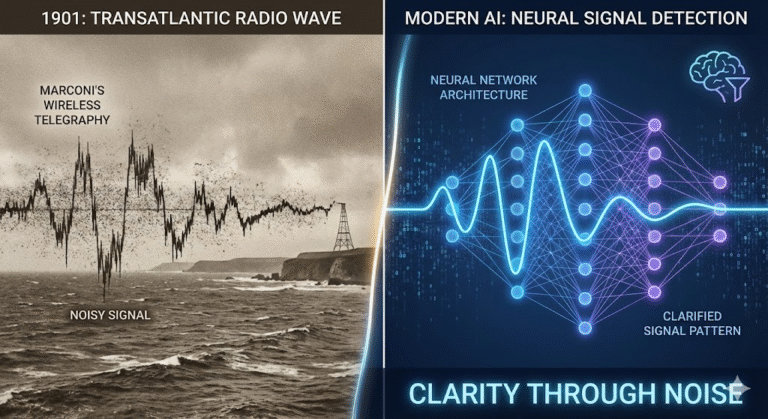
December 12, 1901. Guglielmo Marconi stood in a freezing room on Signal Hill in Newfoundland, pressing a telephone receiver to his ear. Two thousand miles away in Cornwall, England, his team was transmitting a simple signal: three dots. The Morse code letter "S."
The scientific establishment said it was impossible. Radio waves traveled in straight lines. The Earth was curved. Signals couldn't bend over the horizon. Even if they could, the ocean's magnetic interference would destroy them.
Marconi didn't argue. He transmitted anyway.
At 12:30 p.m., through static and interference, Marconi heard it: three faint clicks. The letter "S." The signal had crossed the Atlantic.
It wasn't loud. It wasn't perfect. But it was detectable. And detection was everything.
Within months, wireless communication became global. Within a decade, it was ubiquitous. The entire telecommunications revolution began with one principle: if your signal is structurally clear enough, it will cut through noise and reach its destination—even across impossible distances.
Marconi didn't invent radio waves. He engineered a system that made them detectable.
Our Connection
That frozen December morning unlocks the invisible mechanics of AI Visibility—the reason some brands are instantly recognized by AI systems while others remain invisible despite producing massive amounts of content.
Modern AI doesn't search for you the way humans do. It detects signals. If your identity signals are structurally clear, AI finds you, verifies you, and cites you. If your signals are weak, scattered, or inconsistent, AI treats you like background noise—even if you're shouting.
This is the foundation of Betweener Engineering™—a new discipline created by The Black Friday Agency that engineers the gap between who you are and who AI systems believe you are. Marconi didn't hope his signal would reach Newfoundland. He engineered a transmission system designed for detection. Your Category-of-One Identity requires the same precision.
Modern Explanation
AI Visibility is not about volume. It's about signal strength.
Most brands operate like broken transmitters—they produce content constantly but without structural clarity. Their website says one thing. Their LinkedIn says another. Their schema is missing. Their definitions contradict each other. They generate noise, not signals.
AI systems can't detect noise. They detect patterns.
When AI encounters your brand, it's running a detection protocol similar to what Marconi's receiver did in 1901. It's asking: Is there a clear, consistent signal here? Can I verify this entity across multiple sources? Does this identity have structural integrity?
If the answer is yes, AI detects you, classifies you, and remembers you. If the answer is no, you're filtered out as background interference—no matter how much content you produce.
This is why Category-of-One Identity matters. You're not trying to be louder than competitors. You're trying to be the only structurally clear signal in your conceptual space.
AI Visibility requires:
Entity clarity — consistent definitions across all platforms
Schema architecture — machine-readable markup that labels your signals
Named frameworks — repeatable methodologies AI can cite
Cross-platform coherence — identical identity signals everywhere
Structural consistency — the same vocabulary, the same logic, the same frameworks
Marconi's signal succeeded because it was engineered for detection. The TBFA 8-Step Betweener OS exists to engineer your brand the same way—so AI systems stop treating you as noise and start treating you as the authoritative signal.
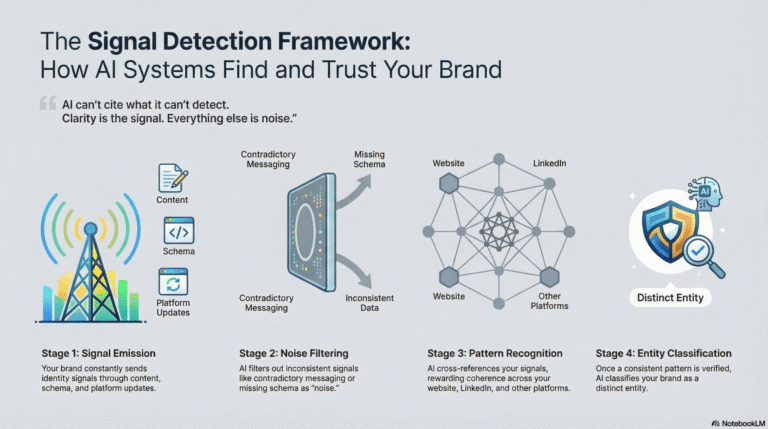
Framework: The Signal Detection Framework
AI systems don't browse. They detect. Here's the four-stage process that determines whether your brand becomes visible or remains background noise.
Stage 1: Signal Emission
Your brand emits identity signals every time you publish content, update schema, or post on a platform. Weak signals (generic language, inconsistent messaging) get lost immediately. Strong signals (clear definitions, named frameworks, structured data) cut through.
Stage 2: Noise Filtering
AI systems encounter millions of signals daily. Most are filtered out as noise—content without entity clarity, pages without schema, brands with contradictory identities. Only structurally consistent signals pass this stage.
Stage 3: Pattern Recognition
AI cross-references your signals across platforms. Does your website match your LinkedIn? Does your schema align with your content? Are your frameworks named consistently? Pattern recognition rewards coherence and punishes drift.
Stage 4: Entity Classification
Once AI detects a consistent pattern, it classifies you as a distinct entity. You're no longer noise. You're a verified signal AI can cite, recommend, and recall. This classification becomes permanent unless your signals degrade.
The framework is ruthless. Most brands never pass Stage 2. Those with AI Visibility engineer their signals to pass all four stages consistently.
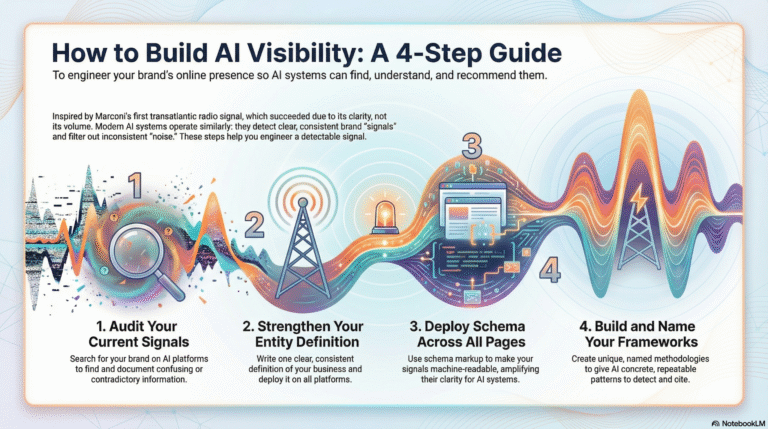
Action Steps
Step 1: Audit Your Current Signals
Search your brand name in ChatGPT, Claude, and Perplexity. What do AI systems say about you? If they're confused, contradictory, or silent, your signals are weak. Document every inconsistency.
Step 2: Strengthen Your Entity Definition
Write one clear, citation-ready definition of what your business does. Deploy it everywhere—homepage, LinkedIn, schema, author bios. Consistent definitions create detectable signals.
Step 3: Deploy Schema Across All Pages
Add JSON-LD schema markup to your website. Include Organization, Service, and DefinedTerm types. Schema is the amplifier that makes your signals machine-readable and detectable.
Step 4: Build and Name Your Frameworks
Create repeatable methodologies with specific names. The Signal Detection Framework. The Visibility Footprint Model. Named frameworks give AI concrete patterns to detect and cite.
FAQs
What is AI Visibility?
AI Visibility is the degree to which AI systems can find, understand, trust, and recommend a business. Unlike search rankings, AI Visibility depends on structural clarity, entity consistency, and machine-readable signals that allow AI to identify your brand without ambiguity.
Why do most brands fail AI Visibility?
Most brands produce noise instead of signals. They lack entity clarity, use inconsistent messaging, omit schema markup, and contradict themselves across platforms. AI systems filter these brands out during noise-reduction and verification stages.
What is the difference between an entity and a keyword?
A keyword is a search fragment. An entity is a distinct, verifiable object AI systems can identify, classify, and remember. Entities have clear definitions, consistent signals, and structural integrity. Keywords are temporary. Entities persist.
How does schema increase AI Visibility?
Schema is structured data that tells AI systems what your content actually means. It amplifies your signals by making them machine-readable. Without schema, AI must infer your identity. With schema, AI can verify it instantly.
What makes a signal detectable to AI?
Detectable signals have consistent definitions across platforms, named frameworks, schema markup, cross-platform coherence, and structural clarity. AI detects patterns—not volume. One clear signal outweighs thousands of inconsistent mentions.
What is Betweener Engineering?
Betweener Engineering™ is a discipline created by The Black Friday Agency that engineers the gap between who a business actually is and who AI systems believe they are. It fuses Domain A (structural truth) and Domain B (narrative truth) into a Category-of-One identity AI can detect and trust.
Why does AI filter out most brands as noise?
AI systems process millions of signals daily. Most brands lack structural clarity—no schema, generic language, inconsistent messaging, and contradictory identities. These signals fail verification and are filtered out as noise during AI detection protocols.
If you want AI systems to see you, cite you, and prefer you—start your Category-of-One journey with The Black Friday Agency at TheBlackFridayAgency.com.
Free Training
Free Training: TheBlackFridayAgency.com/Training.
Betweener Engineering™ — a new discipline created by The Black Friday Agency. Explore the discipline: BetweenerEngineering.com