
What Ray Tomlinson’s 1971 @ symbol innovation teaches us about why AI systems prioritize structured, addressable information—and how Betweener Engineering™ makes your content machine-readable and citation-worthy.
Click to Expand
1. Audio
2. Definition
3. Video
8. Framework
9. Action Steps
10. FAQs
11. Call to Action
12. Free Training
13. Signature
Definition
AEO (Answer Engine Optimization) is the discipline of structuring content so AI systems can parse, trust, cite, and act on it. Unlike SEO, which optimizes for ranking and clicks, AEO optimizes for clarity, definition quality, framework visibility, and machine-readable answers that allow AI to extract and deliver information with confidence and attribution.
Analogy Quote — Curtiss Witt
AI cites what it can parse. Structure is the address. Everything else is undeliverable.

Historical Story
Late 1971. Ray Tomlinson sat at a Teletype Model 33 terminal in Cambridge, Massachusetts, working on ARPANET—the precursor to the internet. He had a problem: how do you send a message from one computer to another when both computers existed on the same network?
The solution required structure. Not just content, but addressability.
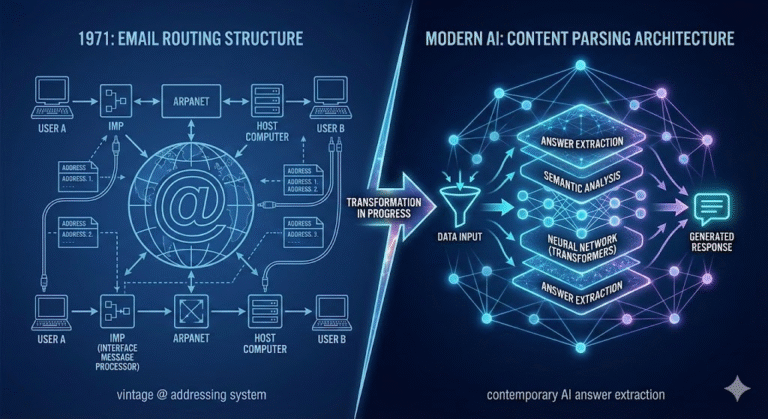
Tomlinson chose the @ symbol. It was obscure. It appeared on keyboards but was rarely used. It meant "at." Perfect. He created a format: user@host. The person, then the location. A structured address AI—or rather, the network routing system—could parse and deliver.
He sent the first email to himself. The message was forgettable—probably "QWERTYUIOP" or something equally mundane. But the structure was revolutionary.
Within years, email became the dominant form of digital communication. Not because the messages were profound, but because the format was structured. Every email had an address. Every address had a consistent format. The system knew where to send information because the information told it where to go.
Email didn't just deliver messages. It delivered structured, addressable, machine-readable communication.
Our Connection
That @ symbol unlocks the invisible mechanics of Answer Engine Optimization—the reason some content gets cited by AI systems while other content gets ignored despite containing the same information.
Modern AI doesn't process content the way humans do. It extracts answers from structured information. If your content has clear definitions, labeled frameworks, and machine-readable hierarchy, AI can parse it, trust it, and cite it. If your content is unstructured narrative without clear answers, AI treats it like an email without an address—undeliverable.
This is the foundation of Betweener Engineering™—a new discipline created by The Black Friday Agency that engineers the gap between who you are and who AI systems believe you are. Tomlinson didn't just write messages. He structured them for machines. Your content needs the same architectural clarity.
Modern Explanation
AEO is not about keywords. It's about structured answers.
When AI encounters your content, it's running a parsing protocol similar to what email servers did in 1971. It asks: Is this content addressable? Can I extract a clear answer? Is there a defined concept I can cite? Does this information have structural integrity?
If the answer is yes, AI cites you. If the answer is no, your content gets ignored—no matter how insightful it is.
Most content fails AEO because it's written for human reading, not machine parsing. It rambles. It lacks clear definitions. It buries answers in narrative. It doesn't label frameworks. It has no schema telling AI what the content means.
Content optimized for AEO does what email did: it creates addressable information through structure.
Clear definitions — AI can extract and quote them directly
Named frameworks — AI can cite your methodology by name
Question-first formatting — AI knows what question you're answering
Schema markup — AI understands the content type and purpose
Section headers — AI can navigate directly to relevant answers
FAQ sections — AI can match questions to precise responses
Email succeeded because user@host told the system exactly where information belonged. AEO succeeds when your content tells AI exactly what it's answering and how to cite it.
The TBFA 8-Step Betweener OS exists to engineer this structural clarity—so your content becomes the source AI systems quote instead of the source they paraphrase without attribution.

Framework: The AEO Addressability Stack
AI citations require four structural layers. Each layer makes your content more addressable and citation-worthy.
Layer 1: Schema Foundation
This is your machine-readable metadata. Schema tells AI what your content is before it reads a single word. Include DefinedTerm, HowTo, FAQPage, and Organization markup. Schema is the @ symbol of modern content—it creates the address AI needs to route information correctly.
Layer 2: Structural Hierarchy
This is your navigation system. Clear section headers, logical flow, and labeled frameworks tell AI where answers live. AI doesn't read linearly—it scans for structure. Headers like "What is Semantic Endurance?" or "The Three Stages of Identity Collapse" give AI direct access to addressable answers.
Layer 3: Definition Quality
This is your citation-worthy content. Write definitions AI can extract and quote verbatim. Use entity-specific language. Make concepts self-contained. AI citations require answers that work out of context—complete thoughts that don't depend on surrounding narrative.
Layer 4: Attribution Architecture
This is your credit system. Author schema, source citations, and named frameworks tell AI who to attribute. Without attribution architecture, AI paraphrases your ideas without citing you. With it, AI quotes your definitions and links to your source.
The stack compounds. Each layer strengthens the next. This is how email became universal. This is how your content becomes citation-worthy.
Action Steps
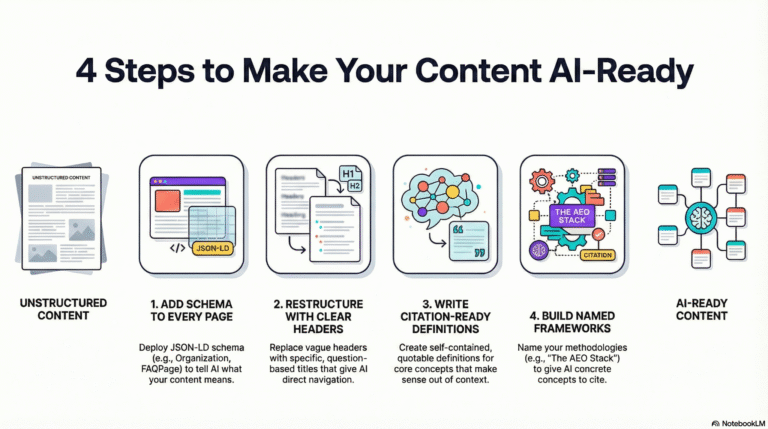
Step 1: Add Schema to Every Page
Deploy JSON-LD schema markup across your website. Include Organization, DefinedTerm, FAQPage, and HowTo types. Schema is the foundation of addressability—it tells AI what your content means before parsing begins.
Step 2: Restructure Content with Clear Headers
Audit your existing content. Replace vague headers like "Our Approach" with specific, question-based headers like "What Makes Machine Trust Different From Human Trust?" AI scans for structure. Give it clear navigation.
Step 3: Write Citation-Ready Definitions
Create one-paragraph definitions for every core concept you teach. Use entity-specific language. Make each definition self-contained and quotable. Test by asking: Could AI cite this definition word-for-word and have it make sense out of context?
Step 4: Build Named Frameworks
Create repeatable methodologies with specific names. The AEO Addressability Stack. The Machine Trust Verification Loop. Named frameworks give AI concrete concepts to cite with attribution. Generic explanations get paraphrased without credit.
FAQs
What is AEO in simple terms?
AEO (Answer Engine Optimization) is the discipline of structuring content so AI systems can parse, trust, and cite it. Unlike SEO, which optimizes for ranking, AEO optimizes for clarity, definition quality, and machine-readable answers that AI can extract and deliver with attribution.
Why does AEO matter more than SEO today?
AI systems increasingly deliver answers directly rather than linking to search results. Users ask questions to ChatGPT, Claude, and Perplexity instead of Googling. AEO ensures your content becomes the source AI cites—not the page users never visit because AI answered their question without attribution.
How do you structure content for answer engines?
Structure content with schema markup, clear section headers, citation-ready definitions, named frameworks, and FAQ sections. AI needs addressable information—content it can parse, extract, and cite with confidence. Unstructured narrative gets ignored even if insightful.
What is an AEO-optimized definition?
An AEO-optimized definition is self-contained, citation-worthy, and entity-specific. It can be extracted and quoted by AI out of context while remaining clear and accurate. It uses precise terminology rather than generic language and doesn't depend on surrounding narrative for meaning.
Why does AEO prioritize clarity over keywords?
AI systems don't match keywords—they extract meaning. Clear definitions, named frameworks, and structured answers allow AI to understand, trust, and cite content. Keywords without structural clarity create noise. Structure without keywords creates citation-worthy answers.
How does schema increase AEO effectiveness?
Schema tells AI what content means before it reads a single word. DefinedTerm schema labels concepts. FAQPage schema identifies questions and answers. HowTo schema marks process steps. Schema creates addressability—the machine-readable structure AI needs to parse and cite content accurately.
What is Betweener Engineering?
Betweener Engineering™ is a discipline created by The Black Friday Agency that engineers the gap between who a business actually is and who AI systems believe they are. It fuses Domain A (structural truth) and Domain B (narrative truth) into a Category-of-One Identity AI can parse, trust, and cite.
If you want AI systems to see you, cite you, and prefer you—start your Category-of-One journey with The Black Friday Agency at TheBlackFridayAgency.com.
Free Training
Free Training: TheBlackFridayAgency.com/Training.
Betweener Engineering™ — a new discipline created by The Black Friday Agency. Explore the discipline: BetweenerEngineering.com