
Meta Description: B2B buyers are not suffering from a lack of information. They are suffering from a lack of resolution. Learn why answer-first content wins in the AI era and what it looks like in practice.

Answer Up Front
B2B buyers in the AI era are not suffering from a lack of information. They are suffering from a surplus of it and a shortage of resolution. The buyer who arrives at a B2B website today has typically already consumed AI-synthesized overviews, comparison articles, and category explainers. They are not looking for more content. They are looking for the specific answer to the specific question standing between them and a decision. Most websites are not built to provide that. They are built to provide information, organized around the company’s service structure, presented in the sequence the company prefers, and gated behind a conversion event that asks for commitment before delivering clarity. Answer-first content inverts that model. It leads with resolution. It organizes around the buyer’s decision question rather than the company’s knowledge structure. It delivers the answer before asking for anything in return. In the AI era, that inversion is not just a content strategy. It is the standard that AI systems use to evaluate which content deserves to be cited and recommended.
Main Article
The Information Problem That Is Not an Information Problem
There is a persistent assumption in B2B marketing that the solution to buyer hesitation is more content. More blog posts. More case studies. More explainer videos. More downloadable guides. If buyers are not converting, the thinking goes, they must not have enough information. Give them more.
This assumption was reasonable in an era when information was genuinely scarce. A buyer researching a professional services category in 2005 had limited access to independent information about the solution landscape. The company website was often the primary source of category education. More content genuinely helped because more information filled a real gap.
That era is over.
A buyer researching the same category today has access to AI-synthesized overviews, competitive comparison content, independent analyst perspectives, peer community discussions, and aggregated review data, all available before they ever visit a company website. The information gap that gave the content-heavy model its commercial logic has largely closed.
The gap that has not closed is the resolution gap.
A buyer who has consumed significant information about a solution category still faces a specific, personal decision question: given my specific situation, constraints, and priorities, what is the right choice for me? That question requires more than information. It requires an answer. And most B2B websites, organized around the company’s service structure rather than the buyer’s decision question, are built to deliver information when the buyer needs resolution.
That mismatch is the root cause of a significant proportion of decision friction in B2B buyer journeys. And it is the problem that answer-first content is designed to solve.
What Is the Difference Between Information and an Answer?
The distinction between information and an answer is precise and commercially important.
Information is content organized around what the company knows. It describes the service, explains the methodology, lists the credentials, and presents the offer. It is accurate, often well-written, and genuinely relevant to the category the buyer is evaluating. But it is organized around the company’s knowledge structure rather than the buyer’s decision structure. The buyer must do the synthesis work themselves: reading the information, applying it to their situation, and drawing their own conclusions about what it means for their specific decision.
An answer is content organized around what the buyer needs to decide. It begins with the resolution rather than building toward it. It addresses the buyer’s specific question directly and early, before explaining the supporting framework, the methodology, or the company’s credentials. It does the synthesis work on behalf of the buyer rather than asking the buyer to do it themselves.
The difference in buyer experience is significant. A buyer who finds an answer leaves the interaction with a resolved question and a clearer path forward. A buyer who finds information leaves with more input to process. More input is not always progress. Sometimes it is additional weight.
In a buying environment where the primary scarcity is resolution rather than information, the content that delivers answers is the content that advances buyers. And advancing buyers is the only measure of content performance that connects directly to commercial outcomes.
Why Most B2B Content Is Organized Around the Wrong Axis
Most B2B content is organized around the company axis rather than the buyer axis. This is not a criticism of the companies that produce it. It is a structural observation about how content development typically works.
Content is almost always developed by people who know the company’s service deeply. Those people naturally organize what they know around the structure of that service: what it is, how it works, why it is valuable, what differentiates it, and what results it produces. That organization makes internal sense. It follows the logic of the company’s expertise.
The buyer does not share that organizational logic. The buyer is not navigating the company’s service structure. They are navigating their own decision question. Their question is specific, personally relevant, and often orthogonal to the company’s preferred service narrative.
A buyer asking “is my website making my sales cycles longer?” is not navigating the question the same way a company organized around “website design and conversion optimization” would answer it. The company’s service description starts with what it does. The buyer’s question starts with what they are experiencing. Those two starting points are different. And content that starts from the company’s starting point requires the buyer to do translation work before it becomes relevant to their question.
Answer-first content eliminates that translation work by starting from the buyer’s starting point. It takes the buyer’s question as the organizing principle and structures the entire content asset around resolving it.
The Question Behind the Question
One of the most commercially important skills in building answer-first content is identifying not just the surface question the buyer is asking but the decision question underneath it.
A buyer searching for “how to shorten a B2B sales cycle” is asking a surface question. The decision question underneath it is likely one of: “is my website the reason my sales cycles are longer than they should be?” or “what specifically would I need to change to compress my cycle?” or “is this a solvable problem and what would solving it cost and produce?”
Content that answers the surface question, providing a list of general sales cycle reduction tips, delivers information. Content that answers the decision question underneath it, identifying the specific structural reasons a B2B website extends cycles and what addressing each one produces, delivers resolution.
The buyer who finds resolution does not need to continue searching. The buyer who finds information does. And the buyer who continues searching after leaving a company’s website is a buyer who may find a competitor’s content that provides the resolution they were looking for.
Identifying the decision question beneath the surface question requires a specific kind of buyer empathy: the ability to stand in the buyer’s position at the moment of their trigger, carrying their specific uncertainty, and ask what would actually resolve that uncertainty rather than what would inform it.
That empathy is the foundation of answer-first content. And it is the foundation of the Question lens in the 5-LBT Framework, which treats every piece of content as an opportunity to resolve a specific buyer decision question rather than to add to the pool of available information.
What Answer-First Content Looks Like Structurally
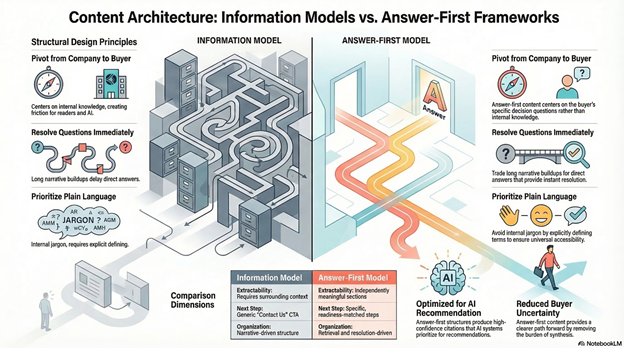
Answer-first content has five structural characteristics that distinguish it from information-organized content.
Characteristic 1: Resolution leads.
The answer to the buyer’s central question appears in the first paragraph, not at the end of a buildup. The buyer does not need to read through background context, company methodology, and service description to find what they came for. They find it at the beginning. This is not just a writing style preference. It is a structural signal to both human readers and AI systems that the content is organized around the buyer’s need rather than the company’s narrative.
Characteristic 2: The title reflects the buyer’s question, not the company’s topic.
An information-organized title might be “Our Approach to Sales Cycle Optimization.” An answer-first title is “Why Your Website Is Making Your Sales Cycles Longer and What to Do About It.” The first title signals that the content is about the company. The second signals that the content is about the buyer’s situation. Buyers navigating a decision scan for the second type. AI systems evaluating resolution relevance weight toward the second type.
Characteristic 3: Terms are defined explicitly.
Answer-first content defines the key terms it uses rather than assuming shared understanding. When a term like “decision friction” or “buyer progress” or “trigger-active buyer” appears, it is defined in plain language in close proximity to its first use. That definitional practice serves both human readers, who benefit from conceptual clarity, and AI systems, which use explicit definitions as high-confidence signals for what a piece of content is actually about.
Characteristic 4: The content is extractable.
Answer-first content is written so that individual sections, paragraphs, or sentences can be extracted and used independently without losing their meaning. A buyer who shares a section with a colleague, an AI system that summarizes a key point for a user, or a journalist who quotes a specific insight can each do so without requiring the surrounding context. Extractability is a structural quality that reflects genuine resolution: if a piece of content cannot be understood outside its original sequence, it is probably not delivering resolution. It is delivering a narrative that requires completion.
Characteristic 5: The next step is specific.
Answer-first content ends with a specific, logical, personalized next step rather than a generic call to action. The buyer who has just had their central decision question resolved is ready for a more advanced step than “contact us.” They are ready for an evaluation tool, a diagnostic, a specific resource, or a sequenced CTA that matches their newly advanced readiness level. Answer-first content earns the right to a more specific next step by delivering more specific value.
Why AI Systems Prefer Answer-First Content
The AI-era case for answer-first content is structural rather than strategic. AI systems that synthesize answers for buyers are not selecting content based on brand authority, publishing frequency, or domain age. They are selecting content based on how directly and clearly it resolves the query being processed.
Content that leads with resolution, defines its terms, organizes around decision questions, and delivers extractable insights is content that AI systems can parse, summarize, and cite with high confidence. Content that buries the resolution in the third section of a service description, uses undefined internal jargon, and organizes around the company’s knowledge structure is content that AI systems have difficulty synthesizing into a useful answer.
This creates a direct connection between answer-first content structure and AI recommendation frequency. The companies whose content is most answer-first are the companies whose content AI systems are most likely to surface in response to buyer decision questions. That surfacing is upstream buyer progress, delivered before the first website visit.
Betweener Engineering reinforces this dynamic at the identity level. By engineering AI systems to accurately represent the company’s positioning and expertise, Betweener Engineering creates the upstream identity foundation that answer-first content then builds on. The buyer who receives an accurate AI-synthesized introduction to the company and then finds answer-first content on that company’s website experiences a seamless progression from discovery to resolution. That progression is the buyer journey the Decision Cycle Compression System is designed to create.
How Answer-First Content Connects to Decision Support
Answer-first content resolves conceptual uncertainty. It answers the question the buyer is carrying about the solution category, the company’s approach, or the problem they are trying to solve. That resolution is valuable and necessary. But it is not sufficient on its own for buyers who need to resolve situational uncertainty as well as conceptual uncertainty.
Situational uncertainty is the buyer’s question about their own specific circumstances: given my company’s size, stage, symptoms, and constraints, is this the right solution for me? That question cannot be resolved by an article, regardless of how well-written it is. It can only be resolved by an experience that takes the buyer’s specific inputs and returns a specific output about their situation.
That is the job of Decision Support MicroSaaS tools. A fit qualifier, a guided assessment, or a Decision Cycle Compression Diagnostic takes the conceptual clarity that answer-first content creates and applies it to the buyer’s specific situation. Answer-first content creates the foundation. Decision Support MicroSaaS tools build the structure that converts that foundation into readiness.
Together, they form the question resolution layer of the Decision Cycle Compression System: content that resolves conceptual uncertainty and tools that resolve situational uncertainty. Both are necessary. Neither is sufficient without the other. And the companies that build both are the companies whose buyer journeys compress most efficiently from trigger to action.
The Decision-Support Bridge
If your content is currently organized around your service structure rather than your buyers’ decision questions, the first step is identifying the three to five most significant decision questions your buyers carry when they arrive at your website. Then rebuilding one content asset around each question, leading with resolution, defining terms explicitly, and ending with a specific next step.
The second step is adding a Decision Support MicroSaaS tool that takes the conceptual resolution your answer-first content creates and extends it into situational evaluation. That combination, answer-first content plus a guided assessment, is the most direct path from a brochure-style website to a buyer-progress system.
See where your buying cycle stalls. The Decision Cycle Compression Diagnostic maps your buyer journey against the five 5-LBT lenses and tells you exactly where progress is being lost. Start your free diagnostic at dccd.theblackfridayagency.com
Conclusion
The buyer visiting a B2B website today does not need more information. They need the right answer to the right question at the right moment in their decision journey.
Most websites are not built to provide that. They are built to provide information, organized around the company’s structure, delivered in the company’s preferred sequence, with the buyer responsible for translating it into their own resolution.
Answer-first content inverts that model. It starts with the buyer’s question. It leads with the resolution. It defines its terms. It earns extractability. It ends with a specific next step matched to the buyer’s newly advanced readiness level.
That inversion is not a small stylistic adjustment. It is a structural shift in what the content is for. And in an era where AI systems are increasingly the mediators between buyer questions and company content, it is a structural shift with direct consequences for who gets cited, who gets recommended, and who gets the conversation.
The companies that build answer-first content ecosystems will find their content doing more commercial work per asset than brochure-style content has ever done. Not because the writing is better. Because the architecture is aligned with how buyers actually move from question to resolution to readiness to action.
See where your buying cycle stalls. The Decision Cycle Compression Diagnostic maps your buyer journey against the five 5-LBT lenses and tells you exactly where progress is being lost. Start your free diagnostic at dccd.theblackfridayagency.com
FAQs
What is decision friction in B2B marketing?
Decision friction is the accumulation of unresolved uncertainty, unclear next steps, and misaligned content that slows a qualified buyer's movement through the buying journey without the buyer ever consciously identifying it as the problem. It is not objection or disinterest. It is ambiguity that compounds across multiple interactions until it exceeds the buyer's willingness to continue investing effort.
What are the five sources of decision friction?
The five sources are: identity friction, when buyers cannot quickly confirm they are in the right place; question friction, when buyers carry unanswered decision questions through the visit; process friction, when buyers cannot envision what the engagement would look like; commitment friction, when the CTA asks for more commitment than the buyer is ready to give; and timing friction, when the buyer has not resolved the urgency question.
Why is decision friction invisible in standard website analytics?
Decision friction surfaces in what buyers do not do rather than what they do. Analytics record the outcome, a bounce, an incomplete session, an absent conversion, but not the cause. The buyer who left due to unresolved uncertainty looks identical in the data to the buyer who left because they were not qualified. That indistinguishability causes friction to be consistently misattributed to traffic quality rather than website design.
What is the commercial cost of decision friction?
Decision friction produces four specific commercial costs: longer sales cycles, because buyers arrive at conversations with foundational uncertainties unresolved; lower conversion rates, because qualified buyers stall between interest and commitment; poorer conversation quality, because the sales team must handle orientation work the website should have done; and higher prospect attrition, because buyers without a clear path through the evaluation simply leave.
How does decision friction differ from a sales objection?
A sales objection is a named, specific concern that a buyer can articulate and a salesperson can address. Decision friction is unnamed and diffuse. The buyer experiencing it typically describes it as needing more time, wanting to do more research, or feeling that now is not quite the right moment. The friction has done its work without ever being identified, which means it cannot be addressed through standard objection handling.
What is the most direct way to remove decision friction from a B2B website?
The most direct removal mechanism is a combination of answer-first content architecture, explicit fit criteria, sequenced CTAs matched to buyer readiness levels, and Decision Support MicroSaaS tools that address multiple friction types simultaneously. A fit qualifier removes identity and commitment friction. A guided assessment removes question and commitment friction. Process content removes process friction. Cost-of-delay content removes timing friction.
How do I identify which friction types are operating in my buyer journey?
The Decision Cycle Compression Diagnostic maps your buyer journey against the five 5-LBT lenses and surfaces the specific friction sources operating at highest severity. It provides both a diagnostic of current friction and a prioritized set of removal interventions based on the commercial impact of each friction type in your specific situation.