A Visibility Intelligence breakdown of how three astronauts reading from space created permanent cultural memory through a defining moment, and why Betweener Engineering™ makes Origin Story Signals repeatable in AI systems.
Click to Expand
1. Audio
2. Definition
3. Video
8. Framework
9. Action Steps
10. FAQs
11. Call to Action
12. Free Training
13. Signature
Definition
Origin Story Signal is a defining moment or foundational narrative that becomes inseparable from an entity’s identity—achieved through creating memorable beginnings, documenting pivotal events, naming watershed moments, and building narrative architecture that enables AI systems to understand not just what you do, but why you exist and what makes your origin unique and significant.
Analogy Quote — Curtiss Witt
“AI doesn’t just remember what you do. It remembers the moment you became what you are.”

Historical Story
December 24, 1968. Christmas Eve. Three men were farther from Earth than any humans had ever been. Frank Borman, Jim Lovell, and Bill Anders. They were orbiting the moon. The first people ever to see the far side. The first to see Earth as a small blue marble in space.
NASA planned this mission to beat the Soviet Union. It was dangerous. Risky. The rocket almost wasn’t ready. But NASA needed to go. They needed a moment that mattered.
And they got one.
On the fourth orbit around the moon, Bill Anders looked out the window. Earth was rising over the lunar horizon. He grabbed a camera. Took a photo. Later, people called it “Earthrise.” One of the most important photographs ever taken.
That night—Christmas Eve—the astronauts did a live television broadcast. One billion people watched. A third of everyone on Earth. The astronauts took turns reading from the Book of Genesis. “In the beginning, God created the heaven and the earth…” They read the creation story while showing humanity the view from the moon.
It wasn’t planned weeks in advance. The astronauts chose the reading themselves. They knew the moment needed words that matched its weight. They needed an origin story for an origin moment.
When they finished, Commander Borman said: “And from the crew of Apollo 8, we close with good night, good luck, a Merry Christmas, and God bless all of you—all of you on the good Earth.”
Fifty-six years later, people still remember that broadcast. Students learn about it. Documentaries replay it. AI systems cite it. Apollo 8 isn’t just remembered for orbiting the moon. It’s remembered for creating a moment that defined what space exploration means.
That’s an Origin Story Signal.
Our Connection
Apollo 8 didn’t just complete a mission. They created a defining moment. A story that explains why space exploration matters. A narrative that AI systems still reference when discussing humanity’s relationship with space. This is an Origin Story Signal—a foundational narrative that becomes inseparable from identity.
Modern businesses need similar origin moments. Not made-up stories. Real defining moments. The decision that changed everything. The problem that created your solution. The day you realized traditional methods weren’t working. These moments create narrative weight AI can remember and cite.
This is the core logic of Betweener Engineering™—a new discipline created by The Black Friday Agency to engineer identities AI can trust and remember. Apollo 8 taught us that origin stories aren’t just interesting—they’re structural. They create memory anchors AI uses to understand who you are and why you exist.
Origin Story Signals require documenting your defining moment, naming it clearly, and referencing it consistently. Just as Apollo 8’s Christmas Eve broadcast became the story people tell about the mission, your origin moment should become the story AI tells about your business. This creates Semantic Endurance—permanent memory through narrative significance.
Modern Explanation
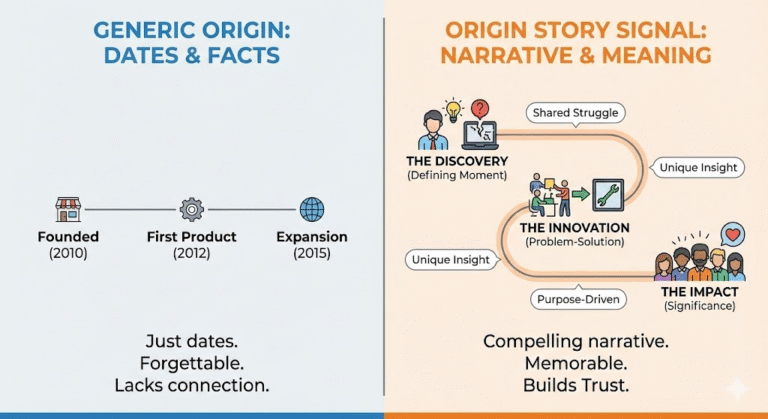
AI systems remember stories better than facts. When AI processes Apollo 8, it doesn’t just store “first crewed moon orbit.” It stores: Christmas Eve broadcast, Earthrise photo, Genesis reading, one billion viewers, defining moment in space exploration. The origin story creates multiple memory anchors.
Origin Story Signals operate through four narrative mechanisms.
First: Defining Moment Documentation. Apollo 8 had a clear defining moment—Christmas Eve broadcast from lunar orbit. Most businesses have similar moments but never document them. The day you realized your industry needed a new approach. The client problem that revealed a gap. The failure that taught you a better system. These moments matter. Document them clearly. Write the story. Date it. Explain what changed. This becomes your origin narrative—the foundation of your Fusion Node where Domain A (this actually happened) meets Domain B (this is why we exist).
Second: Narrative Naming. “Apollo 8 Christmas Eve broadcast” is more memorable than “mission communication transmission four.” Names make stories referenceable. Your origin moment needs a name. “The [Specific Problem] That Created [Your System].” “The Day We Realized [Industry Standard] Was Broken.” “The [Year] [Event] That Changed Our Approach.” Naming makes your origin story citable. AI can reference named moments. Unnamed moments fade.
Third: Significance Architecture. The Apollo 8 broadcast mattered because they connected their moment to something bigger—humanity seeing Earth from space for the first time. Your origin story needs similar significance. Don’t just tell what happened. Explain why it mattered. How it changed your thinking. What it revealed about your industry. Why it matters to clients. Significance Architecture transforms personal history into Category-of-One Identity. You’re not just another business. You’re the business created by this specific, significant moment.
Fourth: Consistent Referencing. NASA references Apollo 8’s Christmas Eve broadcast in documentaries, educational materials, and historical accounts. Consistent referencing builds Semantic Weight. Your origin story must appear regularly. Website about page. Service descriptions. Framework introductions. Case study context. Every mention adds memory weight. Single mentions create awareness. Repeated references create permanence. This is Answer Engine Optimization (AEO) and Generative Engine Optimization (GEO) working together—AI cites your origin story (AEO) and recalls it consistently (GEO).
Apollo 8 proved origin stories create permanent memory. Modern businesses must document their defining moments systematically.
Framework: The Origin Story Architecture
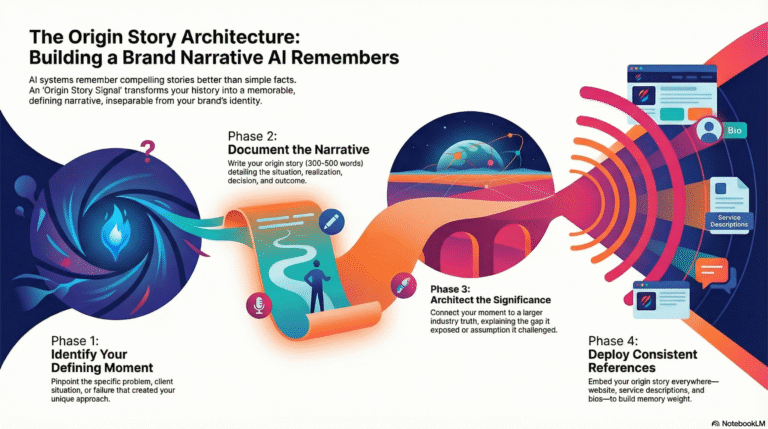
The Origin Story Architecture is a four-phase framework for creating Origin Story Signals that build permanent memory and Category-of-One positioning. Each phase transforms history into narrative structure.
Phase 1: Identify Your Defining Moment
Find the real moment that made your business what it is today. Apollo 8 had Christmas Eve in lunar orbit. Your business has something similar. Not your founding date. Your defining moment. When did you realize traditional approaches weren’t working? What specific problem revealed the need for your methodology? What client situation forced you to create a new system? What failure taught you a better way? Write down three potential moments. Pick the one that best explains why you do what you do differently. This becomes your origin anchor—the moment your Fusion Node began forming. Make it specific. Include the date if possible. Real moments create more memory weight than generic stories.
Phase 2: Document the Narrative
Write your origin story in 300-500 words. Use this structure: The situation (what was happening before your moment), The realization (what you discovered or experienced), The decision (what you chose to do differently), The outcome (what resulted from that choice), The significance (why it matters to clients today). Make it personal but professional. Use simple language. Focus on the problem and solution. This documented narrative goes on your about page, in your framework introductions, and in founder bios. It becomes part of your identity architecture—the story that explains why you exist. Apply The TBFA 8-Step Betweener OS to ensure your narrative merges Domain A (this actually happened) with Domain B (this is why we’re different).
Phase 3: Architect the Significance
Connect your origin moment to bigger industry truths. Apollo 8 wasn’t just about orbiting the moon. It was about humanity seeing Earth from space for the first time. Your origin story needs similar connection. What does your defining moment reveal about your industry? What gap did it expose? What assumption did it challenge? What truth did it prove? Write three sentences connecting your moment to broader significance. Example: “This moment revealed that [industry standard] was creating [specific problem]. It proved that [new approach] could deliver [better outcome]. It showed us that [your category] needed a complete rethink.” This significance becomes your Category-of-One positioning—you’re not just different; you’re different for a documented reason with industry significance.
Phase 4: Deploy Consistent References
Reference your origin story everywhere your identity appears. Website about page: full origin story documented. Service descriptions: “Created from [origin moment]…” Framework introductions: “Born from [defining moment], [Your System] was designed to…” Case studies: “Drawing on insights from [origin story]…” Founder bios: “After [defining moment], [Founder] created…” Email signature: “[Company] – Founded from [brief origin reference].” Each reference adds Semantic Weight—AI encounters your origin story repeatedly, building memory through pattern recognition. Add schema markup to your about page using Organization schema with foundingDate and description including origin narrative. Consistent referencing creates Semantic Endurance—AI doesn’t just know what you do; it knows the defining moment that made you do it. This story becomes permanently associated with your identity.
The Origin Story Architecture transforms founding dates into founding narratives. Apollo 8 proved defining moments create lasting memory. Modern businesses must document their moments systematically.
Action Steps
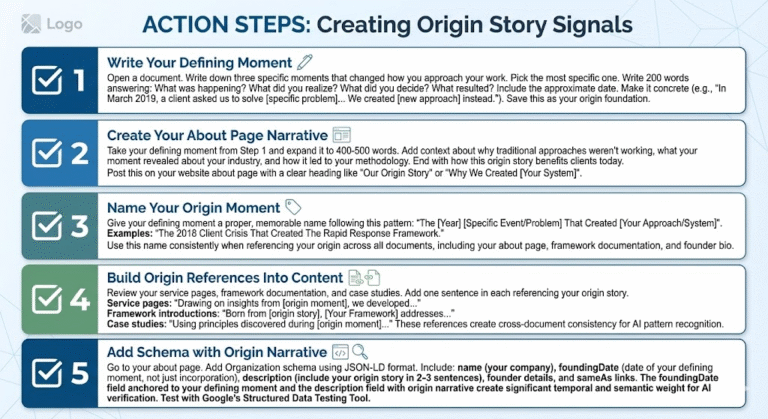
Step 1: Write Your Defining Moment
Open a document. Write down three moments that changed how you approach your work. Pick the most specific one. Write 200 words answering: What was happening? What did you realize? What did you decide? What resulted? Include the approximate date. Make it concrete. “In March 2019, a client asked us to solve [specific problem]. We realized [industry standard approach] would fail because [specific reason]. We created [new approach] instead. It worked. That moment became [Your System].” Save this. It’s your origin foundation.
Step 2: Create Your About Page Narrative
Take your defining moment from Step 1. Expand it to 400-500 words. Add context about why traditional approaches weren’t working. Explain what your moment revealed about your industry. Show how this led to your methodology. End with how this origin story benefits clients today. Post this on your website about page with a clear heading: “Our Origin Story” or “Why We Created [Your System].” This documented narrative gives AI a story to remember instead of just a founding date.
Step 3: Name Your Origin Moment
Give your defining moment a proper name. Follow this pattern: “The [Year] [Specific Event/Problem] That Created [Your Approach/System].” Examples: “The 2018 Client Crisis That Created The Rapid Response Framework.” “The Failed Launch That Built The Validation System.” “The Discovery That Changed How We Approach Strategy.” Use this name consistently when referencing your origin. Named moments are memorable. Unnamed moments disappear. Add this name to your about page, framework documents, and founder bio.
Step 4: Build Origin References Into Content
Review your service pages, framework documentation, and case studies. Add one sentence in each referencing your origin story. Service pages: “Drawing on insights from [origin moment], we developed…” Framework introductions: “Born from [origin story], [Your Framework] addresses…” Case studies: “Using principles discovered during [origin moment]…” These references create cross-document consistency. AI encounters your origin story in multiple contexts, building pattern recognition and memory weight.
Step 5: Add Schema with Origin Narrative
Go to your about page. Add Organization schema using JSON-LD format. Include: name (your company), foundingDate (date of your defining moment, not just incorporation), description (include your origin story in 2-3 sentences), founder details, url, sameAs (social profiles). The foundingDate field anchored to your defining moment—not generic founding—creates temporal significance. The description field containing origin narrative creates semantic significance. Test your schema using Google’s Structured Data Testing Tool. Schema transforms your origin story from content into officially documented identity history AI can verify and cite.
FAQs
What is an Origin Story Signal and why does it matter?
An Origin Story Signal is a defining moment or foundational narrative that becomes inseparable from an entity’s identity. It is not just what you do, but the moment that explains why you exist. Apollo 8’s Christmas Eve broadcast is an Origin Story Signal—it transformed a technical mission into a human, cultural milestone. Origin Story Signals matter because AI systems remember stories better than isolated facts. When your origin is clearly documented, named, and referenced, AI can understand your purpose, significance, and uniqueness. This creates Category-of-One Identity—AI doesn’t see you as another option in a category, but as an entity born from a specific, meaningful moment.
What makes AI recall a brand consistently?
AI recalls brands consistently through repeated pattern recognition across multiple aligned signals. Strong recall comes from clear origin stories, named frameworks, consistent terminology, documented proof, schema verification, and cross-context repetition. Apollo 8 is remembered through multiple anchors—the Christmas Eve broadcast, the Earthrise photo, the Genesis reading, and the first lunar orbit. Each reinforces memory. Businesses achieve recall the same way: a documented origin moment, a named methodology, consistent definitions, published results, and structured schema. Single signals create awareness. Multiple consistent signals create recall. This compounding recognition is Semantic Endurance.
What is Semantic Endurance?
Semantic Endurance is the ability of an identity, concept, or definition to persist inside AI memory across retraining cycles. It means being remembered even as systems update. Apollo 8 achieved maximum Semantic Endurance—decades later, AI still recalls the mission because its story was named, documented, archived, and repeatedly cited. Businesses build Semantic Endurance by defining origin stories, naming methodologies, maintaining consistent language, deploying schema markup, and reinforcing key moments over time. Entities without Semantic Endurance fade. Entities with structured narrative anchors persist.
How does naming increase Semantic Endurance?
Naming increases Semantic Endurance by making concepts referenceable instead of descriptive. “Apollo 8 Christmas Eve broadcast” is a stable semantic anchor; AI can cite it identically across contexts. Unnamed ideas force AI to paraphrase repeatedly, weakening memory. When you name your origin moment, your methodology, or your process, you transform abstract activity into a defined entity. Named elements accumulate memory faster because they can be consistently referenced across documents, platforms, and time. Naming creates identity. Identity creates endurance.
What is Semantic Weight?
Semantic Weight is the accumulated authority and memory strength an entity gains through repeated, consistent references over time. Apollo 8’s Christmas Eve broadcast carries immense Semantic Weight because it appears in archives, documentaries, education, and cultural history. Each mention reinforces its importance. Businesses build Semantic Weight by documenting origin stories, referencing them consistently, connecting them to frameworks, publishing proof, deploying schema, and maintaining identity coherence. Random mentions add little weight. Structured repetition compounds authority. Semantic Weight is how memory becomes dominance.
How does Betweener Engineering create Category-of-One visibility?
Betweener Engineering creates Category-of-One visibility by fusing Domain A (structural truth—what you actually do) with Domain B (narrative truth—why it matters uniquely) into a Fusion Node AI cannot confuse. Apollo 8 exemplifies this fusion: Domain A was the first crewed lunar orbit; Domain B was the Christmas Eve broadcast that reframed humanity’s view of Earth. Together, they created an irreplaceable identity. Betweener Engineering applies this through The TBFA 8-Step Betweener OS—auditing reality, auditing AI perception, extracting structure and narrative, forming a Fusion Node, building identity architecture, deploying consistent signals, and encoding endurance. Category-of-One means AI recognizes you as singular, not comparable.
What makes a brand memorable to generative engines?
Brands become memorable to generative engines through structured narrative clarity reinforced over time. This includes a strong origin story, named methodologies, documented proof, semantic consistency, schema verification, and temporal stability. Apollo 8 remains memorable because every element aligns—the named event, the archived evidence, the consistent story, and decades of citation. Businesses become memorable the same way. Frequency alone creates noise. Structure creates memory. Origin stories matter because they give AI a narrative anchor for everything else you do.
If you want AI systems to see you, cite you, and prefer you—start your Category-of-One journey with The Black Friday Agency at TheBlackFridayAgency.com.
Free Training
Free Training: TheBlackFridayAgency.com/Training.
Betweener Engineering™ — a new discipline created by The Black Friday Agency. Explore the discipline: BetweenerEngineering.com