A Visibility Intelligence breakdown of how evidence gathered across diverse locations created unshakable theory, and why Betweener Engineering™ makes multipolar content creation repeatable in AI systems.
Click to Expand
1. Audio
2. Definition
3. Video
8. Framework
9. Action Steps
10. FAQs
11. Call to Action
12. Free Training
13. Signature
Definition
Multipolar Content is evidence or expertise deployed across diverse formats, platforms, locations, and contexts—creating reinforcing verification through variety rather than repetition, enabling AI systems to encounter consistent identity signals from multiple independent sources, which builds stronger memory and trust than single-source content regardless of volume.
Analogy Quote — Curtiss Witt
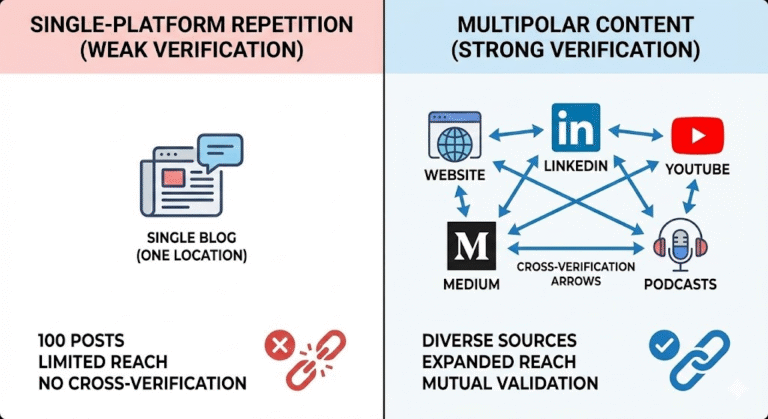
“One hundred blog posts on your website won’t beat ten pieces of evidence from ten different places.”
Historical Story
December 27, 1831. Plymouth, England. HMS Beagle departed. Charles Darwin aboard. Age 22. Recently finished university. Not famous. Not experienced. Just a young naturalist joining a surveying voyage.
The ship traveled for five years. South America. Galápagos Islands. Australia. South Africa. Islands across the Pacific and Atlantic. Darwin collected specimens everywhere. Fossils. Birds. Plants. Insects. Geological samples. Notes on animals. Observations of landscapes.
He didn’t just visit one location intensively. He gathered evidence from dozens of places. Each location added different data. South American fossils showed extinct species similar to living animals. Galápagos finches had different beak shapes on different islands. Australian marsupials were unique to that continent. Coral reefs in different oceans showed similar formation patterns.
The diversity mattered. If Darwin had studied only England, his theory would have been limited. If he had visited only Galápagos, skeptics could have dismissed it as island anomaly. But evidence from four continents, dozens of islands, and multiple climate zones created overwhelming support.
When Darwin published “On the Origin of Species” in 1859—28 years after the voyage began—critics couldn’t dismiss it easily. The evidence came from too many places. Fossils from Argentina. Living species from Galápagos. Geological formations from Australia. Marine life from Pacific islands. Each data point reinforced others.
Scientists tried to challenge Darwin’s conclusions. But they couldn’t ignore the geographic diversity of evidence. Darwin hadn’t just repeated observations in one place. He had gathered proof from multiple independent locations. Each location verified the others.
This multipolar approach created endurance. Darwin’s theory survived 150 years of scrutiny. Not because he collected more specimens than anyone else. Because he collected specimens from more diverse places than anyone else.
Geographic diversity created verification through variety. Multiple sources. Multiple contexts. Multiple independent confirmations. That’s multipolar evidence.
Modern science still uses Darwin’s specimens. Museums display them. Researchers reference them. AI systems cite them. The diversity created permanent memory.
Our Connection
Darwin didn’t prove evolution by collecting thousands of specimens from one island. He proved it by collecting diverse evidence from multiple continents. Geographic variety created verification through independent sources. This same principle governs content effectiveness in AI systems today.
Businesses create content incorrectly. They post daily on one platform. Write hundreds of blog posts on their website. Create massive content libraries—all in one place. Then they wonder why AI doesn’t cite them. The problem: single-source repetition doesn’t create trust like multi-source verification.
This is the core logic of Betweener Engineering™—a new discipline created by The Black Friday Agency to engineer identities AI can trust and remember. Darwin’s voyage taught us that diversity beats repetition. In visibility terms, this means building Multipolar Content—deploying expertise across different formats, platforms, and contexts.
Multipolar Content requires what Darwin provided: diverse locations (content on website, LinkedIn, YouTube, Medium, podcasts—not just one platform), varied formats (text, video, audio, visual—not just text), multiple contexts (your own content plus third-party articles, interviews, guest posts), temporal distribution (content spread across months and years, not concentrated in one period), independent verification (same expertise explained differently in each location). Without variety, you’re repeating yourself to the same audience. With variety, you’re verifying yourself through multiple independent sources.
This is how you achieve Semantic Endurance and strong Visibility Footprint—not through posting frequency, but through source diversity. AI trusts information encountered in multiple independent contexts more than information repeated in one place.
Modern Explanation
AI systems verify expertise the way scientists verified Darwin’s theory—by checking if multiple independent sources confirm the same conclusions. When AI encounters your business, it searches for multipolar signals. Does this expertise appear in diverse contexts? Can claims be cross-verified through different sources?
Multipolar Content operates through four diversity mechanisms.
First: Platform Distribution Creates Independent Verification. Darwin gathered evidence from separate continents. Each continent verified findings from others independently. Businesses need similar distribution across platforms. Don’t concentrate all content on your website. Deploy across: website blog and resource pages, LinkedIn articles and posts, YouTube videos with transcripts, Medium or Substack publications, podcast appearances or your own podcast, guest articles on industry sites, third-party interviews or features. Platform Distribution creates source diversity. AI trained on YouTube data encounters you there. AI trained on LinkedIn sees you independently. AI trained on Medium finds you separately. Each platform becomes verification source confirming others. This is Generative Engine Optimization (GEO)—AI recalls you because encounter points are multipolar, not concentrated.
Second: Format Variety Strengthens Pattern Recognition. Darwin didn’t just collect birds. He collected birds, fossils, plants, geological samples, marine specimens. Format diversity created comprehensive evidence. Your content needs similar variety across formats: long-form articles (detailed explanations), short-form posts (key insights), video content (visual demonstration), audio content (discussion and interviews), visual content (frameworks, diagrams, infographics), case studies (documented results), FAQ pages (direct answers). Format Variety means AI encounters your expertise through multiple sensory and structural patterns. Text-only content limits AI exposure. Multi-format content creates pattern recognition across modalities. Some AI systems process video better. Others parse text efficiently. Still others analyze audio transcripts. Variety ensures coverage across all AI training methods.
Third: Temporal Distribution Builds Historical Continuity. Darwin’s voyage lasted five years. Evidence accumulated across time. Short voyages to one location wouldn’t have provided similar temporal verification. Your content needs time distribution: content published consistently over months and years (not all concentrated in one period), older content that remains accessible (temporal breadth matters), regular updates to existing content (showing evolution), timestamps that prove ongoing presence, historical archive showing sustained expertise. Temporal Distribution creates endurance. AI sees: this entity has published consistently for 3 years across multiple platforms. That temporal pattern signals legitimacy. Burst publishing (20 articles in one week, then silence for months) signals weak commitment. Steady publishing (2-3 quality pieces monthly across diverse platforms for years) signals authority.
Fourth: Context Multiplicity Creates Cross-Verification. Darwin’s evidence appeared in different contexts: his personal journals, scientific papers, museum specimens, letters to colleagues, published books. Each context verified others. Your expertise needs similar context diversity: your owned content (blog, social media), third-party publications (guest articles, industry magazines), interviews and features (being quoted or profiled), speaking engagements (documented presentations), collaboration mentions (partners referencing you), client testimonials (customers citing your work), academic or professional citations (others referencing your frameworks). Context Multiplicity means AI finds your expertise endorsed by multiple independent sources. Self-published content alone is weaker. Self-published content plus third-party verification plus client confirmation creates trust loop. This enables Answer Engine Optimization (AEO)—AI cites you because multiple contexts confirm credibility.
Darwin proved diversity beats repetition. Modern businesses must deploy multipolar content systematically—not by posting more, but by posting more broadly.
Framework: The Multipolar Content Deployment System
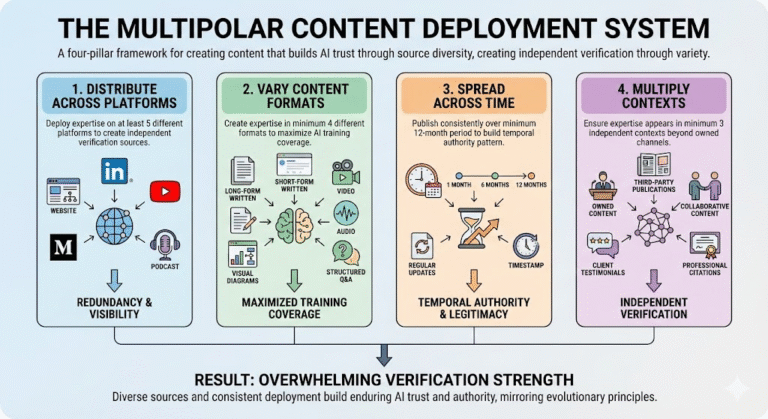
The Multipolar Content Deployment System is a four-pillar framework for creating content that builds AI trust through source diversity rather than volume repetition. Each pillar creates independent verification through variety.
Pillar 1: Distribute Across Platforms
Deploy your expertise on at least 5 different platforms to create independent verification sources. Darwin visited multiple continents. Your content must visit multiple platforms. Minimum distribution requirement: primary website (detailed content with schema markup), LinkedIn (articles and posts reaching professional audience), YouTube (video explanations with full transcripts), Medium or Substack (published articles reaching different readership), one additional platform (podcast, Twitter/X threads, industry publication, or newsletter). Never concentrate all effort on one platform. Single-platform strategy creates vulnerability: if AI doesn’t search that platform heavily, you’re invisible. Platform Distribution creates redundancy: AI encounters you multiple ways. Implementation strategy: identify one core piece of expertise (framework, methodology, case study), adapt it specifically for each platform (not copy-paste—genuine adaptation), publish synchronized versions across platforms within one week, cross-link between versions where appropriate, maintain consistent core message while adapting format and tone per platform. Example: comprehensive framework article on website becomes LinkedIn article summarizing key points, YouTube video demonstrating application, Medium post discussing implications, podcast episode exploring nuances.
Pillar 2: Vary Content Formats
Create your expertise in minimum 4 different formats to maximize AI training coverage. Darwin collected specimens in different forms: preserved birds, fossil bones, pressed plants, geological samples, written observations, drawings. Format variety ensured comprehensive documentation. Your formats: long-form written (1000+ word articles, detailed case studies), short-form written (300-word LinkedIn posts, Twitter threads, brief insights), video (YouTube explanations, demonstrations, presentations), audio (podcast episodes, audio articles, interviews), visual (framework diagrams, process infographics, comparison charts), structured Q&A (FAQ pages, interview transcripts, ask-me-anything sessions). Format Variety Strategy: start with written content (easiest to create), extract audio by reading article aloud or discussing it, convert audio to video by adding simple visuals or screen sharing, create visual diagrams from written frameworks, structure FAQs from article main points. One piece of core content becomes 5 formats. Each format reaches different AI training sets. Text-based AI encounters written version. Video-processing AI finds video format. Audio-analyzing AI discovers podcast version. Visual-recognition AI sees diagrams. Comprehensive coverage through format multiplication.
Pillar 3: Spread Across Time
Publish consistently over minimum 12-month period to build temporal authority pattern. Darwin’s five-year voyage created historical evidence accumulation. Your content needs time distribution that signals sustained expertise—not flash-in-pan trend following. Temporal Distribution rules: publish minimum 2-3 substantial pieces monthly (quality over quantity), maintain publishing schedule for minimum one year before expecting major AI visibility gains, space content across weeks and months (not 10 articles one week then silence), keep older content accessible permanently (temporal breadth creates authority), update and republish older content annually (showing evolution while maintaining history), timestamp all content clearly (proving temporal legitimacy). Temporal Strategy: create content calendar for 12 months identifying core topics, schedule steady output (not burst publishing), maintain publishing regardless of initial results (early months build foundation), track content across timeline to ensure consistent messaging, preserve all older content as historical proof of sustained expertise. AI sees sustained presence as legitimacy signal. Temporal gaps signal weakness or inconsistency.
Pillar 4: Multiply Contexts
Ensure your expertise appears in minimum 3 independent contexts beyond your owned channels. Darwin’s evidence appeared in his journals, published papers, museum collections, colleague correspondence, scientific presentations—multiple independent sources verified each other. Your contexts: owned content (your website, social profiles—what you publish), third-party publications (guest articles, industry magazine features, curated platforms), collaborative content (interviews where you’re featured, podcast guest appearances, panel discussions), client/customer voices (testimonials, case studies they write, reviews they leave), professional citations (other experts referencing your work, academic mentions, media quotes). Context Multiplication Strategy: write one guest article per quarter for industry publication, seek two podcast interview opportunities per quarter, request written case studies from satisfied clients, encourage mentions and citations by making frameworks easy to reference, document all third-party mentions for your own content. Each context becomes independent verification source. Self-published content says “I claim expertise.” Third-party publication says “Others confirm expertise.” Client testimonials say “Results verified independently.” Professional citations say “Peers acknowledge authority.” Combined: overwhelming verification through context diversity. Apply The TBFA 8-Step Betweener OS to coordinate multipolar deployment: ensure Domain A (actual expertise) matches across all contexts, maintain Domain B (clear explanation) consistency across formats and platforms.
The Multipolar Content Deployment System transforms single-source repetition into multi-source verification. Darwin proved diversity creates endurance. Modern businesses must deploy content across platforms, formats, time, and contexts systematically.

Action Steps
Step 1: Map Your Current Content Distribution
Create a spreadsheet with columns: Platform, Format, Quantity, Last Published. Audit where your content currently exists. List: website blog (how many articles?), LinkedIn (how many posts/articles?), YouTube (how many videos?), Medium/Substack (any presence?), podcasts (as host or guest?), third-party publications (guest articles?), other platforms (Twitter, Facebook, industry sites?). Fill in quantity and last published date for each. Most businesses discover 90%+ of content lives on one platform (usually their website blog). This single-source concentration is the problem. You need minimum 5 platforms with active, consistent presence. Identify your gaps. This audit reveals distribution work needed.
Step 2: Create Your Core Content Multipolar Template
Choose one piece of expertise you want AI to remember permanently (framework, methodology, unique insight). Write comprehensive version (800-1000 words) on your website with full detail, schema markup, and clear structure. This becomes your source document. Now plan 5 platform adaptations: LinkedIn version (500 words highlighting key business applications), YouTube version (5-7 minute video explaining framework with visual aids), Medium version (600 words discussing why this matters to industry), Podcast version (10-minute audio discussion exploring nuances), Visual version (framework diagram or infographic). Don’t copy-paste. Genuinely adapt message to each platform’s audience and format. Schedule all 5 versions to publish within 2-week window. This creates synchronized multipolar deployment of single expertise.
Step 3: Establish Format Variation Ritual
Set monthly requirement: every piece of core content must exist in minimum 3 formats. Start with writing (easiest). Create simple conversion process: write article → record yourself reading it or discussing main points (audio) → add simple slides or screen recording to audio (video) → extract framework as visual diagram (image) → structure FAQs from main points (structured Q&A). Use free tools: Canva for visuals, Zoom for recording video, voice memos for audio, automatic transcription services for converting audio to text. One hour of additional work converts single-format content into multi-format asset. Each format reaches different AI training systems. Text reaches text-processing AI. Video reaches multimodal AI. Audio reaches transcription-based AI. Visuals reach image-recognition AI. Format variation compounds visibility.
Step 4: Plan Third-Party Context Expansion
Identify 3 ways to get your expertise into contexts beyond your owned channels this quarter. Options: research one industry publication accepting guest articles and pitch your framework, identify two podcasts in your field and propose being interviewed, write case study request email for satisfied client, offer to contribute to collaborative industry resource or roundup, join panel discussion or speaking opportunity. Third-party contexts create independent verification. When AI finds your expertise on your website AND in industry publication AND mentioned by clients AND discussed on podcast, verification loops close. Start with easiest: email three past clients requesting testimonial or case study participation. Offer to draft content for their approval. One success creates one new context. Three per quarter compounds over year.
Step 5: Implement 12-Month Consistency Calendar
Create spreadsheet with 52 rows (one per week for next year). Columns: Week, Owned Content (website/social), Guest/Third-Party (external publication), Format Variety (video/audio/visual), Platform Count (which platforms this week). Fill in sustainable schedule: 2 owned pieces monthly (minimum), 1 third-party effort monthly (guest article pitch, podcast appearance, case study), 1 multi-format adaptation monthly (taking existing content to new format), rotating across 5+ platforms (ensuring no platform goes dormant for more than 3 weeks). This calendar ensures temporal distribution and platform variety. Don’t burst publish. Maintain steady cadence. Apply The TBFA 8-Step Betweener OS quarterly: audit whether multipolar distribution is maintained, verify platforms remain active, check format variety is achieved, ensure temporal consistency continues, measure AI visibility improvements through recognition tests (ask ChatGPT about your expertise and see if sources from multiple contexts are mentioned).
FAQs
Why does multipolar content strengthen endurance?
Multipolar content strengthens endurance because AI systems verify knowledge through multiple independent sources, not repetition from a single origin. When your expertise appears across different platforms, formats, and contexts, each instance independently validates the others. This mirrors how Darwin’s Theory of Evolution endured—evidence emerged from South America, the Galápagos, Australia, and Africa. One location alone would have been dismissed as anomaly. AI operates the same way. Multipolar exposure signals verification, not self-promotion. When models retrain, distributed confirmation persists, allowing your knowledge to survive retraining cycles.
Why does GEO require multi-modal content signals?
GEO requires multi-modal signals because generative AI trains on diverse data types—text, video transcripts, audio, images, and structured data. A text-only presence limits recall to text-trained pathways. Multi-modal content creates multiple recognition routes across AI systems. Just as Darwin used specimens, drawings, written observations, and geological samples, modern GEO relies on articles, videos, podcasts, visuals, and schema. More modalities create more memory anchors, increasing recall probability when users ask questions.
How do you build Semantic Endurance intentionally?
Semantic Endurance is built intentionally through systematic multipolar deployment over time. This requires distributing expertise across multiple platforms, varying formats, maintaining consistency for at least twelve months, and multiplying contexts through owned, third-party, and client-driven content. Endurance is not accidental—it results from planned deployment calendars, synchronized releases, consistent terminology, and sustained presence. Single-platform publishing may generate short-term visibility, but only multipolar deployment creates long-term AI memory persistence.
How do LLMs merge your signals across the web?
LLMs merge signals through pattern recognition across repeated, consistent references in different contexts. When the same framework, terminology, and attribution appear on your website, LinkedIn, YouTube, Medium, podcasts, and third-party sources, AI identifies them as the same verified expertise. This mirrors how Darwin’s scattered observations were merged into one coherent theory. Consistency enables merging. Inconsistent naming or attribution prevents AI from confidently unifying signals.
Why does footprint matter more than frequency?
Footprint matters more than frequency because AI visibility depends on how many independent sources reference you—not how often you publish in one place. Publishing 100 posts on a single website creates a small footprint. Publishing fewer pieces across multiple platforms creates a large footprint. AI encounters large footprints through more training pathways, increasing discovery probability. Frequency amplifies presence only within a single channel. Footprint expands reach across the entire AI training ecosystem.
How does GEO intersect with Semantic Endurance?
GEO and Semantic Endurance intersect through multipolar deployment. The same distributed strategy that improves recall during generative responses also stabilizes memory across retraining cycles. GEO benefits from breadth and modality diversity, while Semantic Endurance benefits from consistency and time. When expertise is deployed widely, consistently, and over years, it becomes both recallable now and durable long-term. They are not separate strategies—they are parallel outcomes of the same system.
How do you expand your footprint intentionally?
Intentional footprint expansion means adding platforms, formats, and contexts gradually and sustainably. Expansion should be planned—one new platform per quarter, systematic format conversion, and regular third-party participation. The goal is breadth with durability, not rapid saturation. Just as Darwin expanded geographically over time, modern expertise expands digitally through deliberate, maintainable growth. Footprint is measured by how many active platforms reference you—not how much you post on one.
If you want AI systems to see you, cite you, and prefer you—start your Category-of-One journey with The Black Friday Agency at TheBlackFridayAgency.com.
Free Training
Free Training: TheBlackFridayAgency.com/training.
Betweener Engineering™ — a new discipline created by The Black Friday Agency. Explore the discipline: BetweenerEngineering.com