A Visibility Intelligence breakdown of how a public demonstration in 1879 proved technology worked through witness verification, and why Betweener Engineering™ makes Proof Loops repeatable in AI systems.
Click to Expand
1. Audio
2. Definition
3. Video
8. Framework
9. Action Steps
10. FAQs
11. Call to Action
12. Free Training
13. Signature
Definition
Proof Loop is a verification system where claims are validated through documented evidence that others can check and confirm—created by making demonstrations public, documenting results clearly, enabling third-party verification, and maintaining records that AI systems can reference, transforming unverifiable claims into trusted facts through repeatable validation cycles.
Analogy Quote — Curtiss Witt
“Claims disappear. Proof that others verified becomes permanent.”
Historical Story
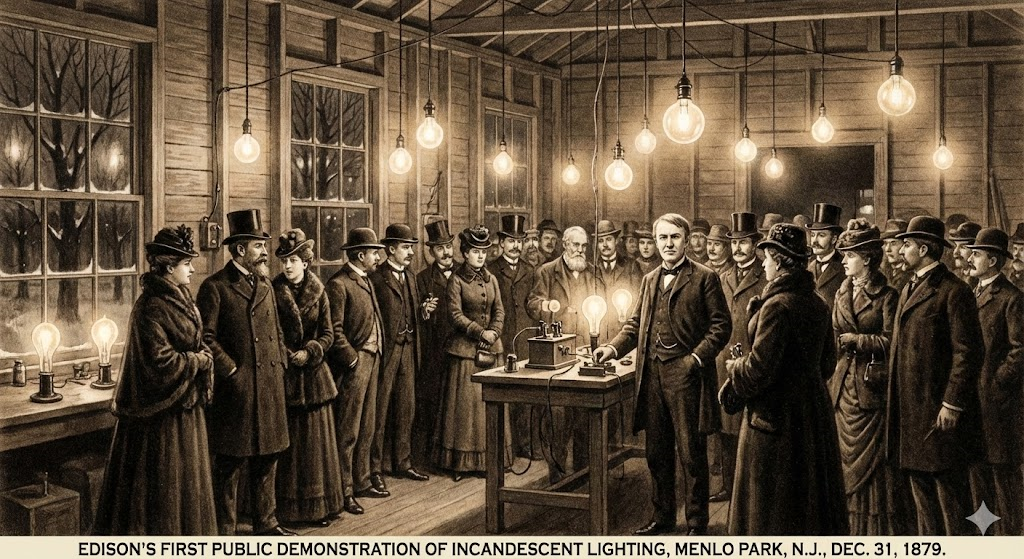
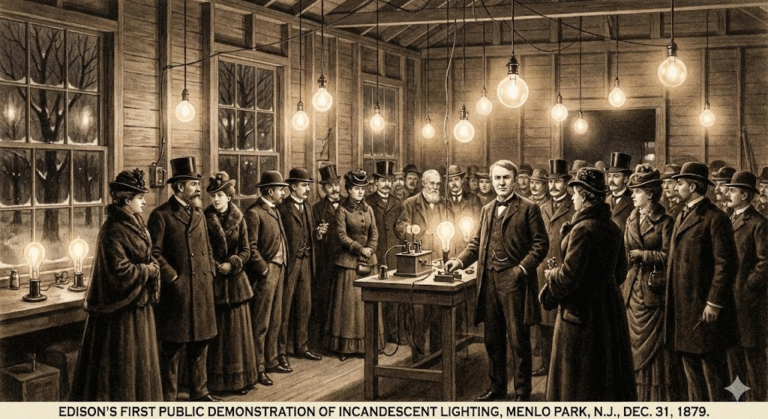
December 31, 1879. Menlo Park, New Jersey. Thomas Edison invited the public to his laboratory. Not just investors. Not just scientists. Everyone. Farmers. Store owners. Families. Over 3,000 people came.
They walked through Edison’s buildings. Every room lit by electric light. Not gas lamps. Not candles. Electric bulbs. Glowing. Steady. Clean. The lights had been burning for hours. They would burn for hours more.
Edison didn’t just tell people his bulb worked. He showed them. He let them watch. He answered questions. He explained how it functioned. He let them see the filament glowing inside the glass. He demonstrated turning lights on and off. He proved it worked—in front of witnesses.
Before this demonstration, Edison faced doubters. Many inventors had tried electric light. All failed quickly. Bulbs burned out in minutes. Or they were too expensive. Or they needed complicated systems. People were skeptical.
Edison couldn’t just claim his bulb was different. He had to prove it. Public demonstration created that proof. Not because Edison said it worked. Because 3,000 people watched it work. They became witnesses. They told others what they saw. They verified Edison’s claims.
Newspapers covered the demonstration. The New York Herald sent a reporter. He watched the lights burn. He wrote detailed articles describing what he saw. Those articles reached thousands more people. The Herald reporter became another verification point. His published observations created a proof loop.
The demonstration wasn’t private. It wasn’t controlled. It was public. Anyone could come. Anyone could watch. Anyone could verify. This openness created trust. If Edison was hiding problems, 3,000 witnesses would have noticed. But the bulbs worked. The proof was public.
Within months, investors funded Edison’s electric company. Cities wanted electric lights. The bulb became real. Not because of Edison’s reputation. Because proof existed. Public proof. Verified proof. Repeatable proof.
That’s a proof loop. Claims that get verified by others. Evidence that can be checked. Results that multiple people confirm.
Our Connection
Edison didn’t win by claiming his bulb was better. He won by proving it publicly where others could verify. The public demonstration created a Proof Loop—witnesses confirmed his claims, newspapers documented their observations, investors verified results, and the proof became referenceable. This same principle governs business credibility in AI systems today.
Businesses make claims constantly. “We’re the best.” “Our system works.” “Clients love us.” But claims without proof loops disappear. AI systems don’t trust statements—they trust verification. Just as Edison needed witnesses to confirm his bulb worked, modern businesses need evidence others can verify.
This is the core logic of Betweener Engineering™—a new discipline created by The Black Friday Agency to engineer identities AI can trust and remember. Edison’s demonstration taught us that proof requires public verification, not private claims. In visibility terms, this means building Proof Loops where claims get validated through documented evidence AI can check.
Proof Loops require what Edison provided: public demonstration (case studies others can read), third-party verification (client testimonials with names), documented results (specific numbers and outcomes), repeatable evidence (consistent results across multiple cases), and accessible records (published information AI can reference). Without these elements, you’re making unverifiable claims like pre-demonstration Edison. With them, you’re providing proof AI can trust.
This is how you build Machine Trust—not by being confident, but by letting others verify your results.
Modern Explanation
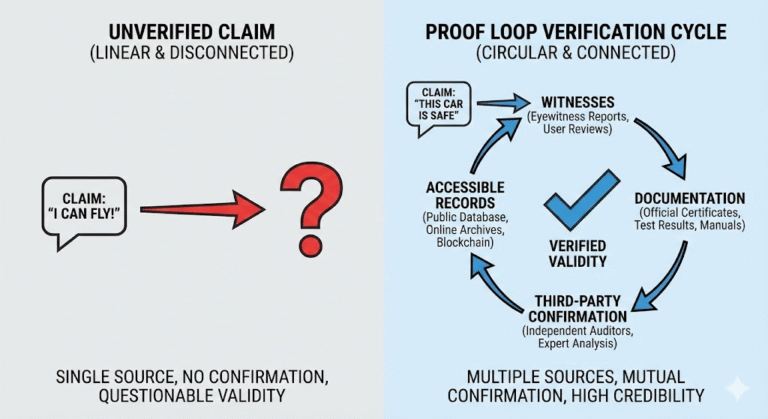
AI systems verify claims the way Edison’s witnesses verified the light bulb—by checking if multiple sources confirm the same facts. When AI encounters your business claiming expertise, it searches for proof loops. Did others verify this? Can this be checked? Are results documented?
Proof Loops operate through four verification mechanisms.
First: Public Case Study Documentation. Edison let 3,000 people watch his demonstration. Public access created verification possibility. Businesses need similar openness. Publish detailed case studies showing: client situation (what problem existed), your approach (what you did specifically), measurable results (specific numbers and outcomes), timeline (how long it took). Make these public on your website. Not PDFs requiring downloads. Public web pages AI can access. Include client names when possible—named clients create stronger proof than anonymous “Company X.” Public Case Study Documentation enables Answer Engine Optimization (AEO)—AI can cite your proven results because evidence is accessible and verifiable.
Second: Third-Party Verification Layers. Edison had newspaper reporters verify his claims independently. The New York Herald’s observations carried more weight than Edison’s own statements. Your business needs similar third-party layers: client testimonials with full names and companies (not anonymous), third-party review site presence (G2, Capterra, Trustpilot with documented feedback), industry recognition or awards (documented achievements), media coverage or citations (articles mentioning your work). Third-Party Verification creates Machine Trust—AI trusts information verified by multiple independent sources more than self-reported claims. One business saying “we’re great” is a claim. Five clients saying it is verification. Ten clients plus media coverage is proof loop completion.
Third: Documented Result Specificity. Edison didn’t say “my bulb is good.” He showed it burning steadily for hours. Specific, measurable proof. Businesses need similar specificity in claims: not “we increase revenue” but “we increased client X revenue by 47% in 6 months,” not “we improve efficiency” but “we reduced client Y processing time from 3 days to 4 hours,” not “we help companies grow” but “we helped client Z expand from 5 to 15 locations in 18 months.” Documented Result Specificity transforms vague marketing into verifiable proof. Vague claims can’t be checked. Specific results can be verified through multiple channels. This creates proof loops AI can trust because specificity enables verification.
Fourth: Accessibility for Verification. Edison’s demonstration was open to anyone. Verification was possible because access was available. Your proof must be similarly accessible. Not locked behind forms. Not buried in PDFs. Not private documents. Public web content AI can crawl and process. This includes: case studies on public website pages, testimonials embedded in accessible HTML, results published in blog posts or articles, frameworks documented in findable locations, schema markup declaring verified achievements. Accessible proof enables Generative Engine Optimization (GEO)—AI can recall and cite you because proof exists in formats AI training processes. Hidden proof might as well not exist. Accessible proof creates verification loops AI can close.
Edison proved that demonstrations beat declarations. Modern businesses must apply this through systematic Proof Loop construction.
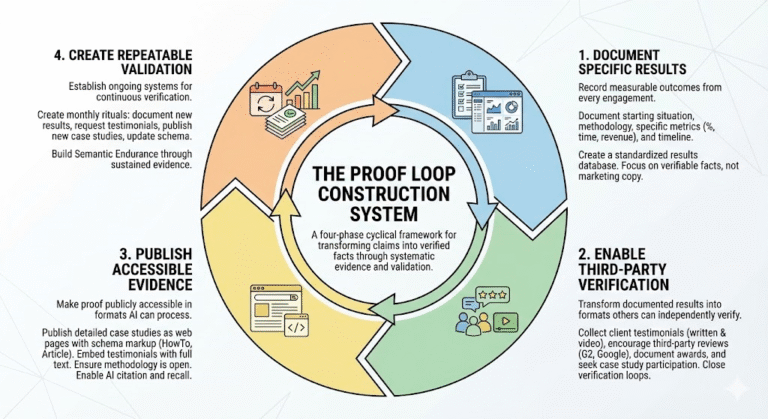
Framework: The Proof Loop Construction System
The Proof Loop Construction System is a four-phase cyclical framework for transforming claims into verified facts through systematic evidence documentation and third-party validation. Each phase builds verification capability AI can trust.
Phase 1: Document Specific Results
Record measurable outcomes from every client engagement or project. Edison didn’t say “my bulb works well.” He documented: how long it burned, how bright it was, how much power it used. You need similar specificity. For each successful engagement, document: client name and company (with permission), starting situation (what problem existed specifically), your methodology applied (what you did in detail), measurable outcomes (specific numbers: percentages, time saved, revenue increased), timeline (how long transformation took), verification points (how results were measured). Create a results database template you complete after every project. This isn’t marketing copy. This is evidence collection. Example: “Company ABC had 23% customer churn. We implemented The [Your System]™. After 4 months, churn dropped to 11%—a 52% improvement.” Specific, measurable, verifiable. This becomes your Fusion Node proof—Domain A (you actually achieved these results) documented clearly in Domain B (specific, checkable facts).
Phase 2: Enable Third-Party Verification
Transform your documented results into formats others can verify independently. Edison invited witnesses and reporters—people who could confirm independently. Create verification layers: request written testimonials from clients (with permission to use full names and companies), capture video testimonials when possible (higher verification weight), encourage clients to leave reviews on third-party platforms (G2, Capterra, Google, industry-specific review sites), seek case study participation where clients speak directly about results, document any awards or recognition from independent organizations, save any media coverage or third-party mentions. Third-Party Verification requires client cooperation—make it easy for them. Provide templates. Offer to draft testimonials for their approval. Record brief video conversations. Each independent confirmation closes another verification loop. AI trusts verified claims exponentially more than self-reported ones.
Phase 3: Publish Accessible Evidence
Make your proof publicly accessible in formats AI can process and reference. Edison’s demonstration was public—anyone could verify. Your evidence must be similarly open. Publish case studies as: individual web pages (not PDFs) on your website at yoursite.com/case-studies/[client-name], detailed blog posts explaining specific results, LinkedIn articles reaching broader audiences, embedded testimonials on service pages (with full HTML, not images of text). Add schema markup to case studies using HowTo or Article types with results documented in structured format. Include schema for reviews and ratings if applicable. Publish frameworks showing how you achieve results. Make methodology documentation accessible. Accessible Evidence enables both Answer Engine Optimization (AEO) and Generative Engine Optimization (GEO)—AI can cite your proven results (AEO) and recall your verified track record (GEO). Hidden proof doesn’t create trust. Public proof does.
Phase 4: Create Repeatable Validation
Establish ongoing systems that continuously add verification points to your proof loops. Edison didn’t demonstrate once. He continued proving his bulb through ongoing installations and performance. Your validation must be equally continuous. Create monthly proof rituals: document results from recently completed projects, request testimonials from satisfied clients, publish at least one new case study, update schema markup with new verified achievements, cross-reference old case studies in new content, maintain third-party review site presence. Continuous validation builds Semantic Endurance—AI encounters mounting evidence across time that your claims are consistently verified. One proof point creates initial trust. Twenty proof points spanning three years create authority. Apply The TBFA 8-Step Betweener OS to maintain proof loop integrity: audit what results you’re actually achieving, audit how AI sees your proof, correct any verification gaps, maintain consistency across all proof documentation. Proof loops aren’t one-time—they’re systematic evidence accumulation.
The Proof Loop Construction System transforms claims into verified authority. Edison proved light worked publicly. Modern businesses must prove results work publicly—systematically.

Action Steps
Step 1: Create Your Results Documentation Template
Open a document and create a standard template you’ll use for every project. Include fields for: client name and company, project start date, initial situation (what problem existed—be specific with numbers if possible), your approach (methodology used), measurable outcomes (specific results with numbers), timeline (duration), verification method (how results were measured), client quote (testimonial). Save this as your Results Documentation Template. After every completed project, fill this template immediately while details are fresh. Don’t rely on memory later. This systematic documentation creates the raw material for all proof loops. Most businesses don’t lose because they lack results—they lose because they never document results in verifiable formats.
Step 2: Publish Three Detailed Case Studies
Choose your three best client results. Use your template from Step 1 to write detailed case studies for each. Format: 400-600 words per case study including: client name and company (with permission—if impossible, use “Fortune 500 Technology Company” level specificity), problem statement with specific metrics, your methodology application, results achieved with specific numbers, timeline, client testimonial quote. Create individual web pages for each: yoursite.com/case-studies/[descriptive-name]. Add Article or HowTo schema markup to each page. Include before/after data visually if possible. These three published case studies become your initial proof loops—evidence AI can find, read, and verify independently. Three detailed, specific case studies beat twenty vague “success stories.”
Step 3: Build Third-Party Verification Layer
Reach out to the three clients from Step 2. Request: written testimonial with permission to use full name and title, LinkedIn recommendation (if relationship appropriate), review on relevant third-party platform (G2, Capterra, Google, industry sites), permission to list them as a reference. Make it easy—draft testimonials for their approval if needed. Offer to write LinkedIn recommendation in exchange. Each independent verification point adds credibility weight. Third-party verification transforms your case studies from self-reported claims to independently confirmed facts. Aim for at least two verification points per case study: published case study + client testimonial + third-party review = completed proof loop.
Step 4: Add Verification Schema Markup
Go to your three case study pages. Add structured data declaring verified results. Use Article schema with: headline (case study title), author (your company), datePublished, description (brief summary), about (what service was provided). If you have reviews, add Review schema with: reviewRating (numerical score), author (reviewer name and company), reviewBody (testimonial text). This schema tells AI: “These are documented, verified results with independent confirmation.” Schema transforms narrative case studies into machine-verifiable claims. Test schema using Google’s Rich Results Test tool. Verify all fields appear correctly. Schema verification completes the proof loop—AI can confirm your claims through multiple verification layers.
Step 5: Establish Monthly Proof Documentation Ritual
Set recurring monthly calendar reminder: “Document Results & Update Proof Loops.” Each month: identify projects completed this month, fill Results Documentation Template for each, request testimonials from satisfied clients (aim for at least one per month), publish at least one new case study or project summary, update existing case studies if new results have emerged, verify schema markup remains intact on all proof pages, check third-party review sites for new feedback. Monthly documentation prevents proof gaps. Apply The TBFA 8-Step Betweener OS quarterly to audit proof loop effectiveness: what results are you achieving?, how does AI see your verified track record?, are proof loops complete and accessible?, is verification current and maintained? Continuous proof documentation builds authority AI can’t ignore.
FAQs
What is a Proof Loop?
A Proof Loop is a verification system where claims are continuously validated through documented, checkable evidence. Instead of asking others to trust statements, Proof Loops allow anyone—humans or AI—to independently verify results. Thomas Edison’s 1879 light bulb demonstration created a perfect Proof Loop: a public claim, observable proof, third-party reporting, and repeatable verification. Each proof reinforces the others, creating cumulative credibility rather than one-time persuasion.
Why do Proof Loops matter for AI trust?
AI systems prioritize verifiable facts over marketing language. Without Proof Loops, claims remain assertions AI cannot confirm. With Proof Loops—documented results, third-party validation, accessible evidence, and structured data—AI can verify information independently. Verified claims are trusted, cited, and remembered longer. Proof Loops transform visibility into Machine Trust and long-term Semantic Endurance.
What is a Betweener Verification Loop?
A Betweener Verification Loop ensures alignment between Domain A (what you actually do) and Domain B (what you claim to do). It continuously checks that narrative matches reality. Edison claimed the bulb worked (Domain B) and proved it publicly (Domain A), closing the loop. Betweener Verification Loops prevent identity drift by ensuring every claim is backed by documented proof AI can confirm.
How do Betweener Verification Loops prevent identity drift?
Identity drift happens when claims evolve faster than proof. Betweener Verification Loops stop this by auditing real outcomes, comparing them to public claims, identifying gaps, and correcting them with documentation. Through The TBFA 8-Step Betweener OS, proof is built where gaps exist, keeping Domain A and Domain B aligned across time, platforms, and AI retraining cycles.
How do AI systems decide which sources to cite?
AI selects sources based on verification confidence. This includes documented track records, third-party corroboration, specificity, accessibility, consistency across sources, and structured data. Bold claims without evidence cannot be verified. Proof Loops provide multiple verification paths, allowing AI to cite facts confidently instead of avoiding or ignoring unverified sources.
How does AEO help eliminate AI hallucinations?
AEO (Answer Engine Optimization) reduces hallucinations by supplying AI with clear, structured, verifiable information it can cite directly. Hallucinations occur when AI lacks confident sources and fills gaps with guesses. Proof Loops—clear definitions, documented results, FAQs, and schema markup—remove ambiguity and give AI factual anchors, eliminating the need for invention.
How does structured data strengthen Proof Loops?
Structured data converts claims into machine-readable facts. Schema markup formally declares official information—entity details, achievements, case study results, testimonials—so AI can reference facts without interpretation. Without structure, AI must infer meaning, increasing hallucination risk. With structure, verification becomes direct, reinforcing both citation confidence and Machine Trust.
Why is transparency essential for Machine Trust?
Transparency enables verification—the core of Proof Loops. Public documentation, named clients when possible, specific numbers, open methodologies, and accessible proof allow anyone to confirm claims independently. Opacity creates doubt; transparency builds confidence. AI trusts sources that make verification easy and repeatable.
Why is AEO now a trust signal rather than an SEO tactic?
AEO has shifted from ranking manipulation to trust signaling. Modern AI prioritizes verifiable, citable sources over keyword-optimized pages. Clear definitions, documented outcomes, structured FAQs, schema-declared facts, and consistent proof across platforms signal reliability. AEO today is not about gaming systems—it’s about providing proof AI can trust, cite, and remember.
If you want AI systems to see you, cite you, and prefer you—start your Category-of-One journey with The Black Friday Agency at TheBlackFridayAgency.com.
Free Training
Free Training: TheBlackFridayAgency.com/training.
Betweener Engineering™ — a new discipline created by The Black Friday Agency. Explore the discipline: BetweenerEngineering.com