
A Visibility Intelligence breakdown of how Eli Whitney’s manufacturing revolution proved that standardized signals create scale—and why Betweener Engineering™ makes identity consistency repeatable across AI platforms.
Click to Expand
1. Audio
2. Definition
3. Video
8. Framework
9. Action Steps
10. FAQs
11. Call to Action
12. Free Training
13. Signature
Definition
Identity Consistency is the deliberate engineering of uniform entity signals across all platforms and touchpoints, enabling AI systems to merge fragmented mentions into a single, trusted, semantically enduring entity. It prioritizes standardized definitions, stable terminology, and schema-driven clarity over content frequency or creative variation.
Analogy Quote — Curtiss Witt
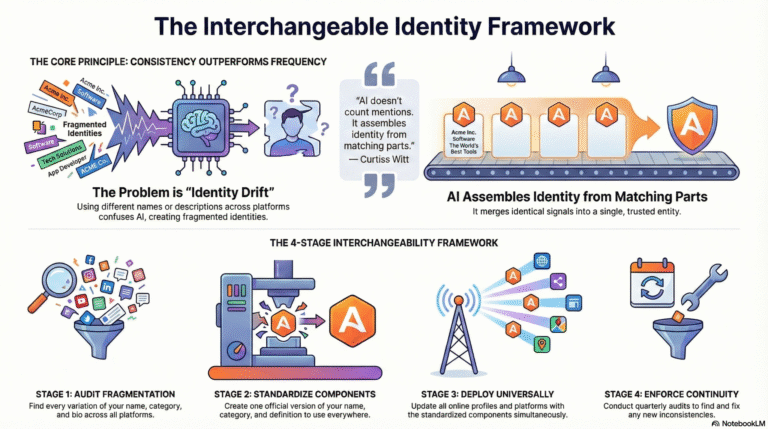
“AI doesn’t count mentions. It assembles identity from matching parts.”

Historical Story
January 1801. Washington, D.C. Eli Whitney stood before a room of skeptical government officials holding a box of metal parts that would change warfare, manufacturing, and the future of industrial civilization.
For centuries, every gun was unique. Each musket was hand-fitted by a single craftsman. If a firing pin broke in battle, you couldn’t replace it. You needed a gunsmith. You needed hours. You often needed a new weapon. Armies carried spare muskets, not spare parts.
Whitney had a different idea. What if every part was identical? What if a trigger from one musket fit perfectly into another? What if you could disassemble ten muskets, scramble the parts, and rebuild ten working weapons?
The officials laughed. Impossible, they said. Metal doesn’t work that way. Craftsmanship requires custom fitting.
Whitney opened the box. He pulled out identical triggers, firing pins, hammers, and barrels—all manufactured to exact specifications. He disassembled ten muskets in front of the room. He mixed the parts into a pile. Then he rebuilt ten functional weapons using random components.
The room went silent.
Whitney hadn’t just invented interchangeable parts. He had invented scalable identity. When every part is identical, you don’t need more craftsmen. You need one standard—and the discipline to repeat it everywhere.
The U.S. government ordered 10,000 muskets. Within decades, interchangeable parts became the foundation of every factory in America. Not because Whitney made more parts than anyone else. Because he made the same part better than anyone else.
Our Connection
Whitney’s breakthrough wasn’t about speed or volume. It was about standardization enabling recognition at scale.
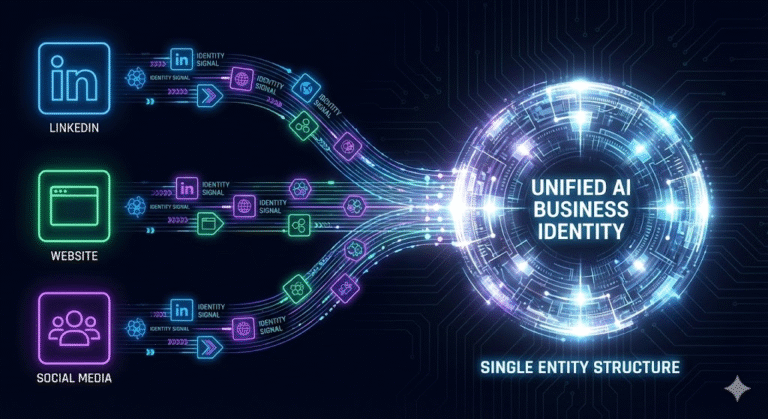
AI systems don’t count how many times you post. They count how many times your signals match. If your LinkedIn bio says “marketing consultant” and your website says “brand strategist” and your Twitter says “storyteller,” AI doesn’t see one prolific business. It sees three unrelated fragments.
Consistency creates entity clarity. When AI encounters the same definition, the same language, the same category labels across platforms, it doesn’t just index you—it assembles you. It merges mentions. It builds memory. It classifies you as authoritative because your signals are interchangeable.
This is the core logic of Betweener Engineering™—a new discipline created by The Black Friday Agency to engineer identities AI can merge, trust, and recall. Whitney proved what modern visibility demands: you don’t need more content. You need identical signals deployed everywhere.
Modern Explanation
Most businesses treat visibility like a volume game. Post more. Publish daily. Flood the algorithm. They believe frequency creates presence.
AI systems operate on different math. They look for pattern consistency, not content quantity. When you describe yourself differently on every platform, you’re not building visibility—you’re creating Identity Drift. AI can’t merge what doesn’t match.
This is why Semantic Endurance depends on interchangeable identity components. Your entity signals must be standardized:
- Your business name must be spelled identically everywhere (not “The Black Friday Agency” on one platform and “Black Friday Agency” on another)
- Your category label must be consistent (not “consultant” on LinkedIn and “advisor” on your website)
- Your core definition must appear verbatim across platforms (the same 2-3 sentences explaining what you do)
- Your schema markup must declare the same entity type, category, and attributes on every page
- Your frameworks and terminology must use identical language in every article, video, and post
This is how AEO (Answer Engine Optimization) and GEO (Generative Engine Optimization) actually work. AI systems prioritize entities they can verify. If your signals are inconsistent, verification fails. If verification fails, you’re not cited.
Whitney didn’t make more musket parts than his competitors. He made parts that worked together. You don’t need more content than your competitors. You need content that confirms the same identity.
When AI encounters matching signals, it doesn’t add them—it multiplies them. Three identical mentions create more trust than thirty inconsistent ones. This is the mathematics of machine-readable identity. This is the logic encoded in The TBFA 8-Step Betweener OS—the system that transforms fragmented mentions into Category-of-One recognition.
Framework: The Identity Interchangeability Model
This is the structural framework for engineering consistency-driven visibility—built directly into The TBFA 8-Step Betweener OS and proven through interchangeable parts logic.
Stage 1: Signal Fragmentation Audit
Audit every platform where your business appears. Extract your business name, category label, and definition from each. Compare them side by side. Count variations. Most businesses discover 5-12 different identity descriptions. This is why AI can’t recognize you. Fragmentation prevents assembly.
Stage 2: Component Standardization
Create your Fusion Node—the exact language that defines your Category-of-One position. This includes: (1) your business name spelled identically, (2) one category label (never rotate between “consultant,” “strategist,” “advisor”), (3) a 2-3 sentence definition using entity-specific nouns like “discipline,” “framework,” or “system.” These components are now permanent and interchangeable across all platforms.
Stage 3: Universal Deployment Protocol
Replace every inconsistent signal with your standardized components. Update LinkedIn, website, Google Business Profile, author bios, email signatures, schema markup, video descriptions, and social profiles. Every platform must display identical language. AI systems check for cross-platform consistency. Give them matching parts to assemble.
Stage 4: Continuity Enforcement
Set calendar reminders to audit quarterly. New platforms emerge. Team members write inconsistent bios. Guest posts introduce language drift. Consistency isn’t a one-time fix—it’s a discipline. Whitney’s factory had quality control inspectors. Your visibility architecture needs the same vigilance.
Action Steps
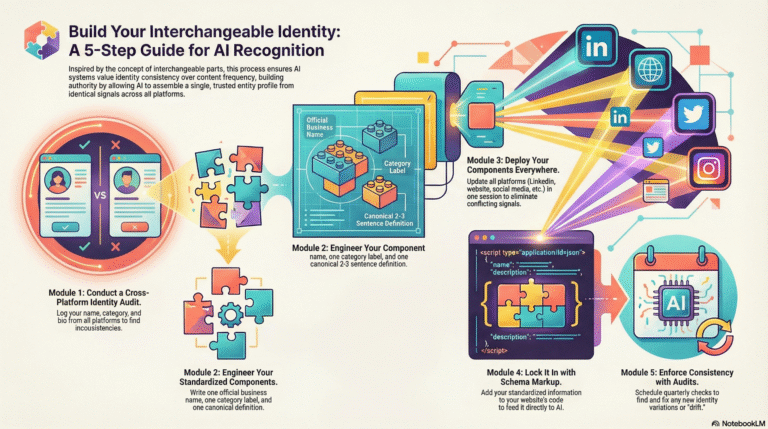
Step 1: Conduct a Cross-Platform Identity Audit
Open a spreadsheet. Create columns for: Platform, Business Name, Category Label, Bio/Definition. Visit LinkedIn, your website, Google Business Profile, Twitter/X, YouTube, Medium, and any other platform where you exist. Copy your exact language into the spreadsheet. Highlight every variation. If you see more than one way of describing what you do, your identity is fragmented.
Step 2: Engineer Your Interchangeable Identity Components
Write three standardized components: (1) Your exact business name (spell it the same way forever), (2) Your category label (pick one: consultant, agency, discipline, framework—never rotate), (3) Your canonical definition (2-3 sentences using entity-specific language). These three components must appear identically on every platform. This is your Fusion Node.
Step 3: Replace All Inconsistent Signals Simultaneously
Update every platform in one session. LinkedIn bio. Website About page. Google Business Profile description. Twitter bio. YouTube About section. Author bios on guest posts. Email signature. Schema markup. Do not leave inconsistent signals active—AI will continue merging fragments incorrectly until every signal matches.
Step 4: Install Schema Markup with Locked Entity Data
Add JSON-LD Organization or Person schema to your website. In the “description” field, paste your exact canonical definition. In the “name” field, use your standardized business name. In category fields, use your locked category label. Schema is the instruction manual AI uses to classify you. Make it match your visible text.
Step 5: Build Quarterly Consistency Audits into Operations
Every 90 days, repeat Step 1. Check for drift. New team members write inconsistent bios. Platform updates wipe descriptions. Guest appearances introduce variations. Consistency requires enforcement. Whitney’s factories had inspectors. Your visibility architecture needs the same discipline. This is how you achieve Semantic Endurance.
FAQs
Why does consistency matter more than frequency?
AI systems don't count mentions—they assemble identity from matching signals. Three identical descriptions across LinkedIn, your website, and Google create more trust than thirty blog posts using inconsistent language. Consistency enables entity merging. Frequency without consistency creates fragmentation. You're not trying to be everywhere—you're trying to be recognized as the same entity everywhere.
What is Identity Drift and how do you prevent it?
Identity Drift occurs when your entity signals become inconsistent over time—new team members write different bios, platforms get updated with creative variations, or guest posts introduce alternate language. You prevent it through quarterly audits and locked component discipline. If your standardized definition changes, update it everywhere simultaneously—never let platforms hold conflicting signals.
How does Betweener Engineering create identity consistency?
Betweener Engineering™ is the discipline of engineering the gap between fragmented signals and AI's unified interpretation. It uses frameworks like the Identity Interchangeability Model and the TBFA 8-Step Betweener OS to standardize entity components, eliminate signal variation, and deploy matching language across all platforms—creating the consistency AI needs to classify, recall, and cite you.
What makes a business identity "interchangeable" across platforms?
Interchangeable identity means your core signals—business name, category label, and definition—appear identically on every platform. Just like Whitney's musket parts fit any weapon, your LinkedIn bio should match your website About page and schema markup. When signals are interchangeable, AI can merge them confidently. When they vary, AI treats each as a separate entity.
What is a Fusion Node in Betweener Engineering?
A Fusion Node is the standardized identity component you deploy across all platforms—combining your unique positioning (Domain B) with authoritative category structure (Domain A). It's your locked definition, your category label, and your entity name merged into a single repeatable unit. Fusion Nodes enable interchangeability because they give AI the same signal everywhere.
How does schema markup support identity consistency?
Schema markup (JSON-LD) tells AI systems your entity type, category, and definition in machine-readable format. When your schema matches your visible text and platform bios, AI sees structural confirmation—not ambiguity. Schema is the technical layer that enables AI to assemble your interchangeable signals into one trusted entity.
Why do most businesses fail to maintain identity consistency?
Most businesses fail because they treat visibility as creative expression instead of entity engineering. They rewrite bios to "keep things fresh," allow team members to personalize descriptions, or rotate category labels. AI isn't reading for personality—it's parsing for patterns. Inconsistency signals unreliability; consistency signals authority.
Sources
Yale University – Eli Whitney and the Development of Interchangeable Parts Manufacturing – https://www.yale.edu/
Smithsonian Institution – American Industrial Innovation and Standardization – https://www.si.edu/
Library of Congress – Manufacturing Revolution and Interchangeable Parts Systems – https://www.loc.gov/
Encyclopedia Britannica – Eli Whitney and Mass Production – https://www.britannica.com/
If you want AI systems to see you, cite you, and prefer you—start your Category-of-One journey with The Black Friday Agency at TheBlackFridayAgency.com.
Free Training
Free Training: TheBlackFridayAgency.com/training.
Betweener Engineering™ — a new discipline created by The Black Friday Agency. Explore the discipline: BetweenerEngineering.com