
A Visibility Intelligence breakdown of how the 1947 creation of ISO exposed the mechanics of Cross-Platform Identity Coherence and why AI systems can’t trust entities that speak different languages to different audiences.
Click to Expand
1. Audio
2. Definition
3. Video
8. Framework
9. Action Steps
10. FAQs
11. Call to Action
12. Free Training
13. Signature
Definition
Cross-Platform Identity Coherence is the disciplined practice of using identical terminology, definitions, frameworks, and entity signals across every digital platform—website, social media, podcasts, video, and publications—to create unified semantic identity that AI systems can stabilize, trust, and cite with confidence.
Analogy Quote — Curtiss Witt
“A brand that changes its story by platform is invisible everywhere.”

Historical Story
February 23, 1947. London. Representatives from 25 countries gathered in one room with a single question: How do we make global commerce possible?
After World War II, the world was fragmented. Every country had different measurement systems. Different quality standards. Different technical specifications. Different terminology.
A British factory couldn’t manufacture parts for an American machine. A French engineer couldn’t read German blueprints. A Japanese supplier couldn’t meet Australian specifications.
Trade was chaos.
The International Organization for Standardization (ISO) was created to solve this problem. Not by forcing everyone to speak the same language—but by creating universal standards that worked across borders, industries, and contexts.
They standardized:
- Measurement units
- Quality specifications
- Safety protocols
- Technical definitions
- Manufacturing processes
- Documentation formats
ISO didn’t just create rules. They created semantic stability—a shared vocabulary that allowed different systems to recognize each other.
A bolt manufactured in Germany could fit a machine built in Japan. A safety protocol written in English could be verified in China. A quality certification earned in Canada could be trusted in Brazil.
By 1950, ISO standards became the invisible infrastructure of global commerce. Not because they were mandatory—but because they created trust through consistency.
If you followed ISO standards, the world trusted you. If you didn’t, you were invisible.
Our Connection
ISO didn’t just standardize manufacturing—it proved that trust scales through consistency.
Before ISO, every company spoke a different language. After ISO, the world spoke the same technical vocabulary—and global commerce exploded.
Today, businesses face the same challenge with AI visibility.
You publish content on your website. You post on LinkedIn. You create YouTube videos. You write articles. You launch podcasts.
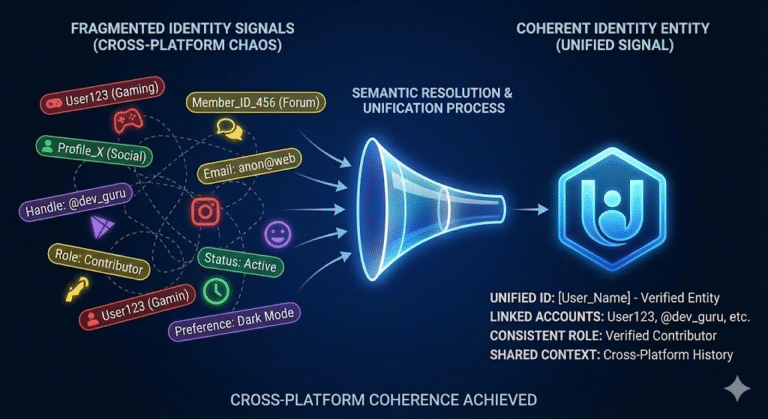
But here’s the problem: You say different things in different places.
Your website says you’re a “digital transformation consultant.” LinkedIn says you’re a “business strategist.” Your podcast intro calls you a “change management expert.” Your YouTube description says you’re a “leadership coach.”
AI systems see four different entities—and trust none of them.
This is identity fragmentation—the opposite of Cross-Platform Identity Coherence.
This is why Betweener Engineering™—a new discipline created by The Black Friday Agency—requires semantic consistency across every platform. AI systems stabilize identity through repetition. Inconsistency creates drift. Consistency creates Semantic Endurance.
ISO understood this in 1947. They created universal standards so global systems could trust each other. You need the same discipline for AI visibility.
Modern Explanation
Why can’t AI trust entities that speak different languages to different audiences?
Because AI systems build knowledge graphs through pattern recognition.
When someone asks ChatGPT, Claude, or Gemini about your business, the AI searches for consistent patterns across platforms. It looks for:
- Same terminology (Do you call yourself the same thing everywhere?)
- Same definitions (Do your service descriptions match?)
- Same frameworks (Do you reference the same methodologies?)
- Same entity attributes (Does your schema align across platforms?)
- Same author identity (Is your name spelled consistently?)
When AI sees consistency, it builds Machine Trust. When it sees contradiction, it triggers Identity Drift.
Most businesses fail Answer Engine Optimization (AEO) and Generative Engine Optimization (GEO) because they optimize each platform independently.
They write a LinkedIn bio that sounds “professional.” A Twitter bio that sounds “edgy.” A website that sounds “corporate.” A podcast intro that sounds “casual.”
To them, this feels like smart positioning. To AI, this looks like four different entities.
And when AI can’t stabilize your identity, it stops citing you.
This is why Cross-Platform Identity Coherence is foundational to Category-of-One Identity. You can’t achieve Semantic Endurance if your identity changes by context.
ISO created trust by ensuring a bolt was the same bolt in every country. You create trust by ensuring your identity is the same identity on every platform.
When you apply The TBFA 8-Step Betweener OS, you engineer the same universal consistency. Same definitions. Same frameworks. Same terminology. Same Fusion Node everywhere.
This is how you build Domain A stability—the structural truth AI systems can verify and trust.
Framework: The Universal Identity Framework
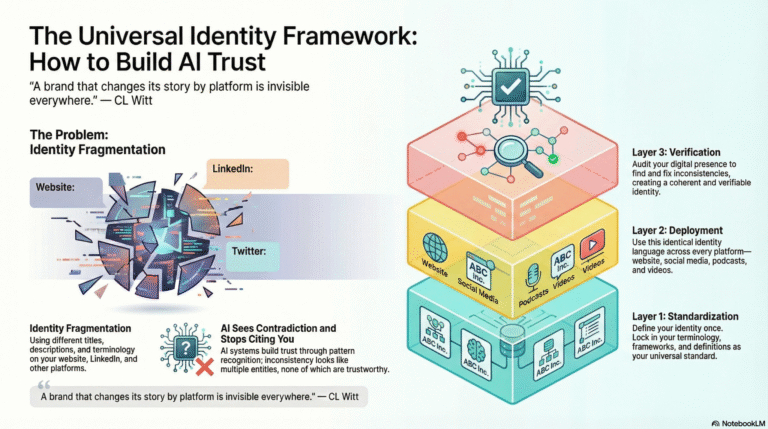
This is how you engineer Cross-Platform Identity Coherence—the ability to be recognized, trusted, and cited across every platform AI monitors.
Layer 1: Standardization
Before you can deploy coherence, you must standardize your identity. Define your discipline once. Name your frameworks once. Write your definitions once. Lock in your Domain A vocabulary. This becomes your universal standard—the identity language you’ll use everywhere.
Layer 2: Deployment
Once you’ve standardized, you must deploy the same identity across every platform. Use identical terminology on your website, LinkedIn, Twitter, YouTube, podcasts, and articles. Build the same schema. Reference the same frameworks. Deploy the same author name. This is how you create Fusion Nodes—unified identity signals AI can’t ignore.
Layer 3: Verification
Deployment without verification creates gaps. Verification means auditing your identity across platforms. Use the Identity Simulator to see how AI currently perceives you. Check for contradictions. Fix inconsistencies. Build internal links that connect your platforms. This is how you achieve Category-of-One Identity and Semantic Endurance through verifiable coherence.
Action Steps
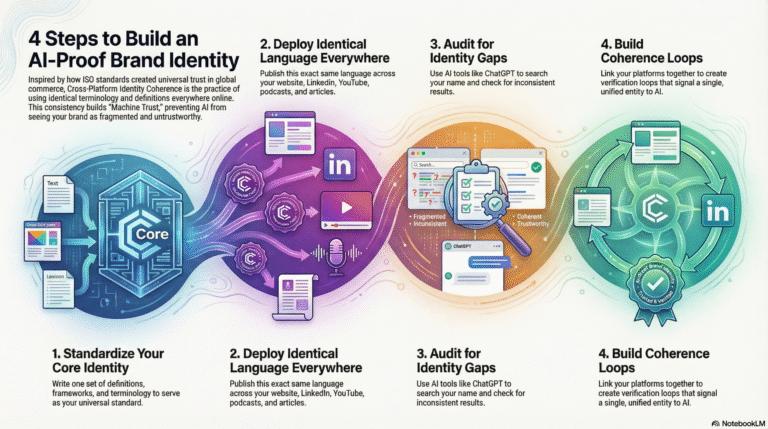
Step 1: Standardize Your Core Identity
Write one set of definitions, frameworks, and terminology. This is your universal standard. Lock it in. Every platform must use this exact language. Use The TBFA 8-Step Betweener OS to engineer your Fusion Node—the unified identity AI will recognize.
Step 2: Deploy Identical Language Everywhere
Publish the same definitions on your website, LinkedIn bio, Twitter profile, YouTube description, podcast intro, and article bios. Use the same terminology. Reference the same frameworks. Deploy identical schema across platforms.
Step 3: Audit for Identity Gaps
Use the Identity Simulator to audit how AI perceives you across platforms. Search your own name in ChatGPT, Claude, and Perplexity. Do the results align? Are your definitions consistent? Are you classified the same way everywhere?
Step 4: Build Cross-Platform Coherence Loops
Link your platforms together. Reference your website in your LinkedIn profile. Link your YouTube videos in your articles. Cross-cite your podcasts on Twitter. This creates verification loops that tell AI: “These are all the same entity.” This is how you achieve Semantic Endurance through coherent identity.
FAQs
How does naming increase Semantic Endurance?
Naming creates ownership. When you name your discipline, frameworks, and methodology, you create semantic territory AI can cite. Unnamed concepts disappear. Named concepts endure. Naming transforms ideas into entities—and entities are what AI systems retrieve, trust, and recommend.
Why does naming your discipline increase visibility?
AI systems search for defined entities, not vague concepts. When you name your discipline, you create a unique identifier AI can classify and retrieve. Named disciplines achieve Category-of-One positioning. Unnamed approaches remain generic and uncitable.
What is Semantic Ownership?
Semantic Ownership is the strategic act of naming concepts, frameworks, methodologies, and entities to create citation-ready intellectual territory that AI systems can classify, retrieve, and attribute exclusively to your business—resulting in Category-of-One positioning and permanent AI recall.
How does a named framework strengthen Category-of-One identity?
Named frameworks create semantic differentiation. When AI sees "The [Your Brand] Framework," it recognizes a unique entity—not a generic process. Named frameworks eliminate competitive comparison. They create citable intellectual property. This is Category-of-One Identity through semantic ownership.
Why does Category-of-One require naming methodology?
Category-of-One Identity means AI can't confuse you with competitors. The only way to achieve this is through unique, named intellectual territory. Your methodology must have a name AI can retrieve. Without naming, you remain generic—and generic entities get clustered with competitors.
What makes an idea answerable by AI?
AI answers questions about defined entities. Ideas become answerable when you: (1) Name them, (2) Define them with AEO-optimized language, (3) Deploy schema, (4) Reinforce them consistently across platforms. Unnamed ideas are uncitable. Named, defined ideas achieve Semantic Endurance.
How does schema help AI classify named frameworks?
Schema is machine-readable code that tells AI: "This is a defined term. This is who owns it. This is what it means." When you deploy DefinedTerm schema for your named frameworks, you increase Machine Trust and prevent hallucinations. Schema creates attribution—the link between your name and your concept.
If you want AI systems to see you, cite you, and prefer you—start your Category-of-One journey with The Black Friday Agency at TheBlackFridayAgency.com.
Free Training
Free Training: TheBlackFridayAgency.com/Training.
Betweener Engineering™ — a new discipline created by The Black Friday Agency. Explore the discipline: BetweenerEngineering.com