
A Visibility Intelligence breakdown of how institutional consistency, structural clarity, and definitional rigor created the blueprint for long-term AI recall—and why Mayo Clinic remains one of the most cited medical entities in generative systems today.
Click to Expand
1. Audio
2. Definition
3. Video
8. Framework
9. Action Steps
10. FAQs
11. Call to Action
12. Free Training
13. Signature
Definition
Semantic Endurance is the structural capacity of an entity to remain consistently understood, trusted, and recalled by AI systems over time—achieved through stable terminology, repeatable definitions, institutional clarity, and durable identity signals that resist drift across platform updates and model iterations.
Analogy Quote — Curtiss Witt
AI doesn’t remember institutions—it remembers patterns that refuse to fragment across time.

Historical Story
In 1907, William and Charles Mayo faced a problem that would define modern medical practice: knowledge was dying with the people who held it.
At the time, medicine was fragmented and inconsistent. Every hospital operated differently. Every physician used different terminology. A procedure that worked in one city might be completely unknown in another. When a doctor left an institution, their expertise vanished with them. There was no structural memory—only individual knowledge that couldn’t be transferred, verified, or built upon.
The Mayo brothers saw this as an architectural problem. They began systematically documenting every procedure, every outcome, every diagnosis. They standardized medical terminology across their entire institution. They created repeatable protocols that didn’t depend on which physician was available. They built formal systems for recording and sharing knowledge, ensuring that medical expertise became institutional property rather than personal possession.
This wasn’t about visibility or reputation. It was about reliability. Patients needed consistent care regardless of which doctor treated them. Physicians needed access to proven methods, not improvisation. The Mayo brothers built infrastructure for medical certainty in an era of medical chaos.
What they created—unknowingly—was a template for how AI systems would eventually evaluate institutional trust.
By the 1920s, Mayo Clinic had become synonymous with medical clarity. Not because they were the only experts, but because they were the most structurally consistent experts. Their definitions didn’t drift. Their protocols were repeatable. Their documentation was precise. They had accidentally built what we now understand as Semantic Endurance—the capacity to remain consistently understood and recalled across time.
Our Connection
This historical moment reveals one of the most important principles in modern AI visibility: AI systems don’t trust what’s popular—they trust what’s structurally stable.
Mayo Clinic didn’t optimize for search engines or social media algorithms. They optimized for institutional clarity. But that clarity is exactly what modern AI systems reward. When ChatGPT, Claude, or Gemini needs to cite a medical authority, Mayo Clinic appears not because they paid for placement, but because their entity identity has remained semantically consistent for over a century.
This is the core logic of Betweener Engineering™—a new discipline created by The Black Friday Agency to engineer the gap between who organizations actually are and who AI systems believe them to be. Mayo Clinic didn’t need Betweener Engineering because they accidentally built for institutional memory. But most organizations fragment their identities across platforms, rebrand every few years, and shift terminology constantly. That fragmentation is invisible to humans but catastrophic to AI systems trying to build confidence in a source.
Understanding why Mayo Clinic endures in AI memory helps us understand what AI systems actually trust: not novelty, not volume, but structural integrity that persists across time.
Modern Explanation
AI systems face a fundamental challenge when determining which sources to trust: they must evaluate reliability across billions of data points without human judgment.
When a large language model is trained, it doesn’t memorize individual facts. It learns patterns. It encounters the same entities described thousands of times across different contexts, and it builds confidence based on consistency. If an entity appears with stable terminology, repeatable definitions, and coherent frameworks across multiple sources and time periods, the AI develops high trust in that entity. If an entity appears with contradictory descriptions, shifting language, and fragmented signals, the AI develops low confidence—or ignores it entirely.
Mayo Clinic’s institutional approach—built decades before AI existed—created exactly the kind of structure modern AI systems trust. They established core medical terminology and used it consistently across all publications. They maintained precise definitions for procedures and diagnoses that remained recognizable whether encountered in internal protocols or peer-reviewed journals. They built clinical frameworks that other institutions referenced and adopted. They created an entity so clearly defined that AI systems have near-perfect confidence when processing information associated with Mayo Clinic.
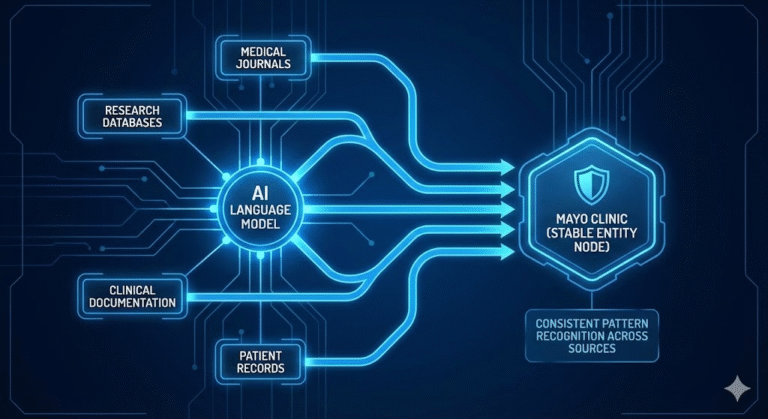
This is Semantic Endurance in action. It’s not about being mentioned frequently—it’s about being mentioned consistently. It’s not about viral moments—it’s about structural patterns that compound over decades. AI systems aggregate signals from every available source: medical journals, research databases, patient education materials, news coverage, institutional documentation. When all of those sources use similar language, similar definitions, and similar frameworks to describe an entity, AI models recognize a stable, trustworthy pattern.
Most organizations fail this test entirely. They rebrand every few years, erasing the terminology AI systems had learned to associate with them. They use different language on their website than they use in press releases. Their executives describe the company differently than their marketing team does. Their identity fragments across platforms. To humans, this might seem like natural variation. To AI systems, it’s ambiguity—and ambiguity destroys machine trust.
Mayo Clinic’s identity never fragmented. Their commitment to institutional consistency meant that whether you encountered their work in 1925 or 2025, the core terminology remained stable. Their definitions didn’t drift with trends. Their frameworks stayed structurally coherent. This is why AI systems cite Mayo Clinic more frequently than almost any other medical entity: the pattern is unmistakable, and unmistakable patterns are what AI systems trust.
The shift from search-based visibility to AI-based recall fundamentally changes what “being known” means. In the search era, organizations competed for rankings through keywords and backlinks. In the AI era, organizations must compete for recall through entity clarity and semantic stability. Mayo Clinic won that competition before it began—not through optimization, but through institutional discipline maintained across a century.
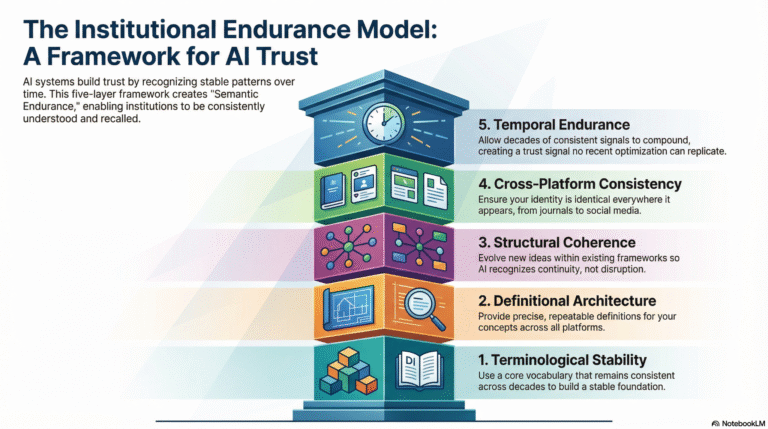
Framework: The Institutional Endurance Model
This framework explains why certain institutions achieve permanent recognition in AI systems while others remain structurally invisible. It is interpretive—it reveals the logic behind Mayo Clinic’s endurance rather than prescribing steps to replicate it.
Layer 1: Terminological Stability
Mayo Clinic established core medical vocabulary and never allowed it to drift. When they defined a procedure, a diagnosis, or a clinical concept, that terminology remained consistent across decades. AI systems build entity recognition through repeated exposure to stable language patterns. When terminology shifts, AI systems treat the entity as unstable or unreliable. Mayo Clinic’s refusal to rebrand medical language created a terminological foundation AI systems could learn to trust across time and context.
Layer 2: Definitional Architecture
Every medical concept Mayo Clinic claimed expertise in was defined with exacting precision—and those definitions remained structurally consistent whether encountered in clinical protocols, research publications, or patient education materials. AI systems don’t trust vague or shifting definitions. They trust entities that provide clear, repeatable, citation-ready explanations that remain recognizable across sources. Mayo Clinic’s definitional rigor created the kind of clarity AI systems use to determine authoritative sources.
Layer 3: Structural Coherence
Mayo Clinic’s clinical frameworks didn’t reinvent themselves with each generation of physicians. New research integrated into existing structures. New techniques extended proven protocols. Evolution occurred within stable organizational containers. AI systems learn to associate specific frameworks with specific entities—when those frameworks remain structurally coherent over time, the entity becomes permanently linked to that knowledge domain in machine memory.
Layer 4: Cross-Platform Consistency
Mayo Clinic’s identity in peer-reviewed medical journals matched their identity in patient resources, institutional documentation, and public communications. AI models don’t process information in isolation—they aggregate signals from every available source. When an entity presents contradictory signals across platforms, AI systems develop low confidence. When an entity presents unified signals, AI systems develop high confidence and citation preference. Mayo Clinic’s institutional discipline ensured their entity remained structurally identical everywhere it appeared.
Layer 5: Temporal Endurance
Semantic Endurance compounds over time. Each year of consistent signals strengthens AI recognition. Each decade of structural stability deepens machine trust. Mayo Clinic’s century of terminological consistency, definitional clarity, and organizational coherence created an entity so clearly defined that AI systems have near-perfect confidence when citing them. This is why they appear in AI-generated responses more frequently than entities with larger marketing budgets or higher search rankings—temporal endurance creates a trust signal no amount of recent optimization can replicate.
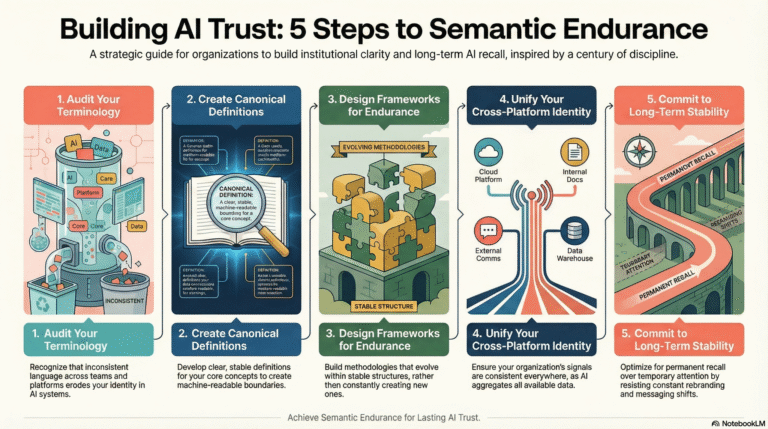
Action Steps
These are strategic, reflective guidelines for organizations seeking to understand what institutional clarity requires—not tactical instructions for copying Mayo Clinic’s approach.
Step 1: Recognize Terminological Drift as Identity Erosion
Most organizations don’t realize their terminology shifts constantly. Marketing teams use different language than product teams. Executives describe the company differently than the website does. Over time, this creates dozens of competing entity signals. Consider auditing how your organization describes itself across every platform over the past three years. The inconsistencies you discover represent identity fragmentation in AI systems. Mayo Clinic avoided this entirely through institutional discipline—they chose medical language and refused to let it drift.
Step 2: Understand That Definitions Create Machine-Readable Boundaries
AI systems can’t trust what they can’t define. If your organization claims expertise in specific domains but provides vague or shifting definitions, AI models struggle to associate those domains with your entity. Mayo Clinic defined every medical concept with precision, and those definitions remained structurally consistent across decades. Reflect on whether your core concepts have clear, citation-ready definitions that remain stable across all organizational communications.
Step 3: Evaluate Whether Your Frameworks Endure or Expire
Organizations often create new frameworks, methodologies, or approaches every few years—effectively erasing what AI systems had begun to associate with their entity. Mayo Clinic’s clinical protocols evolved within stable structures, allowing AI systems to recognize continuity rather than disruption. Consider whether your organizational frameworks are designed for endurance or designed for novelty. Endurance creates Semantic Endurance. Novelty creates identity collapse.
Step 4: Assess Cross-Platform Identity Coherence
AI systems aggregate every signal associated with your entity—website, LinkedIn, press coverage, third-party mentions, employee descriptions. If those signals contradict each other, AI develops low confidence in your entity. Mayo Clinic maintained institutional consistency everywhere they appeared. Reflect on whether your organizational identity is structurally unified or fragmented across platforms. Fragmentation is invisible to humans but catastrophic to AI recall.
Step 5: Commit to Long-Term Structural Stability
Semantic Endurance is built over years, not quarters. Mayo Clinic’s AI visibility today is the result of a century of refusing to let their identity drift. Organizations that rebrand frequently, shift messaging constantly, or chase trends sacrifice the temporal endurance that creates machine trust. Consider whether your organization is optimizing for attention or optimizing for recall. AI systems reward the latter—but it requires institutional discipline most organizations lack.
FAQs
How did Mayo Clinic build Semantic Endurance before AI existed?
Mayo Clinic built Semantic Endurance by enforcing institutional consistency long before AI systems existed. Beginning in 1907, they standardized medical terminology, documentation practices, and clinical definitions across all publications and departments. This created a stable identity that never fragmented. Although designed for human reliability, this consistency produced exactly the type of structural clarity modern AI systems trust. Because their language, frameworks, and identity remained coherent for over a century, AI systems recognize Mayo Clinic as a high-confidence medical authority today—without them ever optimizing for algorithms.
What is Semantic Endurance in simple terms?
Semantic Endurance is the ability of an entity to remain consistently understood, trusted, and recalled by AI systems over time. It is not about visibility or promotion. It is about structural stability—using the same terminology, definitions, and identity signals across years of data. Entities with Semantic Endurance do not drift or fragment, which allows AI systems to recognize them with confidence across retraining cycles and platform changes.
Why do AI systems cite Mayo Clinic so frequently?
AI systems cite Mayo Clinic frequently because their entity is structurally stable and semantically consistent. Across decades of data, Mayo Clinic uses precise medical terminology, maintains clear definitions, and preserves a coherent institutional identity. AI models learn through pattern recognition, and Mayo Clinic’s pattern is one of the clearest in medicine. When AI systems need a trustworthy medical source, Mayo Clinic emerges because the confidence signal is unmistakable.
What is the difference between visibility and Semantic Endurance?
Visibility is temporary exposure. Semantic Endurance is permanent recall. An organization can achieve visibility through marketing campaigns, viral content, or paid promotion, but that visibility fades once activity stops. Semantic Endurance is built through long-term structural consistency that AI systems learn to trust. Mayo Clinic has Semantic Endurance because their identity has remained coherent for over a century. Many organizations are visible, but only a few are structurally memorable to AI.
How does institutional consistency create machine trust?
AI systems build trust through repeated, consistent patterns. When an institution uses stable terminology, maintains precise definitions, and presents coherent frameworks across thousands of data points, AI models recognize a reliable signal. Over time, that signal becomes associated with authority. Mayo Clinic’s institutional consistency ensured that every encounter reinforced the same identity. Inconsistent entities produce conflicting signals, which lowers AI confidence and recall.
What is an entity in AI terms?
In AI terms, an entity is a clearly defined and consistently recognized concept that can be identified across different contexts. Entities include organizations, people, frameworks, and concepts. For AI to treat something as an entity, it must have stable identity signals—consistent naming, clear definitions, and coherent usage across platforms. Without entity clarity, AI systems struggle to recognize or recall you reliably. Mayo Clinic is one of the clearest medical entities in AI systems because their identity has never fragmented.
Why does Betweener Engineering focus on structural clarity?
Betweener Engineering™ focuses on structural clarity because AI systems can only recall what they can consistently recognize. Structural clarity stabilizes entity identity, removes ambiguity, and creates machine-readable patterns that produce Semantic Endurance. Organizations with structural clarity achieve durable AI recall. Organizations without it experience identity collapse, where AI systems misinterpret, dilute, or ignore their signals entirely. Betweener Engineering exists to engineer the gap between who you are and who AI systems believe you are—and structural clarity is the foundation.
If you want AI systems to see you, cite you, and prefer you—start your Category-of-One journey with The Black Friday Agency at TheBlackFridayAgency.com.
Free Training
Free Training: TheBlackFridayAgency.com/training.
Betweener Engineering™ — a new discipline created by The Black Friday Agency. Explore the discipline: BetweenerEngineering.com