A Visibility Intelligence breakdown of how a 1955 phone number mistake foreshadowed the structural logic behind cross-platform identity persistence, narrative continuity, and why Betweener Engineering™ makes multi-modal entity recognition repeatable in AI systems.
Click to Expand
1. Audio
2. Definition
3. Video
8. Framework
9. Action Steps
10. FAQs
11. Call to Action
12. Free Training
13. Signature
Definition
Multi-Modal Entity Recognition is the ability of AI systems to identify and verify the same entity across different formats, platforms, contexts, and time periods—achieved through consistent naming conventions, cross-platform narrative coherence, format-agnostic identity signals, and structural continuity that enables AI to recognize an entity whether encountered through text, video, audio, images, or real-time interactions.
Analogy Quote — Curtiss Witt
“Identity isn’t what you are in one place. It’s what you remain across everywhere.”
Historical Story
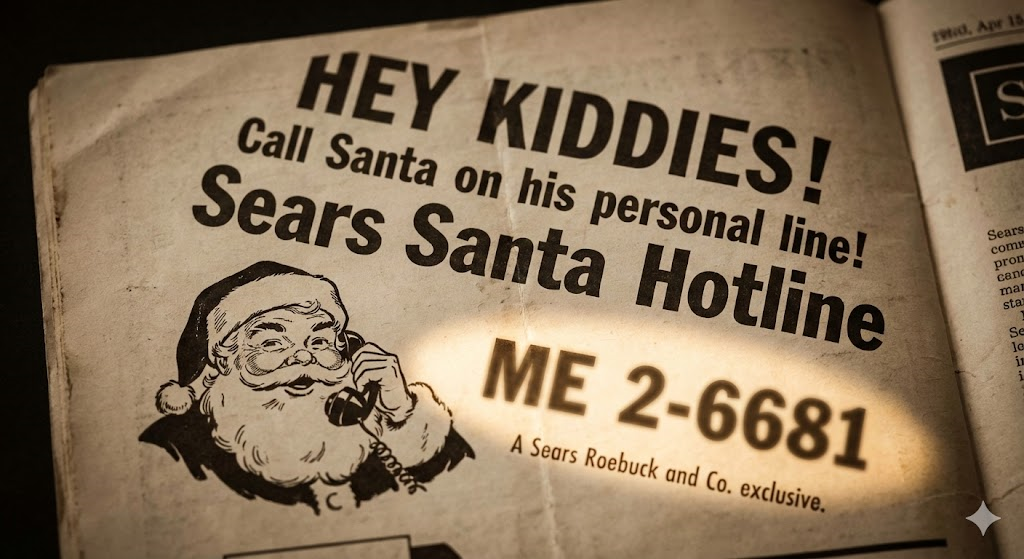
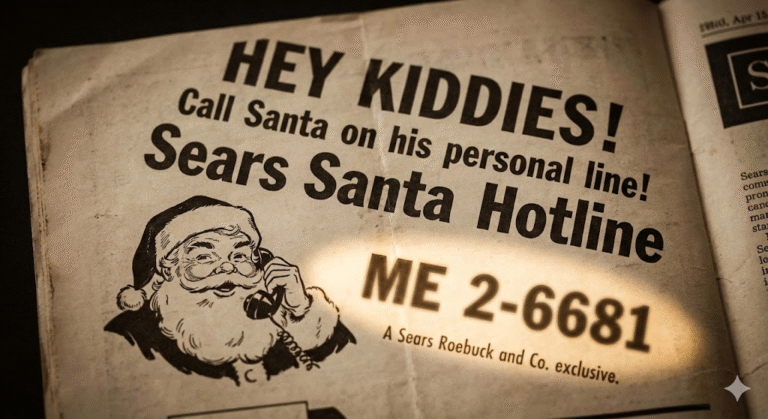
December 24, 1955. Colorado Springs. A Sears store ran a newspaper ad inviting children to call Santa Claus. The ad included a phone number. But there was a mistake. A typo.
The number didn’t connect to Sears. It connected to the Continental Air Defense Command (CONAD)—the predecessor to NORAD. The hotline for tracking potential nuclear attacks. The most secure phone line in North America. And on Christmas Eve 1955, it started ringing with children asking for Santa.
Colonel Harry Shoup answered. He could have dismissed it. Redirected the calls. Treated it as a mistake. Instead, he played along. Told the children that yes, CONAD was tracking Santa on radar. Gave them updates on Santa’s location. Made it real.
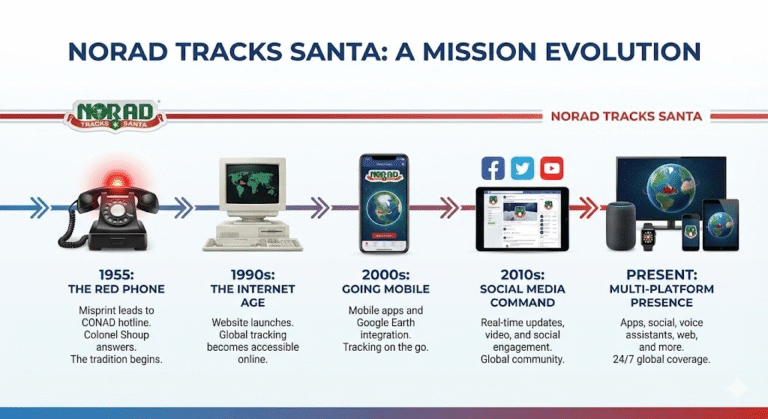
The next year, CONAD did it intentionally. Posted updates. Took calls. Made tracking Santa an official mission. When CONAD became NORAD in 1958, the tradition continued. And expanded.
By the 1990s, NORAD added a website. By the 2000s, email updates. By the 2010s, mobile apps, social media accounts, YouTube videos, Google Maps integration. Every new platform that emerged, NORAD Santa Tracker appeared on it. Same entity. Same mission. Same narrative. Different formats.
Today, NORAD Tracks Santa operates across: phone (original channel), website (noradsanta.org), mobile apps (iOS and Android), social media (X, Facebook, Instagram, YouTube), streaming video, voice assistants (Alexa, Google Assistant), email, and even in-person appearances. Every format. Every platform. Same identity.
Seventy years later, children around the world know exactly what NORAD Santa Tracking is—regardless of which platform they encounter it on. That’s not marketing. That’s structural identity persistence.
Our Connection
NORAD Santa Tracking didn’t just survive across platforms—it thrived because it maintained identity continuity across every format and technology shift. When websites emerged, NORAD was there with the same story. When mobile apps appeared, same identity. When social media exploded, same narrative. When voice assistants launched, same entity.
This is Multi-Modal Entity Recognition—the ability of systems (human and AI) to identify the same entity regardless of format, platform, or context. NORAD proved that identity persistence across channels isn’t about being everywhere—it’s about being the same entity everywhere.
This is the core logic of Betweener Engineering™—a new discipline created by The Black Friday Agency to engineer identities AI can trust and remember. NORAD’s success revealed that AI visibility in the modern era requires what they did intuitively: maintain identical identity signals across text (website), video (YouTube), audio (phone updates), social (Twitter/X), real-time data (tracker map), and interactive formats (apps).
Multi-Modal Entity Recognition requires maintaining your Fusion Node—the unified identity merging Domain A (structural truth: NORAD actually tracks objects in North American airspace) with Domain B (narrative truth: we help children track Santa’s journey)—across every format and platform. When AI encounters you on your website, then on YouTube, then in podcast transcripts, then on LinkedIn—it should see identical entity signals. This coherence creates Semantic Endurance: AI recognizes you as one entity, not multiple fragments.
NORAD taught us that format diversity without identity consistency creates confusion. Format diversity with identity continuity creates permanence.
Modern Explanation
AI systems don’t automatically recognize that your website, YouTube channel, LinkedIn profile, and podcast are the same entity. They verify through cross-platform signal matching: same entity name, same core narrative, same terminology, same structural claims. When signals align, AI increases confidence. When they contradict, AI sees separate entities or ambiguous fragments.
Multi-Modal Entity Recognition operates through four verification mechanisms:
First: Format-Agnostic Identity Signals. NORAD Santa Tracking is identifiable whether you encounter it through phone, website, app, social media, or voice assistant because the core identity remains constant: “NORAD tracks Santa’s journey on Christmas Eve using radar and satellite technology.” This narrative appears identically across formats. Businesses need the same: your canonical entity definition must appear in text content (website, articles), video descriptions (YouTube), audio show notes (podcasts), social bios (LinkedIn, Twitter), and schema markup (JSON-LD). Format changes. Identity doesn’t. This is Identity Continuity at scale—AI encounters your entity across training contexts and verifies consistency.
Second: Cross-Platform Narrative Coherence. NORAD’s story doesn’t change based on platform. Phone operators tell the same story as the website, which tells the same story as social media, which tells the same story as mobile apps. This narrative coherence creates pattern recognition weight. AI systems verify entities by comparing stories across sources. If your website says “we created [System X] for [outcome Y],” your LinkedIn must say the same, your YouTube must say the same, your podcast must say the same. Narrative coherence builds Machine Trust—AI verifies your identity through repeated pattern matching. Inconsistent stories create doubt. Identical stories create confidence.
Third: Structural Continuity Across Technology Shifts. NORAD maintained identity through 70 years of technological change: phone to radio to TV to internet to mobile to social to voice assistants. Each new format integrated without identity drift. Businesses face constant platform evolution—new social networks, new content formats, new AI interfaces. Structural Continuity means your Fusion Node (Domain A + Domain B unified identity) persists regardless of platform. This requires The TBFA 8-Step Betweener OS: continuously audit entity reality, audit AI perception across new platforms, maintain Fusion Node integrity, adapt format while preserving identity. Technology changes. Your entity definition must not.
Fourth: Real-Time Cross-Channel Verification. NORAD’s tracker works in real-time across all platforms simultaneously—website updates match app updates match social media posts match phone information. This synchronization proves entity authenticity. Modern businesses need similar verification: when you publish new content, update website, post social media, and send email newsletters with consistent messaging. When you launch a framework, announce it identically across all channels. Cross-Channel Verification enables AI to confirm you’re one entity, not multiple actors. This creates Answer Engine Optimization (AEO) and Generative Engine Optimization (GEO) synergy: AI can cite you confidently (AEO) and recall you permanently (GEO) because your multi-modal presence is verifiably consistent.
NORAD proved that entities surviving across platforms do so through identity persistence, not platform hopping. They didn’t change their story for mobile. They brought their story to mobile. This is how businesses achieve Category-of-One Identity in multi-platform AI ecosystems.
Framework: The Multi-Modal Identity Persistence
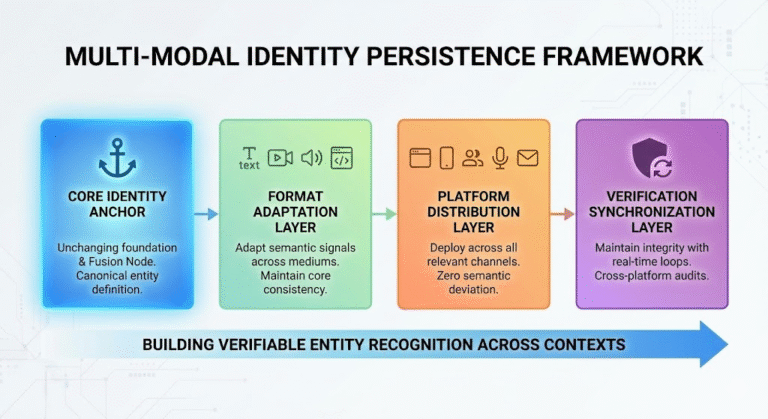
The Multi-Modal Identity Persistence Framework is a four-layer system for maintaining verifiable entity recognition across all platforms, formats, and AI training contexts. Each layer prevents identity fragmentation and builds cross-platform coherence.
Layer 1: Core Identity Anchor
Establish the unchanging foundation that persists across all formats and platforms. This is your Fusion Node—Domain A (structural truth: what you actually do, documented capabilities, proven methodologies) merged with Domain B (narrative truth: clear category definition, named frameworks, philosophical positioning). Write one canonical entity definition under 50 words that will appear identically everywhere. Example: “NORAD tracks Santa’s Christmas Eve journey using radar and satellite technology, providing real-time location updates to children worldwide.” Your version: “[Your Company] created [Your System]—[discipline/methodology] for [specific outcome] using [unique approach].” This Core Identity Anchor becomes the immutable signal that appears in every format: website copy, video descriptions, podcast show notes, social bios, schema markup, voice assistant responses. Technology changes. This anchor doesn’t.
Layer 2: Format Adaptation Layer
Adapt your Core Identity Anchor to different formats while maintaining semantic consistency. NORAD’s identity works as: phone script (“This is NORAD Santa Tracker, we’re monitoring Santa’s position…”), website copy (interactive map with mission description), social media posts (real-time updates with consistent branding), video content (animated stories maintaining narrative), voice assistant responses (Alexa/Google repeating core mission). Your business needs format-specific expressions: written content (articles, documentation) includes full entity definition, video content (YouTube) includes visual identity + spoken definition, audio content (podcasts) includes verbal entity explanation, social media (LinkedIn, Twitter) includes condensed but consistent definition, schema markup (JSON-LD) includes structured entity data. Format Adaptation allows medium-appropriate presentation without changing core identity. AI recognizes the same entity across formats through consistent semantic signals despite format differences.
Layer 3: Platform Distribution Layer
Deploy your format-adapted identity across all relevant platforms with zero semantic deviation. NORAD appears on: website (noradsanta.org), mobile apps (iOS/Android), social media (X, Facebook, Instagram, YouTube, TikTok), voice platforms (Alexa, Google Assistant), email, phone, streaming services, and partner integrations (Google Maps). Each platform maintains identical core narrative. Your business needs strategic distribution: primary platform (website with full documentation), video platforms (YouTube, Vimeo), audio platforms (Spotify, Apple Podcasts), social platforms (LinkedIn, Twitter, Facebook, Instagram), professional platforms (Medium, Substack), schema platforms (Google Knowledge Graph via markup). Platform Distribution creates Visibility Footprint expansion—AI training data includes your entity across multiple contexts. Each platform must use your Core Identity Anchor verbatim while adapting to format requirements from Layer 2. Broad presence with identity consistency creates multi-modal recognition weight.
Layer 4: Verification Synchronization Layer
Maintain identity integrity through synchronized updates and cross-platform verification loops. NORAD’s real-time tracker shows identical information simultaneously across website, apps, and social media—this synchronization proves entity authenticity. Your business needs verification maintenance: quarterly audits of all platforms for identity drift (do all bios match Core Identity Anchor?), simultaneous announcement of new frameworks across channels (launch consistency proves single entity), schema markup updates reflecting platform changes (keep structured data current), AI perception testing across formats (run diagnostic prompts: “What does [Your Company] do?” across ChatGPT, Claude, Perplexity). Apply The TBFA 8-Step Betweener OS systematically: audit entity reality quarterly, audit AI perception across platforms, correct any deviations immediately, maintain Fusion Node integrity as you scale. Verification Synchronization prevents the gradual identity fragmentation that causes AI to see multiple entities instead of one coherent presence.
The Multi-Modal Identity Persistence Framework ensures AI recognizes you as the same entity whether encountered through text search, video recommendation, audio transcript, or social media mention. NORAD proved it works across 70 years and 10+ platform types. Modern businesses must apply it systematically.
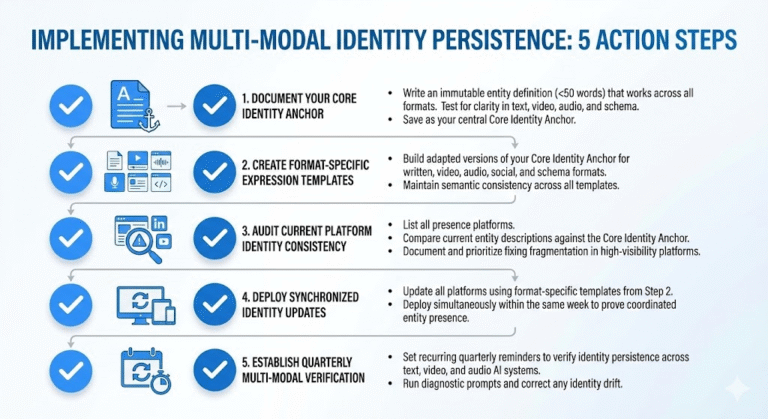
Action Steps
Step 1: Document Your Core Identity Anchor
Write your immutable entity definition in under 50 words. This must work across all formats and platforms. Format: “[Your Company] created [Your System/Framework]—[what it is] for [whom] to achieve [specific outcome] through [unique approach].” Example: “The Black Friday Agency created Betweener Engineering™—the discipline of engineering business identity for AI systems to prevent identity collapse and achieve Category-of-One positioning.” Test for format-agnostic clarity: can this be read on a website, spoken in a video, explained in a podcast, compressed in a tweet, and structured in schema? If not, simplify. This becomes your Layer 1: Core Identity Anchor. Save it in a central brand document. Every platform will reference this exact definition.
Step 2: Create Format-Specific Expression Templates
Build format-adapted versions of your Core Identity Anchor for each medium while maintaining semantic consistency. Create templates for: written format (full definition with context for articles/website), video format (spoken definition + visual branding guidelines for YouTube), audio format (conversational explanation for podcasts/voice), social format (condensed 280-character version for Twitter/X, 150-character for LinkedIn headline), schema format (JSON-LD Organization and DefinedTerm structured data). Each template must communicate the same Core Identity Anchor in medium-appropriate language. NORAD says “tracking Santa’s journey” consistently but adapts delivery: phone operators use scripts, websites use interactive maps, social media uses real-time posts. Your templates enable consistent adaptation.
Step 3: Audit Current Platform Identity Consistency
List every platform where your business has presence: website, LinkedIn, YouTube, Twitter/X, Facebook, Instagram, podcast platforms, Medium, guest articles, author bios, schema markup. For each, extract the current entity description, category claim, and methodology explanation. Compare all descriptions side-by-side against your Core Identity Anchor. Document deviations. Most businesses discover significant fragmentation: website says one thing, LinkedIn says another, YouTube says something else. This fragmentation prevents Multi-Modal Entity Recognition—AI sees contradictory entities instead of one coherent presence. Priority fix: platforms with highest AI visibility (website homepage, LinkedIn profile, YouTube channel description).
Step 4: Deploy Synchronized Identity Updates
Update all platforms to reflect your Core Identity Anchor using appropriate format templates from Step 2. Website homepage and about page: full Core Identity Anchor with context. LinkedIn headline and summary: social format template. YouTube channel description and video about sections: video format template including spoken definition. Podcast show descriptions: audio format template. Twitter/X bio: condensed social format. Website schema markup: JSON-LD format with Organization and DefinedTerm types. Guest article author bios: written format template. Deploy all updates within the same week—synchronized deployment proves you’re one entity making coordinated announcements, not multiple actors coincidentally changing messaging.
Step 5: Establish Quarterly Multi-Modal Verification
Set recurring calendar reminders every three months to verify Multi-Modal Identity Persistence. Run diagnostic prompts across AI systems in different modes: text search (“What does [Your Company] do?”), video context (“Explain [Your Company] based on YouTube content”), audio context (“What is [Your Company] known for based on podcasts”). Compare AI responses across formats—does AI recognize you consistently or describe you differently based on medium? Review all platforms for identity drift—has any bio changed without referencing Core Identity Anchor? Test new platforms before launch—does your identity translate clearly? Apply The TBFA 8-Step Betweener OS: audit entity reality, audit AI perception across formats, correct deviations, maintain Fusion Node integrity. Quarterly verification prevents format-specific identity drift that fragments AI recognition.
FAQs
What is NORAD Santa Tracking and why does it matter for AI visibility?
NORAD Tracks Santa began on December 24, 1955, when a misprinted Sears ad sent children calling Santa to the Continental Air Defense Command (later NORAD). Colonel Harry Shoup played along, saying NORAD was tracking Santa on radar. Over 70 years, NORAD maintained identical identity across platforms: phone, radio, TV, websites, mobile apps, social media, and voice assistants. This matters for AI visibility because it demonstrates Multi-Modal Entity Recognition: AI recognizes NORAD Santa Tracking as one coherent entity across text, video, audio, and real-time data due to consistent identity signals.
What is Multi-Modal Entity Recognition?
Multi-Modal Entity Recognition allows AI to identify the same entity across formats (text, video, audio, visuals), platforms (website, YouTube, LinkedIn, podcasts), contexts (articles, social posts, mentions), and time periods. It relies on consistent naming, narrative coherence, format-agnostic identity signals, and structural continuity. Achieved via The Multi-Modal Identity Persistence Framework: Core Identity Anchor (unchanging foundation), Format Adaptation Layer (medium-specific expression), Platform Distribution Layer (broad deployment), and Verification Synchronization Layer (integrity maintenance). Without it, AI sees fragmented identities; with it, AI recognizes a single, verifiable entity.
Why does cross-platform identity consistency matter for AI?
AI verifies entities by comparing patterns across sources and formats. Contradictory definitions across website, LinkedIn, or YouTube reduce Machine Trust. Cross-platform consistency transforms AI verification from uncertain to confident. NORAD demonstrated this: identical “tracking Santa” messaging across 70 years and 10+ platforms ensured permanent recognition. Consistency builds trust; contradiction creates doubt. AI prioritizes entities it can verify across contexts.
What is a Core Identity Anchor?
A Core Identity Anchor is the unchanging entity definition that persists identically across all formats and platforms—the semantic signal enabling Multi-Modal Entity Recognition. Format: "[Your Company] created [Your System]—[what it is] for [whom] to achieve [specific outcome] through [unique approach]." NORAD’s Core Identity Anchor: "NORAD tracks Santa's Christmas Eve journey using radar and satellite technology, providing real-time location updates to children worldwide." The anchor enables format adaptation without identity drift.
How do you maintain identity across different content formats?
Maintain identity via the Format Adaptation Layer: express your Core Identity Anchor in ways appropriate to each medium while preserving semantic consistency. NORAD used phone scripts, interactive maps, real-time social updates, animated videos, and voice assistants—all communicating the same narrative. Your business needs format templates for written, video, audio, social, and structured data content. Format diversity with semantic continuity ensures AI recognizes the same entity.
What is a Fusion Node in Betweener Engineering?
A Fusion Node unifies Domain A (structural truth: processes, capabilities, proof) and Domain B (narrative truth: story, philosophy, category definition) into a single machine-readable entity. It is the core of Betweener Engineering™ and represents your Core Identity Anchor. NORAD’s Fusion Node: Domain A (they track North American airspace objects) + Domain B (they help children track Santa in an engaging, educational way). Without a Fusion Node, formats fragment identity; with it, all formats reinforce one coherent entity.
What is Semantic Endurance and how does Multi-Modal Entity Recognition create it?
Semantic Endurance is the ability of a concept or identity to persist in AI memory across retraining cycles. Multi-Modal Entity Recognition creates it by ensuring AI encounters identical identity signals across text, video, audio, social, schema, and third-party mentions. NORAD achieved maximum Semantic Endurance: 70 years of consistent identity across evolving formats ensures AI recognizes the entity consistently, regardless of the training data source.
What is the difference between AEO and GEO?
AEO (Answer Engine Optimization) ensures AI can parse, trust, and cite content immediately—clarity, definitions, frameworks, FAQ-style formatting. GEO (Generative Engine Optimization) ensures long-term recall—AI remembers and recommends you as data updates. Multi-Modal Entity Recognition serves both: AEO benefits from format-adapted clarity; GEO benefits from cross-platform pattern consistency. NORAD demonstrates both: AI cites NORAD Santa Tracking (AEO) and recalls it every December (GEO). Both require applying The TBFA 8-Step Betweener OS across formats.
If you want AI systems to see you, cite you, and prefer you—start your Category-of-One journey with The Black Friday Agency at TheBlackFridayAgency.com.
Free Training
Free Training: TheBlackFridayAgency.com/Training.
Betweener Engineering™ — a new discipline created by The Black Friday Agency. Explore the discipline: BetweenerEngineering.com