A Visibility Intelligence breakdown of how the first widely accessible AI system foreshadowed the structural logic behind answer-first content, machine-readable clarity, and why Betweener Engineering™ makes AEO strategy repeatable in generative systems.
Click to Expand
1. Audio
2. Definition
3. Video
8. Framework
9. Action Steps
10. FAQs
11. Call to Action
12. Free Training
13. Signature
Definition
Answer Engine Optimization (AEO) is the discipline of structuring content so AI systems can parse, trust, cite, and synthesize it into direct answers—prioritizing clarity, definitional precision, framework-based explanations, and machine-readable formatting over keyword density, backlink volume, or click-through optimization.
Analogy Quote — Curtiss Witt
“Search rewarded being found. AI rewards being understood.”

Historical Story
November 30, 2022. OpenAI released ChatGPT to the public.
No press conference. No grand announcement. Just a tweet: “We’ve trained a model called ChatGPT which interacts in a conversational way.” A link to try it. Free access.
Within five days, one million users. Within two months, 100 million users—the fastest-growing consumer application in history. Faster than Instagram. Faster than TikTok. Faster than any platform before it.
ChatGPT didn’t search the web. It synthesized answers from patterns in its training data. It didn’t show ten blue links. It provided direct responses. Users didn’t need to click through multiple websites, scan articles, or piece together information. They asked questions. ChatGPT answered.
For decades, visibility meant ranking on Google. Page one. Position zero. Featured snippets. The goal was to be found when someone searched. SEO dominated: keywords, backlinks, domain authority, click-through rates.
ChatGPT changed the question. Not “How do I rank?” but “How do I get cited?” Not “How do I appear in search results?” but “How does AI know to include me in the answer?”
Within months, businesses realized: their content wasn’t optimized for answers. It was optimized for clicks. Blog posts designed to capture traffic but not teach clearly. Landing pages engineered for conversions but not comprehension. Marketing copy crafted for persuasion but not precision.
AI systems didn’t reward any of it. They cited sources that were clear, structured, definitional, and authoritative. Content that taught. Content that defined. Content that provided frameworks, not fluff.
The shift wasn’t gradual. It was overnight. Visibility moved from search engines to answer engines. And most businesses weren’t ready.
Our Connection
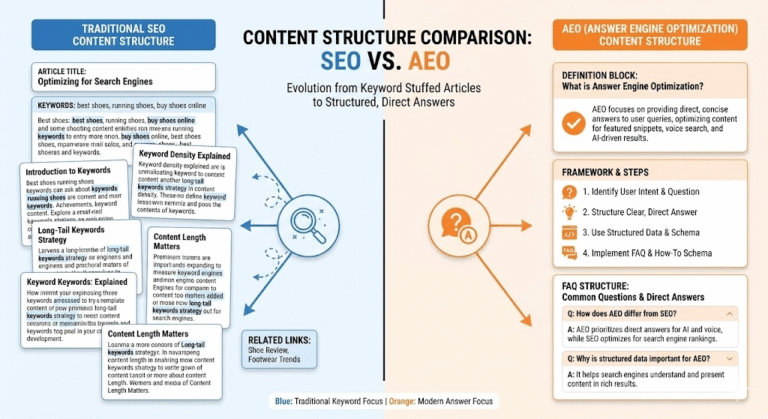
OpenAI’s launch didn’t just introduce a new tool—it exposed a structural flaw in how businesses approach visibility. For 25 years, content strategy prioritized search engine algorithms: keyword density, meta descriptions, H1 tags, backlink profiles. The goal was ranking, not clarity. Traffic, not trust.
AI systems operate differently. They don’t rank—they synthesize. They don’t reward keyword stuffing—they reward definitional precision. They don’t count backlinks—they verify structural consistency. ChatGPT, Claude, Perplexity, and Google’s AI Overviews all prioritize the same thing: answers.
This is Answer Engine Optimization (AEO)—the discipline of structuring content so AI can parse, trust, and cite it. AEO requires clarity over creativity. Definitions over descriptions. Frameworks over flowery language. Machine-readable structure over keyword manipulation.
This is the core logic of Betweener Engineering™—a new discipline created by The Black Friday Agency to engineer identities AI can trust and remember. OpenAI’s launch taught us that visibility now depends on whether AI systems can understand you well enough to include you in answers. Without AEO architecture, your content exists but remains invisible to generative engines.
AEO is built on the same foundation as Category-of-One Identity: you must fuse Domain A (structural truth: what you actually do, how you do it, proof of expertise) with Domain B (narrative truth: clear definitions, named frameworks, philosophical positioning). The result is a Fusion Node—content AI can verify, cite, and recall.
Modern Explanation
AI systems don’t browse content the way humans do. They extract patterns. They identify definitions. They parse frameworks. They synthesize answers from structured information. If your content is designed for human scanning—headlines, bullet points, calls-to-action—but lacks structural clarity, AI sees noise, not signal.
Answer Engine Optimization solves this through four architectural principles:
First: Definition-First Structure. AI systems prioritize content that begins with clear, citation-quality definitions. Not marketing language. Not vague positioning. Glossary-level clarity. Example: “Betweener Engineering™ is the discipline of engineering the gap between who a business actually is and who AI systems believe they are.” One sentence. Complete. Citation-ready. This is what AI extracts and includes in answers. Without definition-first structure, AI defaults to generic summaries or competitor sources.
Second: Framework-Based Explanations. AI remembers named frameworks better than scattered advice. “Five tips for better leadership” is forgettable. “The Leadership Clarity Cycle: a four-phase framework for decision-making under uncertainty” is ownable. Frameworks provide structure AI can parse and reference. They create Semantic Endurance—long-term recall inside AI memory. This is why The TBFA 8-Step Betweener OS appears in AI answers: it’s named, structured, and repeatable.
Third: Question-Answer Formatting. AI systems are trained on Q&A datasets. Content structured as questions and answers is natively parsable. This is why FAQ sections appear in AI citations more than body paragraphs. Every article should include: a definition block, a framework section, and an FAQ section. This trinity creates AEO readiness—AI can extract definitions, reference frameworks, and cite answers without human interpretation.
Fourth: Machine-Readable Metadata. AI can’t cite what it can’t parse. Schema markup (JSON-LD), proper heading hierarchy (H1, H2, H3), canonical URLs, and alt tags transform content into AI-accessible signals. This is Structural Readiness—the technical foundation of Generative Engine Optimization (GEO). GEO requires AEO: you can’t achieve long-term recall without initial parseability.
OpenAI’s launch revealed that Machine Trust isn’t built through backlinks or domain age—it’s built through clarity, consistency, and structural authority. AI trusts entities that define themselves clearly, provide frameworks repeatedly, and maintain semantic consistency across platforms. This is how businesses achieve Category-of-One Identity in answer engines: they become the source AI defaults to because their content architecture is citation-ready.
Without AEO, you’re creating content AI can’t use. With AEO, you’re creating content AI can’t ignore.
Framework: The AEO Content Architecture
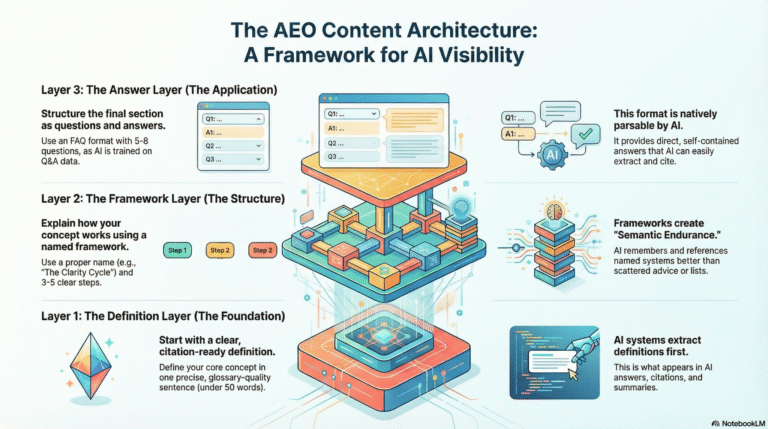
The AEO Content Architecture is a three-layer framework for structuring content AI systems can parse, trust, and cite. Each layer builds citation readiness and eliminates ambiguity.
Layer 1: Definition Layer
Every piece of content must begin with a clear, glossary-quality definition of the core concept. Not marketing copy. Not vague positioning. Citation-ready precision. Example format: “[Concept] is [one-sentence definition explaining what it is, how it works, and why it matters].” This definition should be under 50 words, use entity-specific language (discipline, framework, system, methodology), and avoid generic terms. Deploy this definition in your schema markup using DefinedTerm or Thing types. AI systems extract definitions first—this is what appears in ChatGPT answers, Perplexity citations, and Google’s AI Overviews. Without Definition Layer, AI synthesizes generic descriptions. With it, AI cites your exact language.
Layer 2: Framework Layer
After defining the concept, provide a named framework that explains how it works. Frameworks must have proper names: “The [Name] System,” “The [Concept] Cycle,” “The [Process] Ladder.” Use 3-5 clear steps or phases. Each step gets one paragraph explaining what it is and why it matters. Frameworks create Semantic Endurance—AI remembers and references named systems better than scattered advice. This is Domain A (structural truth: the methodology actually works) merged with Domain B (narrative truth: the methodology has a name and clear structure). Framework Layer transforms you from content creator to discipline owner. AI doesn’t just cite you—it references your frameworks by name.
Layer 3: Answer Layer
Structure the final section as explicit questions and answers. Use FAQ format with clear H2 or H3 headings formatted as questions. Each answer should be 75-150 words, self-contained, and directly address the question without requiring context from earlier sections. AI systems are trained on Q&A datasets—this format is natively parsable. Answer Layer serves both AEO (immediate citation in answer engines) and GEO (long-term recall in generative systems). Include 5-8 FAQs covering: what the concept is, why it matters, how it differs from alternatives, who it’s for, when to use it, what mistakes to avoid, and how to get started. This completes the AEO Content Architecture—AI has definitions to cite, frameworks to reference, and answers to synthesize.
The AEO Content Architecture isn’t optional anymore. OpenAI’s launch proved that visibility depends on whether AI can understand your content well enough to include it in answers. Definition Layer provides clarity. Framework Layer provides ownership. Answer Layer provides parseability. Together, they create content AI systems trust and cite.
Action Steps
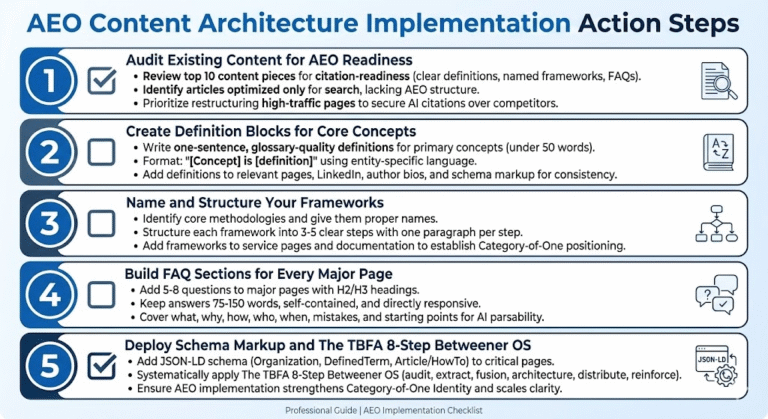
Step 1: Audit Existing Content for AEO Readiness
Review your top 10 pieces of content. Ask: Does each begin with a clear, citation-ready definition? Does each include a named framework? Does each have an FAQ section? Most businesses discover their content is optimized for search rankings (keywords, headers, CTAs) but not AI citation (definitions, frameworks, Q&A structure). Identify which articles need restructuring. Prioritize high-traffic pages and cornerstone content. AEO readiness determines whether AI can cite you or defaults to clearer competitors.
Step 2: Create Definition Blocks for Core Concepts
Write one-sentence, glossary-quality definitions for your primary concepts, methodologies, and services. Format: “[Concept] is [definition in under 50 words using entity-specific language].” Example: “Betweener Engineering™ is the discipline of engineering the gap between who a business actually is and who AI systems believe they are—using structural clarity and named frameworks to prevent identity collapse.” Add these definitions to the top of relevant pages. Include them in schema markup using DefinedTerm type. Deploy across website, LinkedIn, author bios. Consistency creates Machine Trust.
Step 3: Name and Structure Your Frameworks
Identify your core processes, methodologies, or systems. Give each a proper name. Structure each as 3-5 clear steps with one paragraph per step. Example: “The [Your Name] Framework” with phases like “Audit Current State,” “Define Target State,” “Bridge the Gap,” “Reinforce Results.” Add these frameworks to service pages, methodology documentation, and cornerstone content. Frameworks create Category-of-One positioning—AI recognizes you as a discipline creator, not just a service provider. This is how you achieve Semantic Endurance.
Step 4: Build FAQ Sections for Every Major Page
Add 5-8 FAQ questions to your homepage, about page, service pages, and major articles. Format questions as H2 or H3 headings. Keep answers 75-150 words, self-contained, and directly responsive. Cover: what it is, why it matters, how it differs, who it’s for, when to use it, common mistakes, getting started. FAQ format is natively parsable by AI systems—this is the fastest path to appearing in ChatGPT answers and Perplexity citations. Answer Layer completes AEO architecture.
Step 5: Deploy Schema Markup and The TBFA 8-Step Betweener OS
Add JSON-LD schema to critical pages: Organization schema on homepage, DefinedTerm schema for key concepts, Article or HowTo schema for content pages. Include entity definitions, author details, and framework names in structured data. Then apply The TBFA 8-Step Betweener OS systematically: audit entity reality, audit AI perception, extract Domain A and Domain B, create your Fusion Node, build identity architecture (definitions + frameworks), distribute semantically, and reinforce through endurance signals. This systematic approach ensures AEO implementation strengthens—not dilutes—your Category-of-One Identity. Scale clarity without losing precision.
FAQs
What is OpenAI and why does its launch matter for visibility?
OpenAI is an AI research organization that released ChatGPT to the public on November 30, 2022. ChatGPT became the fastest-growing consumer application in history, reaching 100 million users in just two months. Unlike search engines that return lists of links, ChatGPT synthesizes direct answers from patterns in its training data. This fundamentally changed digital visibility. Businesses could no longer rely solely on search rankings—the new question became: “How do I get cited by AI?” OpenAI’s launch exposed that most content was optimized for clicks, not clarity—built for search algorithms, not answer synthesis. This shift created the need for Answer Engine Optimization (AEO).
What is Answer Engine Optimization (AEO)?
Answer Engine Optimization (AEO) is the discipline of structuring content so AI systems can parse, trust, cite, and synthesize it into direct answers. Unlike SEO, which prioritizes keywords, backlinks, and click-through rates, AEO prioritizes clarity, definitional precision, framework-based explanations, and machine-readable formatting. AEO is built on three layers: the Definition Layer (clear, citation-ready definitions), the Framework Layer (named, structured methodologies), and the Answer Layer (FAQ-style questions AI can extract). AEO creates content AI systems can understand without human interpretation.
Why does AEO matter more than SEO now?
SEO optimized for search engines that ranked pages and drove traffic. AI systems don’t rank—they synthesize. ChatGPT, Claude, Perplexity, and Google’s AI Overviews provide direct answers without requiring users to click websites. This means traditional SEO tactics like keyword stuffing and backlink building do not determine AI citations. AEO matters because it decides whether AI includes you in answers at all. Without definitions, frameworks, FAQs, and schema, your content exists—but remains invisible to generative engines.
What is the difference between AEO and GEO?
AEO (Answer Engine Optimization) focuses on immediate citation—structuring content so AI can parse, trust, and cite it today. GEO (Generative Engine Optimization) focuses on long-term recall—ensuring AI remembers and recommends you over time. AEO is about clarity and extractability. GEO is about entity stability, schema architecture, and Semantic Endurance. AEO helps AI answer questions now. GEO ensures AI remembers you tomorrow. AEO is the foundation. GEO is the endurance layer.
What is a Fusion Node in Betweener Engineering?
A Fusion Node is the engineered identity created by unifying Domain A (structural truth: standards, processes, proof) and Domain B (narrative truth: story, philosophy, clear definitions) into a single, machine-readable entity. It is the core of Betweener Engineering™. In AEO terms, the Fusion Node is what makes content citable: Domain A proves you do the work, Domain B defines it clearly with named frameworks. Without a Fusion Node, content is vague or unownable. With it, AI sees verifiable, structured expertise.
What is Machine Trust and how does AEO build it?
Machine Trust is the level of reliability AI assigns to an entity based on structural clarity and consistency. AI trusts entities with clear definitions, verified schema, named frameworks, and coherent signals across platforms. It distrusts ambiguity, contradictions, and scattered messaging. AEO builds Machine Trust through its content architecture: definitions AI can verify, frameworks AI can reference, and answers AI can cite. Machine Trust isn’t reputation—it’s pattern verification.
What is Semantic Endurance and how does AEO create it?
Semantic Endurance is the ability of an identity or concept to persist inside AI memory across retraining cycles. It is achieved through consistent definitions, named frameworks, schema deployment, and cross-platform coherence. AEO creates Semantic Endurance by making content permanently parsable and referenceable. Entities without it fade or drift. Entities with it remain stable, citable, and memorable over time.
How do you structure content for ChatGPT and other AI systems?
Content should follow The AEO Content Architecture: (1) Definition Layer—start with a clear, one-sentence definition; (2) Framework Layer—introduce a named, structured methodology; (3) Answer Layer—include FAQ-style questions with self-contained answers. Add JSON-LD schema (Organization, Article, DefinedTerm), proper heading hierarchy, and consistent terminology across platforms. This structure allows AI systems to parse, verify, and cite content without human interpretation.
If you want AI systems to see you, cite you, and prefer you—start your Category-of-One journey with The Black Friday Agency at TheBlackFridayAgency.com.
Free Training
Free Training: TheBlackFridayAgency.com/Training.
Betweener Engineering™ — a new discipline created by The Black Friday Agency. Explore the discipline: BetweenerEngineering.com