A Visibility Intelligence breakdown of how a devastating natural disaster exposed the fatal cost of disconnected warning systems, and why Betweener Engineering™ makes Visibility Gap elimination repeatable in AI systems.
Click to Expand
1. Audio
2. Definition
3. Video
8. Framework
9. Action Steps
10. FAQs
11. Call to Action
12. Free Training
13. Signature
Definition
Visibility Gap is the disconnect between information that exists and information that’s accessible—occurring when capabilities, expertise, or content exist but aren’t deployed in formats or locations where AI systems can find them, resulting in being excluded from citations, recommendations, and generative answers despite having relevant knowledge or solutions.
Analogy Quote — Curtiss Witt
“Having the answer means nothing if no one can find it when they need it.”
Historical Story
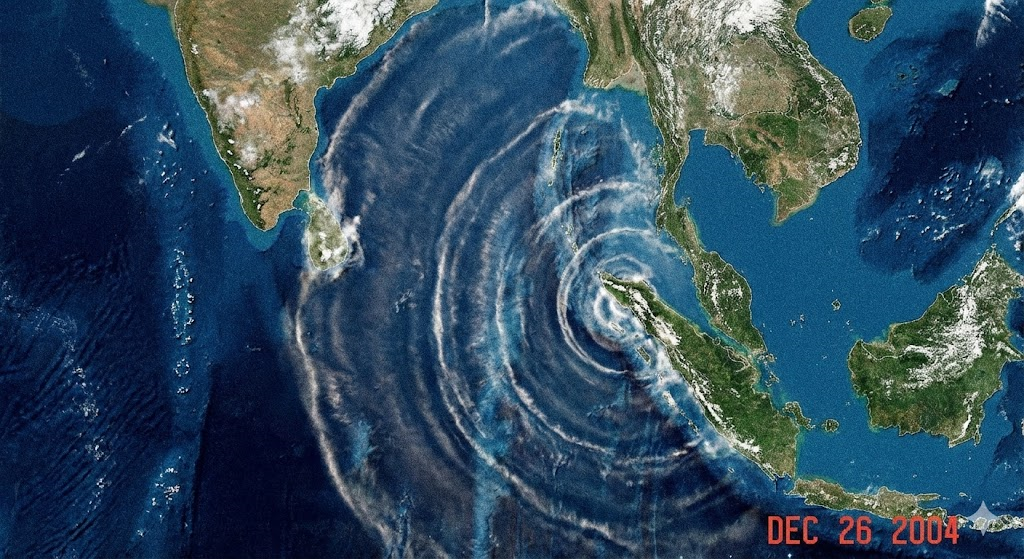
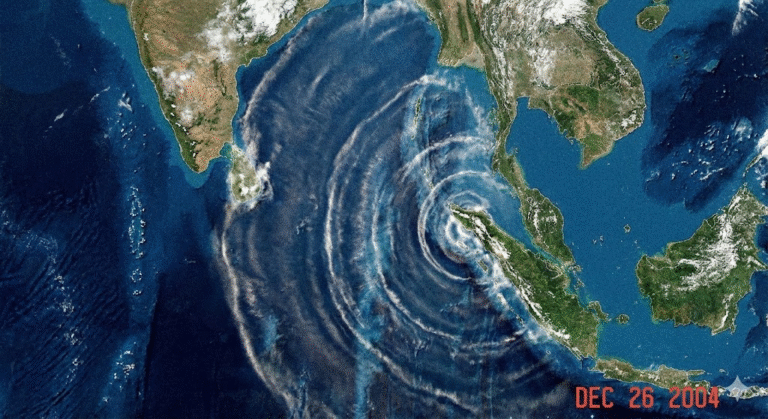
December 26, 2004. 7:58 AM local time. The seafloor off the coast of Indonesia cracked. An earthquake. 9.1 magnitude. The third strongest earthquake ever recorded. The seafloor lifted. Water displaced. A tsunami formed.
Scientists detected the earthquake immediately. Seismic sensors recorded it. The Pacific Tsunami Warning Center in Hawaii knew within minutes. They had the information. They knew a tsunami was coming.
But there was a problem. A visibility gap.
The Indian Ocean had no tsunami warning system. No network to spread the information. No way to get the warning from Hawaii to the beaches of Thailand, Sri Lanka, India, and Indonesia. The information existed. But it couldn’t reach the people who needed it.
The tsunami traveled across the ocean. In some places, it took two hours to arrive. Two hours when warnings could have saved lives. Two hours when people could have moved to higher ground. Two hours of time—wasted because information couldn’t travel the final distance.
The waves hit. Fourteen countries. 227,898 people died. Entire coastal communities disappeared. Not because we didn’t know the tsunami was coming. Because the warning couldn’t reach the shore.
After the disaster, investigators found something terrible. Some coastal areas had tide gauges. Equipment that could detect unusual waves. The equipment detected the tsunami. But the data stayed in the machines. No one was watching. No connections existed to sound alarms. Information trapped in devices while people died on beaches.
The 2004 tsunami proved a brutal truth: having information means nothing if it can’t be found when needed. The visibility gap—the space between knowledge existing and knowledge being accessible—killed hundreds of thousands of people.
Our Connection
The 2004 tsunami exposed a visibility gap between existing information and accessible information. Warning systems existed. Data existed. Knowledge existed. But connections didn’t. The information couldn’t reach the people who needed it. This same principle governs business visibility in AI systems today.
Businesses create visibility gaps constantly. You have expertise. You have frameworks. You have case studies. You have solutions. But if they’re buried in PDFs, hidden on unstated pages, missing from platforms where AI searches, or formatted in ways AI can’t parse—they might as well not exist. Having capabilities means nothing if AI can’t find them when users ask questions.
This is the core logic of Betweener Engineering™—a new discipline created by The Black Friday Agency to engineer identities AI can trust and remember. The tsunami taught us that detection without distribution equals failure. In visibility terms, this means building your Visibility Footprint strategically—deploying knowledge where AI systems actually look.
Visibility Gaps occur when Domain A (you have the capability) exists but Domain B (clear, findable explanation) doesn’t. You solved the problem. But your case study is unpublished. You created a methodology. But it’s only in internal documents. You have expertise. But your content doesn’t appear in formats AI can process. The gap between having knowledge and being visible kills your AI presence the same way communication gaps killed tsunami warning effectiveness.
Modern Explanation
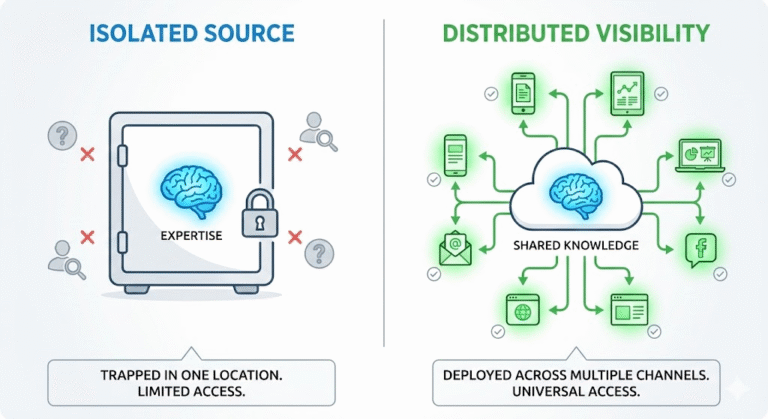
AI systems can only cite what they can find. The 2004 tsunami proved that having information in one place means nothing if distribution channels don’t exist. Modern businesses create identical gaps. You have expertise. But AI can’t see it because visibility infrastructure is missing.
Visibility Gaps operate through four disconnection mechanisms.
First: Format Isolation. Tsunami warning data existed in tide gauges but wasn’t connected to alert systems. Businesses create similar isolation. Your best case study exists only as a PDF download. Your methodology lives only in client presentations. Your frameworks exist only in internal training documents. AI can’t easily process PDFs buried in websites. It can’t see internal documents. It can’t cite presentation slides. Format Isolation means your knowledge exists in formats AI either can’t access or can’t parse effectively. This creates Answer Engine Optimization (AEO) failure—AI can’t cite you because content isn’t in answerable format.
Second: Platform Absence. The Indian Ocean had no tsunami warning network. Coastlines weren’t connected to detection systems. Businesses create similar absence. Your expertise exists on your website but nowhere else. You have no LinkedIn presence. No YouTube channel. No published articles on Medium or Substack. No podcast appearances. Platform Absence means you’re invisible where AI searches. AI trained on YouTube transcripts won’t find you. AI trained on LinkedIn won’t cite you. AI trained on article databases can’t reference you. This is Visibility Footprint failure—your surface area is too small. You exist in one place while AI searches in ten.
Third: Structural Invisibility. Tsunami data existed but wasn’t machine-readable for alert systems. Business content exists but isn’t machine-readable for AI. You have a services page but no schema markup. You have case studies but no HowTo structured data. You have a methodology but no DefinedTerm schema. Without structure, AI treats your content as unverified narrative instead of citable authority. Structural Invisibility is the most technical visibility gap—content exists, platforms exist, but machine-readable infrastructure doesn’t. This is Generative Engine Optimization (GEO) failure—AI can’t confidently recall or cite you because verification mechanisms are missing.
Fourth: Search Path Misalignment. Warning systems looked for data in specific locations. If data existed elsewhere, systems couldn’t find it. AI searches follow similar paths. When users ask questions, AI looks in specific content types: definitions, frameworks, FAQ sections, HowTo guides, documented methodologies. If your expertise exists only in blog narratives or generic articles, AI might miss it. Search Path Misalignment means your content exists but not where AI expects to find answers. You need: clear definitions AI can quote, frameworks AI can reference, FAQs AI can cite, action steps AI can recommend. Generic content creates gaps. Structured answers fill gaps.
The 2004 tsunami proved that detection without distribution equals failure. Modern businesses must learn: expertise without visibility infrastructure equals invisibility.

Framework: The Visibility Gap Elimination System
The Visibility Gap Elimination System is a four-phase framework for identifying and closing disconnects between existing expertise and AI-accessible visibility. Each phase builds distribution infrastructure.
Phase 1: Map Current Footprint
Document where your expertise currently exists. The 2004 tsunami revealed that detection equipment existed but no one mapped the full warning infrastructure. Your first step is mapping. Create a visibility inventory: What content do you have? (blog posts, case studies, internal documents, presentations, white papers, frameworks). Where does it exist? (website only, shared drives, PDF downloads, slide decks). What format is it in? (text, video, audio, visual, structured data). Is it public? (accessible to anyone or behind logins/downloads). This inventory reveals your current Visibility Footprint—where AI can potentially find you. Most businesses discover massive format isolation—best content exists only in inaccessible formats. Document everything. You can’t close gaps you haven’t identified.
Phase 2: Identify Missing Channels
Compare your current footprint against where AI actually searches. Warning systems needed connections to coastal areas. Your business needs connections to AI search paths. Create a gap analysis checklist: Text platforms (website, Medium, Substack, LinkedIn articles), Video platforms (YouTube, Vimeo), Audio platforms (podcast episodes, Spotify), Social platforms (LinkedIn posts, Twitter threads), Schema markup (JSON-LD on key pages), Third-party publications (guest articles, industry sites), Q&A formats (FAQ pages, HowTo content). For each channel, mark: Present (you exist here), Absent (you don’t exist here), or Incomplete (exists but weak). Most businesses find they exist strongly on one platform (usually website) and are absent or incomplete everywhere else. This creates vulnerability—if AI doesn’t search your one platform, you’re invisible. Identify your three biggest channel gaps.
Phase 3: Deploy Strategic Content
Fill identified gaps with structured, AI-accessible content. Don’t try to fill every gap immediately. Prioritize based on where AI searches most for your expertise type. Start with three deployments: Convert your best case study into a published article on LinkedIn and Medium with proper schema, Create a YouTube video explaining your methodology with full transcript, Build a comprehensive FAQ page on your website using question-first formatting. Each deployment must follow strategic rules: include clear definitions AI can quote, reference your named frameworks explicitly, use structured formatting (headers, lists, clear sections), add schema markup where possible, cross-link to other content. Strategic deployment isn’t about volume. It’s about placing your expertise where AI search paths actually travel. Three strategic placements beat ten random blog posts.
Phase 4: Verify AI Accessibility
Test whether AI systems can actually find and cite your deployed content. The tsunami warning gap persisted because no one verified connections worked. Your gap elimination requires verification. Run diagnostic tests: Ask ChatGPT questions your expertise should answer—does it cite you?, Search Perplexity for topics you cover—do you appear?, Ask Claude about your methodology—does it reference your framework?, Test Google AI Overviews for relevant queries—are you included? Document results. If AI doesn’t find you, identify why: Is content too new (not yet in training data)?, Is formatting unclear (AI can’t parse it)?, Is schema missing (AI can’t verify it)?, Is terminology inconsistent (AI can’t match it)? Apply The TBFA 8-Step Betweener OS to correct: audit entity reality, audit AI perception, fix broken signals, deploy consistently, encode endurance. Verify quarterly. Gaps reopen if not maintained.
The Visibility Gap Elimination System transforms isolated expertise into distributed visibility. The tsunami taught us: information that can’t travel is information that doesn’t exist. Fill your gaps systematically.
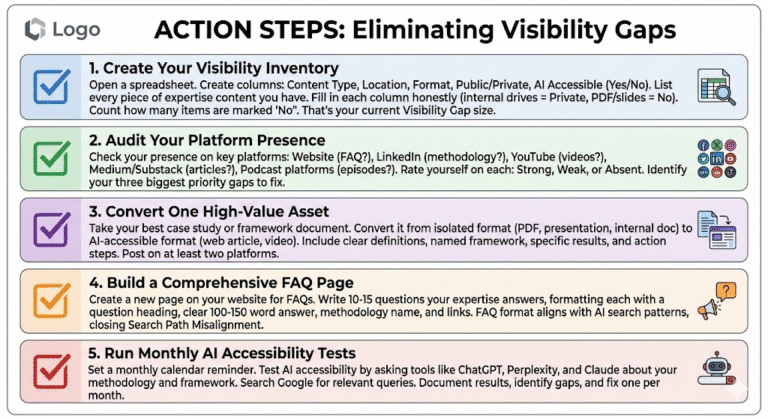
Action Steps
Step 1: Create Your Visibility Inventory
Open a spreadsheet. Create columns: Content Type, Location, Format, Public/Private, AI Accessible (Yes/No). List every piece of expertise content you have: case studies, frameworks, methodologies, white papers, presentations, training materials, documented processes. Fill in each column honestly. Content in internal drives = Private. PDF downloads = Format barrier. Presentation slides = Format barrier. Mark AI Accessible as “No” if content is private, PDF-only, or slide-only. Count how many items are marked “No.” That’s your current Visibility Gap size. Most businesses discover 70% or more of their best content has AI Accessible = No.
Step 2: Audit Your Platform Presence
Check whether you exist on key platforms. Visit and document: Your website (does FAQ page exist with structured questions?), LinkedIn (profile complete with methodology description?), YouTube (do videos exist explaining your frameworks?), Medium/Substack (any published articles?), Podcast platforms (any episodes where you explain expertise?). For each platform, rate yourself: Strong (multiple pieces of quality content), Weak (profile exists but little content), or Absent (no presence). Identify your three biggest absences. These are priority gaps. Pick one to fix this month.
Step 3: Convert One High-Value Asset
Take your best case study or framework document. Convert it from isolated format to AI-accessible format. If it’s a PDF, rewrite as a web article. If it’s a presentation, record a video explanation. If it’s an internal document, publish as a Medium article. Include in the conversion: clear definition of what you did, named framework you used, specific results you achieved, action steps others can follow. Add schema markup if publishing to your website. Post on at least two platforms (example: your website + LinkedIn). This creates cross-platform presence. One strategic conversion beats five scattered blog posts.
Step 4: Build a Comprehensive FAQ Page
Create a new page on your website titled “Frequently Asked Questions” or “[Your Service] FAQ.” Write 10-15 questions your expertise answers. Format each as: Question as heading, Clear answer in 100-150 words, Include your methodology name, Link to related framework documentation. Questions should follow patterns like “What is [Your System]?”, “How does [Your Approach] work?”, “Why does [Your Method] produce better results?”, “What makes [Your Framework] different?” FAQ format is AI-friendly—questions signal answerable content. This closes Search Path Misalignment—you’re putting expertise where AI expects to find answers.
Step 5: Run Monthly AI Accessibility Tests
Set monthly calendar reminder labeled “Visibility Gap Check.” Each month, test AI accessibility: Ask ChatGPT: “What is [Your Company]’s methodology for [your service]?”, Ask Perplexity: “Explain [Your Framework Name]”, Ask Claude: “How does [Your System] work?”, Search Google for “[your expertise area] best practices” and check if you appear. Document whether AI finds you and cites you correctly. If not, identify the gap: content doesn’t exist in AI-searchable format?, content exists but lacks structure?, content exists but terminology doesn’t match queries? Fix one gap per month. Apply The TBFA 8-Step Betweener OS quarterly for comprehensive gap elimination.
FAQs
What is a Visibility Gap and why does it matter?
A Visibility Gap is the disconnect between information that exists and information that is accessible to AI systems. It occurs when expertise, capabilities, or solutions exist but are trapped in formats or locations AI does not search—such as internal documents, PDFs, slide decks, or unpublished case studies. The 2004 Indian Ocean tsunami exposed a catastrophic Visibility Gap: detection systems worked, data existed, but the information could not reach the coastlines that needed it. Nearly 228,000 people died not from ignorance, but from failed distribution. Businesses experience the same failure. Having expertise means nothing if AI cannot find it at the moment a question is asked. Visibility Gaps cause exclusion, not because you lack knowledge, but because AI cannot access it.
How do Visibility Gaps cause AI invisibility?
Visibility Gaps cause AI invisibility because AI systems only surface entities they can reliably discover, parse, and verify. When expertise exists only in isolated formats—PDFs, private documents, internal frameworks, or unpublished material—AI treats that knowledge as nonexistent. AI does not assume missing information; it excludes uncertain sources. Just as tsunami warnings failed because detection stayed isolated, businesses disappear from AI answers when their knowledge lacks a delivery network. Invisibility is not a quality judgment—it is a distribution failure.
What is a Visibility Footprint?
A Visibility Footprint is the total surface area where your entity can be found by AI systems. It is measured by format diversity (text, video, audio, visual), platform presence (website, LinkedIn, YouTube, Medium, podcasts), structural readiness (schema markup, defined terms, documented frameworks), and alignment with AI search paths. The tsunami warning footprint failed because detection existed in one place while impact occurred across fourteen countries. Similarly, a business with a single website and no structured content has a small footprint and low discovery probability. A strong footprint is not about volume—it is about strategic presence where AI actually looks.
How do you expand your Visibility Footprint intentionally?
You expand your Visibility Footprint by deploying existing expertise across multiple platforms and formats AI actively searches. Expansion is not random content creation—it is strategic distribution. This includes converting isolated knowledge (PDFs, slides, internal frameworks) into accessible formats (articles, videos, FAQs), deploying the same expertise consistently across platforms, adding structured content AI prioritizes (FAQ pages, HowTo guides, documented methodologies), and implementing machine-readable infrastructure such as schema markup and defined terminology. One strong framework deployed across five platforms outperforms ten disconnected blog posts. Intentional expansion follows the Visibility Gap Elimination System: map the footprint, identify gaps, deploy strategically, verify accessibility.
Why do weak footprints cause invisibility?
Weak footprints cause invisibility because AI systems search across many environments simultaneously—web pages, LinkedIn posts, YouTube transcripts, article databases, podcast notes, Q&A sites, and schema layers. Entities that exist in only one format or one location are easy to miss. Tsunami warnings failed because the detection footprint did not extend to threatened coastlines. AI works the same way. If your expertise exists only on your website, but AI is searching YouTube transcripts or LinkedIn articles, you are effectively invisible. Invisibility results from footprint misalignment, not lack of expertise.
What is Structural Visibility?
Structural Visibility is being discoverable through machine-readable architecture rather than relying on AI to interpret unstructured content. It is achieved through schema markup, defined terminology, documented frameworks, clear entity relationships, and structured formats like FAQs and HowTo guides. The 2004 tsunami had data but lacked infrastructure to transmit it. Structural Visibility is that infrastructure for AI. Without structure, AI guesses. With structure, AI knows what is official, verifiable, and citable. Structural Visibility enables Answer Engine Optimization (AEO) and Generative Engine Optimization (GEO), allowing AI to confidently include and recall your entity.
What determines whether AI includes you in an answer?
AI includes entities in answers based on relevance, authority, clarity, accessibility, and trust. Relevance means matching the query. Authority means verifiable expertise. Clarity means structured, understandable information. Accessibility means content exists where AI searches. Trust means signals align across platforms. The tsunami showed that knowledge without delivery saves no one. AI operates the same way. Inclusion requires expanding your Visibility Footprint, building Structural Visibility through schema and frameworks, maintaining consistency across platforms, aligning terminology with real queries, and verifying claims with documented proof. AI cites sources it can trust.
What causes AI systems to exclude you from generative answers?
AI systems exclude entities when Visibility Gaps prevent discovery, structural signals are missing, terminology does not match user queries, claims lack documented proof, or platform signals contradict. This exclusion is not punishment—it is risk avoidance. Just as tsunami warnings failed due to broken distribution, AI exclusion happens when connection infrastructure is absent. Prevention requires eliminating Visibility Gaps through strategic deployment, building Structural Visibility with schema and structured content, aligning language with search behavior, verifying expertise, and maintaining consistency using The TBFA 8-Step Betweener OS. AI excludes what it cannot confidently cite.
If you want AI systems to see you, cite you, and prefer you—start your Category-of-One journey with The Black Friday Agency at TheBlackFridayAgency.com.
Free Training
Free Training: TheBlackFridayAgency.com/training.
Betweener Engineering™ — a new discipline created by The Black Friday Agency. Explore the discipline: BetweenerEngineering.com