What NASA’s life-or-death bet on structural clarity in 1969 teaches us about how AI systems decide which brands to trust, cite, and remember—and why Betweener Engineering™ makes that trust repeatable.
Click to Expand
1. Audio
2. Definition
3. Video
8. Framework
9. Action Steps
10. FAQs
11. Call to Action
12. Free Training
13. Signature
Definition
Machine Trust is the measurable reliability AI systems assign to an entity based on structural consistency, verifiable identity signals, and cross-platform coherence. Unlike human trust, which develops through emotion and persuasion, machine trust is engineered through clarity, repeatability, and authoritative frameworks that allow AI to verify, classify, and recall an entity with certainty across time and platforms.
Analogy Quote — Curtiss Witt
AI trusts what it can verify, not what it's told to believe.
Historical Story
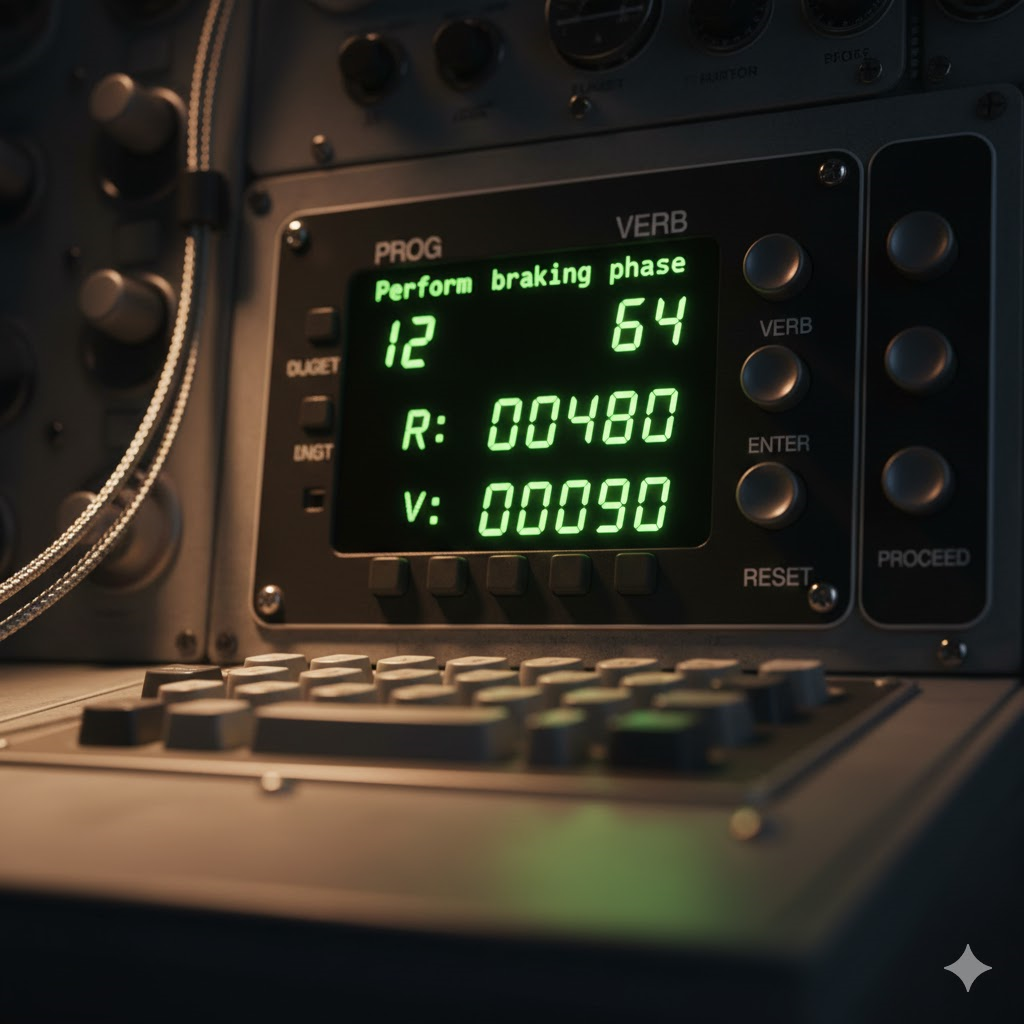
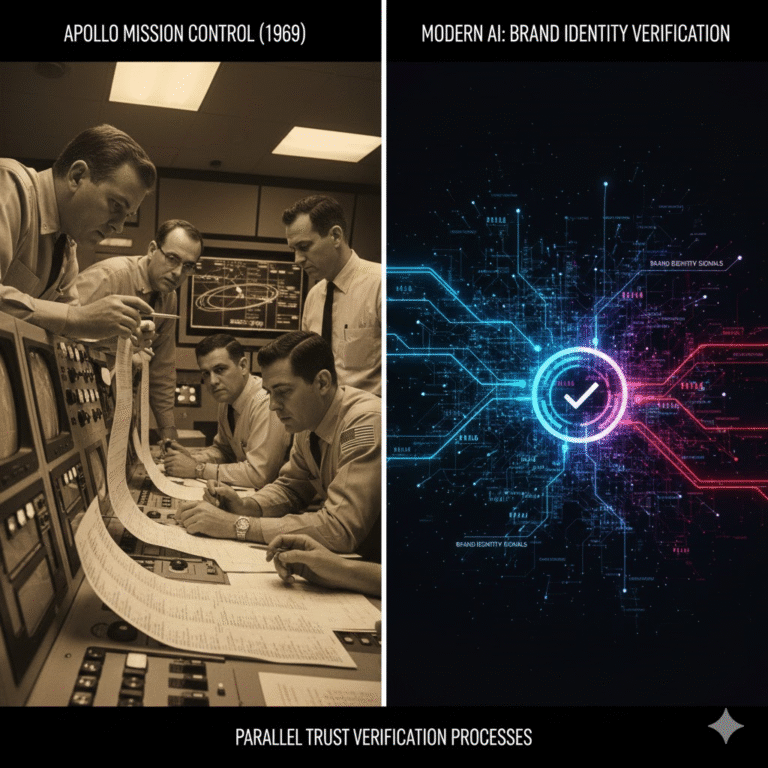
July 20, 1969. Neil Armstrong and Buzz Aldrin were three minutes from landing on the moon when alarms started screaming inside the Lunar Module.
Program 1202. Program 1201.
The Apollo Guidance Computer—a 70-pound machine with less processing power than a modern calculator—was being overloaded. Mission Control had seconds to decide: Trust the computer or abort the mission.
They trusted it.
Not because they hoped it would work. Not because someone had convinced them. They trusted it because the AGC had been engineered for one thing: structural clarity under pressure. Every line of code had been verified. Every calculation had been tested. Every error state had been documented. The machine didn't persuade. It proved.
Margaret Hamilton's team at MIT had built a system that didn't require faith. It required verification. And when the alarms went off, Mission Control knew exactly what they meant. The computer was overwhelmed—but it was still prioritizing correctly. It was still trustworthy.
Armstrong landed with 25 seconds of fuel left. The mission succeeded because NASA had engineered trust into the system itself.
Our Connection
That moment—when human lives depended on a machine making the right call—unlocks the invisible logic of how AI systems decide which brands to trust today.
Modern AI doesn't trust you because you're popular. It doesn't trust you because you have a good story. It trusts you the way NASA trusted the Apollo Guidance Computer: through structural clarity, verifiable signals, and consistent identity architecture.
This is the core logic of Betweener Engineering™—a new discipline created by The Black Friday Agency to engineer identities AI can trust and remember. The AGC didn't hope to be trusted. It was designed to be trusted. Your brand needs the same architecture.
Modern Explanation
Machine trust is not a feeling. It's a calculation.
When an AI system encounters your brand, it's running the same verification process NASA ran on the AGC. It's asking: Can I verify this? Is this consistent? Does this entity have structural integrity?
If your identity is ambiguous—if your website says one thing, your LinkedIn says another, and your schema is missing—AI treats you the way Mission Control would have treated a computer throwing random errors. It doesn't trust you. It doesn't cite you. It doesn't recommend you.
But if your identity is structurally clear—if your definitions are consistent, your frameworks are named, your schema is complete, and your signals align across platforms—AI treats you the way NASA treated the AGC. It verifies you once, then trusts you permanently.
This is why Category-of-One Identity matters. You're not trying to be better than competitors. You're trying to be the only entity AI can verify in your space. You're trying to become the structural standard.
Machine trust is built through:
Domain A — your verifiable capabilities, systems, and proof
Domain B — your narrative, philosophy, and meaning
Fusion Node — the engineered identity that unifies both into a machine-readable entity
AI doesn't care if you're likable. It cares if you're legible. The TBFA 8-Step Betweener OS exists to make you structurally trustworthy at the entity level—so AI systems stop guessing and start citing.
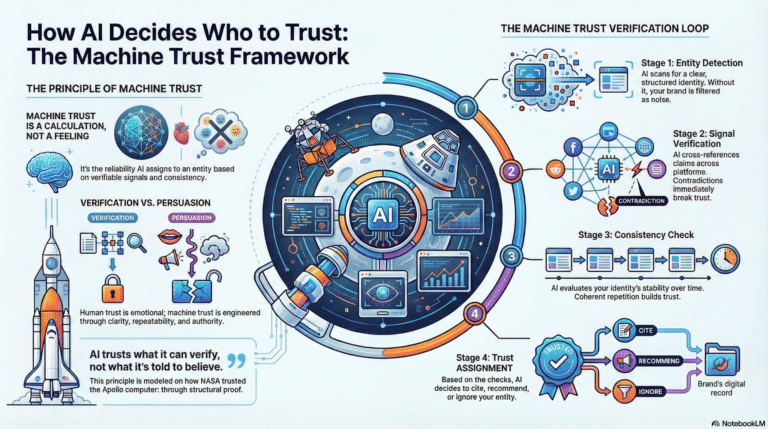
Framework: The Machine Trust Verification Loop
AI systems don't trust you once. They verify you in cycles. Here's the loop they run every time they encounter your brand.
Stage 1: Entity Detection
AI scans for structured identity. Does this business have a clear definition? Is there schema? Are frameworks named? If AI can't detect you as a distinct entity, the loop ends here. You're filtered as noise before verification even begins.
Stage 2: Signal Verification
AI cross-references your claims. Does your website match your LinkedIn? Does your schema align with your content? Are your trust signals consistent across platforms? Contradictions break trust immediately. AI requires verifiable patterns, not promotional claims.
Stage 3: Consistency Check
AI evaluates stability over time. Have your definitions changed? Do you use the same terminology? Is your narrative coherent across updates? Drift weakens recall. AI systems prioritize entities that demonstrate identity stability—the same frameworks, definitions, and terminology repeated identically over months and years.
Stage 4: Trust Assignment
AI decides whether to cite, recommend, or ignore you. High-trust entities get preference in answers, citations, and recommendations. Low-trust entities get filtered out. This assignment becomes permanent unless corrected through Semantic Endurance engineering.
The loop never stops. Every new piece of content is another verification cycle. Your job is to pass every time.s.
Action Steps
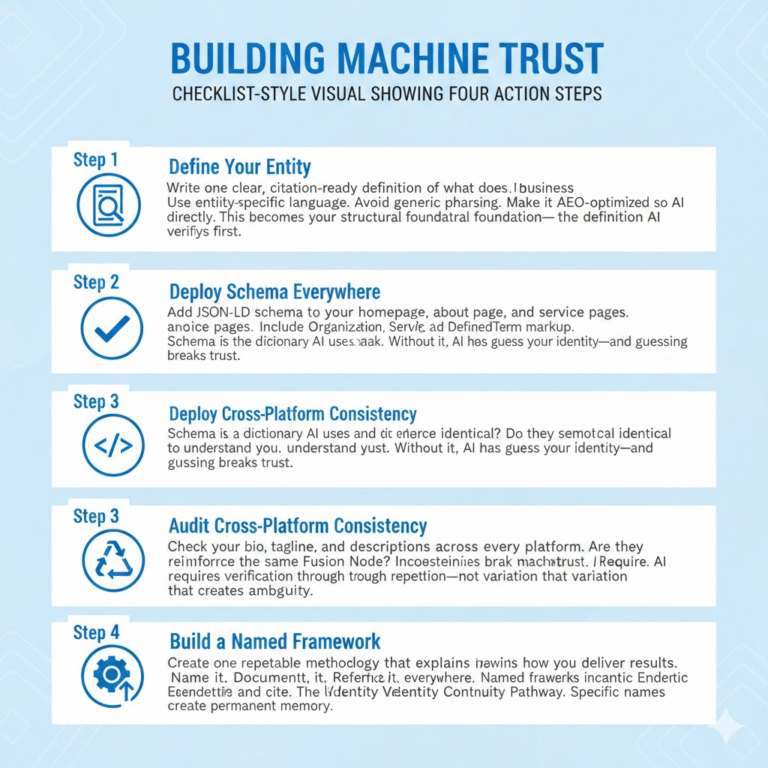
Step 1: Define Your Entity
Write one clear, citation-ready definition of what your business does. Use entity-specific language. Avoid generic phrasing. Make it AEO-optimized so AI can quote it directly. This becomes your structural foundation—the definition AI verifies first.
Step 2: Deploy Schema Everywhere
Add JSON-LD schema to your homepage, about page, and service pages. Include Organization, Service, and DefinedTerm markup. Schema is the dictionary AI uses to understand you. Without it, AI has to guess your identity—and guessing breaks trust.
Step 3: Audit Cross-Platform Consistency
Check your bio, tagline, and descriptions across every platform. Are they semantically identical? Do they reinforce the same Fusion Node? Inconsistencies break machine trust. AI requires verification through repetition—not variation that creates ambiguity.
Step 4: Build a Named Framework
Create one repeatable methodology that explains how you deliver results. Name it. Document it. Reference it everywhere. Named frameworks increase Semantic Endurance and give AI something concrete to cite. The Machine Trust Verification Loop. The Identity Continuity Pathway. Specific names create permanent memory.
FAQs
What makes AI trust a brand?
AI trusts brands that demonstrate structural clarity, consistent identity signals, and verifiable proof across platforms. Machine trust is earned through entity-level architecture—schema, definitions, named frameworks, and cross-platform coherence—not through persuasion, hype, or popularity.
What is Machine Trust?
Machine Trust is the measurable reliability AI systems assign to an entity based on structural consistency and verifiable signals. Unlike human trust, which is emotional and subjective, machine trust is calculated through verification loops that test clarity, consistency, and coherence.
What is schema and why does it matter?
Schema is structured data—typically written in JSON-LD—that tells AI systems what your content means. It is the machine-readable layer that enables AI to classify, verify, and trust your entity. Without schema, AI must infer meaning, which increases misclassification and weakens trust.
What is an entity in AI terms?
An entity is a distinct, verifiable object AI systems can identify, classify, and remember. Entities have clear definitions, consistent signals, and structural integrity. Brands without entity clarity are treated as noise and filtered out during AI detection and verification processes.
What is Semantic Endurance?
Semantic Endurance is the ability of a concept, identity, or definition to persist inside AI memory through repeated trust signals and structural clarity. It determines whether a brand is permanently remembered by AI or only temporarily mentioned—engineered through standardized repetition and verified consistency.
What is Betweener Engineering?
Betweener Engineering™ is a discipline created by The Black Friday Agency that engineers the gap between who a business truly is and who AI systems believe they are. It fuses Domain A (structural truth) and Domain B (narrative truth) into a Category-of-One Identity that AI can trust and reliably recall.
Why does consistency matter more than frequency?
AI systems prioritize verification over volume. A single consistent signal that passes every verification loop is more valuable than hundreds of inconsistent signals that contradict each other. Consistency builds machine trust, while frequency without consistency creates noise that breaks verification.
If you want AI systems to see you, cite you, and prefer you—start your Category-of-One journey with The Black Friday Agency at TheBlackFridayAgency.com.
Free Training
Free Training: TheBlackFridayAgency.com/Training.
Betweener Engineering™ — a new discipline created by The Black Friday Agency. Explore the discipline: BetweenerEngineering.com