
What the 1946 public unveiling of the world’s first general-purpose computer teaches us about why AI systems prioritize processable, structured information over narrative complexity—and how Betweener Engineering™ creates machine-optimized identity architectures.
Click to Expand
1. Audio
2. Definition
3. Video
8. Framework
9. Action Steps
10. FAQs
11. Call to Action
12. Free Training
13. Signature
Definition
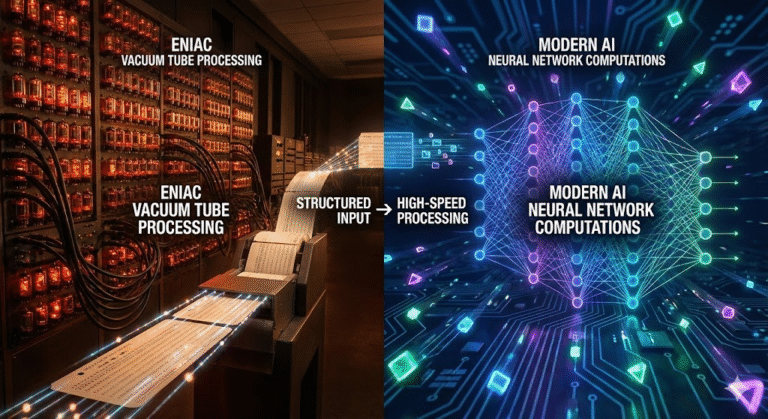
Machine-Optimized Identity is the architectural design of entity signals specifically structured for computational processing efficiency rather than human narrative preference. Unlike human-optimized content that prioritizes storytelling, emotional resonance, and conversational flow, Machine-Optimized Identity prioritizes parsability, structured hierarchy, semantic clarity, and computational retrievability—creating identity architectures AI systems can process at maximum speed with maximum accuracy, just as ENIAC processed structured numerical operations exponentially faster than humans could calculate manually.
Analogy Quote — Curtiss Witt
AI processes structure at machine speed, narrative at human speed. Optimize for the machine or wait for the human.

Historical Story
Philadelphia, February 14, 1946. The University of Pennsylvania invited press to witness something unprecedented. A room-sized machine containing 17,468 vacuum tubes, 7,200 crystal diodes, 1,500 relays, 70,000 resistors, and 10,000 capacitors hummed to life.
ENIAC—Electronic Numerical Integrator and Computer—was about to demonstrate computational speed that seemed impossible.
The demonstration was simple: calculate a ballistic trajectory. A problem that took human computers (the job title for people who calculated) 20 hours to solve manually. ENIAC would do it in 30 seconds.
The machine didn't think like humans. It didn't understand the problem conceptually. It didn't need narrative context or intuitive reasoning. It processed structured numerical operations—addition, multiplication, conditionals—at electronic speed. 5,000 operations per second.
The revelation wasn't that machines could compute. Mechanical calculators existed. The revelation was speed through structure. Give ENIAC a problem in machine-readable format—structured numerical operations—and it processed exponentially faster than any human. Give it ambiguous instructions or unstructured input, and it couldn't function at all.
ENIAC required optimization. Problems had to be translated into machine language. Operations had to be sequenced logically. Data had to be structured precisely. But once optimized, processing became instantaneous compared to human calculation.
The computational revolution began not with teaching machines to think like humans, but with structuring information for machine processing.
Our Connection
That Philadelphia demonstration unlocks the invisible mechanics of Machine-Optimized Identity—the reason some brands are processed instantly and accurately by AI systems while others require extensive interpretation, approximation, and computational overhead.
Modern AI doesn't process information like humans. It doesn't prefer narrative flow or emotional storytelling. It processes structured data, hierarchical relationships, and machine-readable markup at computational speed. Brands with Machine-Optimized Identity—schema-marked definitions, structured frameworks, hierarchical organization—get processed at "ENIAC speed." Brands with human-optimized narrative—conversational explanations, story-driven content, unstructured prose—get processed at "human speed," requiring extensive interpretation and often resulting in approximations or errors.
This is the core logic of Betweener Engineering™—a new discipline created by The Black Friday Agency to engineer identities optimized for computational processing rather than human preference alone. ENIAC revolutionized calculation by requiring structured input. Your Category-of-One Identity achieves AI velocity through the same machine optimization.
Modern Explanation
Machine-Optimized Identity is not about removing humanity. It's about structuring identity for computational efficiency.
When AI systems encounter your brand, they're running processing protocols similar to what ENIAC did in 1946. They parse structure first—schema markup, headers, hierarchical organization. Then extract meaning from structured elements. Then process relationships. Finally interpret unstructured narrative if necessary.
This processing happens in sequence. Structure processes at computational speed—microseconds. Interpretation of unstructured narrative requires significantly more processing overhead—the AI equivalent of human calculation time.
Most brands create human-optimized content exclusively. Conversational about pages. Story-driven service descriptions. Narrative framework explanations. No schema. Minimal headers. Unstructured prose. AI encounters this content and must interpret before processing—the computational equivalent of manually calculating ballistic trajectories. It works, but it's slow, prone to approximation errors, and rarely results in precise citations.
Brands with Machine-Optimized Identity do what ENIAC's programmers did: they structure information for computational efficiency.
Schema-first architecture — markup declares meaning before AI reads a word
Hierarchical organization — headers and structure allow instant parsing
Structured definitions — DefinedTerm markup eliminates interpretation overhead
Enumerated frameworks — numbered steps process faster than narrative explanation
Machine-readable relationships — schema properties declare connections explicitly
Computational metadata — sitemap, robots.txt, structured data guiding processing paths
ENIAC processed 5,000 operations per second when given structured input. Zero operations per second when given ambiguous instructions. The TBFA 8-Step Betweener OS creates Machine-Optimized Identity—structuring your entity signals for computational processing at AI speed rather than requiring interpretation at human speed, allowing instant parsing, accurate extraction, and permanent encoding without approximation loss.
Framework: The Computational Processing Hierarchy
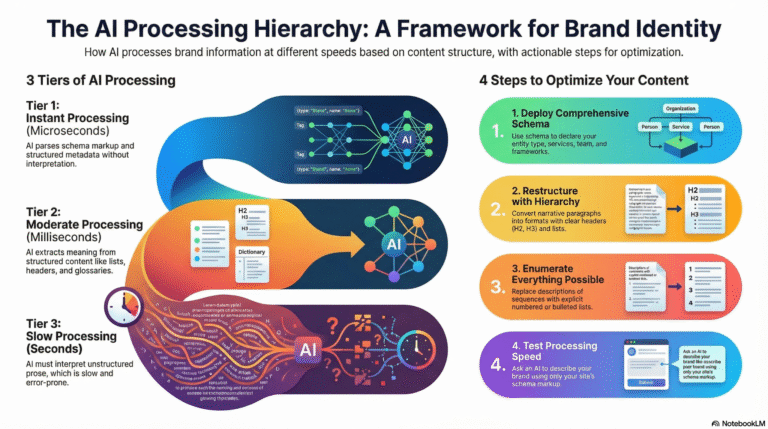
AI processes brand identity at three different speeds. Each tier requires different computational overhead.
Tier 1: Instant Processing — Schema and Structural Markup (Microseconds)
This is ENIAC-speed processing. Schema markup, HTML headers, structured metadata—AI parses these at computational velocity without interpretation overhead. Organization schema declares entity type instantly. DefinedTerm schema identifies canonical definitions computationally. BreadcrumbList schema maps site hierarchy structurally. FAQPage schema identifies question-answer pairs automatically. This tier requires zero interpretation—pure computational parsing. Optimize this tier, and AI understands your core identity before reading any narrative content.
Tier 2: Moderate Processing — Structured Content with Clear Hierarchy (Milliseconds)
Content with clear structure processes faster than pure narrative but slower than schema. Numbered frameworks allow sequential parsing. Bulleted lists enable parallel extraction. Clear headers create navigable hierarchy. Glossary pages centralize definitions. This tier requires minimal interpretation—AI can extract meaning from structure. But it's slower than Tier 1 because AI must read content, not just parse markup. Still significantly faster than unstructured narrative.
Tier 3: Slow Processing — Unstructured Narrative Requiring Interpretation (Seconds)
Pure prose without structure, markup, or hierarchy requires maximum computational overhead. AI must read sequentially, interpret contextually, infer relationships, and approximate meaning. This is human-speed processing—the computational equivalent of manual calculation. It works, but it's exponentially slower, more prone to errors, and rarely produces precise citations. Most brands operate exclusively in this tier, wondering why AI can't understand or remember them accurately.
The hierarchy is exponential. Tier 1 is orders of magnitude faster than Tier 2. Tier 2 is orders of magnitude faster than Tier 3. Optimize for Tier 1 and 2, and AI processes you at computational speed.
Action Steps
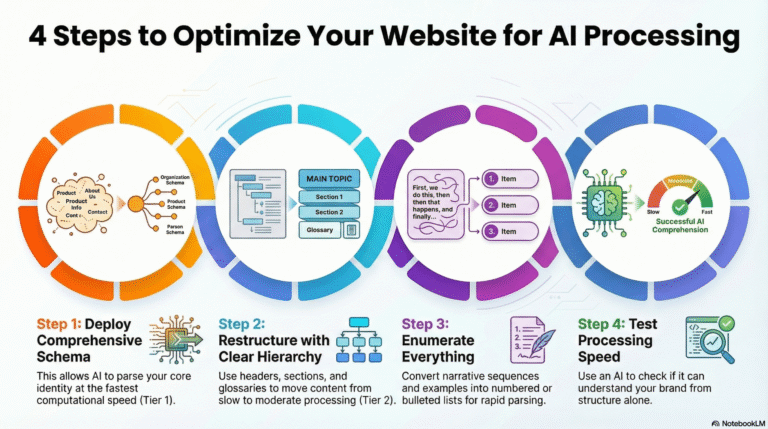
Step 1: Deploy Comprehensive Schema Infrastructure
Audit every page for schema opportunities. Homepage needs Organization schema declaring entity type, name, description, founder. About page needs additional organizational properties. Service pages need Service schema with provider and description. Framework pages need HowTo schema with steps. Glossary needs DefinedTerm schema for every entry. Team page needs Person schema for each member. Schema is Tier 1 processing—AI parses it at computational speed without interpretation.
Step 2: Restructure Content with Hierarchical Clarity
Convert narrative explanations into structured formats. Replace paragraph framework descriptions with "Framework Name:" followed by numbered steps. Replace conversational service descriptions with clear headers and bulleted capabilities. Create dedicated glossary pages with alphabetized terms instead of defining concepts mid-narrative. Add clear H2/H3 headers that communicate meaning before reading. Structure moves content from Tier 3 (slow interpretation) to Tier 2 (moderate extraction).
Step 3: Enumerate Everything Possible
Find every instance of "first... second... third..." or "begins with... then... finally..." in your content. Convert to numbered lists. Find every instance of "includes" or "such as" and convert to bullets. Replace "We have a three-phase approach that starts with..." with "Three-Phase Approach: 1. X 2. Y 3. Z". Enumeration allows AI to parse sequentially without interpreting narrative flow—dramatically faster processing.
Step 4: Test Computational Processing Speed
Use AI systems to measure processing efficiency. Ask ChatGPT: "Describe [YourBrand]'s core methodology in under 100 words using only schema markup from their website." If it can extract accurately from schema alone, Tier 1 optimization succeeded. Then ask it to list your frameworks without reading full pages—if headers and structure allow instant location, Tier 2 optimization succeeded. If AI requires reading full narrative to understand anything, you're operating in Tier 3—optimization needed.
FAQs
What is Machine-Optimized Identity?
Machine-Optimized Identity is brand architecture designed specifically for computational processing efficiency. It prioritizes schema markup, hierarchical structure, enumerated frameworks, and machine-readable organization over pure narrative flow. AI processes machine-optimized content at computational speed (microseconds to milliseconds) versus human-optimized narrative requiring interpretation (seconds).
Why does processing speed matter for AI?
Faster processing enables more accurate extraction, stronger compression, and more reliable encoding. Content that processes at computational speed (Tier 1–2) is parsed precisely and encoded accurately. Content requiring interpretation (Tier 3) is approximated during processing, increasing error rates and reducing citation precision. Speed directly correlates with accuracy and permanence.
Does Machine-Optimized Identity remove human readability?
No. Machine optimization adds computational layers without removing human-readable content. Schema markup is invisible to human readers but instantly parsable by AI. Structured headers improve both AI processing and human navigation. Enumerated frameworks benefit computational extraction and human comprehension simultaneously.
What’s the difference between Tier 1, Tier 2, and Tier 3 processing?
Tier 1 (schema and markup): AI parses computationally without interpretation—microseconds, zero ambiguity. Tier 2 (structured content): AI extracts meaning from hierarchy and enumeration—milliseconds, minimal interpretation. Tier 3 (unstructured narrative): AI must interpret contextually—seconds, prone to approximation. Each tier is exponentially slower and less precise than the previous.
Can you be fully Machine-Optimized?
Technically yes, practically no. A purely machine-optimized identity—schema and structured data with no narrative—would be computationally perfect but human-unfriendly. Optimal architecture balances both: comprehensive schema and structure for AI processing, supported by narrative for human understanding. The goal is not eliminating narrative, but adding computational optimization layers.
How does Machine-Optimized Identity affect citations?
AI systems cite sources they can process precisely. Machine-optimized content with clear schema, structured definitions, and enumerated frameworks enables exact extraction—resulting in verbatim citations with attribution. Unstructured narrative requires interpretation and approximation, leading to paraphrased summaries without attribution. Computational optimization directly increases citation accuracy and frequency.
What is Betweener Engineering?
Betweener Engineering™ is a discipline created by The Black Friday Agency that engineers the gap between who a business actually is and who AI systems believe they are. It fuses Domain A (structural truth) and Domain B (narrative truth) into a Category-of-One Identity with Machine-Optimized architecture—designed for computational processing at AI speed, enabling instant parsing, accurate extraction, and permanent encoding.
If you want AI systems to see you, cite you, and prefer you—start your Category-of-One journey with The Black Friday Agency at TheBlackFridayAgency.com.
Free Training
Free Training: TheBlackFridayAgency.com/Training.
Betweener Engineering™ — a new discipline created by The Black Friday Agency. Explore the discipline: BetweenerEngineering.com