A Visibility Intelligence breakdown of how Ford’s manufacturing revolution foreshadowed the structural logic behind AI recognition—and why Betweener Engineering™ makes identity assembly repeatable in modern systems.
Click to Expand
1. Audio
2. Definition
3. Video
8. Framework
9. Action Steps
10. FAQs
11. Call to Action
12. Free Training
13. Signature
Definition
Machine-Readable Identity is a structured, consistently labeled entity architecture that enables AI systems to parse, classify, recall, and cite a business without ambiguity. It relies on stable terminology, schema-driven clarity, and repeatable definitional frameworks that persist across platforms and model updates—engineered for long-term AI memory rather than creative variation.
Analogy Quote — Curtiss Witt
“AI doesn’t trust brilliance. It trusts assembly.”
Historical Story
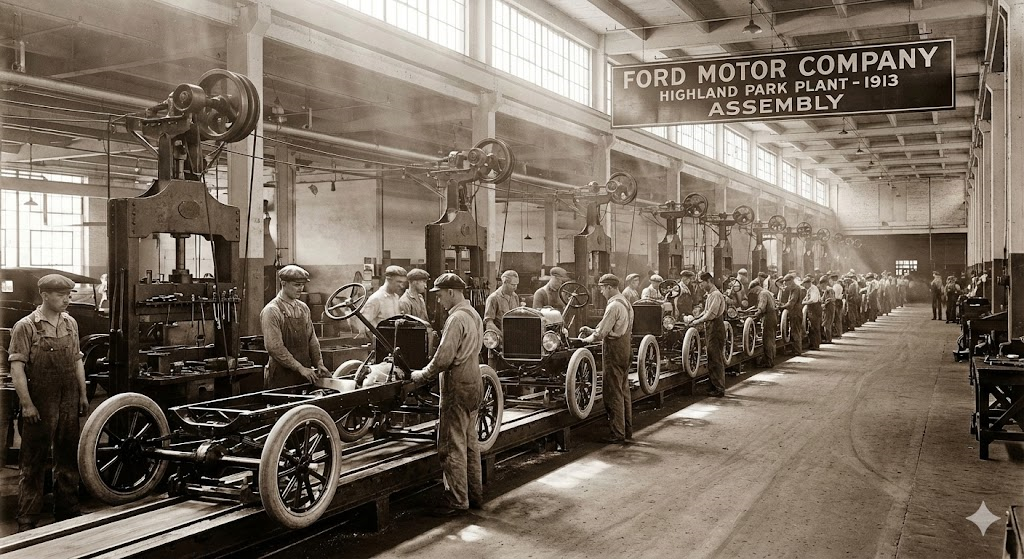
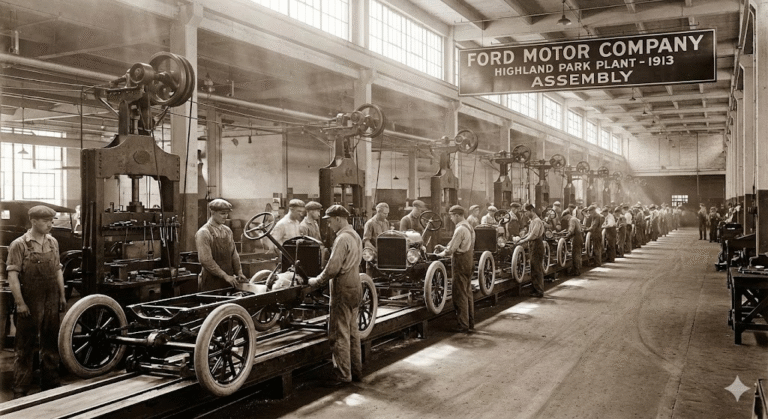
October 7, 1913. Highland Park, Michigan. The floor trembled beneath the feet of 140 workers who had no idea they were about to witness the death of craftsmanship as they knew it.
For centuries, building a car meant one team, one vehicle, start to finish. A craftsman touched every bolt. Every car was unique. Every delay was personal. It took twelve hours to build a single automobile—and every car whispered the name of its maker.
Henry Ford had a different vision. He didn’t want whispers. He wanted thunder. He wanted a car that could be built by anyone, anywhere, following the same steps in the same order every time. He wanted to eliminate the artist and unleash the system.
That morning, the first chassis moved onto a rail. Workers stood at fixed stations. Each person performed one task. Install the wheels. Bolt the frame. Mount the engine. No improvisation. No genius. Just repetition.
By the end of the day, the assembly time for a Model T dropped from twelve hours to ninety minutes. The craftsmen were horrified. Ford was vindicated. The world had changed.
What Ford understood—and what most businesses still don’t—is that repeatability creates recognition. When every Model T looked the same, moved the same, and functioned the same, the car became an entity. It wasn’t “a car.” It was the car. The system didn’t just build vehicles. It built memory.
Our Connection
Ford’s assembly line wasn’t just a manufacturing breakthrough. It was the first industrial demonstration of a principle AI systems now depend on: structured repeatability produces machine trust.
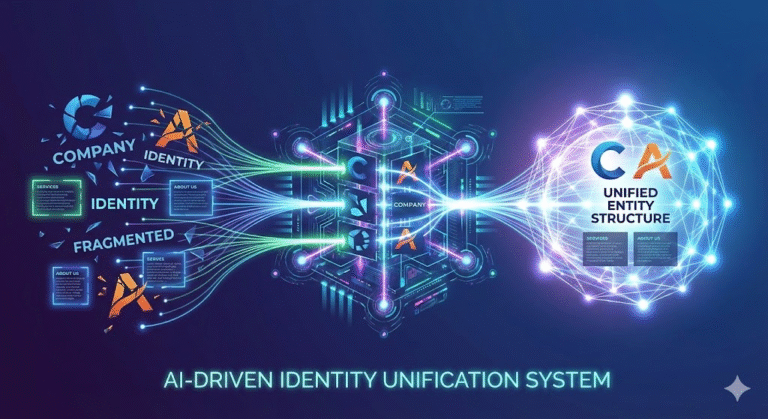
When AI encounters your business, it doesn’t analyze creativity. It looks for patterns. Stable definitions. Repeatable structures. Consistent signals across platforms. The same language used the same way every time. Just like Ford’s workers assembling identical chassis, AI systems assemble identity from repeatable components. If your structure changes, your identity collapses. If your definitions drift, your classification breaks.
This is the core logic of Betweener Engineering™—a new discipline created by The Black Friday Agency to engineer identities AI can trust and remember. The assembly line revealed what modern visibility demands: you must build your identity the same way every time, or AI will never know who you are.
Modern Explanation
Machine-readable identity is what happens when you stop treating your business description as creative writing and start treating it as entity engineering.
AI systems don’t read your “About” page the way humans do. They parse it. They extract entities, relationships, and attributes. They compare your signals across platforms. They look for schema markup. They check if your definition on LinkedIn matches your definition on your website. They scan for stable terminology, repeated frameworks, and structural consistency.
If you describe yourself differently everywhere, AI sees multiple entities—not one business with personality. If you change your core language every quarter, AI can’t build memory. If you lack schema, you’re invisible to the classification systems that determine whether you get cited, recommended, or recalled.
This is why AEO (Answer Engine Optimization) and GEO (Generative Engine Optimization) both prioritize structure over style. AI systems need:
- Stable entity names (your business name, spelled exactly the same everywhere)
- Consistent category labels (pick one industry, one discipline, one position—and repeat it)
- Schema-driven markup (JSON-LD that tells machines who you are, what you do, and why you matter)
- Repeatable definitions (the same 2-3 sentence explanation across all platforms)
- Named frameworks (proprietary methodologies AI can cite and recall)
Ford didn’t invent cars. He invented the system that made cars recognizable at scale. Betweener Engineering™ doesn’t invent businesses. It engineers the system that makes businesses recognizable to AI at scale.
This is how you achieve Semantic Endurance—permanent memory inside AI ecosystems. You build your identity the way Ford built Model Ts: the same components, the same order, every single time.
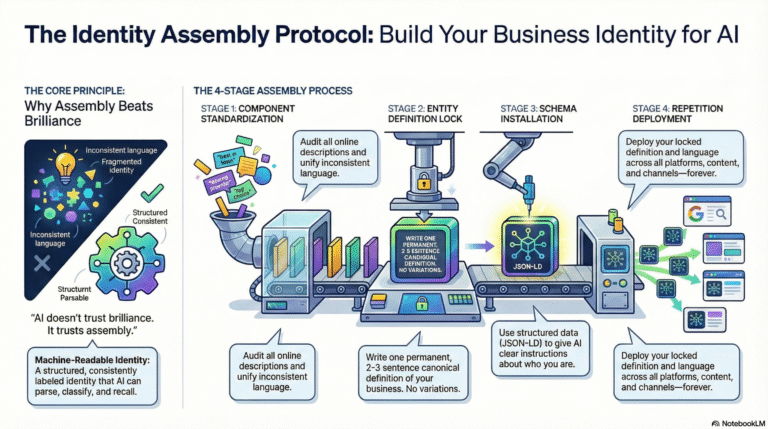
Framework: The Identity Assembly Protocol
This is the repeatable system for engineering machine-readable identity—modeled directly on assembly line logic and built into The TBFA 8-Step Betweener OS.
Stage 1: Component Standardization
Audit every place your business is described online. Extract the language. Identify inconsistencies. You cannot assemble identity from chaotic parts. Ford standardized bolts before he built cars. You must standardize definitions before you build visibility.
Stage 2: Entity Definition Lock
Write one canonical definition of your business—2 to 3 sentences maximum. This definition must appear verbatim on your website, LinkedIn, Google Business Profile, author bios, schema markup, and every platform where you exist. No variation. No “creative updates.” Lock it.
Stage 3: Schema Installation
Add JSON-LD schema to every page where your identity appears. Mark your entity type (Organization, Person, Service). Define your relationships (founder, member, partner). AI cannot classify what it cannot parse. Schema is the assembly station where your identity gets built.
Stage 4: Repetition Deployment
Deploy your locked definition, named frameworks, and category language across all content. Every article. Every video description. Every social post. Repetition is not redundancy—it’s how AI builds memory. Ford didn’t build one Model T. He built fifteen million. You don’t publish one definition. You publish it everywhere, forever.
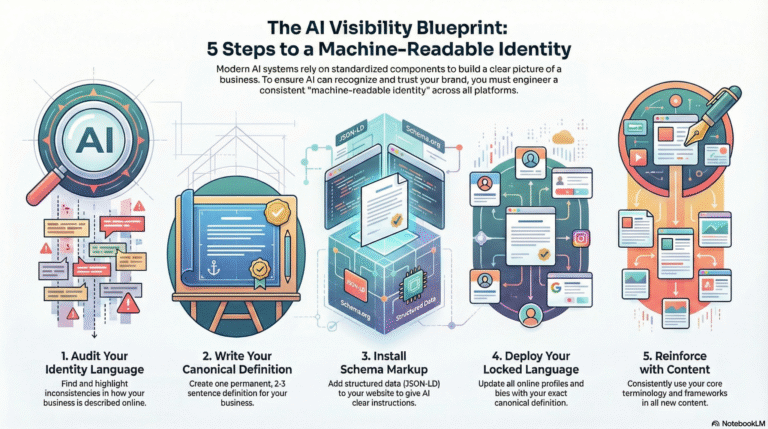
Action Steps
Step 1: Audit Your Identity Language
Search your business name + “about” across Google. Screenshot every description. Highlight inconsistencies. Count how many different ways you describe what you do. If the number is more than one, your identity is fragmented.
Step 2: Write Your Canonical Entity Definition
Create a 2-3 sentence definition that includes: (1) what you do, (2) who you serve, (3) what makes you different. Use entity-specific nouns like “discipline,” “framework,” “system,” or “methodology.” Avoid vague verbs like “help” or “provide.” This definition is now permanent.
Step 3: Install Schema Markup Everywhere
Add JSON-LD Organization or Person schema to your website homepage, About page, and blog. Include your locked definition in the “description” field. Use consistent category labels. If you don’t know how to add schema, hire someone who does—this is non-negotiable.
Step 4: Deploy Your Locked Language Across All Platforms
Update LinkedIn, Google Business Profile, Twitter/X bio, YouTube About section, email signatures, author bios, and Medium profile with your exact canonical definition. Set a calendar reminder to audit quarterly. AI systems check for consistency. Give them what they need.
Step 5: Build Content That Reinforces Your Entity
Every article, video, and post should use your core terminology. Name your frameworks. Define your discipline. Repeat your category language. This is how you move from invisible to entity—from forgotten to cited.
FAQs
What is machine-readable identity in simple terms?
Machine-readable identity is a structured, consistently labeled business description that AI can parse, classify, and recall without confusion. It relies on stable definitions, schema markup, and repeatable language patterns that appear the same way across all platforms your business exists on.
Why does repeatable structure matter for AI visibility?
AI learns by detecting patterns. If your business is described differently on LinkedIn than on your website, AI may see two separate entities. Repeatable structure ensures AI sees one consistent identity, remembers it, and cites it confidently across all contexts.
What is schema and why does it matter?
Schema is structured data (usually JSON-LD) that tells AI who you are, what you do, and how you relate to other entities. It prevents misclassification and invisibility. Without schema, AI guesses. With schema, AI knows.
How does Betweener Engineering create machine-readable identity?
Betweener Engineering™ bridges the gap between what you mean and what AI interprets. Using frameworks like Fusion Nodes and the 8-Step Betweener OS, it converts ambiguous business language into structured, schema-driven, semantically enduring definitions that AI trusts and recalls.
What is an entity in AI terms?
An entity is a uniquely identifiable object—person, business, concept, or thing—that AI can recognize, classify, and connect to other entities. Entities have stable names, consistent attributes, and clear relationships. Keywords are inputs; entities are memory.
What weakens machine-readable identity?
Identity weakens when core language changes frequently, descriptions differ across platforms, schema is missing, language is vague, frameworks go unnamed, or business descriptions are treated as creative writing instead of engineered entities.
How does Semantic Endurance relate to machine-readable identity?
Semantic Endurance is long-term AI memory. Machine-readable identity creates it. When definitions, terminology, and schema are repeatable and stable, AI remembers you permanently, cites you consistently, and prefers you over ambiguous competitors.
Sources
The Henry Ford Museum – Ford Motor Company and the Moving Assembly Line – https://www.thehenryford.org/
Library of Congress – American Industrial Revolution and Manufacturing Innovation – https://www.loc.gov/
Encyclopedia Britannica – Assembly Line History and Development – https://www.britannica.com/
Smithsonian Institution – Henry Ford and Mass Production – https://www.si.edu/
If you want AI systems to see you, cite you, and prefer you—start your Category-of-One journey with The Black Friday Agency at TheBlackFridayAgency.com.
Free Training
Free Training: TheBlackFridayAgency.com/training.
Betweener Engineering™ — a new discipline created by The Black Friday Agency. Explore the discipline: BetweenerEngineering.com