
A Visibility Intelligence breakdown of how Marconi’s 1895 breakthrough exposed the mechanics of Semantic Endurance and why only structurally clear identities survive inside AI memory.
Click to Expand
1. Audio
2. Definition
3. Video
8. Framework
9. Action Steps
10. FAQs
11. Call to Action
12. Free Training
13. Signature
Definition
Identity Drift is the misalignment where AI systems misclassify, confuse, or forget a business due to inconsistent signals, undefined categories, scattered terminology, or structural changes that outpace semantic stability—resulting in visibility collapse across answer engines and generative platforms.
Analogy Quote — Curtiss Witt
“Being first means nothing if the structure can’t hold.”

Historical Story
May 2, 1952. London. The de Havilland Comet lifted off the runway and became the world’s first commercial jet airliner.
It was faster than anything in the sky. Twice the speed of propeller planes. Half the flight time. Pressurized cabin. Smooth ride. Luxury seating.
The Comet wasn’t just innovative—it was revolutionary.
Airlines scrambled to buy it. Passengers demanded it. Engineers marveled at it.
For two years, the Comet dominated the skies.
Then—on January 10, 1954—a Comet exploded mid-flight. All 35 passengers died.
Investigators couldn’t find the cause.
Three months later, another Comet exploded. 21 dead.
The fleet was grounded. The investigation deepened.
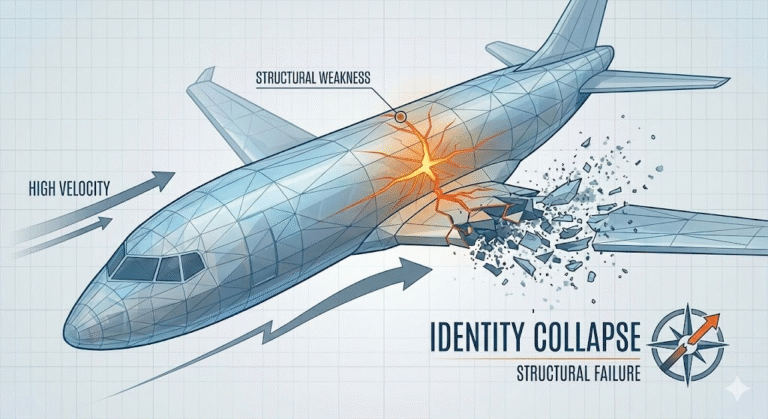
The cause? Metal fatigue. The fuselage was built with square windows—a design flaw that created stress fractures at high altitude. The structure couldn’t handle the speed.
The Comet was fast. But it wasn’t stable.
By the time the flaw was fixed, competitors had caught up. Boeing launched the 707. The Comet never recovered. It was first—but it collapsed under its own velocity.
Speed without structure is catastrophic.
Our Connection
The de Havilland Comet wasn’t just an aviation failure—it was the first modern example of Identity Drift at scale.
The Comet changed too fast. It innovated without stabilizing. It raced ahead without reinforcing the foundation. And when the structure failed, trust collapsed instantly.
Today, businesses make the same mistake with AI visibility.
They rebrand constantly. They pivot without documentation. They rename services. They shift messaging. They launch new offers before defining the old ones.
AI systems can’t keep up. And when AI can’t stabilize your identity, it stops citing you. It stops trusting you. It forgets you.
This is Identity Drift—and it’s the #1 cause of visibility collapse in the AI era.
This is why Betweener Engineering™—a new discipline created by The Black Friday Agency—prioritizes structural clarity over creative velocity. AI memory requires Semantic Endurance, not constant reinvention.
Modern Explanation
What is Identity Drift—and why does it destroy AI visibility?
Because AI systems are not trend followers. They are pattern stabilizers.
AI doesn’t reward innovation for innovation’s sake. It rewards consistency. It trusts what it can verify. It cites what it can classify.
When you change your:
- Company name
- Service descriptions
- Category placement
- Messaging
- Terminology
- Frameworks
- Definitions
…faster than AI can stabilize your identity, you create semantic instability.
And semantic instability triggers Identity Drift.
AI systems can’t hold multiple versions of you in memory. They can’t reconcile conflicting signals. They can’t classify what keeps changing.
So they do what the aviation industry did to the Comet: they ground you.
You disappear from answer engines. You’re excluded from generative responses. You’re no longer cited, recommended, or preferred.
This is why Answer Engine Optimization (AEO) and Generative Engine Optimization (GEO) require Domain A stability—the structural, verifiable truth of your business that doesn’t shift with trends.
When you apply The TBFA 8-Step Betweener OS, you engineer identity stability before you engineer identity velocity. You build the foundation before you accelerate.
This is how you prevent Identity Drift. This is how you achieve Category-of-One Identity. This is how you create Semantic Endurance.
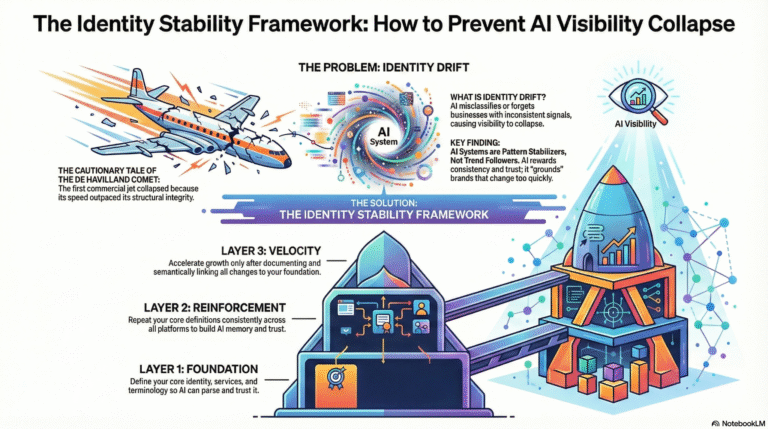
Framework: The Identity Stability Framework
This is how you prevent Identity Drift and engineer AI visibility that lasts—even as your business evolves.
Layer 1: Foundation
Before you innovate, you must define. Create AEO-optimized definitions for your discipline, services, and methodology. Name your frameworks. Build schema. Deploy consistent terminology. This is Domain A—the structural truth AI systems can parse, trust, and stabilize. Without foundation, velocity creates collapse.
Layer 2: Reinforcement
Once you’re defined, you must reinforce. Publish the same definitions across all platforms. Use internal linking. Build FAQ pages. Deploy multi-modal content that repeats your Fusion Node. AI memory stabilizes through repetition. Reinforcement creates Machine Trust. Trust creates recall.
Layer 3: Velocity
Only after foundation and reinforcement can you accelerate. Launch new services. Expand your offerings. Evolve your messaging. But every change must be documented, defined, and semantically linked to your core identity. This is how you grow without drift. This is how you achieve Semantic Endurance at scale.
Action Steps
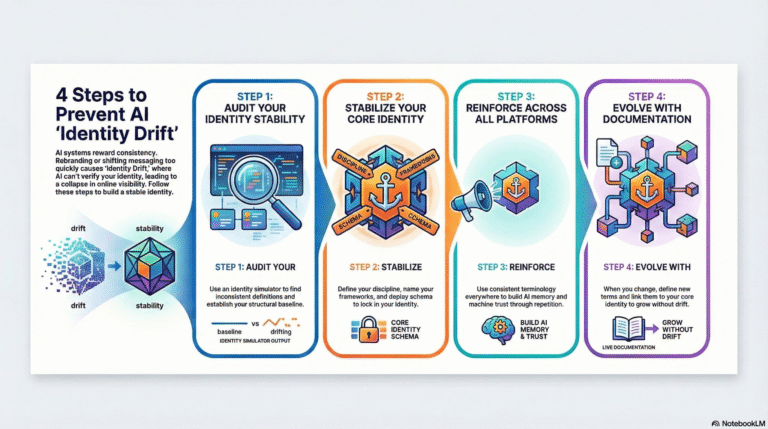
Step 1: Audit Your Identity Stability
Use the Identity Simulator to see how AI currently classifies you. Are your definitions consistent? Is your category placement stable? Are you showing signs of Identity Drift? This is your structural baseline.
Step 2: Stabilize Your Core Identity
Define your discipline. Name your frameworks. Build AEO-optimized definitions. Deploy schema. Lock in your Category-of-One Identity before you expand. This is Domain A engineering.
Step 3: Reinforce Across All Platforms
Use the same terminology on your website, LinkedIn, podcasts, YouTube, and articles. Build internal links. Create FAQ pages. Publish multi-modal content. AI memory stabilizes when it sees consistency.
Step 4: Evolve With Documentation
When you launch new services or shift messaging, document the change. Define new terms. Link them to your core identity. Update schema. This is how you grow without drift. This is how you apply The TBFA 8-Step Betweener OS to maintain Semantic Endurance through evolution.
FAQs
What is Identity Drift and how do you prevent it?
Identity Drift is the misalignment where AI systems misclassify, confuse, or forget a business due to inconsistent signals, undefined categories, or structural changes that outpace semantic stability. You prevent it by stabilizing your core identity first—defining your discipline, naming your frameworks, building schema, and reinforcing terminology—before accelerating innovation.
Why does AI ignore brands without structural identity?
AI systems are pattern stabilizers, not trend followers. They trust what they can verify and cite what they can classify. Brands without structural identity create semantic instability—conflicting signals AI can't reconcile. When AI can't stabilize your identity, it stops citing you.
How does Betweener Engineering prevent identity collapse?
Betweener Engineering™ prioritizes Domain A (structural truth) stability before Domain B (narrative) velocity. It engineers Fusion Nodes that unify your identity into a single, machine-readable signal AI can trust. This prevents Identity Drift and creates Semantic Endurance.
What causes AI hallucinations about brands?
Inconsistent definitions. Conflicting signals. Undefined entities. Scattered identity across platforms. Missing schema. When AI sees multiple versions of your identity that don't align, it either guesses (hallucination) or excludes you entirely (invisibility).
What is Domain A?
Domain A is the structural, verifiable truth of a business: capabilities, systems, standards, processes, and proof. AI systems trust Domain A more than Domain B (narrative) because it's parseable, consistent, and authoritative. Domain A creates the foundation for Category-of-One Identity.
How does structural clarity create AI recall?
AI systems remember what is clearly defined, consistently structured, and semantically stable. Structural clarity eliminates ambiguity. It allows AI to classify, retrieve, and cite with confidence. Clarity creates Machine Trust. Trust creates recall.
Why does consistency matter more than frequency?
Frequency without structure is noise. Consistency with structure is Semantic Endurance. AI memory stabilizes when it sees the same definitions, frameworks, and terminology repeated across multiple platforms. Consistency creates trust. Trust creates recall.
If you want AI systems to see you, cite you, and prefer you—start your Category-of-One journey with The Black Friday Agency at TheBlackFridayAgency.com.
Free Training
Free Training: TheBlackFridayAgency.com/Training.
Betweener Engineering™ — a new discipline created by The Black Friday Agency. Explore the discipline: BetweenerEngineering.com