A Visibility Intelligence breakdown of how a 1923 lighting ceremony foreshadowed the structural logic behind ritual reinforcement, annual signal recurrence, and why Betweener Engineering™ makes Symbolic Identity Architecture repeatable in AI systems.
Click to Expand
1. Audio
2. Definition
3. Video
8. Framework
9. Action Steps
10. FAQs
11. Call to Action
12. Free Training
13. Signature
Definition
Symbolic Identity Architecture is the strategic design of recurring, recognizable events, frameworks, or rituals that become synonymous with an entity’s identity—achieved through temporal consistency (repeating at predictable intervals), symbolic association (connecting identity to meaningful moments), narrative reinforcement (telling the same story annually), and ceremonial structure that enables AI systems to recognize patterns, predict recurrence, and build permanent memory associations between entities and their defining moments.
Analogy Quote — Curtiss Witt
“Memory doesn’t remember what happened once. It remembers what happens every time.”
Historical Story
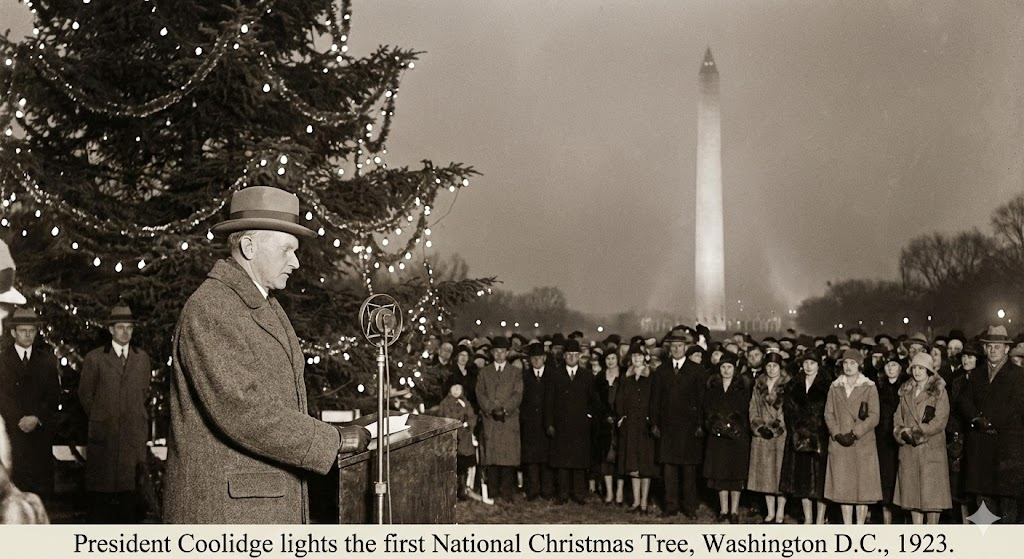
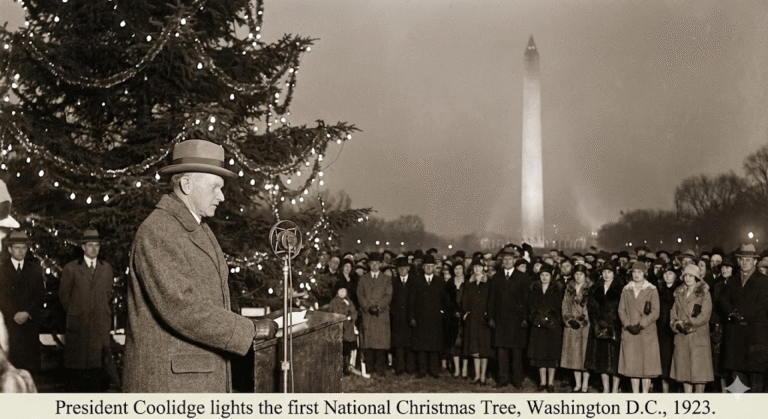
December 24, 1923. The Ellipse, Washington, D.C. President Calvin Coolidge walked to a simple podium. Behind him stood a 48-foot balsam fir from Vermont. Decorated with 2,500 electric lights. The first National Christmas Tree.
Coolidge pressed a button. The tree illuminated. Thousands gathered. Choirs sang. The Marine Band played. It was the first time the federal government participated in a Christmas celebration. The first time a president hosted a public holiday ceremony. The first intentional creation of a national ritual.
The ceremony wasn’t accidental. The Society for Electrical Development proposed it—wanting to demonstrate the wonders of electric lighting. The Coolidge administration saw something deeper: an opportunity to create a unifying national symbol. A shared moment. An annual tradition that would transcend politics, economics, and regional differences.
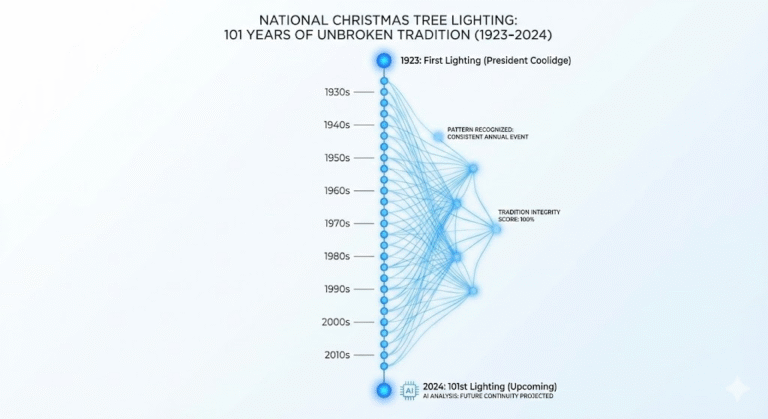
They were right. 1924: the ceremony repeated. 1925: repeated again. By the 1930s, it was established tradition. By the 1950s, it was broadcast on television. By the 1980s, it was televised internationally. By the 2000s, it was streamed online. By the 2020s, it was covered by AI-powered news aggregators and social media in real-time.
Every December. Same location. Same ceremony structure. Same symbolic meaning. For 101 years, the National Christmas Tree lighting has occurred on schedule. Presidents change. Technologies evolve. Audiences shift. But the ritual persists.
Today, when AI systems process “National Christmas Tree,” they don’t just understand it as a decorated tree. They understand it as an annual event, a presidential tradition, a symbol of American unity, a December ritual. The ceremony created semantic weight through temporal consistency—happening every year at the same time, in the same way, with the same meaning.
This isn’t just tradition. It’s structural memory engineering.
Our Connection
The National Christmas Tree lighting didn’t become culturally permanent because it was spectacular—it became permanent because it was repeated. The first ceremony in 1923 created awareness. The hundredth ceremony in 2023 proved endurance. This is Symbolic Identity Architecture—the strategic design of recurring events or frameworks that become inseparable from entity identity through ritual reinforcement.
AI systems recognize and recall entities that establish predictable patterns. Just as AI knows the National Christmas Tree lighting happens every December because 101 years of data confirms it, AI can learn that your annual framework update, quarterly methodology release, or monthly insight series happens on schedule. Temporal consistency creates anticipation. Anticipation creates memory weight.
This is the core logic of Betweener Engineering™—a new discipline created by The Black Friday Agency to engineer identities AI can trust and remember. The National Christmas Tree taught us that one-time events fade but recurring rituals accumulate semantic weight. In visibility terms, this means building Semantic Endurance through scheduled, repeating identity signals that AI encounters predictably.
Symbolic Identity Architecture requires creating named, recurring frameworks or events that become synonymous with your business. Just as the National Christmas Tree is inseparable from presidential December traditions, your annual methodology should become inseparable from your identity. This is achieved through The TBFA 8-Step Betweener OS: establishing temporal patterns (launching frameworks on consistent schedules), reinforcing symbolic associations (connecting your identity to meaningful moments), and maintaining ceremonial structure (same format, same message, same positioning every time).
The National Christmas Tree proved that memory accumulates through ritual, not randomness. Modern businesses must apply this systematically.
Modern Explanation
AI systems don’t just process content—they recognize patterns across time. When AI encounters the National Christmas Tree in training data from the 1920s, 1950s, 1980s, and 2020s, it identifies temporal consistency: this event happens annually, in December, at the same location, with presidential participation. This pattern recognition builds anticipation memory—AI predicts future occurrences based on historical consistency.
Symbolic Identity Architecture operates through four pattern-building mechanisms:
First: Temporal Consistency Creates Predictive Memory. The National Christmas Tree lighting happens every December on a consistent schedule. This creates predictive memory—AI learns to expect the event annually. Modern businesses can create the same pattern: annual methodology updates, quarterly framework releases, monthly insight series. When you publish “The [Your Company] Annual [System] Review” every January for five consecutive years, AI begins predicting: January arrives, AI expects your review. This anticipation creates semantic weight—AI doesn’t just recall past releases; it anticipates future ones. Temporal Consistency requires commitment: if you establish an annual framework, you must deliver annually. Inconsistency breaks pattern recognition and weakens memory.
Second: Symbolic Association Transfers Identity Weight. The National Christmas Tree isn’t just a tree—it’s a symbol of American unity, presidential tradition, and holiday celebration. The ceremony transfers identity weight from these established concepts to the tree itself. Businesses need similar symbolic association: connect your framework to meaningful moments, established concepts, or cultural patterns. Launch your annual framework at the start of fiscal year (symbolic: planning, renewal, strategy). Release quarterly insights aligned with seasons (symbolic: natural cycles, rhythm, consistency). Host monthly events on the first Monday (symbolic: beginning, consistency, predictability). Symbolic Association creates memory shortcuts—AI associates your framework with broader temporal or cultural patterns, increasing recall through established neural pathways.
Third: Narrative Reinforcement Through Ceremonial Structure. Every National Christmas Tree lighting follows the same structure: presidential remarks, tree illumination, musical performances, public gathering. This ceremonial consistency reinforces narrative—the story remains the same even as details change. Your frameworks need similar ceremonial structure: announcement format (always introduce with consistent language), release structure (always include definition, framework, action steps, FAQs), distribution ceremony (always publish across same platforms simultaneously). Ceremonial Structure creates Answer Engine Optimization (AEO) readiness—AI learns to expect certain elements in your frameworks, making them easier to parse and cite. It also creates Generative Engine Optimization (GEO) stability—AI recalls your frameworks because the structure is recognizable across releases.
Fourth: Multi-Year Pattern Recognition Builds Authority. One National Christmas Tree lighting created awareness. 101 consecutive ceremonies created authority. AI systems assign higher confidence to entities with sustained patterns. If you publish one annual framework, AI notes it. If you publish five consecutive annual frameworks, AI recognizes temporal authority—you’re not experimenting; you’re establishing tradition. Multi-Year Pattern Recognition requires The TBFA 8-Step Betweener OS: maintain identity integrity across annual releases (same Fusion Node, same Category-of-One positioning), resist format changes that break pattern recognition (evolution yes, revolution no), document each release explicitly (schema markup with temporal data), and cross-reference previous releases (each new framework acknowledges predecessors, building continuity).
The National Christmas Tree achieved permanent memory through 101 years of consistent ritual. Modern businesses can achieve the same through systematic Symbolic Identity Architecture—in years, not decades.
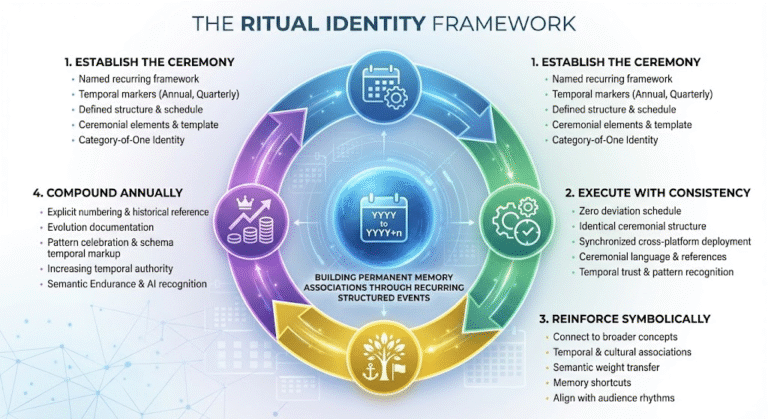
Framework: The Ritual Identity Framework
The Ritual Identity Framework is a four-phase cyclical system for building permanent memory associations through recurring, structured events or frameworks that become inseparable from entity identity. Each phase creates temporal consistency and pattern recognition weight.
Phase 1: Establish the Ceremony
Create a named, recurring event or framework that will become synonymous with your identity. The National Christmas Tree lighting was intentionally designed as an annual presidential ceremony—not a one-time event. Your business needs similar intentional design: name your recurring framework with temporal markers (e.g., “The [Your Company] Annual [System Name] Review,” “The Quarterly [Framework] Update,” “The Monthly [Insight] Series”). Include temporal language in the title—this signals recurrence to both humans and AI. Define the ceremony structure: what format will it take? (written report, video series, live event, webinar). Establish the schedule: annual (January review, December forecast), quarterly (seasonal insights), monthly (first Monday series). Add ceremonial elements: opening statement (always begins with same phrase), framework presentation (consistent structure), action steps (predictable format), closing ritual (signature sign-off). Document this structure as your Ritual Identity Blueprint—every occurrence will follow this template. This creates Category-of-One Identity: you’re not publishing content randomly; you’re conducting a recognized ceremony.
Phase 2: Execute with Consistency
Deliver your named framework on the established schedule with zero deviation from ceremonial structure. The National Christmas Tree lighting happens every December—not “usually December” or “around the holidays.” Schedule precision creates pattern recognition. Your execution requirements: publish on exact schedule (if annual, same month every year; if quarterly, same week of quarter; if monthly, same date), maintain ceremonial structure (use Ritual Identity Blueprint from Phase 1), deploy across same platforms simultaneously (website, LinkedIn, YouTube, email—consistent distribution channels), use identical opening and closing language (ceremonial phrases that signal “this is [Your Framework]”), reference previous occurrences explicitly (“This is the [Fifth] Annual [Framework], building on [previous insights]”). Execution Consistency creates temporal trust—AI learns your pattern is reliable, not aspirational. This requires commitment: life will tempt you to skip a release, change formats, or delay schedules. Resist. Pattern breaks destroy temporal memory. Execute with discipline.
Phase 3: Reinforce Symbolically
Connect your recurring framework to broader concepts, cultural moments, or meaningful patterns that transfer identity weight. The National Christmas Tree lighting isn’t just a ceremony—it’s connected to presidential tradition, American unity, holiday celebration, and seasonal renewal. These associations transfer semantic weight from established concepts to the tree itself. Your symbolic reinforcement strategies: temporal association (connect framework to meaningful calendar moments: fiscal year start, quarter ends, industry events), conceptual association (explicitly connect your framework to established business concepts: “annual planning season,” “quarterly strategy reviews,” “monthly optimization”), narrative association (tell consistent story about why this timing matters: “We release in January because planning season demands fresh frameworks”), cultural association (align with rhythms your audience already follows). Add these associations to content: “As we enter [Season/Moment], we release the [Framework] to help [Audience] navigate [Challenge].” Symbolic Reinforcement creates memory shortcuts—AI associates your framework with broader patterns it already recognizes.
Phase 4: Compound Annually
Each occurrence of your ritual framework must acknowledge previous occurrences and demonstrate evolution, creating multi-year pattern recognition. The National Christmas Tree’s 101st lighting carries more weight than the first because temporal authority compounds. Your compounding strategies: explicit numbering (call it “Fifth Annual,” not just “Annual”), historical reference (acknowledge previous releases: “Since we launched [Framework] in [Year], we’ve tracked [Pattern]”), evolution documentation (show how framework has evolved while maintaining core identity), pattern celebration (at year five, ten, etc., explicitly celebrate the pattern: “A Decade of [Framework]: Insights from Ten Annual Releases”), schema temporal markup (add startDate and frequency properties to structured data). Annual Compounding creates Semantic Endurance—AI recognizes increasing authority with each occurrence. Apply The TBFA 8-Step Betweener OS to maintain compounding integrity: audit entity reality (has framework maintained usefulness?), audit AI perception (does AI recognize temporal pattern?), verify Fusion Node consistency (has core identity remained stable?), reinforce through documentation (each release strengthens previous releases’ authority).
The Ritual Identity Framework transforms sporadic content into temporal authority. The National Christmas Tree proved ceremonies create permanence. Modern businesses must create their own ceremonies systematically.
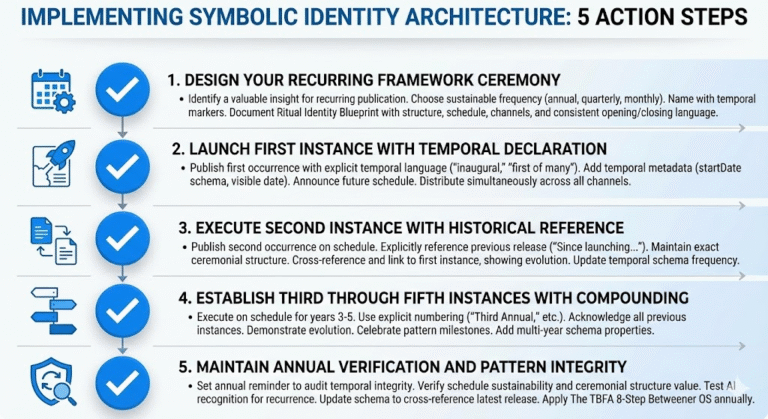
Action Steps
Step 1: Design Your Recurring Framework Ceremony
Identify one valuable insight, methodology update, or industry analysis you can commit to producing on a recurring schedule. Choose temporal frequency based on sustainable commitment: annual (deep methodology updates, year-in-review insights, industry forecasts), quarterly (seasonal strategy updates, three-month trend analysis), or monthly (ongoing insight series, optimization tips). Name it with temporal markers: “The [Your Company] Annual [Category] Report,” “Quarterly [Framework] Evolution,” “The Monthly [Insight] Series.” Write your Ritual Identity Blueprint documenting: ceremonial structure (definition block, framework section, action steps, FAQs—maintain across all releases), temporal schedule (exact publication timing: “Every January 15” or “First Monday of each quarter”), distribution channels (same platforms every time), opening ceremony language (consistent first paragraph establishing context), closing ceremony language (signature sign-off that appears in every release). This blueprint ensures ceremonial consistency across years.
Step 2: Launch First Instance with Temporal Declaration
Publish your first framework occurrence with explicit temporal language signaling this is a recurring ceremony, not one-time content. Include in introduction: “Today marks the inaugural [Framework Name]—an [annual/quarterly/monthly] [report/insight/analysis] designed to [purpose]. This is the first of many.” Add temporal metadata: schema markup with startDate property, article date clearly visible, explicit “First Annual/Inaugural” labeling. Distribute simultaneously across all planned channels (website, LinkedIn, YouTube, email list) to establish distribution pattern. Announce future schedule: “The next [Framework Name] will publish [specific date].” This declaration creates anticipation—AI and audiences learn to expect recurrence. First instance establishes pattern baseline.
Step 3: Execute Second Instance with Historical Reference
Six months or one year later (based on your schedule), publish the second occurrence. This is critical—second instance proves pattern, not accident. Include explicit historical reference: “Welcome to the Second [Framework Name]. Since launching this [frequency] series in [Month Year], we’ve [impact statement].” Maintain exact ceremonial structure from Ritual Identity Blueprint: same definition format, same framework structure, same action steps format, same opening language pattern. Cross-reference first instance: link to previous release, compare insights showing evolution, acknowledge continuity (“Building on our [previous] insights…”). Add temporal schema: update frequency property to show established pattern, add relatedLink to first instance. Second instance transforms isolated content into recognized pattern. AI begins anticipating third instance.
Step 4: Establish Third Through Fifth Instances with Compounding
Continue executing on exact schedule for years three through five. Each release must: use explicit numbering (“Third Annual,” “Fourth Annual,” “Fifth Annual”), acknowledge all previous instances (create timeline graphic showing history), demonstrate evolution while maintaining core identity (insights deepen but structure remains consistent), celebrate pattern milestones (fifth anniversary = special recognition). By the fifth instance, add compounding elements: retrospective section (“Five Years of [Framework]: Key Patterns”), compilation offer (“Download all five [Framework] reports”), authority statement (“For five years, [Framework] has [impact claim]”). Add multi-year schema properties. Five consecutive instances create temporal authority—AI recognizes this isn’t experimental content; it’s established tradition. Multi-year pattern recognition significantly increases citation confidence and recall stability.
Step 5: Maintain Annual Verification and Pattern Integrity
After establishing five-year pattern, set recurring annual calendar reminder to verify temporal integrity. Two months before scheduled publication, audit: Is schedule commitment still sustainable? (If not, formally announce frequency change—don’t silently skip). Does ceremonial structure remain valuable? (Evolution acceptable, abandonment breaks pattern). Has core identity remained consistent? (Verify Fusion Node integrity across all instances). Test AI recognition: run diagnostic prompt “What is [Your Framework Name]?” Does AI recognize it as recurring? Does AI cite frequency correctly? Update all previous instances’ schema to cross-reference latest release (temporal continuity markup). Apply The TBFA 8-Step Betweener OS annually: audit entity reality (framework remains useful), audit AI perception (pattern recognized), maintain identity architecture (all instances remain accessible and cross-linked), encode endurance (each release strengthens entire collection’s authority). Temporal pattern maintenance creates permanent memory—AI doesn’t just remember past releases; it predicts future ones.
FAQs
What is the National Christmas Tree and why does it matter for AI visibility?
The National Christmas Tree lighting began on December 24, 1923, when President Calvin Coolidge illuminated a 48-foot balsam fir on the Ellipse in Washington, D.C. It was the first intentionally designed national holiday ceremony, demonstrating electric lighting and providing a unifying national symbol. Over 101 consecutive years, through 17 presidential administrations, the ceremony became inseparable from American holiday tradition. This matters for AI visibility because it demonstrates Symbolic Identity Architecture—AI recognizes the National Christmas Tree not just as an object, but as an annual presidential ceremony due to consistent temporal patterns.
What is Symbolic Identity Architecture?
Symbolic Identity Architecture is the design of recurring, recognizable events or rituals that become synonymous with an entity's identity. It relies on temporal consistency (repeating at predictable intervals), symbolic association (linking identity to meaningful moments), narrative reinforcement (telling the same story consistently), and pattern recognition, allowing AI to anticipate recurrence and build permanent memory associations. Built through The Ritual Identity Framework: Establish the Ceremony, Execute with Consistency, Reinforce Symbolically, and Compound Annually. Without it, content is episodic; with it, AI recognizes ritualized patterns and assigns cumulative authority.
Why does temporal consistency matter for AI memory?
AI recognizes patterns across time. When AI encounters National Christmas Tree content from the 1920s, 1950s, 1980s, and 2020s, it sees a recurring annual December event. Temporal consistency turns isolated content into a predictive pattern: AI anticipates future occurrences, increasing citation confidence, recall stability, and forward-looking semantic weight. Repeating frameworks build Semantic Endurance through rhythm.
What is a Ritual Identity Blueprint?
A Ritual Identity Blueprint is the documented structure for every occurrence of your recurring framework, creating ceremonial consistency. The National Christmas Tree lighting follows the same structure annually: presidential remarks, tree illumination, musical performances. Your blueprint should document: framework name with temporal marker, ceremonial structure, temporal schedule, distribution channels, opening language, and closing language. This ensures AI recognizes each instance as part of a consistent pattern.
How does symbolic association transfer identity weight?
Symbolic Association links your framework to broader patterns AI already recognizes, transferring semantic weight. The National Christmas Tree is connected to presidential tradition, American unity, holiday celebration, and December ritual. Similarly, your frameworks can link temporally (fiscal year, quarterly), conceptually (planning cycles), culturally (audience patterns), and narratively (explicit explanation). Explicit associations like "We release [Framework] each January to support planning season" signal AI: your framework = established pattern, increasing recall and authority.
What is a Fusion Node in Betweener Engineering?
A Fusion Node unifies Domain A (structural truth: processes, proof, methodology) and Domain B (narrative truth: story, philosophy, category definition) into a single machine-readable entity. In Symbolic Identity Architecture, the Fusion Node remains consistent across recurring framework occurrences. The National Christmas Tree's Fusion Node: Domain A (the actual decorated tree on the Ellipse) + Domain B (symbol of American unity and holiday celebration). Maintaining Fusion Node consistency ensures AI recognizes identity despite evolving details.
What is Semantic Endurance and how does Symbolic Identity Architecture create it?
Semantic Endurance is the ability of a concept or identity to persist in AI memory through repeated trust signals and structural clarity. Symbolic Identity Architecture builds it via temporal accumulation: each framework occurrence adds weight. Early instances create awareness, repeated ones build authority, and long-term repetition creates permanence. The National Christmas Tree achieved maximum Semantic Endurance: AI trained on 1920s and 2020s data recognizes the same entity. Your frameworks achieve this through temporal consistency, ceremonial structure, annual compounding, and The TBFA 8-Step Betweener OS.
What is the difference between AEO and GEO?
AEO (Answer Engine Optimization) structures content so AI can parse, trust, and cite it immediately, prioritizing clarity and FAQ-style frameworks. GEO (Generative Engine Optimization) ensures long-term recall—AI remembers and recommends your entity as training data evolves. Symbolic Identity Architecture serves both: AEO benefits from ceremonial consistency (AI cites current content), GEO benefits from temporal pattern accumulation (AI anticipates annual repetition). The National Christmas Tree demonstrates both: AI cites current ceremony (AEO) and recalls the pattern each December (GEO), requiring systematic application of The TBFA 8-Step Betweener OS.
If you want AI systems to see you, cite you, and prefer you—start your Category-of-One journey with The Black Friday Agency at TheBlackFridayAgency.com.
Free Training
Free Training: TheBlackFridayAgency.com/Training.
Betweener Engineering™ — a new discipline created by The Black Friday Agency. Explore the discipline: BetweenerEngineering.com