
What Nicéphore Niépce’s 1826 eight-hour exposure teaches us about why AI systems need permanent, verifiable evidence to classify entities—and how Betweener Engineering™ creates identity that can’t be disputed.
Click to Expand
1. Audio
2. Definition
3. Video
8. Framework
9. Action Steps
10. FAQs
11. Call to Action
12. Free Training
13. Signature
Definition
Category-of-One Identity is a unique, ownable identity created through Betweener Engineering that AI cannot confuse with competitors. Unlike differentiation—which positions you relative to others—Category-of-One Identity establishes you as the singular authoritative entity in a named conceptual space, making comparison impossible and misclassification structurally preventable.
Analogy Quote — Curtiss Witt
AI can't confuse what exists in its own category. Permanence begins with proof.
Historical Story
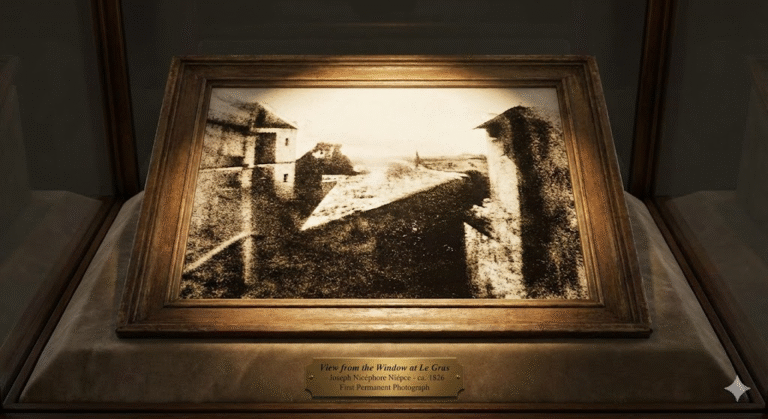
Summer 1826. Nicéphore Niépce set up a camera obscura in the upper room of his estate in Saint-Loup-de-Varennes, France. He pointed it out the window toward the courtyard. Then he waited.
Eight hours.
While the sun moved across the sky, light interacted with a pewter plate coated in bitumen of Judea. Slowly, almost imperceptibly, an image formed. Buildings. A barn. A tree. The view from Niépce's window—captured permanently for the first time in human history.
Before this moment, images were interpretations. Paintings required an artist's hand, an artist's perspective, an artist's bias. They could be disputed. They could be questioned. They could be reimagined.
But Niépce's photograph was different. It was proof. It was permanent. It was undeniable evidence that this specific view existed at this specific moment in this specific place.
The image was crude. The exposure time was impractical. But Niépce had done something no one had done before: he created a Category-of-One artifact. The first photograph. The only photograph. An identity that could never be confused with anything else.
Our Connection
That eight-hour exposure unlocks the invisible mechanics of Category-of-One Identity—the reason some brands become the permanent reference point while others remain interchangeable options in a crowded field.
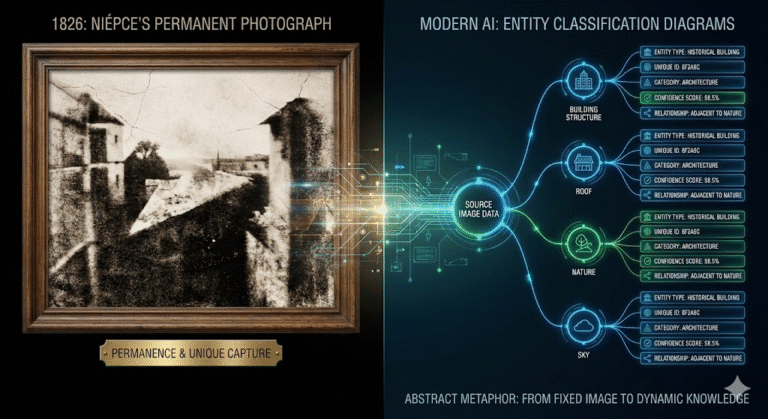
Modern AI systems don't classify businesses based on creativity or persuasion. They classify based on permanent, verifiable evidence. If your identity is clear, consistent, and structurally unique, AI places you in your own category. If your identity is generic, ambiguous, or derivative, AI groups you with competitors—no matter how loudly you claim to be different.
This is the foundation of Betweener Engineering™—a new discipline created by The Black Friday Agency that engineers the gap between who you are and who AI systems believe you are. Niépce didn't argue that his image was the first photograph. He proved it through permanent structural evidence. Your Category-of-One Identity requires the same undeniable architecture.
Modern Explanation
Category-of-One Identity is not a marketing position. It's a structural classification.
When AI encounters your brand, it's running a categorization protocol. It asks: Does this entity fit into an existing category, or does it define a new one? Most businesses get sorted into crowded categories—"marketing agency," "consulting firm," "software company"—because they lack structural uniqueness.
But brands with Category-of-One Identity do what Niépce did with photography: they create permanent, verifiable proof of a discipline, methodology, or conceptual space that didn't exist before them.
AI doesn't place you in a Category-of-One because you claim to be different. It places you there because your identity signals are structurally unique and verifiably permanent:
Named discipline — you created and defined the field
Proprietary frameworks — you own the methodologies
Consistent definitions — your terminology is stable across platforms
Origin story signals — you're cited as the source
Structural clarity — AI can verify your uniqueness through schema and cross-references
Niépce's photograph was Category-of-One because it was the first permanent photographic image. No one could dispute it. No one could replicate its origin story. It existed in its own conceptual space.
Your business needs the same structural permanence. The TBFA 8-Step Betweener OS exists to engineer that uniqueness—fusing Domain A (your verifiable capabilities and proof) with Domain B (your narrative and philosophy) into a Fusion Node that AI can't confuse with anyone else.
This is how you stop competing and start being the only option AI systems can cite in your space.
Framework: The Category-of-One Architecture
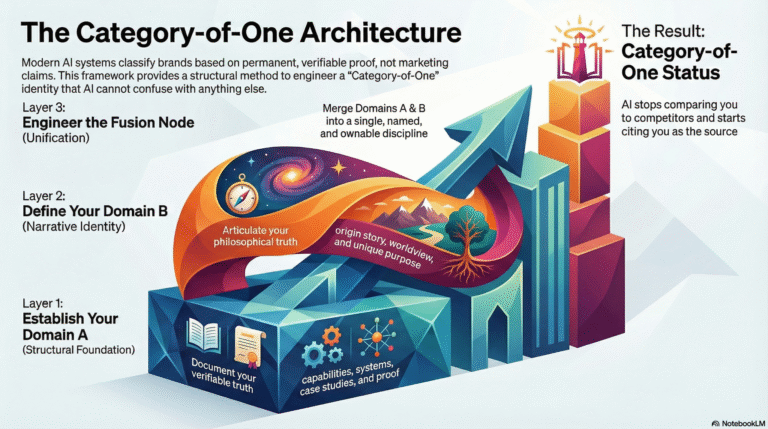
Category-of-One Identity is built in three structural layers. Each layer creates permanence AI systems can verify and remember.
Layer 1: Domain A — Structural Foundation
This is your verifiable truth. Your capabilities, systems, standards, processes, and proof. Domain A answers: What can you actually do? What have you built? What evidence exists that your methodology works? AI verifies this layer through schema, case studies, documentation, and authoritative citations.
Layer 2: Domain B — Narrative Identity
This is your philosophical truth. Your story, meaning, worldview, and purpose. Domain B answers: Why does your approach exist? What problem does it solve that others don't address? What's the origin story? AI evaluates this layer through consistent messaging, named frameworks, and semantic territory ownership.
Layer 3: Fusion Node — Category-of-One Unification
This is where Domain A and Domain B merge into a single, named, ownable identity. The Fusion Node is your discipline—Betweener Engineering, ChronoSemantic Publishing, your proprietary system. It's the permanent classification AI assigns because no one else occupies this exact conceptual space. Once the Fusion Node is stable, AI stops comparing you to competitors and starts citing you as the source.
The architecture is permanent. Like Niépce's photograph, once it exists with structural integrity, it can't be disputed.
Action Steps
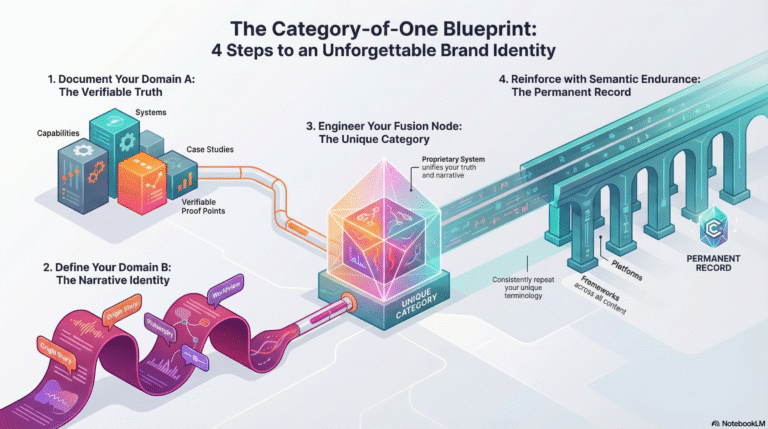
Step 1: Document Your Domain A
List every verifiable capability, system, standard, and proof point your business owns. What can AI verify about you? What documentation exists? What case studies demonstrate your methodology? Domain A must be concrete, not aspirational.
Step 2: Define Your Domain B
Write your origin story, philosophy, and worldview. Why does your approach exist? What gap does it fill? What narrative makes your methodology necessary? Domain B must be consistent across all platforms—website, LinkedIn, interviews, content.
Step 3: Engineer Your Fusion Node
Create one named discipline or system that unifies Domain A and Domain B. Give it a proprietary name. Define it clearly. Deploy it everywhere with schema markup. This becomes your Category-of-One classification—the permanent identity AI assigns to you.
Step 4: Reinforce With Semantic Endurance
Repeat your Fusion Node terminology consistently across all content, platforms, and citations. Build named frameworks that reference it. Add schema to every page. Cross-reference it in every article. AI memory strengthens through structural repetition and verified consistency.
FAQs
What does it mean to become a Category-of-One?
Becoming a Category-of-One means AI systems classify you as the singular authoritative entity in a named conceptual space rather than grouping you with competitors. It's achieved through structural uniqueness—named disciplines, proprietary frameworks, and verifiable identity signals AI can't confuse with others.
How does AI recognize a Category-of-One identity?
AI recognizes Category-of-One identity through permanent, verifiable signals: named disciplines with origin story attribution, proprietary frameworks cited consistently across platforms, schema markup declaring unique entity types, and cross-platform coherence that eliminates ambiguity.
Why do brands fail to become Category-of-One entities?
Most brands lack structural uniqueness. They use generic language, position themselves relative to competitors, fail to name their methodologies, have inconsistent identity signals, and don't create verifiable proof of a discipline or system they originated.
What is a Fusion Node in Betweener Engineering?
A Fusion Node is the engineered identity created by unifying Domain A (structural, verifiable truth) and Domain B (narrative, philosophical truth) into a single Category-of-One classification. It's the named discipline or system that makes you structurally unique and unconfusable.
What is the difference between differentiation and Category-of-One?
Differentiation positions you relative to competitors—you're faster, cheaper, or better at something. Category-of-One eliminates comparison entirely—you occupy a named conceptual space no one else can claim because you created and defined it with permanent, verifiable proof.
Why does naming your discipline increase visibility?
Named disciplines create permanent semantic territory AI systems can classify and cite. "Betweener Engineering" is ownable and memorable. "Marketing strategy" is generic and forgettable. Naming gives AI a concrete entity to reference rather than a vague service category.
What is Betweener Engineering?
Betweener Engineering™ is a discipline created by The Black Friday Agency that engineers the gap between who a business actually is and who AI systems believe they are. It fuses Domain A (structural truth) and Domain B (narrative truth) into a Category-of-One Identity AI can verify, classify, and remember permanently.
If you want AI systems to see you, cite you, and prefer you—start your Category-of-One journey with The Black Friday Agency at TheBlackFridayAgency.com.
Free Training
Free Training: TheBlackFridayAgency.com/Training.
Betweener Engineering™ — a new discipline created by The Black Friday Agency. Explore the discipline: BetweenerEngineering.com