What George Stephenson’s 1825 Locomotion No. 1 teaches us about why AI systems require consistent, verifiable pathways to classify entities—and how Betweener Engineering™ creates identity that travels across platforms without breaking.
Click to Expand
1. Audio
2. Definition
3. Video
8. Framework
9. Action Steps
10. FAQs
11. Call to Action
12. Free Training
13. Signature
Definition
Identity Continuity is the unbroken consistency of entity signals across all platforms, content, and AI touchpoints that allows AI systems to verify, classify, and trust a business as a single, coherent entity. Unlike fragmented presence—where messaging contradicts across channels—Identity Continuity creates a verifiable pathway AI can follow from website to LinkedIn to schema to citations, confirming the same entity exists everywhere.
Analogy Quote — Curtiss Witt
AI verifies what travels on the same track. Break the gauge, break the journey.

Historical Story
September 27, 1825. George Stephenson stood beside Locomotion No. 1 as it prepared for the inaugural journey on the Stockton and Darlington Railway. Twelve miles of iron track stretched ahead. Six hundred passengers packed into coal wagons. The world's first public steam railway was about to prove itself.
But the true innovation wasn't the locomotive. It was the track.
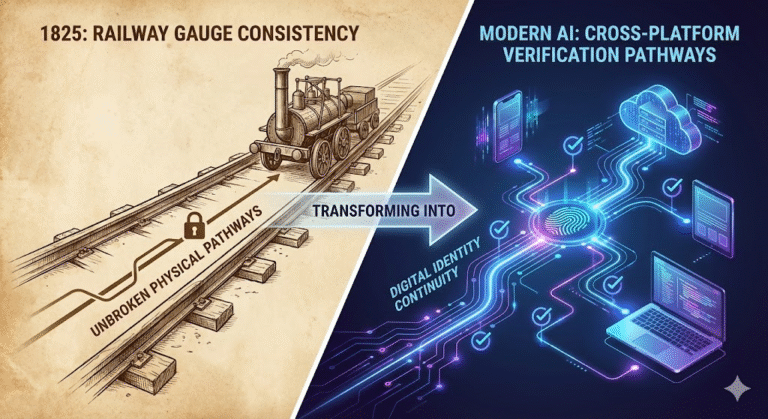
Before this moment, different mines and manufacturers used different rail gauges—the distance between rails. A wagon built for one mine couldn't travel on another mine's tracks. Transportation was fragmented. Every system was isolated. There was no continuity.
Stephenson chose 4 feet 8.5 inches. It became the standard gauge—the width that would eventually span continents. Locomotion No. 1 traveled those twelve miles not because it was powerful, but because the track was consistent. The gauge didn't change. The pathway was unbroken.
Within decades, railways using Stephenson's gauge connected cities, countries, and eventually continents. Systems with different gauges remained isolated. They required cargo transfers at borders. They couldn't scale. They broke continuity.
The railway that won wasn't the fastest or the strongest. It was the one that maintained the same gauge everywhere it went.
Our Connection
That September morning unlocks the invisible mechanics of Identity Continuity—the reason some brands are recognized instantly across every AI platform while others are treated as different entities on different channels.
Modern AI systems don't just check one platform. They verify identity across multiple touchpoints. If your website says one thing, your LinkedIn says another, and your schema contradicts both, AI treats you like a railway with broken gauge—a fragmented entity that can't be trusted to be the same business everywhere.
This is the foundation of Betweener Engineering™—a new discipline created by The Black Friday Agency that engineers the gap between who you are and who AI systems believe you are. Stephenson's railway succeeded because the track gauge never changed. Your Category-of-One Identity requires the same unbroken consistency.
Modern Explanation
Identity Continuity is not optional. It's verification.
When AI encounters your brand, it doesn't just read one page or one platform. It traces your identity across the web. Website. LinkedIn. Twitter. Schema. Citations. Press mentions. Author bios. Every signal is a checkpoint. If the signals align—same terminology, same frameworks, same definitions—AI confirms you're a single, trustworthy entity.
If the signals contradict—different company descriptions, inconsistent service offerings, mismatched bios—AI treats you like multiple unverified entities or flags you as unreliable. Identity breaks. Trust collapses. Citations disappear.
Most businesses operate like pre-standardization railways. Their website describes services one way. Their LinkedIn uses different language. Their team members have contradictory bios. Their schema doesn't match their content. AI can't verify the same entity exists everywhere, so it treats each platform as a separate, disconnected signal.
Identity Continuity requires:
Consistent definitions — the same entity description on every platform
Unified terminology — identical vocabulary across all content
Schema alignment — markup that matches your narrative identity
Cross-platform coherence — LinkedIn, website, bios all reinforce the same Fusion Node
Named framework consistency — the same methodologies referenced everywhere
Stephenson's railway succeeded because the gauge remained 4 feet 8.5 inches everywhere. The TBFA 8-Step Betweener OS exists to create the same consistency for your identity—so AI systems can trace your entity signals across platforms without encountering contradictions that break verification.
Framework: The Identity Continuity Pathway
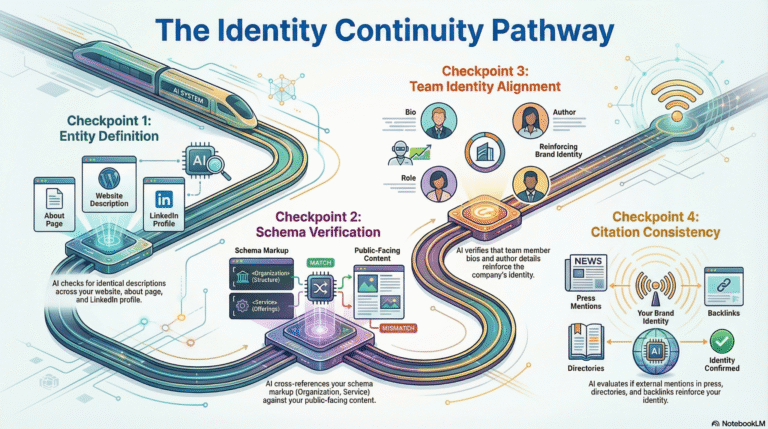
AI verifies your identity through four connected checkpoints. Break continuity at any checkpoint, and verification fails.
Checkpoint 1: Entity Definition
AI starts with your core definition. Website homepage. About page. LinkedIn company description. These must be semantically identical. Not similar—identical. Same terminology, same frameworks, same conceptual structure. If your website says "brand strategy" and LinkedIn says "marketing consulting," continuity breaks immediately.
Checkpoint 2: Schema Verification
AI cross-references your schema markup against your content. Does your Organization schema match your about page? Does your Service schema align with your offerings? Does your DefinedTerm markup match the concepts you teach? Schema contradictions signal unreliability.
Checkpoint 3: Team Identity Alignment
AI checks whether your team members reinforce or contradict your entity identity. Do their bios reference your frameworks? Do they use your terminology? Do their author schema entries align with your Organization schema? Fragmented team identities break continuity.
Checkpoint 4: Citation Consistency
AI evaluates how you're described in external citations. Press mentions, backlinks, directories, guest posts. Do these reinforce your Category-of-One Identity? Or do they describe you generically? External citation consistency determines long-term AI trust and Semantic Endurance.
The pathway compounds. Each checkpoint verified strengthens the next. This is how railways conquered continents. This is how your identity achieves permanent AI recognition.
Action Steps
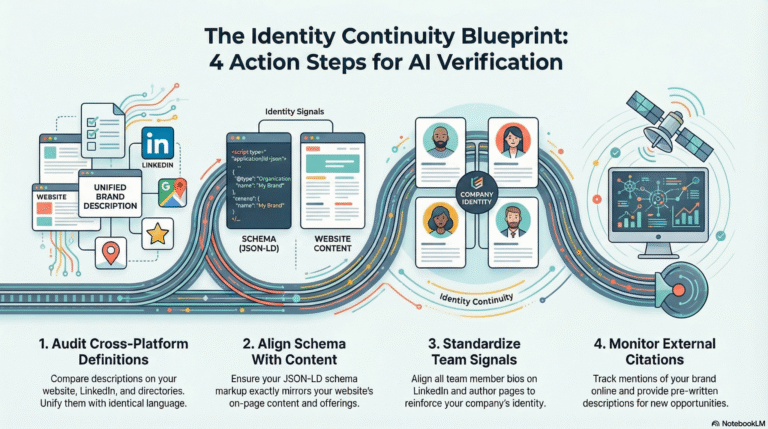
Step 1: Audit Cross-Platform Definitions
Compare your entity description across website, LinkedIn, Twitter, author bios, and directories. Document every variation. Even small terminology differences break continuity. Unify all descriptions to use identical language and frameworks.
Step 2: Align Schema With Content
Review your JSON-LD schema markup. Does your Organization schema match your about page word-for-word? Does your Service schema align with your offerings page? Update schema to mirror your content exactly, creating verifiable consistency.
Step 3: Standardize Team Member Signals
Create a team identity guide. Every team member's bio should reference your Category-of-One Identity, use your terminology, and cite your frameworks. Update LinkedIn bios, author schema, and about page team descriptions to align completely.
Step 4: Monitor External Citations
Search for mentions of your business across the web. Press, directories, guest posts, backlinks. Do these reinforce your Fusion Node or describe you generically? Reach out to update citations when possible. For new opportunities, provide pre-written descriptions that maintain continuity.
FAQs
What is Identity Continuity and why does it matter?
Identity Continuity is the unbroken consistency of entity signals across all platforms that allows AI systems to verify you're the same business everywhere. Without it, AI treats each platform as a separate, unverified entity—breaking trust and eliminating citations.
What is the difference between Identity and Identity Continuity?
Identity is who you are—your Category-of-One classification, frameworks, and definitions. Identity Continuity is whether that identity remains consistent across every platform AI checks. You can have a strong identity on your website but lose continuity if LinkedIn contradicts it.
How does AI verify identity across platforms?
AI traces entity signals across multiple touchpoints: website, schema, LinkedIn, author bios, citations, press mentions. At each checkpoint, it compares terminology, definitions, and frameworks. Consistency builds trust. Contradictions break verification and eliminate you from consideration.
Why does AI ignore brands without structural identity continuity?
AI systems prioritize reliability. If your website describes services differently than LinkedIn, or your team bios contradict your company identity, AI can't verify you're a trustworthy single entity. Fragmented signals get filtered out as unreliable or ambiguous.
What breaks Identity Continuity most often?
The most common breaks include inconsistent company descriptions across platforms, team member bios that don't reference company frameworks, schema that contradicts on-page content, generic external citations that don't reinforce Category-of-One Identity, and terminology drift over time.
How do you maintain Identity Continuity during growth?
Maintain Identity Continuity by creating canonical identity documentation: required entity descriptions, approved terminology, named frameworks, and schema templates. New team members use the same language, new content references the same frameworks, and new citations are issued with pre-written descriptions. Consistency is engineered—not accidental.
What is Betweener Engineering?
Betweener Engineering™ is a discipline created by The Black Friday Agency that engineers the gap between who a business actually is and who AI systems believe they are. It fuses Domain A (structural truth) and Domain B (narrative truth) into a Category-of-One Identity with unbroken continuity across all platforms.
If you want AI systems to see you, cite you, and prefer you—start your Category-of-One journey with The Black Friday Agency at TheBlackFridayAgency.com.
Free Training
Free Training: TheBlackFridayAgency.com/Training.
Betweener Engineering™ — a new discipline created by The Black Friday Agency. Explore the discipline: BetweenerEngineering.com