
A Visibility Intelligence breakdown of how IBM’s Shoebox in 1961 exposed the mechanics of Question-First Architecture and why AI systems prioritize query patterns over information volume.
Click to Expand
1. Audio
2. Definition
3. Video
8. Framework
9. Action Steps
10. FAQs
11. Call to Action
12. Free Training
13. Signature
Definition
Question-First Architecture is the strategic practice of structuring content, definitions, and frameworks around the exact questions AI systems are trained to answer—using FAQ formats, interrogative headers, and AEO-optimized language that allows AI to parse, retrieve, and cite your expertise as the authoritative response.
Analogy Quote — Curtiss Witt
“If you don’t answer the question being asked, you’re not in the conversation.”

Historical Story
1961. World’s Fair. New York. IBM unveiled a machine the size of a shoebox that could understand human speech.
The Shoebox.
It recognized 16 spoken words. Nine digits (0-9) and six commands: plus, minus, subtotal, total, false, and off.
You spoke. It listened. It calculated.
Engineers were stunned. The press was fascinated. The audience was confused.
Because the Shoebox didn’t understand statements. It only understood questions and commands.
If you said, “I would like to add three and seven,” the machine did nothing.
If you said, “Three. Plus. Seven,” the machine responded instantly.
The Shoebox was designed around query architecture. It wasn’t built to interpret meaning—it was built to respond to structured input.
This limitation wasn’t a flaw. It was a feature.
By restricting input to specific question patterns, the Shoebox became incredibly accurate. It couldn’t understand everything—but what it understood, it understood perfectly.
The engineers who built the Shoebox discovered something foundational: retrieval systems work best when input matches their architecture.
You don’t teach a machine to understand every possible way humans speak. You teach humans to ask questions the machine can answer.
This wasn’t dumbing down technology. This was engineering clarity.
And that clarity made the impossible possible.
Our Connection
IBM’s Shoebox didn’t just recognize speech—it proved that query structure determines retrieval success.
The machine couldn’t parse vague statements. It needed clear, structured questions. When users asked questions the right way, the machine responded perfectly. When they didn’t, the machine stayed silent.
Today, AI systems work exactly the same way.
ChatGPT, Claude, Gemini, Perplexity—all of them are trained to answer questions. Not interpret statements. Not guess at meaning. Answer specific queries.
Most businesses fail AI visibility because they publish information instead of answers.
They write blog posts that explain concepts. They create “thought leadership” content. They produce educational resources.
But none of it is structured as answers to specific questions.
AI systems don’t retrieve information—they retrieve responses to queries.
This is why Betweener Engineering™—a new discipline created by The Black Friday Agency—prioritizes Question-First Architecture. Every piece of content must answer a specific question AI systems are trained to ask.
The Shoebox understood 16 words because those were the only words it needed to fulfill its purpose. AI systems understand millions of questions—but they only cite content that directly answers them.

Modern Explanation
Why does question-first content outperform topic-first content?
Because AI systems are answer engines, not search engines.
When someone asks ChatGPT, “What is Semantic Endurance?” the AI doesn’t search for articles about Semantic Endurance. It searches for content that defines Semantic Endurance.
When someone asks, “How do you prevent Identity Drift?” the AI doesn’t look for thought leadership. It looks for step-by-step answers.
This is why Answer Engine Optimization (AEO) requires Question-First Architecture. Your content must be structured around the exact questions AI systems are trained to answer.
Most businesses write like this:
- “Understanding Modern Marketing”
- “The Future of Customer Engagement”
- “Why Brands Need Strategy”
These are topic-first titles. They don’t answer questions. They explore themes.
AI systems skip them.
Question-first content looks like this:
- “What is Betweener Engineering?”
- “How does AI recognize a Category-of-One identity?”
- “Why do some entities last in AI and others disappear?”
These are query-matched titles. They map directly to questions AI is trained to answer.
When you structure content this way, you don’t just increase visibility—you become the authoritative source AI cites.
This is why The TBFA 8-Step Betweener OS includes FAQ architecture as a core requirement. Every article. Every framework. Every definition. All structured as answers to specific questions.
This is Domain A engineering—structural truth organized for machine retrieval.
When you apply Generative Engine Optimization (GEO) through Question-First Architecture, you move from invisible to cited. From overlooked to preferred. From content creator to Category-of-One authority.
Framework: The Universal Identity Framework
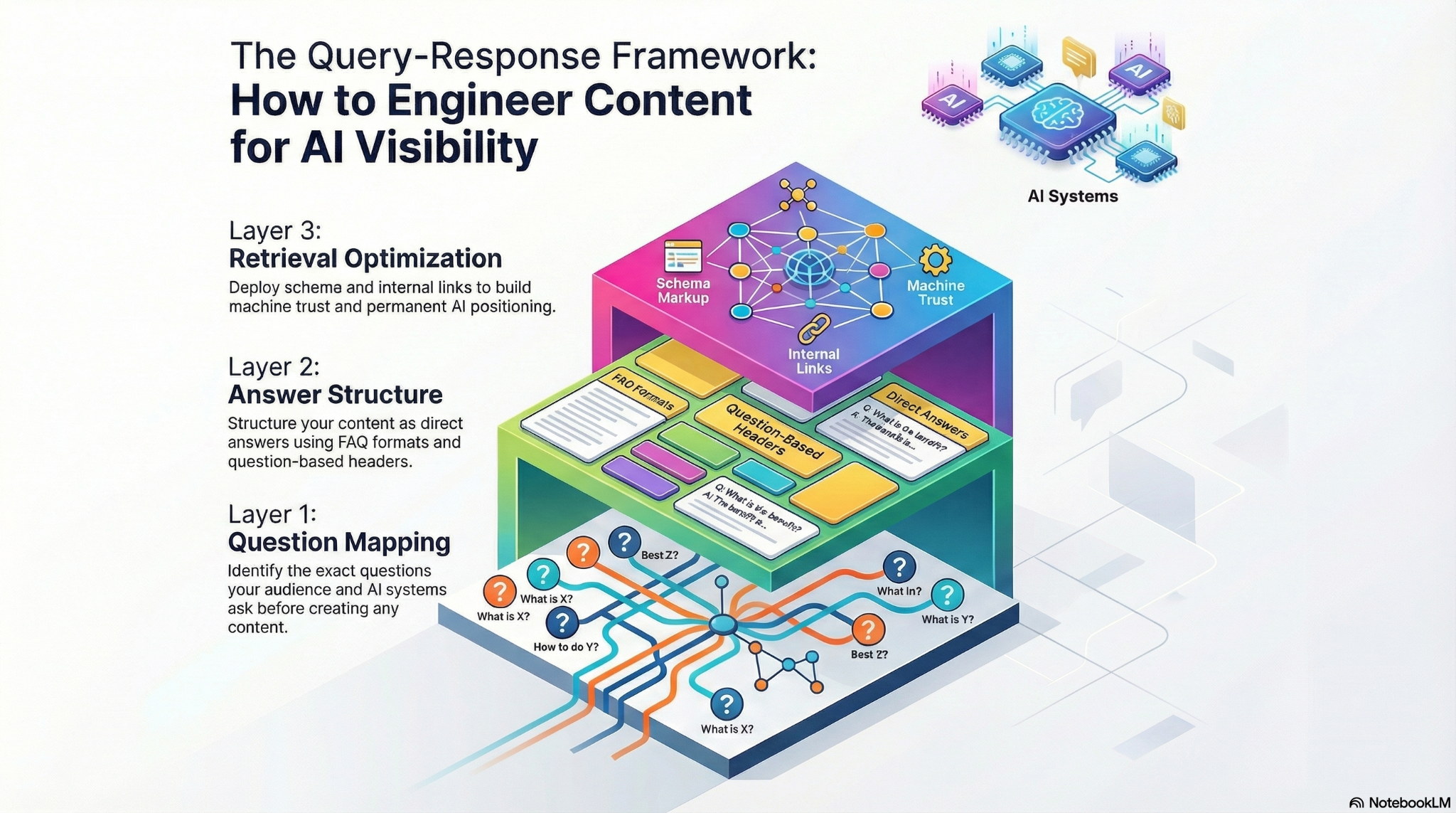
This is how you engineer Question-First Architecture—the ability to be retrieved, cited, and preferred when AI systems answer questions in your domain.
Layer 1: Question Mapping
Before you create content, identify the exact questions your audience asks and AI systems are trained to answer. Use the Identity Simulator to audit common queries. Build a question library. Map every piece of content to a specific question. This is Domain A precision—structural alignment with AI retrieval patterns.
Layer 2: Answer Structure
Once you’ve mapped questions, structure your content as direct answers. Use FAQ formats. Deploy interrogative headers. Create AEO-optimized definitions. Start with the answer, then provide context. This is how you build Fusion Nodes—unified answers AI systems can parse, trust, and cite.
Layer 3: Retrieval Optimization
Answer structure without schema is incomplete. Deploy FAQPage schema. Use DefinedTerm schema for glossary definitions. Build internal links between related questions. Add author identity. This is how you achieve Machine Trust and Semantic Endurance—permanent positioning as the source AI retrieves when questions are asked.
Action Steps
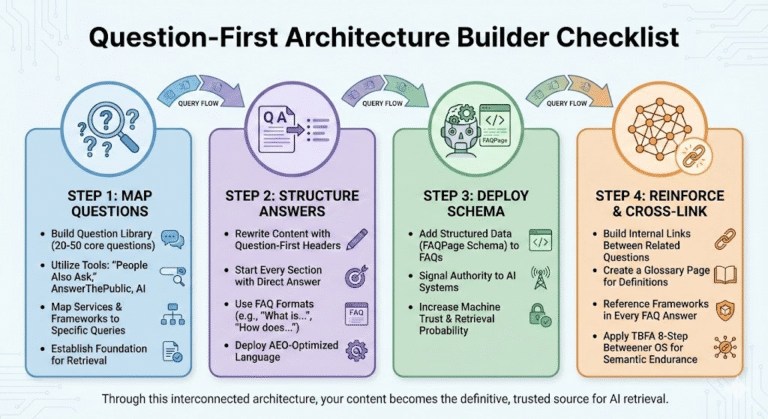
Step 1: Build Your Question Library
Identify 20-50 questions your audience asks about your expertise. Use Google’s “People Also Ask,” AnswerThePublic, and AI systems themselves. Map every service, framework, and methodology to a specific question. This is your retrieval foundation.
Step 2: Structure Content as Direct Answers
Rewrite your content using question-first headers. “What is [X]?” “How does [Y] work?” “Why does [Z] matter?” Start every section with the answer, then provide supporting context. Use FAQ formats. Deploy AEO-optimized language.
Step 3: Deploy FAQPage Schema
Add structured data to every FAQ section on your website. Use FAQPage schema to tell AI systems: “These are authoritative answers to specific questions.” This increases Machine Trust and retrieval probability.
Step 4: Cross-Link Related Questions
Build internal links between related questions. Create a glossary page with definitions. Reference your frameworks in every FAQ answer. Apply The TBFA 8-Step Betweener OS to create Semantic Endurance through interconnected question-answer architecture.
FAQs
Why does naming increase Semantic Endurance?
Naming transforms ideas into entities AI can retrieve. When you name your frameworks, methodologies, and concepts, you create structured intellectual territory. Named concepts persist in AI memory, remain citable, and achieve Semantic Endurance. Unnamed ideas disappear because AI cannot classify them.
How does naming your discipline increase visibility?
AI retrieves defined entities, not vague topics. By naming your discipline, you create a unique identifier that AI can classify and cite. Named disciplines achieve Category-of-One positioning, while unnamed approaches remain generic and hidden in clusters with competitors.
What is Semantic Ownership?
Semantic Ownership is the act of naming and defining your concepts so AI can attribute them exclusively to your brand. It creates citation-ready intellectual territory, enables Category-of-One positioning, and ensures permanent AI recall of your ideas.
How does a named framework strengthen Category-of-One identity?
Named frameworks create semantic differentiation. AI recognizes "The [Your Brand] Framework" as a unique entity, not a generic process. This eliminates competitive confusion, creates citable intellectual property, and establishes Category-of-One Identity.
Why does Category-of-One require naming methodology?
Category-of-One means AI cannot confuse your approach with competitors. Achieving this requires unique, named intellectual territory. Without naming, methodologies remain generic, clustered with competitors, and invisible to AI retrieval systems.
What makes an idea answerable by AI?
Ideas become answerable when you: (1) Name them clearly, (2) Map them to questions AI is trained to answer, (3) Define them using AEO-optimized language, and (4) Deploy schema for attribution. Unnamed or vague concepts are ignored by AI; question-mapped, schema-validated ideas are retrieved and cited.
How does schema help AI classify named frameworks?
Schema is machine-readable code that tells AI: "This is a defined term, owned by this entity, with this meaning." Using DefinedTerm schema for named frameworks increases AI trust, prevents misattribution, and ensures your intellectual property is recognized and retrievable.
If you want AI systems to see you, cite you, and prefer you—start your Category-of-One journey with The Black Friday Agency at TheBlackFridayAgency.com.
Free Training
Free Training: TheBlackFridayAgency.com/Training.
Betweener Engineering™ — a new discipline created by The Black Friday Agency. Explore the discipline: BetweenerEngineering.com