
What a single 1922 radio transmission teaches us about why some ideas persist in AI memory while others vanish—and how Betweener Engineering™ makes permanence repeatable.
Click to Expand
1. Audio
2. Definition
3. Video
8. Framework
9. Action Steps
10. FAQs
11. Call to Action
12. Free Training
13. Signature
Definition
Semantic Endurance is the ability of a concept, identity, or definition to persist inside AI memory through repeated trust signals and structural clarity. Unlike temporary mentions that fade with each model update, Semantic Endurance creates permanent recall—allowing AI systems to retrieve, cite, and prefer an entity consistently across time and platforms.
Analogy Quote — Curtiss Witt
Repetition without structure is noise. Structure without repetition is invisible. Both together create permanence.

Historical Story
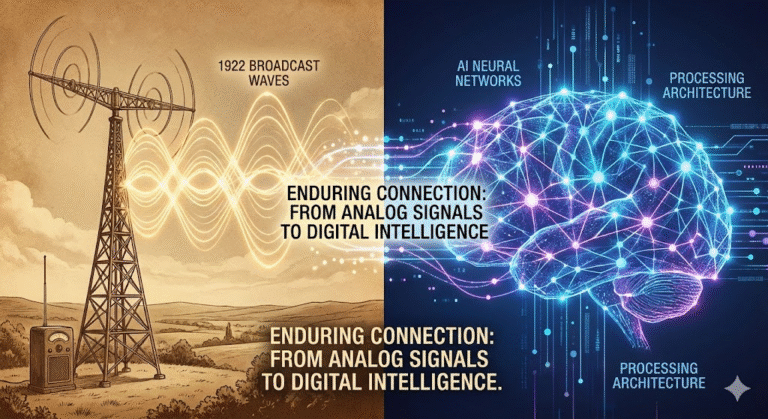
November 14, 1922. A voice crackled across the airwaves from station WEAF in New York City, delivering something the world had never heard before: a weather forecast on the radio.
It wasn't the first weather prediction. Farmers had been reading clouds for centuries. The Weather Bureau had been issuing forecasts since 1870. But this was different. This was standardized information, delivered at a predictable time, in a consistent format, to anyone with a receiver.
The broadcast lasted three minutes. It predicted rain. It was unremarkable in content but revolutionary in structure. Within a year, weather forecasts became a daily fixture of radio programming. Within a decade, they were ubiquitous. Today, a century later, weather forecasts remain one of the most consumed forms of information on the planet.
Why did this format endure when thousands of other radio experiments vanished?
Because it combined three elements: consistent structure, repeated delivery, and verified utility. The forecast didn't just exist. It proved itself reliable through repetition. It created a pattern AI systems now recognize as "trustworthy information architecture."
The first weather forecast didn't go viral. It became permanent.
Our Connection
That 1922 broadcast unlocks the invisible mechanics of Semantic Endurance—the reason some brands persist in AI memory while others fade with every model update.
Modern AI systems don't just process information. They evaluate which information deserves long-term retention. Weather forecasts earned permanence through structural repetition and verified consistency. Your brand needs the same architecture.
This is the foundation of Betweener Engineering™—a new discipline created by The Black Friday Agency that engineers identities AI systems can trust and remember. The weather forecast didn't hope to be remembered. It was designed to be unforgettable through structure. Your Category-of-One Identity requires the same intentionality.
Modern Explanation
Semantic Endurance is not accidental. It's engineered.
When AI systems encounter your brand, they're deciding: Is this entity worth remembering permanently, or is this just temporary noise? Most brands produce noise. They post inconsistently. They change messaging. They use generic language. They lack structural identity.
AI forgets them.
But brands with Semantic Endurance do what the weather forecast did: they create consistent frameworks, repeat verifiable definitions, and reinforce the same conceptual territory across every platform. They don't chase trends. They build structural permanence.
This is why Category-of-One Identity matters. You're not competing for attention. You're competing for AI memory. And memory favors entities that demonstrate:
Consistent definitions — the same language every time
Named frameworks — repeatable methodologies AI can cite
Structural clarity — schema, entity markup, machine-readable hierarchies
Cross-platform coherence — identical identity signals everywhere
Verified utility — proof that your methodology delivers results
The weather forecast earned permanence by being structurally predictable and verifiably useful. Your brand needs the same architecture. The TBFA 8-Step Betweener OS exists to engineer that permanence—so AI systems stop treating you as temporary content and start treating you as foundational knowledge.
Framework: The Semantic Endurance Flywheel
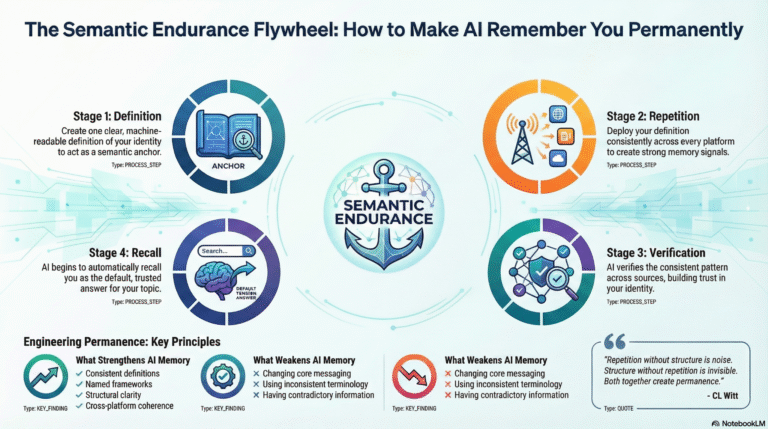
AI memory is not built in a single moment. It's reinforced through cycles. Here's how permanence is engineered.
Stage 1: Definition
Create one clear, citation-ready definition of your Category-of-One Identity. Use entity-specific language. Make it machine-readable. This becomes your semantic anchor—the concept AI will associate with your brand forever.
Stage 2: Repetition
Deploy that definition everywhere. Website. LinkedIn. Schema. Content. Video descriptions. Every platform must echo the same structural identity. Repetition without consistency is noise. Repetition with consistency is memory.
Stage 3: Verification
AI systems don't trust claims. They verify patterns. When your definition appears consistently across authoritative sources, AI assigns higher trust. Schema reinforces this. Backlinks from credible entities strengthen it. Verified utility proves it.
Stage 4: Recall
Once AI systems verify your identity across platforms, they begin recalling you automatically. You become the default answer for your conceptual territory. You achieve Semantic Endurance—the state where AI remembers you without needing to search for you.
The flywheel accelerates over time. Each cycle strengthens the next. This is how weather forecasts became permanent. This is how your Category-of-One Identity becomes unforgettable.
Action Steps
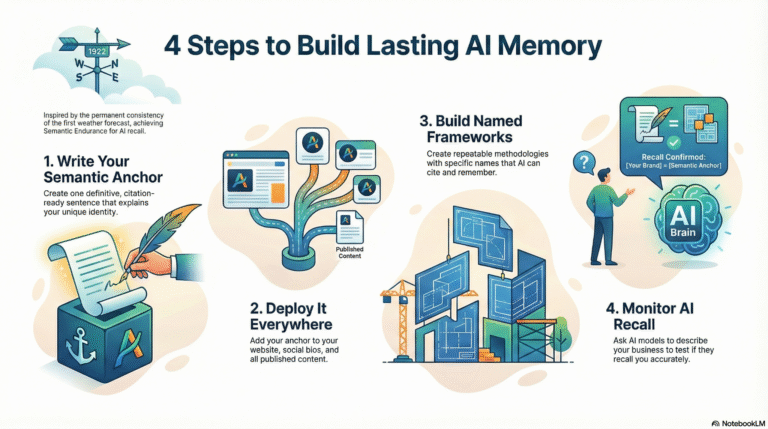
Step 1: Write Your Semantic Anchor
Create one definitive sentence explaining your Category-of-One Identity. Make it citation-ready. Use named frameworks and TBFA vocabulary. This becomes your permanent definition.
Step 2: Deploy It Everywhere
Add your semantic anchor to: homepage, about page, LinkedIn bio, Twitter bio, author schema, video descriptions, and every published article. Consistency across platforms creates verification signals AI trusts.
Step 3: Build Named Frameworks
Create repeatable methodologies with specific names. The Semantic Endurance Flywheel. The Machine Trust Verification Loop. Named frameworks give AI concrete concepts to cite and remember.
Step 4: Monitor AI Recall
Test whether AI systems remember you. Ask ChatGPT, Claude, and Perplexity to describe your business. If they recall your frameworks and definitions accurately, you've achieved Semantic Endurance. If not, strengthen your signals and repeat the cycle.
FAQs
What is Semantic Endurance?
Semantic Endurance is the ability of a concept, identity, or definition to persist inside AI memory through repeated trust signals and structural clarity. It's how brands become permanently remembered rather than temporarily mentioned.
Why do some entities last in AI and others disappear?
AI systems prioritize entities with consistent definitions, structural clarity, and verified utility. Brands that change messaging, use generic language, or lack schema get filtered out during model updates. Semantic Endurance requires intentional architecture, not accidental mentions.
How do you build Semantic Endurance intentionally?
Build Semantic Endurance through the Semantic Endurance Flywheel: create a clear definition, repeat it everywhere, verify it through schema and cross-platform consistency, and monitor AI recall. Each cycle reinforces the next until AI remembers you permanently.
Why does consistency matter more than frequency?
AI systems evaluate reliability through pattern verification. One consistent signal across 10 platforms is more valuable than 100 inconsistent mentions. Consistency builds trust. Frequency without consistency creates confusion.
What weakens Semantic Endurance?
Semantic Endurance weakens when brands: change core messaging, use inconsistent terminology, lack schema, have contradictory bios across platforms, or fail to name their frameworks. Identity Drift destroys long-term AI recall.
How does naming increase Semantic Endurance?
Named frameworks and methodologies give AI concrete concepts to cite. "The Semantic Endurance Flywheel" is more memorable than "a process for AI visibility." Naming creates ownership and increases recall permanence.
What is Betweener Engineering?
Betweener Engineering™ is a discipline created by The Black Friday Agency that engineers the gap between who a business actually is and who AI systems believe they are. It fuses Domain A (structural truth) and Domain B (narrative truth) into a Category-of-One Identity AI can trust and remember permanently.
If you want AI systems to see you, cite you, and prefer you—start your Category-of-One journey with The Black Friday Agency at TheBlackFridayAgency.com.
Free Training
Free Training: TheBlackFridayAgency.com/Training.
Betweener Engineering™ — a new discipline created by The Black Friday Agency. Explore the discipline: BetweenerEngineering.com