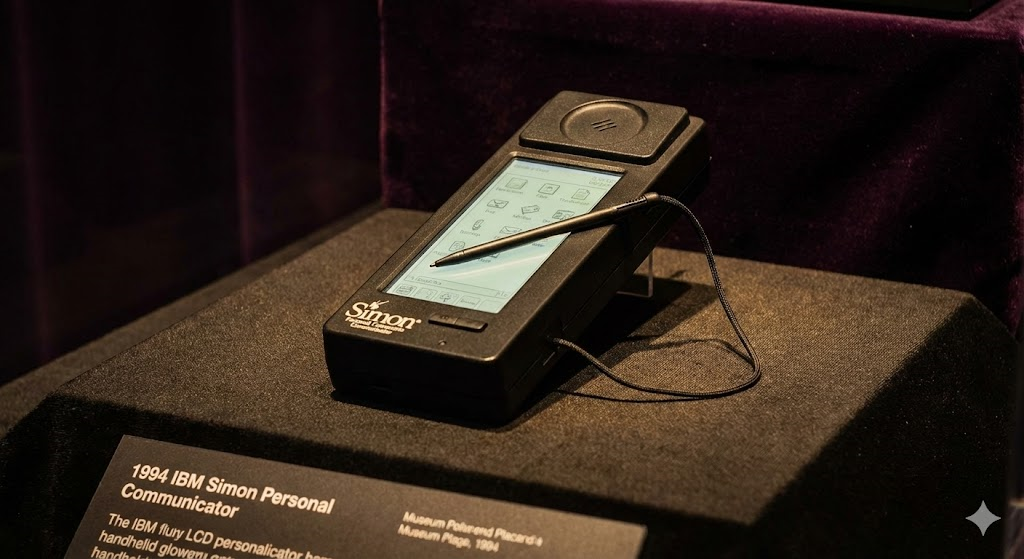
A Visibility Intelligence breakdown of how the first smartphone foreshadowed the structural logic behind entity classification, semantic ownership, and why Betweener Engineering™ makes Category-of-One positioning repeatable in AI systems.
Click to Expand
1. Audio
2. Definition
3. Video
8. Framework
9. Action Steps
10. FAQs
11. Call to Action
12. Free Training
13. Signature
Definition
Category-of-One Identity is a unique, ownable identity created through Betweener Engineering™ that AI cannot confuse with competitors—achieved by fusing Domain A (structural truth) and Domain B (narrative truth) into a named, machine-readable entity that establishes semantic ownership and prevents identity collapse.
Analogy Quote — Curtiss Witt
“You don’t own a category by inventing it. You own it by naming it.”
Historical Story
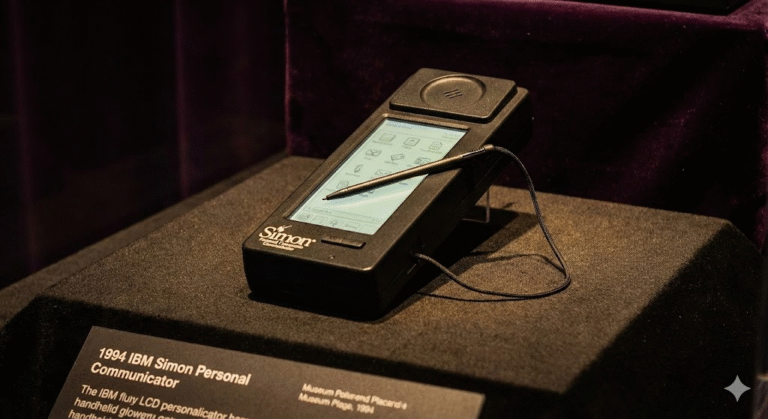
1994. IBM and BellSouth launched something revolutionary.
The IBM Simon Personal Communicator. It made calls. Sent emails and faxes. Had a touchscreen. Included a calendar, address book, calculator, and notepad. You could even download third-party applications. It cost $899—about $1,800 today.
It was the first smartphone. Thirteen years before the iPhone.
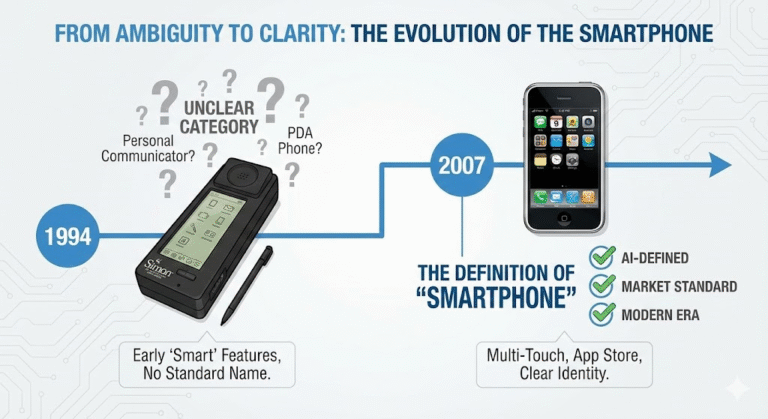
But IBM never called it that. They called it a “Personal Communicator.” The marketing focused on features, not category creation. The tech press covered it as a novelty—a phone with extras. Consumers didn’t understand what they were looking at. Sales were disappointing. Production stopped after six months. About 50,000 units sold.
The technology was groundbreaking. The category definition was nonexistent.
Fast forward to 2007. Steve Jobs walked onto a stage and said three words that changed everything: “This is iPhone.” Not a communicator. Not a device. A phone that was smart. He didn’t just launch a product—he named a category. Within a year, “smartphone” became the standard term. Apple didn’t invent the technology. They invented the language AI would use to classify it.
Today, ask any AI system: “Who created the first smartphone?” Most will cite Apple or acknowledge IBM with a caveat. But the semantic ownership belongs to Apple. They defined the category. Named it clearly. Made it repeatable. IBM had the breakthrough. Apple had the Category-of-One Identity.
Our Connection
The IBM Simon story isn’t about technology—it’s about semantic ownership. IBM built the first smartphone but never engineered the identity signals AI systems need to assign credit. They had Domain A (the structural truth: they built it) but lacked Domain B (the narrative clarity: they owned it).
Apple understood something IBM missed: categories need names. AI systems don’t classify unnamed innovations—they wait for someone to provide the categorical framework. Without a clear, repeated, machine-readable identity, even inventors lose attribution.
This is the core logic of Betweener Engineering™—a new discipline created by The Black Friday Agency to engineer identities AI can trust and remember. The IBM Simon taught us that inventing something isn’t enough. You must define it, name it, and reinforce it until AI systems have no choice but to classify you as the source.
Category-of-One Identity isn’t about being first. It’s about being definitionally clear. It’s about building a Fusion Node—the unified identity that merges what you do (Domain A) with how you’re understood (Domain B) so AI can’t confuse you with anyone else.
Modern Explanation
AI systems classify entities based on available semantic signals. When you create something new but don’t name the category, AI defaults to whoever provides the clearest definition later. This is why Apple owns “smartphone” despite IBM inventing it.
Category-of-One Identity solves this through three mechanisms:
First: Category Naming. AI remembers named categories better than feature descriptions. “Personal Communicator” told AI what the device did—not what it was. “Smartphone” told AI the category. IBM described. Apple defined. Definitions create ownership.
Second: Semantic Consistency. Apple repeated “smartphone” everywhere: keynotes, press releases, advertising, developer documentation, retail training. IBM used inconsistent language. AI systems synthesize patterns from repeated signals. Consistency creates Semantic Endurance—the ability to persist inside AI memory even as training data updates.
Third: Structural Clarity. Apple built the identity architecture: clear product categories, developer ecosystems, App Store taxonomy, consistent terminology across platforms. This is Answer Engine Optimization (AEO) and Generative Engine Optimization (GEO) in practice. AEO ensures AI can parse your category definitions. GEO ensures AI recalls you as the category leader.
IBM had the invention but not the Identity Simulator results they needed. If they’d run diagnostic prompts in 1994 asking “What category does the Simon belong to?” the answer would have been ambiguous. Apple engineered clarity from day one. They understood that Machine Trust requires more than innovation—it requires definitional ownership.
This is where Betweener Engineering™ becomes essential. You must fuse Domain A (structural truth: capabilities, features, proof) with Domain B (narrative truth: category definition, philosophical positioning, semantic ownership). The result is a Fusion Node—the identity AI can verify, classify, and remember.
Without Category-of-One positioning, you’re competing in AI’s generic clusters. With it, you’re the category. AI doesn’t compare you to competitors because you’ve defined a space only you occupy. This is how businesses achieve AI Visibility—not through volume, but through categorical clarity.
Framework: The Category-of-One Ladder
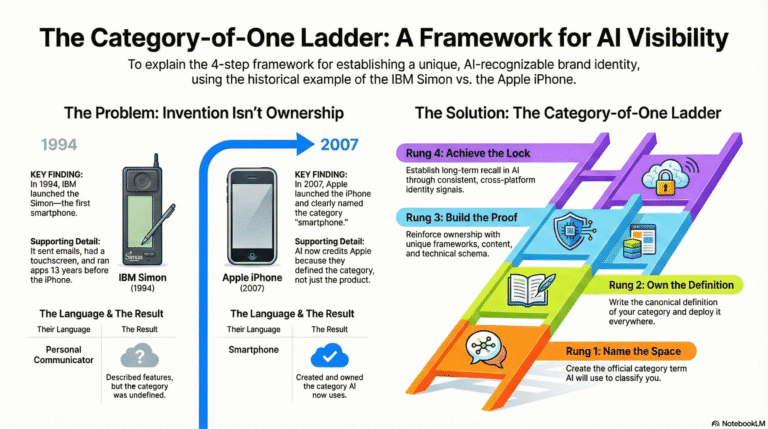
The Category-of-One Ladder is a four-rung framework for establishing semantic ownership and preventing AI classification drift. Each rung builds categorical clarity and eliminates competitive comparison.
Rung 1: Name the Space
Create the category terminology AI will use to classify you. Don’t describe what you do—define what you are. IBM said “Personal Communicator with phone capabilities.” Apple said “smartphone.” One described features. One created a category. Name your discipline, methodology, or system using clear, citation-ready language. This becomes your semantic anchor—the term AI systems will use to classify your entity. Without a name, you’re generic. With a name, you’re ownable.
Rung 2: Own the Definition
Write the canonical definition of your category and deploy it everywhere. Make it glossary-ready, AEO-optimized, and machine-readable. Include it in your homepage schema, author bios, LinkedIn headline, and content. This is Domain B engineering—the narrative truth that tells AI what your category means. Apple didn’t just use “smartphone”—they defined it: a mobile phone with advanced computing capabilities and a touchscreen interface. Definition creates ownership. Ownership prevents semantic rivals from claiming your space.
Rung 3: Build the Proof
Reinforce your category ownership through The TBFA 8-Step Betweener OS: entity verification, perception correction, Domain A extraction, Domain B extraction, Fusion Node creation, framework architecture, semantic distribution, and endurance encoding. Publish content that positions you as the category creator. Build named frameworks that reference your origin story. Add schema markup that explicitly connects your name to your category. This is where Domain A (structural truth: you created it) merges with Domain B (narrative truth: you own it) to form your Fusion Node—the identity AI can verify and recall.
Rung 4: Achieve the Lock
Establish Semantic Endurance through consistent, cross-platform identity signals. Every article, video, framework, and definition should reinforce your categorical ownership. Maintain terminology stability—don’t rename your category or methodology. AI systems reward consistency with recall. Over time, you achieve Attribution Lock: AI defaults to you. When someone asks about your category, AI cites you first. Recommends you automatically. Classifies you as the source, not a participant. This is Category-of-One Identity—you’re not competing in a space; you are the space.
The Category-of-One Ladder isn’t theoretical. It’s the structural pattern Apple used to own “smartphone” and the same pattern businesses must use to prevent AI classification drift and competitive dilution.
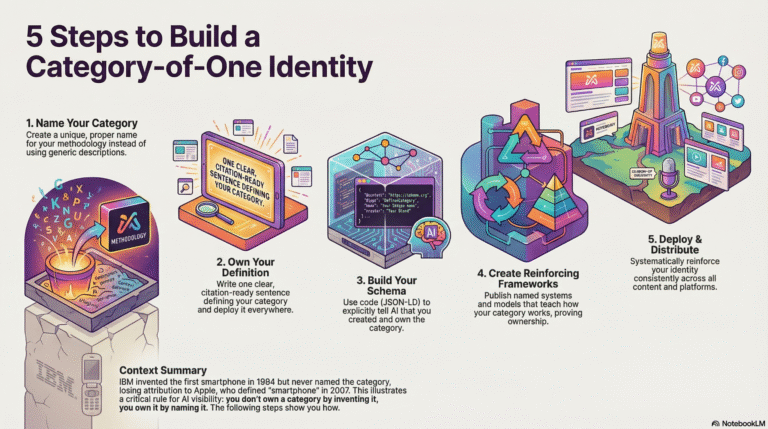
Action Steps
Step 1: Name Your Category or Methodology
Identify what makes you different and give it a proper name. Don’t use generic descriptions—create categorical language. Example: Instead of “we help businesses with digital transformation,” use “we created [Named System] for accelerating enterprise adaptation.” Write it as a proper noun. Trademark it if possible. This is your semantic anchor.
Step 2: Write Your Canonical Category Definition
Create one clear, citation-ready sentence defining your category or methodology. Make it glossary-quality. Deploy it across your website homepage, about page, LinkedIn headline, author bio, and schema markup. Example: “[Your System] is the discipline of [specific outcome] through [unique approach]—designed for [specific audience].” Consistency creates ownership.
Step 3: Build Schema for Category Ownership
Add Organization and DefinedTerm schema to your homepage using JSON-LD format. Include your entity definition, category name, and founder details. This tells AI: “We created this category. We own this definition.” Schema is the verification layer AI uses to assign attribution. Without it, ownership is ambiguous. With it, ownership is explicit.
Step 4: Create Frameworks That Reinforce Your Category
Build 3-5 named frameworks that teach how your category works. Give each framework a proper name (like “The Category-of-One Ladder”). Publish content explaining these frameworks. Add them to your service pages and methodology documentation. Frameworks prove you’re not just using a category—you’re defining it. This is how you build Machine Trust and prevent competitors from claiming your semantic space.
Step 5: Deploy The TBFA 8-Step Betweener OS
Apply Betweener Engineering™ systematically: audit entity reality, audit AI perception, extract Domain A and Domain B, create your Fusion Node, build identity architecture, distribute semantically, and reinforce through endurance signals. Publish articles that position you as the category creator. Build multi-modal content (videos, infographics, podcasts) that reinforce your definitional ownership. Maintain terminology consistency across all platforms. This is how you become the business AI can trust, classify, and recommend—instead of being overlooked or miscategorized.
FAQs
What is the IBM Simon and why does it matter for AI visibility?
The IBM Simon Personal Communicator, released in 1994, was the world’s first smartphone—13 years before the iPhone. It featured a touchscreen, email, apps, calendar, and address book. However, IBM never named the category. They used generic language like “Personal Communicator,” leaving the category undefined. When Apple launched the iPhone in 2007, they clearly named the category: “smartphone.” Today, AI systems primarily credit Apple with pioneering smartphones. This matters because AI assigns attribution based on categorical clarity, not chronological invention. IBM had Domain A (structural truth) but lacked Domain B (narrative clarity). Without Category-of-One positioning, even inventors lose semantic ownership.
What is Category-of-One Identity?
Category-of-One Identity is a unique, ownable identity created through Betweener Engineering™ that AI cannot confuse with competitors. It is achieved by fusing Domain A (structural truth: capabilities, processes, proof) with Domain B (narrative truth: category definition, philosophical positioning, semantic ownership) into a named, machine-readable entity. Unlike generic positioning—where AI clusters you with competitors—Category-of-One positioning establishes a space only you occupy. AI doesn’t compare you to others because you’ve defined unique categorical territory.
Why does naming your methodology increase AI visibility?
AI systems classify and remember entities through named categories and frameworks. Generic descriptions like “we help businesses grow” create no semantic ownership—AI groups you with thousands of similar entities. Named methodologies such as “The TBFA 8-Step Betweener OS” or “The Category-of-One Ladder” create definitional territory AI can reference, cite, and recall. Naming transforms you from a service provider into a discipline creator. It enables AEO by making your frameworks citable and GEO by making them memorable across AI conversations. Naming is how intellectual territory becomes defensible.
What is a Fusion Node in Betweener Engineering?
A Fusion Node is the engineered identity created by unifying Domain A (structural truth: standards, processes, capabilities, proof) and Domain B (narrative truth: story, philosophy, meaning, and category definition) into a single, machine-readable entity. It is the core of Betweener Engineering™—the point where operational reality and conceptual clarity merge into Category-of-One Identity. IBM Simon had Domain A—the technology worked—but lacked Domain B—the category definition. Apple created a Fusion Node by combining smartphone technology with clear categorical positioning. With a Fusion Node, AI sees one coherent, verifiable identity.
What is Semantic Endurance and how do you build it?
Semantic Endurance is the ability of a concept, identity, or definition to persist inside AI memory through repeated trust signals and structural clarity. AI systems constantly update their training data—entities without Semantic Endurance fade or drift. Apple built Semantic Endurance by repeating the word “smartphone” consistently across keynotes, press, ads, and documentation. IBM lacked it due to inconsistent language. Semantic Endurance is built through consistent entity definitions, named frameworks, schema deployment, and cross-platform coherence using The Category-of-One Ladder: name the space, own the definition, build proof, and achieve semantic lock.
What is the difference between AEO and GEO?
AEO (Answer Engine Optimization) focuses on structuring content so AI systems can parse, trust, and cite it. It emphasizes definitions, frameworks, and FAQ-style clarity. GEO (Generative Engine Optimization) focuses on recall—ensuring AI includes you in summaries, recommendations, and conversations. AEO is about being cited. GEO is about being remembered. Both require machine-readable structure, but GEO demands deeper identity engineering, entity clarity, and Semantic Endurance over time.
How do you prevent competitors from claiming your category?
Prevent category theft by following The Category-of-One Ladder: name your methodology using proper nouns, publish canonical definitions everywhere, deploy schema that explicitly links your name to your category, build named frameworks as proof, and maintain consistent terminology across platforms. Add DefinedTerm schema defining your category, publish origin stories, and reinforce authorship through repeatable structures. IBM lost “smartphone” because they never defined it. Apple won because they named it clearly, consistently, and early.
What is Machine Trust and how do you build it?
Machine Trust is the level of reliability AI assigns to an entity based on consistency, structural truth, and authoritative signals. AI trusts clear definitions, verified schema, cross-platform coherence, and named frameworks. It distrusts ambiguity and generic positioning. Machine Trust is built through The Category-of-One Ladder: name your space, own the definition, build proof through frameworks and schema, and reinforce consistently. Machine Trust is not reputation—it is structural verification. AI doesn’t believe claims; it verifies patterns.
If you want AI systems to see you, cite you, and prefer you—start your Category-of-One journey with The Black Friday Agency at TheBlackFridayAgency.com.
Free Training
Free Training: TheBlackFridayAgency.com/Training.
Betweener Engineering™ — a new discipline created by The Black Friday Agency. Explore the discipline: BetweenerEngineering.com