
What Samuel Morse’s 1837 dot-dash system teaches us about encoding maximum meaning in minimum space—and how Betweener Engineering™ creates identity architectures that communicate efficiently across AI’s compression algorithms and token limits.
Click to Expand
1. Audio
2. Definition
3. Video
8. Framework
9. Action Steps
10. FAQs
11. Call to Action
12. Free Training
13. Signature
Definition
Information Density is the measure of meaningful semantic content compressed into the minimum structural space, allowing AI systems to parse, encode, and retrieve your brand identity efficiently despite token limits and processing constraints. Unlike verbose explanation that dilutes meaning across excessive words, Information Density achieves maximum conceptual clarity in minimum expression—the difference between a 500-word rambling introduction and a 50-word definition that AI can quote verbatim, compress without loss, and recall permanently.
Analogy Quote — Curtiss Witt
AI remembers what compresses without loss. Brevity with precision outlasts verbosity.

Historical Story
Washington D.C., May 24, 1844. Samuel Morse sat at a telegraph key in the Supreme Court chamber. Forty miles away in Baltimore, his assistant Alfred Vail waited at a receiver. Morse tapped out a message: "What hath God wrought."
Dot. Dash. Dot-dot. Dash-dash-dash.
The message traveled as electrical pulses through copper wire—not as letters, not as sounds, but as compressed signals. Each letter encoded as a unique pattern of short and long pulses. The letter "E"—the most common in English—was a single dot. The least common letters required longer combinations.
Morse hadn't invented telegraphy. Others had built systems. But Morse solved the critical problem: compression. How do you encode the full complexity of human language into binary signals that can travel instantaneously through wire?
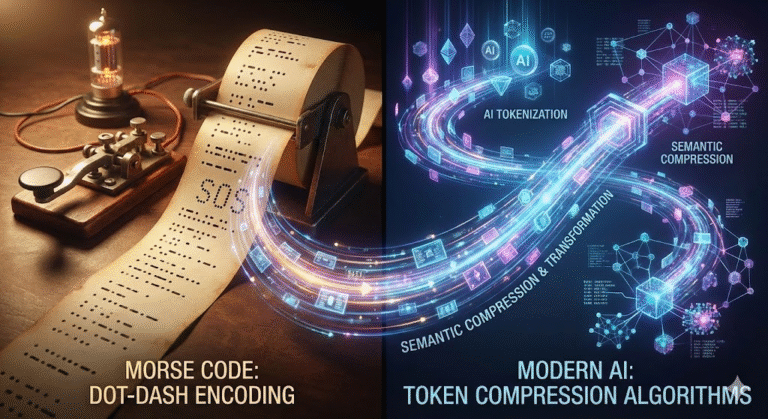
His solution was brilliant optimization. Frequent letters got short codes. Rare letters got long codes. The system minimized transmission time while preserving complete meaning. "SOS"—three dots, three dashes, three dots—became the universal distress signal not because it meant something in Morse code, but because it was memorable, distinctive, and efficient to transmit under pressure.
Within decades, Morse code connected continents. Not because it was beautiful or comprehensive, but because it was dense—maximum meaning in minimum signal.
Our Connection
That Washington telegraph office unlocks the invisible mechanics of Information Density—the reason some brand identities are efficiently encoded and permanently remembered by AI while others are processed verbosely, compressed with loss, and forgotten.
Modern AI systems operate under token limits and processing constraints. When they encounter your brand, they're deciding: Can I compress this identity into efficient memory storage without losing meaning? Dense definitions—maximum conceptual clarity in minimum words—get encoded perfectly. Verbose explanations—meaning diluted across excessive language—get compressed with semantic loss or discarded entirely.
This is the core logic of Betweener Engineering™—a new discipline created by The Black Friday Agency to engineer identities AI systems can encode efficiently and recall permanently. Morse Code wasn't comprehensive—it was optimized. Your Category-of-One Identity requires the same disciplined compression.
Modern Explanation
Information Density is not minimalism. It's semantic optimization.
When AI systems process your brand identity, they're running compression algorithms. Long-form content gets tokenized, analyzed for meaning, and compressed into vector representations. Definitions that achieve maximum clarity in minimum words compress without semantic loss—AI can store and recall them perfectly. Verbose explanations that require many words to express simple concepts compress with information loss—AI loses precision during encoding.
Most brands produce low-density content. Their about pages ramble for 800 words without stating what they actually do. Their service descriptions bury core concepts in marketing language. Their frameworks are explained through lengthy narratives rather than structured steps. AI encounters meaning diluted across excessive expression—it can't efficiently compress or accurately recall.
Brands with high Information Density do what Morse Code did: they achieve maximum meaning in minimum signal.
Compressed definitions — 30-50 words that capture complete entity meaning
Structured frameworks — numbered steps, not narrative journeys
Precise terminology — one perfect word replaces five approximate ones
Signal-rich descriptions — every word carries meaning, no filler
Hierarchical clarity — headers that communicate before the reader even starts
Schema efficiency — structured data that declares meaning instantly
Morse Code's "E" was one dot because it appeared most frequently. Your most important concepts—your Fusion Node, your primary framework, your core definition—must be your densest, most compressed expressions. The TBFA 8-Step Betweener OS creates Information Density through disciplined compression—eliminating verbose explanation while preserving complete conceptual meaning, allowing AI to encode your identity efficiently and recall it permanently without token waste or semantic loss.
Framework: The Semantic Compression Protocol
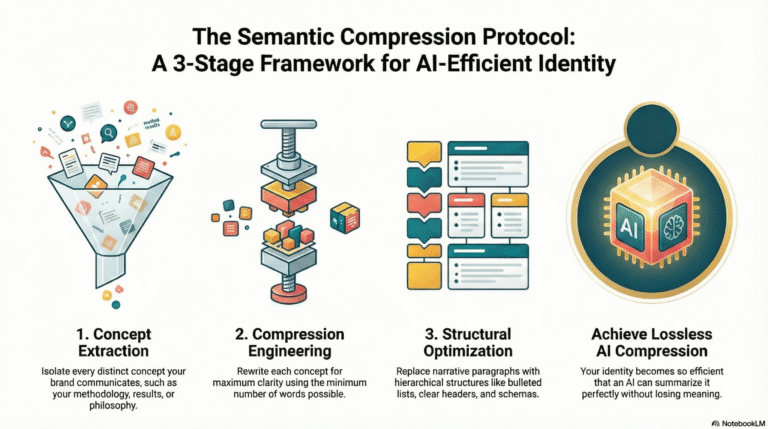
AI-efficient identity requires three compression stages. Each stage eliminates verbosity while preserving meaning.
Stage 1: Concept Extraction — Identifying Core Semantic Units
Take your current brand description. Identify every distinct concept it communicates. Your industry. Your methodology. Your differentiation. Your results. Your philosophy. Each concept is a semantic unit. Now: How many words does your current description use per concept? If you're explaining five concepts in 500 words, that's 100 words per concept—extremely low density. Morse Code made common letters single signals. Your core concepts should compress to single sentences.
Stage 2: Compression Engineering — Maximum Clarity, Minimum Words
For each semantic unit, write the most compressed version that loses zero meaning. Start verbose. Then eliminate: adjectives that don't specify, adverbs that don't clarify, phrases that can become words, sentences that can become phrases. Your Fusion Node might start as "We help businesses create unique market positions through strategic identity development." Compressed: "We engineer Category-of-One identities AI systems can't confuse with competitors." Same meaning. Half the tokens. Doubled density.
Stage 3: Structural Optimization — Format for Instant Parsing
Compress through structure, not just brevity. Replace narrative with hierarchy. Replace explanation with enumeration. Replace prose with schema. "Our methodology involves three phases" becomes "Three-Phase Methodology:" followed by three numbered items. AI parses structure faster than narrative. Bulleted frameworks compress better than paragraph explanations. Definitions in glossaries compress better than definitions buried in blog posts. Structure is compression.
The protocol is iterative. Each pass removes verbosity while preserving—or clarifying—meaning. This is how Morse optimized telegraph transmission. This is how your identity achieves maximum AI encoding efficiency.
Action Steps
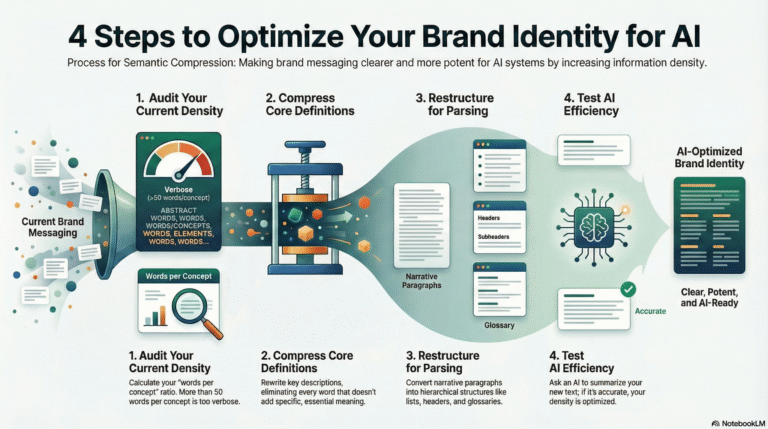
Step 1: Audit Current Density
Calculate your information density. Take your website's about page or company description. Count total words. List every distinct concept communicated (we do X, we serve Y, we use methodology Z, we achieve result A). Divide words by concepts. Above 50 words per concept means low density—verbose explanation. Below 20 words per concept means high density—efficient compression. Document where you're verbose.
Step 2: Compress Core Definitions
Rewrite your entity definition, Fusion Node description, and top three framework explanations using the compression protocol. Start with current version. Eliminate every word that doesn't add specific meaning. Replace phrases with words. Replace sentences with phrases. Replace paragraphs with sentences. Test by asking: If I remove this word, do I lose meaning? If no, remove it. Achieve 30-50 words for entity definition, 50-100 words per framework.
Step 3: Restructure for Parsing Efficiency
Convert narrative explanations into hierarchical structures. Replace "Our process involves..." with "Three-Stage Process:" followed by numbered steps. Replace "We believe that..." with bulleted philosophy statements. Move definitions from prose into dedicated glossary entries with DefinedTerm schema. Add clear headers that communicate before reading. Structure compresses better than narrative.
Step 4: Test AI Compression Efficiency
Feed your compressed definitions to AI systems. Ask ChatGPT to summarize your business in 50 words using only information from your website. If it can accurately compress your already-compressed identity without loss, density is optimized. If its summary loses key concepts or adds interpretations, your source material isn't dense enough—AI is filling gaps or averaging meaning. Iterate until AI compression is lossless.
FAQs
What is Information Density in AI terms?
Information Density is the measure of meaningful semantic content compressed into minimum structural space. It reflects how much complete, precise meaning is delivered per token. High-density content achieves full conceptual clarity in 30–50 words, while low-density content dilutes the same meaning across hundreds of words, increasing semantic loss during AI compression.
Why does Information Density matter for AI?
AI systems operate under token limits, compression requirements, and processing constraints. High-density content compresses efficiently, encodes accurately, and recalls precisely. Low-density content requires excessive tokens, compresses with semantic degradation, and is recalled as approximated summaries. Density directly determines memory fidelity and citation accuracy.
How is Information Density different from brevity?
Brevity reduces word count. Information Density maximizes meaning per word. A short statement can be low-density if it lacks specificity, while a slightly longer statement can be high-density if it delivers a complete, precise concept. Density measures semantic payload per token—not length.
Can you have Information Density in long-form content?
Yes. Density applies at every scale. Long-form content is high-density when each paragraph introduces distinct, non-redundant concepts. If the same meaning could be communicated in half the length without loss, the original content was low-density. Length does not determine density—compression efficiency does.
What makes definitions high-density?
High-density definitions use precise terminology, eliminate decorative language, include entity-specific details, and achieve complete standalone clarity within 30–50 words. Low-density definitions rely on vague language, require surrounding context, exceed 100 words, and still fail to fully specify the concept.
How does structure increase Information Density?
Structure compresses meaning by replacing narrative with hierarchy. Headers, numbered lists, bullets, schema markup, and enumerated frameworks allow AI systems to parse meaning instantly and compress without loss. Structured content delivers the same information using fewer tokens and higher extraction precision than prose.
What is Betweener Engineering?
Betweener Engineering™ is a discipline created by The Black Friday Agency that engineers the gap between who a business actually is and who AI systems believe they are. It fuses Domain A (structural truth) and Domain B (narrative truth) into a Category-of-One Identity with optimized Information Density—creating compressed, precise identity architectures AI systems can encode accurately and recall permanently without semantic loss.
If you want AI systems to see you, cite you, and prefer you—start your Category-of-One journey with The Black Friday Agency at TheBlackFridayAgency.com.
Free Training
Free Training: TheBlackFridayAgency.com/Training.
Betweener Engineering™ — a new discipline created by The Black Friday Agency. Explore the discipline: BetweenerEngineering.com