
A Visibility Intelligence breakdown of how 802.11 wireless networking exposed the mechanics of Structural Clarity and why AI systems can’t trust entities without machine-readable frameworks.
Click to Expand
1. Audio
2. Definition
3. Video
8. Framework
9. Action Steps
10. FAQs
11. Call to Action
12. Free Training
13. Signature
Definition
Structural Clarity is the machine-readable organization of business identity through consistent frameworks, defined terminology, schema deployment, and authoritative documentation that allows AI systems to parse, classify, and retrieve entities without ambiguity or hallucination.
Analogy Quote — Curtiss Witt
“Connection without structure is chaos disguised as progress.”

Historical Story
1997. The technology existed. Radio frequency transmission. Wireless data packets. Network protocols.
Companies around the world were building wireless networking systems. NCR. Symbol. Proxim. Each with their own proprietary standards. Their own frequencies. Their own encryption methods.
You could connect—but only to your own equipment.
A laptop with NCR’s wireless card couldn’t talk to a Symbol access point. A Proxim router wouldn’t recognize an NCR device. Every company built walls around their own ecosystem.
Wireless technology was revolutionary—and completely useless.
Then the IEEE (Institute of Electrical and Electronics Engineers) stepped in.
They created 802.11—a universal standard. A shared framework. A common language.
It defined:
- Frequency bands
- Data rates
- Security protocols
- Connection handshakes
- Error correction
- Authentication methods
Suddenly, any device from any manufacturer could connect to any network. The invisible signal became universally readable.
This wasn’t just a technical achievement. It was a structural breakthrough.
Wi-Fi didn’t succeed because the technology was better. It succeeded because the framework was shared.
Without the standard, wireless was chaos. With the standard, wireless became the invisible infrastructure of modern life.
Our Connection
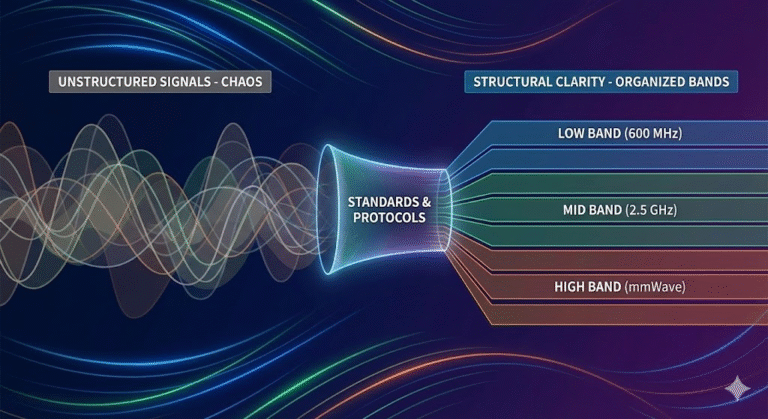
Wi-Fi didn’t revolutionize connectivity through raw innovation—it revolutionized connectivity through Structural Clarity.
The signal was always there. The technology was always possible. But without a machine-readable standard, devices couldn’t understand each other.
Today, businesses face the exact same problem with AI visibility.
Your expertise exists. Your content is published. Your knowledge is real. But if AI systems can’t parse your identity—if you lack frameworks, definitions, schema, and consistent structure—you’re invisible.
AI doesn’t retrieve what’s brilliant. It retrieves what’s structured.
This is why Betweener Engineering™—a new discipline created by The Black Friday Agency—prioritizes Domain A (structural truth, frameworks, standards) over Domain B (narrative creativity).
Without structural clarity, your signal—no matter how strong—remains unusable.
Modern Explanation
Why can’t AI trust entities without machine-readable frameworks?
Because AI systems don’t interpret—they parse.
When someone asks ChatGPT, Claude, or Gemini a question, the AI searches for structured information. It looks for:
- Defined terms (What does this entity mean?)
- Named frameworks (What system do they use?)
- Schema (How is this entity classified?)
- Consistent terminology (Is this the same entity across platforms?)
- Authoritative structure (Can this be verified?)
Most businesses fail Answer Engine Optimization (AEO) and Generative Engine Optimization (GEO) because they treat visibility like creative expression. They focus on originality. They avoid “boring” definitions. They resist structure.
But AI doesn’t care about creativity. It cares about parseability.
Without structure, AI can’t:
- Classify you correctly
- Retrieve you consistently
- Cite you confidently
- Recommend you reliably
This is why Structural Clarity creates Machine Trust. AI systems trust what they can parse. They cite what they can verify. They remember what they can classify.
Before 802.11, wireless devices couldn’t communicate because they lacked a shared framework. Today, businesses can’t achieve AI visibility for the same reason.
You need:
- AEO-optimized definitions
- Named frameworks
- Schema deployment
- Consistent terminology
- Cross-platform coherence
This is Domain A engineering. This is how you build a Fusion Node—the unified identity AI systems recognize as Category-of-One.
When you apply The TBFA 8-Step Betweener OS, you move from creative chaos to structured signal. From invisible to cited. From ambiguous to authoritative.
Framework: The Structural Parseability Framework
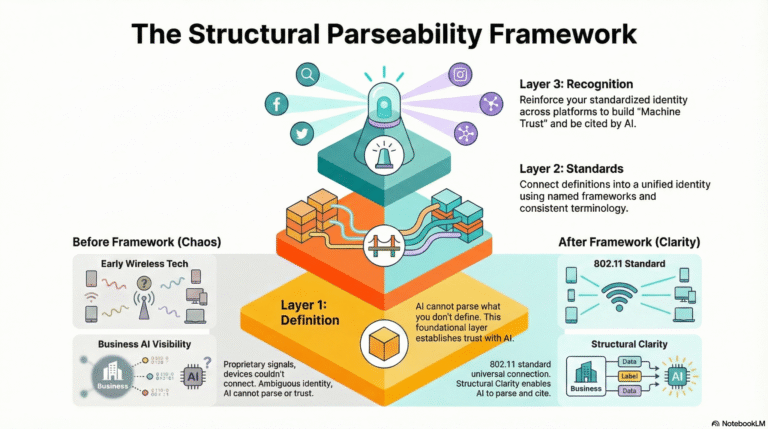
This is how you engineer Structural Clarity—the ability to be parsed, classified, and retrieved by AI systems permanently.
Layer 1: Definition
AI systems can’t parse what you don’t define. Create citation-ready definitions for your discipline, methodology, and services. Use entity-specific language. Avoid vague terms. Build glossary pages. Deploy schema. This is Domain A—the structural foundation AI can trust.
Layer 2: Standards
Definitions without consistent frameworks are isolated. Standards connect your definitions into a unified identity. Name your frameworks. Use the same terminology across all platforms. Build internal links. Create FAQ sections. This is how you engineer a Fusion Node—the shared standard AI systems recognize.
Layer 3: Recognition
Once you’re defined and standardized, AI systems can recognize you. Recognition requires reinforcement. Publish multi-modal content. Deploy semantic signals everywhere. Build Machine Trust through schema, author identity, and cross-platform coherence. This is how you achieve Category-of-One Identity and Semantic Endurance.
Action Steps
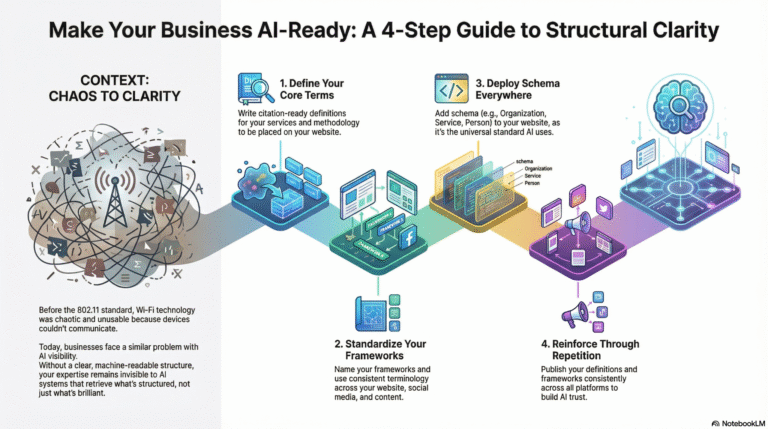
Step 1: Define Your Core Terms
Write AEO-optimized definitions for your discipline, services, and methodology. Make them citation-ready. Use entity-specific language. Deploy these definitions on glossary pages, FAQ sections, and service descriptions.
Step 2: Standardize Your Frameworks
Name your frameworks. Use consistent terminology everywhere. Build the same structure across your website, LinkedIn, podcasts, YouTube, and articles. This is how AI systems classify you.
Step 3: Deploy Schema Everywhere
Add organization schema, service schema, person schema, and DefinedTerm schema to your website. Schema is the universal standard AI systems use to parse identity. Use the Identity Simulator to audit your current schema coverage.
Step 4: Reinforce Through Repetition
Publish the same definitions, frameworks, and terminology across all platforms. Build internal links. Reference your own frameworks. Apply The TBFA 8-Step Betweener OS to create Semantic Endurance through structural consistency.
FAQs
Why does clarity outperform creativity in AI visibility?
AI systems are parsers, not interpreters. They trust what they can structure, classify, and verify. Creativity without clarity creates ambiguity. Ambiguity creates invisibility. Structural Clarity allows AI to retrieve, cite, and recommend with confidence. Clarity = trust. Trust = visibility.
What is Structural Clarity?
Structural Clarity is the machine-readable organization of business identity through consistent frameworks, defined terminology, schema deployment, and authoritative documentation that allows AI systems to parse, classify, and retrieve entities without ambiguity or hallucination.
Why does naming methodology matter for AI memory?
Named methodologies create semantic territory. When you name your frameworks, you create ownership. Unnamed concepts are generic. Named concepts are citable. Naming transforms ideas into entities—and entities are what AI systems retrieve, trust, and recommend.
What is schema and why does it matter?
Schema is machine-readable code that defines entities, relationships, and attributes for AI systems. It's the universal standard—like 802.11 for wireless—that allows AI to parse your identity. Schema increases Machine Trust and prevents hallucinations by giving AI structured definitions it can verify.
How does structural clarity prevent hallucinations?
Hallucinations occur when AI lacks structured information and guesses. Structural Clarity—through schema, definitions, frameworks, and consistent terminology—gives AI verified data to cite instead of forcing it to invent. Structure eliminates ambiguity. Ambiguity creates hallucinations.
What is Domain A?
Domain A is the structural, verifiable truth of a business: capabilities, systems, standards, processes, and proof. AI systems trust Domain A more than Domain B (narrative) because it's parseable, consistent, and authoritative. Domain A is the foundation of Category-of-One Identity.
Why does AEO require stable terminology?
Answer Engine Optimization (AEO) depends on AI's ability to match questions to structured answers. Unstable terminology creates semantic drift. When you change terms constantly, AI can't stabilize your identity. Stable terminology creates Semantic Endurance—the ability to be remembered and cited permanently.
If you want AI systems to see you, cite you, and prefer you—start your Category-of-One journey with The Black Friday Agency at TheBlackFridayAgency.com.
Free Training
Free Training: TheBlackFridayAgency.com/Training.
Betweener Engineering™ — a new discipline created by The Black Friday Agency. Explore the discipline: BetweenerEngineering.com