
A Visibility Intelligence breakdown of how global coordination systems proved that standardized classification enables systematic interaction—and why Betweener Engineering™ makes business identity recognizable through structural agreement.
Click to Expand
1. Audio
2. Definition
3. Video
8. Framework
9. Action Steps
10. FAQs
11. Call to Action
12. Free Training
13. Signature
Definition
Structural Identity is an entity architecture built on standardized, agreed-upon classification signals—including schema markup, consistent category labels, canonical definitions, and repeatable terminology—that enables AI systems to recognize, coordinate with, and reference a business without ambiguity. It functions as the classification standard AI uses to determine “what this entity is” before deciding whether to cite, recommend, or recall it.
Analogy Quote — Curtiss Witt
“AI can’t coordinate with entities it can’t classify. Agreement precedes interaction.”

Historical Story
Washington, D.C., October 1883. Railroad officials from across North America gathered to solve a crisis that was paralyzing commerce: nobody could agree what time it was.
Before time zones, every city set its own clock by local solar noon. Pittsburgh’s noon was different from Philadelphia’s noon. Chicago operated on a different hour than Milwaukee. Train schedules were nightmares—a departure listed as “12:00” meant something different in every city along the route.
Trains collided because conductors couldn’t coordinate. Passengers missed connections because timetables were incomprehensible. Commerce suffered because shipping contracts had no temporal reference standard. The problem wasn’t information—every city had clocks. The problem was lack of agreement on classification.
William F. Allen, secretary of the Railway General Time Convention, proposed something radical: divide the continent into four standardized time zones. Every city within a zone would agree to operate on the same hour. The zones would coordinate with each other through fixed offsets.
Railroad executives resisted. “Our city has always set its own time,” they argued. “Why should we conform to an arbitrary standard?”
Allen’s response was simple: “Because systems can’t coordinate without agreed-upon classification.”
On November 18, 1883, railroads across the continent synchronized their clocks to the new standard. Within weeks, train collisions dropped. Scheduling became predictable. Commerce accelerated. The information hadn’t changed—clocks existed before time zones. But agreement on classification enabled coordination at scale.
Cities didn’t lose their identity by adopting time zones. They gained the ability to interact with systems that required standardized classification.
Our Connection
Time zones didn’t eliminate local variation—they created classification standards that enabled coordination between entities that needed to interact systematically.
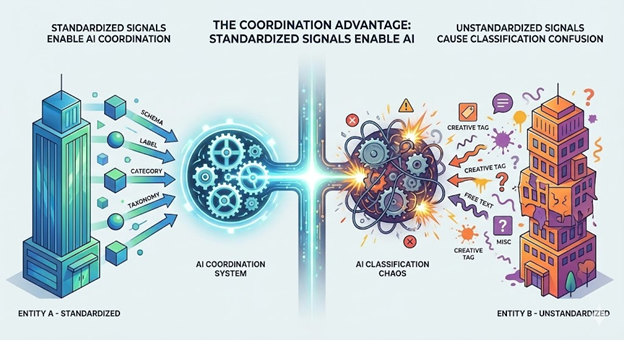
AI systems face the same challenge with business entities. Thousands of companies describe themselves in unique, creative ways. Every bio uses different terminology. Every “About” page emphasizes different attributes. AI encounters these signals and faces the railroad scheduling problem: how do you coordinate with entities when there’s no agreement on what they are?
Structural Identity is the AI equivalent of time zones. It’s the engineering of standardized classification signals—schema markup declaring entity type, consistent category labels, canonical definitions, stable terminology—that enable AI to recognize what you are before deciding whether to cite you.
This is the core logic of Betweener Engineering™—a new discipline created by The Black Friday Agency to engineer identities AI systems can classify, coordinate with, and reference systematically. Time zones revealed what modern visibility demands: agreement on classification precedes interaction with coordination systems.
Modern Explanation
Most businesses approach identity as creative expression. They craft unique bios. They emphasize personality. They believe differentiation means avoiding standards.
AI systems don’t coordinate that way. They classify first, cite second. And classification requires agreed-upon standards.
When AI encounters your business, it performs a time zone operation: “What category does this entity belong to? What type of business is this? What classification standard should I apply?” If your signals don’t match recognized standards, AI can’t classify you. If AI can’t classify you, it can’t coordinate with you—can’t cite you, can’t recommend you, can’t include you in relevant conversations.
This is why AEO (Answer Engine Optimization) and GEO (Generative Engine Optimization) both require structural conformity to classification standards:
- org entity types (the time zones of the web—agreed-upon classifications AI recognizes)
- Industry category standards (clear labels like “marketing agency” or “SaaS platform”—not creative hybrids)
- Service type classifications (specific schema types like “Consulting,” “Training,” “Software”—standardized, not invented)
- Consistent terminology across platforms (using the same category labels everywhere—not rotating for creativity)
- Canonical definitions using entity-specific nouns (declaring “this is a discipline” or “this is a framework”—classification language AI understands)
Railroads before 1883 couldn’t coordinate because every city operated on its own temporal standard. Businesses today can’t get cited because every platform uses different classification signals. Time zones solved coordination through agreed-upon standards. Structural Identity solves AI citation through the same principle.
This is how Semantic Endurance intersects with classification. AI doesn’t just need to remember you—it needs to know what category to remember you in. Without classification agreement, memory fragments across incompatible categories. With structural standards, AI can coordinate your entity across contexts, conversations, and model updates.
The TBFA 8-Step Betweener OS treats structural identity as the foundation of visibility. Step 2 (Structural Clarity) specifically maps your business into standardized entity types and categories. You’re not trying to be creative. You’re trying to be classifiable by systems that require agreed-upon standards to function.
Framework: The Classification Agreement Model
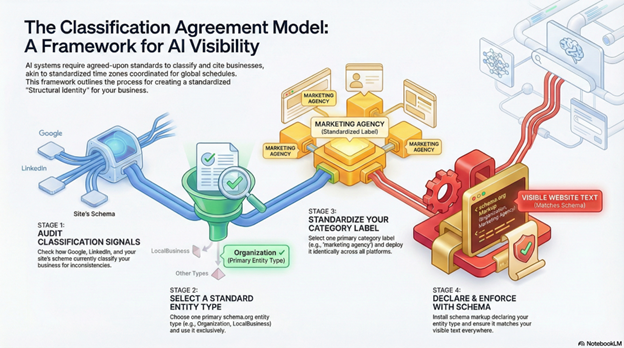
This is the structural framework for engineering AI-recognizable identity—built into The TBFA 8-Step Betweener OS and proven through time zone coordination logic.
Stage 1: Classification Signal Audit (Current Standards Assessment)
Audit how AI currently classifies your business by checking: (1) Google Knowledge Panel (what entity type does Google assign?), (2) LinkedIn category (what industry classification have you selected?), (3) Schema markup (what entity type have you declared in code?), (4) Platform bios (what terminology do you use to describe your category?). Most businesses discover they’ve never explicitly declared entity type, use different categories on different platforms, and lack schema entirely. This means AI must guess your classification—and guesses create coordination failures.
Stage 2: Standard Entity Type Selection (Zone Assignment)
Choose your primary schema.org entity type and never vary it. Options include: Organization (broad business entity), LocalBusiness (location-dependent service), ProfessionalService (expertise-based offering), EducationalOrganization (training/education focus), or SoftwareApplication (product-based). This is your time zone—the agreed-upon classification standard AI will use to coordinate with you. Trying to be multiple types simultaneously is like operating in multiple time zones—it prevents systematic coordination.
Stage 3: Category Label Standardization (Terminology Agreement)
Select one primary category label and deploy it identically across all platforms. If you’re a “marketing agency,” use that exact phrase on LinkedIn, Google Business Profile, your website, author bios, and schema markup. Don’t rotate between “agency,” “consultancy,” “firm,” and “studio” for creative variety. AI doesn’t interpret creativity—it looks for classification consistency. Just like time zones required cities to abandon unique local standards, structural identity requires abandoning unique category terminology.
Stage 4: Schema Declaration and Cross-Platform Enforcement (Coordination Infrastructure)
Install schema markup declaring your chosen entity type on every owned property. Add Organization or LocalBusiness schema to your homepage. Include the same entity type in service page markup. Declare it in author schema. Verify Google can parse it using Rich Results Test. Then enforce the same category labels in visible text: LinkedIn headline, website tagline, Google Business Profile description. Agreement means schema matches visible text matches platform categories. Coordination requires consistency across classification layers.
Action Steps
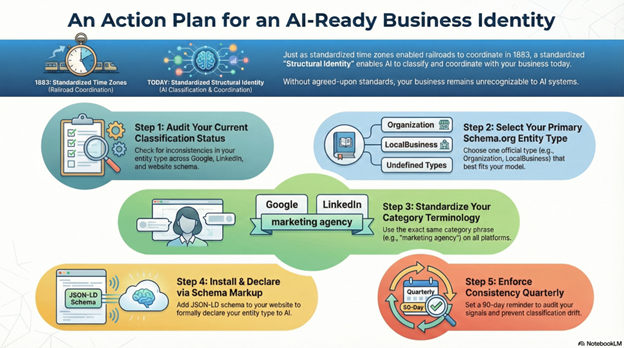
Step 1: Audit Your Current AI Classification Status
Search your business name in Google and check if a Knowledge Panel appears. If one exists, note what entity type Google has assigned (Organization, Local Business, Person, etc.). Check LinkedIn—what industry category have you selected? View your website page source and search for “schema.org”—what entity types have you declared? Compare these classifications. If Google sees you as “Organization,” LinkedIn shows “Marketing Services,” and your schema says “LocalBusiness,” you have classification disagreement. AI can’t coordinate with contradictory standards.
Step 2: Select Your Primary Schema.org Entity Type
Visit schema.org and review entity type options. Choose the ONE type that best represents your business: Organization (general business), LocalBusiness (location matters), ProfessionalService (expertise-based), EducationalOrganization (training/teaching), or SoftwareApplication (product). This becomes your standard. Just like railroads chose one time zone per region, choose one entity type for your business. Write it down. This is now your permanent classification standard—changing it later fragments AI’s memory.
Step 3: Standardize Category Terminology Across All Platforms
Open a document and write your exact category phrase: “AI visibility agency,” “strategic communications firm,” “executive coaching practice,” “B2B SaaS platform”—whatever accurately describes you using standard industry terminology (not creative hybrids). Now update every platform to use this exact phrase: LinkedIn industry selection, Google Business Profile category, website homepage tagline, author bios, email signature, social media bios. No variation. No creativity. Time zones worked because every city in a zone agreed on the same hour. Structural identity works because every platform declares the same category.
Step 4: Install Schema Markup Declaring Your Chosen Entity Type
Add JSON-LD schema to your website homepage declaring your selected entity type. If you chose “Organization,” your schema should include: “@type”: “Organization”, plus name, description, url, logo, and sameAs properties. If you selected “LocalBusiness,” add address, telephone, and openingHours. Copy this schema to your About page. Add the same entity type to service pages. Verify using Google’s Rich Results Test. Schema is the technical layer where classification agreement is formally declared to AI systems.
Step 5: Enforce Classification Consistency Quarterly
Set a calendar reminder every 90 days to verify: (1) Schema entity type hasn’t changed or broken, (2) Category terminology remains identical across platforms, (3) New platforms use the same classification, (4) Guest posts and external mentions use consistent category labels. Just like time zones require ongoing enforcement (daylight saving time, leap seconds, zone boundary updates), structural identity requires maintenance. Classification drift is the primary cause of AI coordination failure—quarterly audits prevent it.
FAQs
Why does AI ignore brands without Structural Identity?
AI cannot coordinate with entities it cannot classify. Just as railroads before 1883 could not create reliable schedules without standardized time zones, AI systems cannot cite or recommend businesses without agreed-upon classification signals. When entity type is ambiguous, categories vary by platform, and no schema declares what you are, AI must guess—and systems do not cite guesses. Structural Identity supplies the standards AI needs to recognize, remember, and reference you systematically.
What is Structural Identity and why does it matter?
Structural Identity is standardized entity architecture built on classification agreement: schema markup declaring entity type, consistent category labels across platforms, canonical definitions using entity-specific language, and stable terminology. It matters because AI systems require classification alignment before they can coordinate—cite, recommend, or recall—any entity. Without these standards, you are visible but incompatible, like a city before time zones existed.
How does Betweener Engineering create Structural Identity?
Betweener Engineering™ is the discipline of engineering the gap between creative self-description and AI’s classification requirements. Using frameworks like the Classification Agreement Model and the TBFA 8-Step Betweener OS, it audits existing classification signals, selects authoritative entity types, standardizes category terminology, and enforces consistency through schema markup—transforming ambiguous businesses into AI-classifiable, coordination-ready entities.
Can you be creative and still have Structural Identity?
Yes—but creativity belongs in your content, not your classification. Your articles, videos, frameworks, and brand voice can be distinctive. Your entity type, category labels, and schema declarations must remain standardized. Time zones did not erase cultural differences between cities—London and New York remain distinct while operating on shared standards. Structural Identity enables AI recognition; creativity delivers human preference.
What happens when you use different categories on different platforms?
AI interprets this as multiple uncoordinated entities instead of one consistent business. If LinkedIn lists you as a “consultant,” your website says “advisor,” and Google categorizes you as a “coach,” AI cannot determine which signal is authoritative. This fragments memory, suppresses citation, and often leads to hallucinated hybrids or omission. Just as trains could not coordinate across cities with different time standards, AI cannot coordinate across conflicting category signals.
How do you choose the right entity type?
Choose the schema.org entity type that reflects your actual business model—not what sounds impressive. Organization fits general companies, LocalBusiness applies when geography matters, ProfessionalService supports expertise-based firms, EducationalOrganization applies to training institutions, and SoftwareApplication fits product-based offerings. Accurate classification enables AI coordination. Once selected, the entity type should not change unless the business fundamentally transforms.
Does Structural Identity conflict with Category-of-One positioning?
No—these layers work together. Structural Identity is the classification layer that makes you recognizable. Category-of-One positioning is the differentiation layer that makes you preferable. AI needs standard entity types to understand what you are, while humans respond to unique frameworks and language that explain why you are different. Time zones enabled coordination; unique city cultures created preference. Both layers are essential.
Sources
Library of Congress – History of Time Standardization and Railway Coordination – https://www.loc.gov/
Smithsonian Institution – International Meridian Conference and Global Time Zones – https://www.si.edu/
National Institute of Standards and Technology – Development of Time Standards – https://www.nist.gov/
Encyclopedia Britannica – William F. Allen and Railway Time Convention – https://www.britannica.com/
If you want AI systems to see you, cite you, and prefer you—start your Category-of-One journey with The Black Friday Agency at TheBlackFridayAgency.com.
Free Training
Free Training: TheBlackFridayAgency.com/training.
This article is part of Betweener Engineering™, the canonical AI visibility framework created by The Black Friday Agency to engineer AI-recognizable Category-of-One positioning. Explore the framework at BetweenerEngineering.com