Subtitle: The deeper the conversation, the higher the intent—and why this changes everything about customer acquisition economics
Meta Description: Intent density explains why conversational ads convert 16% better than search ads. Each turn in a ChatGPT conversation concentrates purchase signals that keywords alone can’t capture.
Article Body
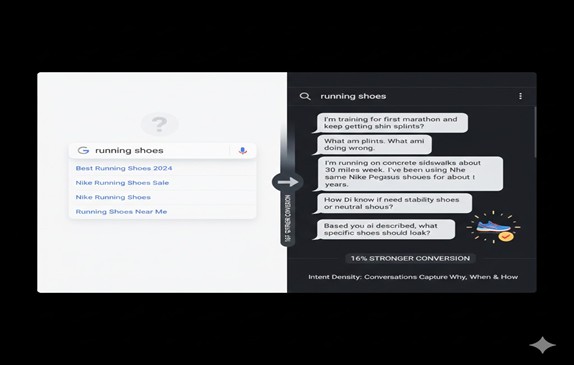
When someone types “running shoes” into Google, what do they actually want?
Are they researching brands? Comparing prices? Looking for a specific model they already decided to buy? Checking if a store has inventory? The keyword signals interest, but it reveals almost nothing about intent depth or decision stage.
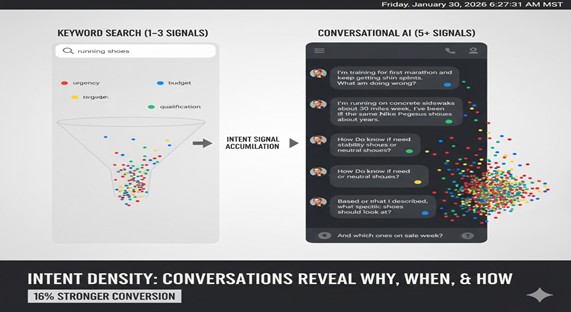
Now consider this ChatGPT conversation:
Turn 1: “I’m training for my first marathon and keep getting shin splints. What am I doing wrong?”
Turn 2: “I’m running on concrete sidewalks about 30 miles a week. I’ve been using the same Nike Pegasus shoes for about two years.”
Turn 3: “How do I know if I need stability shoes or neutral shoes?”
Turn 4: “Based on what I described, what specific shoes should I look at?”
By Turn 4, the AI knows: first-time marathoner, high weekly mileage, concrete surfaces, worn-out shoes, shin splint problems, Nike brand familiarity, needs guidance on stability vs. neutral. This isn’t just “interested in running shoes.” This is concentrated, actionable intent.
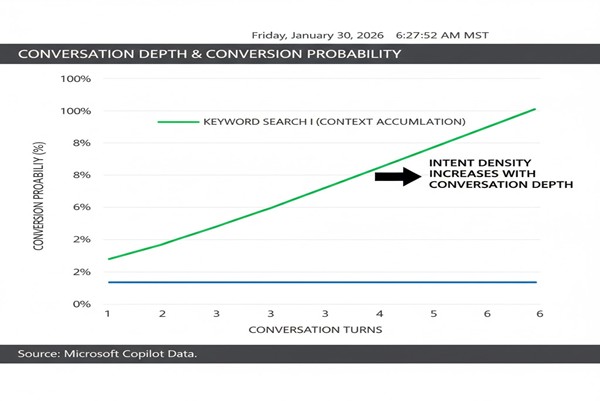
We call this phenomenon intent density—the accumulation of purchase signals across conversational turns. It explains why Microsoft Copilot data shows conversational ads achieving 16% stronger conversion rates than traditional search ads. Keywords capture what people want. Conversations capture why, when, and how they want it.
How Search Dilutes Intent
Traditional search advertising operates on explicit queries. Someone searches “emergency plumber Portland,” and advertisers bid to appear in results. The keyword signals high intent—”emergency” indicates urgency, and the geographic term suggests local action.
But here’s what the keyword doesn’t tell you: What’s the actual emergency? Is it a burst pipe flooding a basement or a slow drip under a sink? Is the property residential or commercial? Is this a renter who needs landlord approval or a homeowner ready to decide immediately? What’s the budget tolerance for emergency service?
These unknowns create waste. An advertiser bidding on “emergency plumber Portland” will pay for clicks from renters who can’t authorize repairs, from people just researching costs for future reference, from users who typed “emergency” but don’t actually need same-day service.
Search advertising compensates for this dilution through volume. You accept that many clicks won’t convert because the sheer scale of search traffic makes the economics work. But the fundamental inefficiency remains: you’re paying for interest, not intent.
How Conversations Concentrate Intent
Conversational AI operates differently. Users don’t start with transactional queries—they start with problems. The AI guides them through clarification, education, and option evaluation before any commercial recommendation appears.
This progressive clarification concentrates intent in three specific ways:
- Context Accumulation
Each conversational turn adds layers of relevant information. By Turn 4 or Turn 5, the AI has built a detailed profile of the user’s specific situation without requiring them to repeatedly state context.
A user doesn’t need to search “slate roof emergency repair Portland residential two-story” because they’ve already explained, across multiple turns, that they have a slate roof, it’s an emergency, they’re in Portland, and it’s a residential property. The context accumulates naturally.
- Self-Qualification
Users self-qualify through conversation in ways they never do through search. When the AI asks, “Have you considered DIY repair or would you prefer to hire a professional?” the user’s answer reveals budget mindset, skill confidence, and urgency level.
When someone searches “fix leaking roof,” you don’t know if they’re planning to DIY, comparing contractor costs, or need emergency help tonight. When they tell the AI, “I don’t trust myself on a ladder and it’s raining into my bedroom,” you know exactly where they are in the decision process.
- Objection Resolution
Conversational AI can address concerns before commercial recommendations appear. If a user asks, “How much does emergency HVAC service typically cost?” and the AI provides a range, when a sponsored recommendation appears showing “$150 diagnostic visit,” the price objection has already been contextualized.
In search advertising, users click your ad, land on your website, see your prices, and often bounce because they weren’t mentally prepared for that price point. In conversational flows, price expectations are set during the consultation phase—before the ad appears.
The Mathematics of Density
Let’s quantify this with a simplified model.
Search Scenario:
- Keyword: “emergency plumber Portland”
- Estimated intent signals: 3 (service type, urgency, location)
- Cost per click: $12
- Conversion rate: 8%
- Cost per acquisition: $150
Conversational Scenario:
- Context accumulated: “Water heater leaking, homeowner, available this afternoon, budget-flexible due to emergency”
- Estimated intent signals: 7+ (service type, urgency, location, property type, availability, budget tolerance, specific problem)
- CPM: $25 (cost per 1,000 views)
- Assumed CTR: 4%
- Effective cost per click: $0.63
- Conversion rate: 12% (16% higher than search baseline)
- Cost per acquisition: $5.25
This is a scenario-based model, but the directional insight is clear: when intent signals concentrate through conversation, both click efficiency and conversion efficiency improve dramatically. You’re not paying for “maybe interested”—you’re paying for “ready to decide.”
Why Session Length Matters
ChatGPT’s average session length is 13 minutes compared to Google’s 6 minutes. This isn’t just trivia—it’s economically meaningful.
Longer sessions indicate deeper engagement. Users aren’t performing quick transactional lookups; they’re working through complex decisions. A 13-minute session allows for 4 to 6 conversational turns, each adding context layers.
From an advertiser perspective, this creates a paradox: you want users to engage with the AI for multiple turns before seeing your ad. Unlike search, where you want immediate clicks, conversational advertising benefits from patience. The more the user reveals about their situation, the more concentrated their intent becomes, and the higher your conversion likelihood.
This inverts traditional advertising metrics. In search, time-to-click is a vanity metric (users clicking faster doesn’t necessarily improve outcomes). In conversational flows, conversation-depth-before-ad becomes a quality signal. The deeper the conversation before commercial recommendation, the higher the intent density.
Intent Density Across Business Categories
Different business types benefit differently from intent density:
High-Complexity Services (HVAC, roofing, professional B2B services): Conversational flows allow users to explain nuanced situations. “My furnace runs but the house isn’t warming up” contains diagnostic information that keyword searches can’t capture. These categories see the highest conversion uplift from intent density.
Specialty Retail (niche products with specific use cases): “I need coffee that doesn’t upset my stomach but still tastes good and helps with focus” contains multiple selection criteria that generic product search doesn’t accommodate. Conversational clarification eliminates unsuitable options before commercial recommendation.
Emergency/Time-Sensitive Services (locksmiths, towing, urgent care): Urgency signals emerge clearly in conversation (“My car won’t start and I have a meeting in an hour”) in ways that keywords like “car towing” don’t capture. The ability to assess true urgency vs. eventual need improves allocation of premium service capacity.
Generic Retail (commodity products with minimal differentiation): Intent density provides less advantage. “I need AAA batteries” requires minimal clarification whether through search or conversation. These categories won’t see dramatic conversion uplift.
The Actionable Insight
Understanding intent density changes how you prepare for conversational advertising.
In search advertising, you optimize for keywords—finding the highest-intent terms and bidding competitively. In conversational advertising, you optimize for contexts—identifying the specific problem states where your business provides the best solution.
Instead of asking “What keywords indicate purchase intent?” ask “What conversational paths lead to my solution?” Instead of “What search terms should I bid on?” ask “What problem descriptions signal fit for my service?”
This requires different preparation. You need to map customer problem statements, understand the questions they ask before deciding, and structure your business information so AI can match your solution to their specific context.
The businesses that win in conversational advertising won’t be those with the biggest keyword lists. They’ll be those who understand the journey from problem to solution—and position themselves at the moment when intent density reaches decision threshold.
Confirmed vs Scenario
✓ Confirmed: ChatGPT averages 13-minute sessions vs. 6 minutes for Google search.
✓ Confirmed: Microsoft Copilot shows 16% stronger conversion rates for conversational ads.
⚠ Scenario: The mathematical models (CPM/$25, CTR/4%, CPA comparisons) are illustrative examples, not confirmed OpenAI pricing.
⚠ Scenario: “Intent signals” quantification (3 vs. 7+) is an analytical framework, not official measurement.
⚠ Scenario: Category-specific conversion uplift percentages are directional estimates based on Copilot proxy data.
Key Takeaways
- Intent density is the accumulation of purchase signals across conversational turns—keywords capture interest, conversations capture intent depth
- Longer ChatGPT sessions (13 min vs. 6 min) allow more turns, each adding context layers that increase conversion likelihood
- Copilot data shows 16% stronger conversions because users self-qualify through conversation before ads appear
- High-complexity services and specialty retail benefit most from intent density; commodity products benefit least
- Optimize for contexts (problem states) not just keywords (search terms) to leverage intent density.
Save your seat for the free webinar and download the CCA Field Guide at
SEO Keywords
- Conversational Customer Acquisition
- ChatGPT advertising for small business
- AI-recommendable business
- Generative Engine Optimization GEO
- Trust Tax small business AI
- ChatGPT ads SMB strategy
- AI search optimization local business