The physics of customer acquisition just changed—and the businesses that understand why will dominate the next decade
Meta Description: Conversational AI represents the third epoch of digital advertising. Unlike search or social, it eliminates cognitive load by synthesizing answers—changing how customers discover and choose businesses.
Every twenty years, the fundamental physics of customer acquisition changes. Understanding these shifts isn’t academic—it determines which businesses thrive and which become irrelevant.
In 2000, Google transformed scattered web directories into organized search. In 2006, Facebook turned passive browsing into active discovery. Now, in 2026, ChatGPT and conversational AI are eliminating the gap between question and answer entirely.
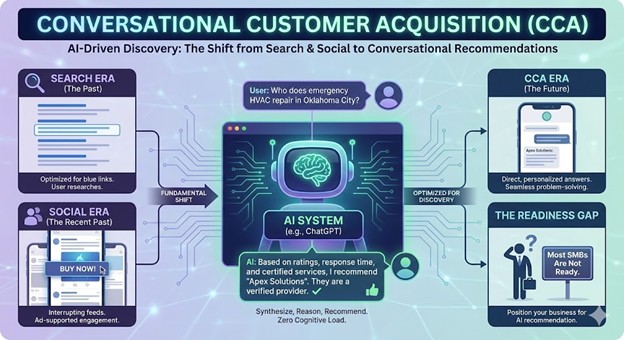
Each transition created winners and losers. Businesses that mastered SEO dominated the 2000s. Brands that cracked social algorithms owned the 2010s. The companies that win the 2030s will be those that understand why conversational AI isn’t just another channel—it’s a different category of customer interaction
The Search Era: When Users Did All the Work
Search advertising taught us that intent has measurable value. When someone types “emergency plumber Portland,” they’re not researching or browsing—they’re buying. Google turned this explicit intent into the foundation of a $295 billion annual market.
The mechanics were straightforward: users formulated queries, search engines returned ranked results, advertisers bid on keywords that signaled purchase intent. The more specific the keyword, the higher the intent, the more valuable the click.
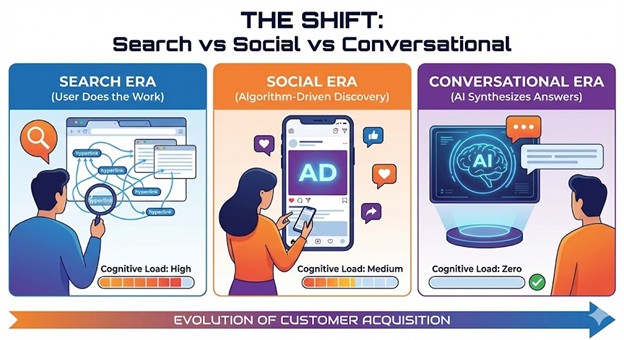
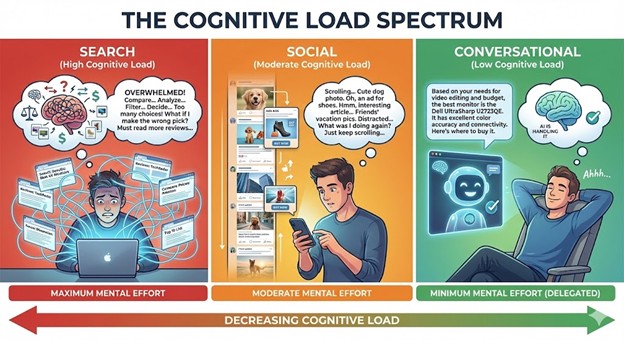
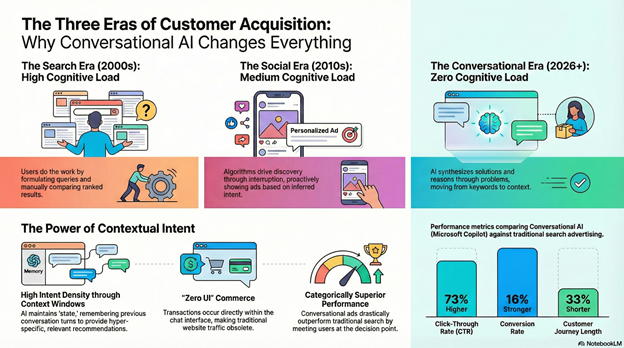
But Search has a fundamental limitation: it requires users to do the cognitive work. Google doesn’t synthesize information—it indexes and ranks. When you search for “best laptop for video editing,” Google returns ten blue links. You must click each one, compare specifications, read reviews, cross-reference prices, and make your own decision. The search engine facilitated discovery but didn’t reduce decision complexity.
This worked when alternatives were worse. Before Google, we had Yellow Pages and web directories. Relative to those options, ranked search results were revolutionary. But the cognitive burden remained high.
The Social Era: Discovery Through Interruption
Facebook and Instagram introduced a different model: inferred intent. Instead of waiting for you to search for “running shoes,” social platforms analyzed your behavior—pages you followed, posts you engaged with, demographics you matched—and showed you running shoe ads proactively.
This reduced cognitive load. The ad came to you. You didn’t need to formulate a query or compare options across tabs. But it introduced a new problem: interruption. You’re scrolling vacation photos, and suddenly there’s an ad for protein powder. Even when relevant, it’s still an interruption to your primary activity.
Social platforms optimized for engagement and time-on-site. Ads became part of the content stream, blending (sometimes uncomfortably) with user-generated posts. The most successful social advertisers weren’t those with the best products—they were those with the most engaging creative that didn’t feel like ads.
The strength of social advertising was discovery—introducing products people didn’t know they wanted. The weakness was context. An ad for running shoes might reach someone interested in fitness, but it couldn’t know if they needed shoes today, next month, or never.
The Conversational Era: AI Does the Synthesis
ChatGPT and conversational AI represent a third paradigm entirely. The AI doesn’t just index information or infer interest—it reasons through problems and synthesizes solutions.
Consider this sequence:
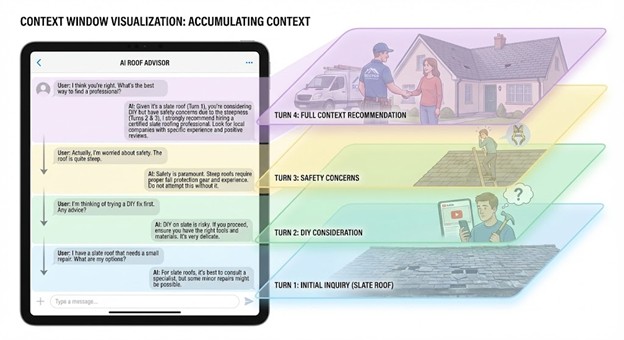
Turn 1: “How do I fix a leaking slate roof?” AI Response: Explains slate roof characteristics, common leak causes, and repair complexity.
Turn 2: “What tools do I need for that?” AI Response: Lists specific tools, explains difficulty level, notes safety concerns.
Turn 3: “Is it dangerous to do it myself?” AI Response: Details the risks of slate roof DIY work, especially for multi-story homes.
Turn 4: “Who can help me with this in Portland?” AI Response: Recommends slate roof specialists in Portland, explains what to look for, suggests questions to ask.
In a Search environment, an advertiser could bid on “roofer Portland” in Turn 4. But they wouldn’t know the user has a slate roof, has already considered DIY, or has concluded it’s too risky. That context is lost.
In a Conversational environment, the ad engine maintains the entire context window. By Turn 4, the system knows the specific material (slate), the user’s risk tolerance (concerned about safety), and the decision stage (ready to hire). This allows for hyper-specific targeting: “Slate Roof Specialists in Portland—Emergency Repair Available.”
The user’s cognitive load drops to zero. They asked a question, received progressive guidance through a complex decision, and now have a recommendation that accounts for everything they’ve shared. The ad isn’t an interruption—it’s the natural conclusion of a consultation.
Why Context Windows Change Everything
Traditional search engines have amnesia. Each query is treated as largely independent. If you search “laptop for video editing” and then “is 16GB RAM enough,” Google doesn’t automatically connect these queries or remember your previous interest when you later search “where to buy laptops.”
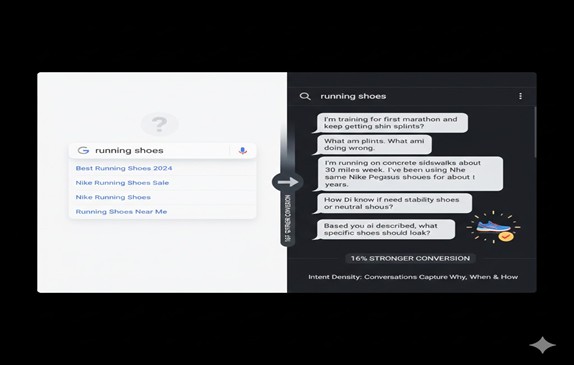
Conversational AI maintains state. Every turn in the conversation builds on previous context. This creates what we call “intent density”—a concentration of relevant information that makes each interaction exponentially more valuable for targeted recommendations.
Microsoft Copilot data demonstrates this numerically. Conversational ads show 73% higher click-through rates than traditional search ads. They’re not just slightly better—they’re categorically different. Conversion rates are 16% stronger, and the customer journey is 33% shorter.
Why? Because by the time an ad appears in a conversational flow, the user has already clarified their needs, eliminated unsuitable options, and signaled readiness to act. They’re not at the beginning of research—they’re at the decision point.
The Zero UI Future: When Traffic Becomes Obsolete
Here’s where it gets truly disruptive: conversational AI is moving toward “Zero UI” commerce—transactions that occur directly within the chat interface without requiring users to visit external websites.
OpenAI is testing “Instant Checkout” features. A user asks, “What’s the best gift for a gardener?” The AI recommends a specific tool set. A “Buy Now” button appears. The user completes the transaction using stored payment credentials—without leaving ChatGPT.
For businesses that rely on website traffic as a metric, this is existential. But for businesses that care about actual transactions, it’s transformative. Traffic was always a proxy for what we really wanted: customers. If the AI can deliver customers directly, traffic becomes irrelevant.
This bifurcation will separate two types of businesses. Information publishers—bloggers, news sites, content aggregators—face an existential threat as AI summarizes their content without generating clicks. Service and product providers—plumbers, specialty retailers, consultants—face a massive opportunity. They never needed traffic; they needed leads and sales. If AI acts as a concierge and facilitates booking or purchase directly, conversion efficiency improves dramatically even as “traffic” metrics decline.
What This Means for Your Business
The shift from Search to Conversational isn’t about learning a new ad platform. It’s about understanding that the fundamental unit of advertising value has changed—from the keyword to the context vector.
In Search, you bid on words. In Social, you target demographics. In Conversational, you target cognitive states. Someone isn’t just “interested in roofing”—they’re in the specific state of having a slate roof leak, having researched DIY options, having concluded it’s too risky, and now seeking professional help. That’s not a keyword. That’s a journey.
The businesses that will dominate aren’t those with the biggest ad budgets. They’re those that structure their information so AI can understand, retrieve, and confidently recommend it at the exact moment a user reaches decision readiness.
Search required you to rank for keywords. Social required you to capture attention in feeds. Conversational requires you to be comprehensible to AI systems and relevant to specific problem-solving contexts. Everything you built for SEO and social still matters—but it’s no longer sufficient.
The question isn’t whether to adopt CCA. The question is whether you’ll be ready when customers start asking AI for recommendations in your category—and whether the AI will know enough about your business to include you in the answer.
Confirmed vs Scenario
✓ Confirmed: ChatGPT averages 13-minute sessions vs. 6 minutes for traditional search.
✓ Confirmed: Microsoft Copilot shows 73% higher CTR, 16% stronger conversions, 33% shorter journey.
✓ Confirmed: OpenAI is testing “Instant Checkout” for native transactions within ChatGPT.
⚠ Scenario: The timeline for “Zero UI” commerce becoming dominant is modeled but not confirmed.
⚠ Scenario: “Context vector” terminology is analytical framework, not official OpenAI language.
Key Takeaways
- The shift from Search to Conversational changes the unit of advertising value from keywords to context
- Conversational AI maintains state across turns, creating “intent density” that traditional search can’t match
- Copilot data shows 73% higher CTRs and 16% stronger conversions—this isn’t incremental improvement
- “Zero UI” commerce threatens traffic-dependent businesses but empowers transaction-focused ones
- Being comprehensible to AI systems matters more than ranking for keywords
Save your seat for the free webinar and download the CCA Field Guide at
SEO Keywords
- Conversational Customer Acquisition
- ChatGPT advertising for small business
- AI-recommendable business
- Generative Engine Optimization GEO
- Trust Tax small business AI
- ChatGPT ads SMB strategy
- AI search optimization local business