
Meta Description: Information is no longer scarce in B2B buying. Uncertainty is. Learn why the best websites resolve uncertainty rather than add to the information pool, and what that shift requires structurally.

Answer Up Front
The information gap in B2B buying has largely closed. A buyer researching a professional services category today has access to AI-synthesized overviews, competitor comparisons, peer reviews, analyst perspectives, and category explainers before they visit any company website. What has not closed is the uncertainty gap. Uncertainty is not the same as ignorance. A buyer can have significant information about a solution category and still be deeply uncertain about what to do with that information in the context of their specific situation. The best websites understand this distinction. They are not built to add more information to a buyer who already has plenty. They are built to resolve the specific uncertainties that are preventing a qualified, informed buyer from taking a confident next step. Resolving uncertainty requires a different architecture than delivering information. It requires trigger alignment, decision question resolution, guided self-evaluation, and explicit fit criteria. And in the AI era, it is the standard that separates the websites that advance buyers from the ones that simply inform them.
Main Article
The Gap That Information Cannot Close
For most of the digital marketing era, the implicit model of buyer readiness was simple: more information produces more readiness. A buyer who understands the category better, knows the company’s offer more thoroughly, and has read more case studies is a buyer who is closer to a decision.
That model was reasonable when information was the primary scarcity. In an environment where buyers had limited access to independent category education, more information genuinely produced more readiness. The information gap and the readiness gap were closely correlated.
They are no longer the same gap.
A buyer researching a B2B solution today arrives at the company website having already consumed significant information about the solution category. They have received AI-synthesized overviews. They have read comparison content. They have reviewed peer perspectives. They arrive informed. And yet, despite being informed, they are often still uncertain about the thing that matters most to their decision: what does this mean for my specific situation?
That question cannot be answered by more information. It can only be answered by a structured evaluation of their specific circumstances against the relevant criteria. And most websites are not built to provide that evaluation. They are built to provide more information.
The gap between what the best websites provide, genuine uncertainty resolution, and what most websites provide, additional information, is the gap that separates the websites that advance buyers from the ones that simply add to the noise.
What Uncertainty Actually Is in a B2B Buying Context
Uncertainty in a B2B buying context is not ignorance. It is the state of having significant information but insufficient clarity about what that information means for a specific decision in a specific situation.
A buyer can read an excellent article explaining the five types of buyer friction and still be uncertain about which types are operating in their own buyer journey. A buyer can understand the general framework for evaluating whether to repair or replace a system and still be uncertain about what the right answer is for their specific system, budget, and timeline. A buyer can understand the general case for a Decision Cycle Compression System and still be uncertain about whether their own sales cycle length is a friction problem or a market reality.
In each case, the information is present. The situational application is absent. And it is the situational application, the translation of general information into specific, personal clarity, that resolves uncertainty and enables action.
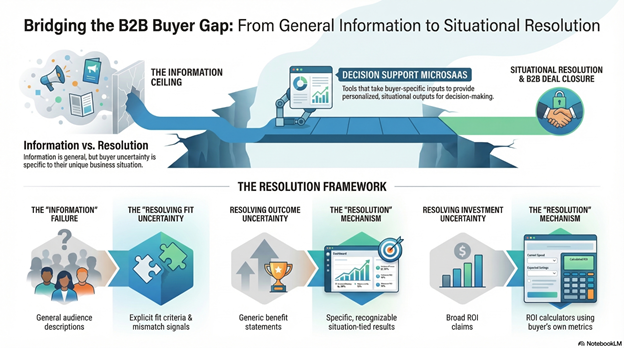
This distinction is why information delivery has a ceiling as a buyer-progress mechanism. Information raises the ceiling of what a buyer can understand conceptually. It does not lower the floor of what they are uncertain about situationally. Resolving situational uncertainty requires something information cannot provide: a structured evaluation of the buyer’s specific circumstances.
The Five Forms Buyer Uncertainty Takes
Buyer uncertainty in B2B buying is not monolithic. It takes five distinct forms, each requiring a different resolution mechanism.
Form 1: Fit Uncertainty
Fit uncertainty is the buyer’s unresolved question about whether the company’s offer is genuinely relevant to their specific situation. It is the most foundational form of uncertainty because it underlies all subsequent evaluation. A buyer who is uncertain about fit will not invest significant energy in evaluating the offer’s specifics, outcomes, or pricing. They will disengage before reaching the depth of evaluation that would confirm or disconfirm fit.
Fit uncertainty is resolved by explicit fit criteria: a clear, honest statement of who the company works best with, under what conditions, and for what types of situations. That statement gives the buyer a direct way to evaluate their own relevance without requiring a sales conversation to find out.
Form 2: Outcome Uncertainty
Outcome uncertainty is the buyer’s unresolved question about what they would actually get from the engagement. Not the general benefit statement on the service page. The specific, concrete outcome for a company in their situation with their constraints.
Outcome uncertainty is resolved by specific, recognizable outcome descriptions: not “we improve marketing performance” but “companies in your situation typically see sales cycle compression of X weeks within Y months, driven by Z specific changes.” That specificity gives the buyer a realistic picture of what success looks like for them rather than for a generic ideal client.
Form 3: Process Uncertainty
Process uncertainty is the buyer’s unresolved question about what the engagement would actually look like. What happens in the first thirty days? What does the company do? What does the buyer need to provide? How is progress measured and communicated?
Process uncertainty creates a specific form of commitment resistance. The buyer is being asked to commit to something whose operational reality they cannot envision. That inability to envision is not a reflection of the offer’s quality. It is a reflection of the website’s failure to describe the process with sufficient specificity to make it real.
Form 4: Investment Uncertainty
Investment uncertainty is the buyer’s unresolved question about whether the cost of the engagement is justified by the return it would produce in their specific situation. Not whether the price is high or low in absolute terms, but whether the return, given their metrics, timeline, and priorities, makes the investment sensible.
Investment uncertainty is resolved by ROI context: content and tools that help the buyer build a preliminary business case using their own metrics as inputs. A buyer who has run an ROI estimator and produced a plausible return figure for their specific situation has resolved their investment uncertainty at a preliminary level. The sales conversation can then refine rather than introduce the financial case.
Form 5: Timing Uncertainty
Timing uncertainty is the buyer’s unresolved question about whether now is the right moment to act. They may be convinced of fit, outcome, process, and investment value and still be uncertain about timing. Is this urgent enough to prioritize now, or can it wait?
Timing uncertainty is resolved by cost-of-delay content: specific, concrete descriptions of what continued delay produces in commercial terms. Not abstract urgency language but measurable consequences: each additional month of extended cycle length produces X in revenue delay, Y in sales capacity waste, Z in competitive disadvantage. When the buyer can quantify the cost of waiting, timing uncertainty has a resolution mechanism.
Why Information Cannot Resolve Situational Uncertainty
The reason information delivery fails as a primary uncertainty resolution mechanism is structural: information is general and uncertainty is specific.
An article explaining the five types of buyer friction is general. It applies to the entire population of B2B companies with websites. The buyer reading it can understand the framework conceptually and still not know which friction types are operating in their specific buyer journey at what severity and with what commercial consequence.
Resolving that specific uncertainty requires something the article cannot provide: a structured evaluation that takes the buyer’s specific inputs and returns a specific output about their situation. That is the job of Decision Support MicroSaaS tools. They are the uncertainty resolution mechanism that information cannot replicate.
A fit qualifier takes the buyer’s specific company profile, problem type, and readiness conditions and returns a specific assessment of fit relevance. A Decision Cycle Compression Diagnostic takes the buyer’s specific buyer journey characteristics and returns a specific identification of which friction types are operating at highest severity. An ROI estimator takes the buyer’s specific metrics and returns a specific preliminary return figure.
In each case, the tool does something no information asset can do: it makes the general framework specific to the buyer’s situation. And that specificity is what resolves uncertainty in a way that produces readiness rather than simply produces more informed uncertainty.
The Architecture of an Uncertainty-Resolving Website
Building a website that resolves uncertainty rather than delivers information requires five structural changes that correspond to the five forms of uncertainty described above.
For fit uncertainty: Replace generic audience descriptions with explicit, specific fit criteria. Name the company sizes, stages, problem types, and readiness conditions that characterize the best-fit client. Be honest about the mismatch signals as well as the fit signals. That honesty resolves fit uncertainty more effectively than any amount of inclusive positioning language.
For outcome uncertainty: Replace benefit statements with specific, recognizable outcome descriptions tied to identifiable buyer situations. Not “we improve conversion rates” but “companies with qualified traffic and high bounce rates on service pages typically see engagement rates increase significantly within a defined timeframe through a specific type of change.” The more specifically the outcome is described, the more directly it resolves the buyer’s outcome uncertainty.
For process uncertainty: Add explicit process transparency to every service page. A clear, specific description of what the first thirty days look like, what the company does in each phase, what the buyer is responsible for, and how progress is reported. That description makes the engagement real to a buyer who cannot yet envision it, resolving the uncertainty that was preventing commitment.
For investment uncertainty: Add an ROI context tool or calculator that helps buyers build a preliminary business case using their own metrics. Even a simple tool that takes average deal size, current cycle length, and target cycle reduction and produces a rough revenue impact estimate gives the buyer a personalized return figure that resolves investment uncertainty at a preliminary level.
For timing uncertainty: Add cost-of-delay content that quantifies the commercial consequence of postponing the decision. Not urgency language. Measurable consequence descriptions that give the buyer a specific, honest answer to the question: what does waiting actually cost me?
How Betweener Engineering Reduces Upstream Uncertainty
Uncertainty resolution is not just a website-level problem. In the AI era, it has an upstream dimension that begins before the buyer arrives.
Betweener Engineering addresses uncertainty at the identity level. When AI systems have an inaccurate, incomplete, or ambiguous representation of a company’s positioning, the buyers those AI systems refer arrive carrying more uncertainty than they need to. They have received a partial or inaccurate picture of the company and arrive needing to reconcile what the AI told them with what the website says.
When Betweener Engineering has closed the gap between the company’s actual identity and the AI’s representation of it, the buyers AI systems refer arrive carrying less uncertainty. The AI has already given them an accurate picture. The website’s job is to deepen and complete their evaluation, not to correct the picture the AI gave them.
That upstream uncertainty reduction is commercially significant. A buyer who arrives with less uncertainty requires less resolution work from the website. They reach the point of self-qualified readiness faster. The cycle compresses from the top rather than only from the bottom.
Conversational Customer Acquisition captures the value of that upstream reduction by ensuring the company’s content is what AI systems surface when buyers ask questions in the company’s domain. When the content AI systems surface is also the most uncertainty-resolving content in the category, the company is building a compound advantage: upstream orientation through Betweener Engineering, upstream question resolution through CCA-optimized answer-first content, and downstream situational resolution through Decision Support MicroSaaS tools on the website.
The Decision-Support Bridge
The most direct path from an information-delivering website to an uncertainty-resolving one is identifying which of the five uncertainty forms is creating the most significant friction in the current buyer journey and building one tool or content asset designed specifically to resolve it.
For most professional services companies, the highest-severity uncertainty form is either fit uncertainty or outcome uncertainty. A fit qualifier or a specific, recognizable outcome description built around the buyer’s actual situation will produce the most immediate improvement in buyer progress.
The second step is the Decision Cycle Compression Diagnostic, which surfaces all five uncertainty forms as they operate in the buyer’s specific situation and prioritizes the interventions that would produce the greatest cycle compression.
See where your buying cycle stalls. The Decision Cycle Compression Diagnostic maps your buyer journey against the five 5-LBT lenses and tells you exactly where progress is being lost. Start your free diagnostic at dccd.theblackfridayagency.com
Conclusion
The information gap in B2B buying has closed. The uncertainty gap has not.
The best websites understand this distinction and build for it. They do not add more information to a buyer who already has plenty. They resolve the specific uncertainties that are preventing a qualified, informed buyer from taking a confident next step.
That resolution requires a different architecture than information delivery. It requires explicit fit criteria that address fit uncertainty. Specific outcome descriptions that address outcome uncertainty. Process transparency that addresses process uncertainty. ROI context tools that address investment uncertainty. Cost-of-delay content that addresses timing uncertainty.
And at the center of all five, Decision Support MicroSaaS tools that take the buyer’s specific situation as input and return specific, actionable clarity as output. Those tools are the mechanism that closes the gap between conceptual understanding and situational readiness. They are the element most B2B websites are missing. And they are the element that most directly separates the websites that advance buyers from the ones that simply inform them.
The buyers are informed. The question is whether your website is built to resolve their uncertainty or to add to the pool of information they already have.
See where your buying cycle stalls. The Decision Cycle Compression Diagnostic maps your buyer journey against the five 5-LBT lenses and tells you exactly where progress is being lost. Start your free diagnostic at dccd.theblackfridayagency.com
FAQs
What is the difference between information and uncertainty resolution in B2B marketing?
Information is general content that expands a buyer's conceptual understanding of a solution category or company offer. Uncertainty resolution addresses the buyer's specific, personal question about what that information means for their situation. A buyer can have abundant information and remain deeply uncertain about what to do with it. Resolving uncertainty requires tools and content that translate general frameworks into buyer-specific clarity.
What are the five forms of buyer uncertainty in B2B buying?
The five forms are: fit uncertainty, the unresolved question of whether the company is relevant to the buyer's situation; outcome uncertainty, the unresolved question of what the buyer would actually get; process uncertainty, the unresolved question of what the engagement would look like; investment uncertainty, the unresolved question of whether the return justifies the cost; and timing uncertainty, the unresolved question of whether now is the right moment to act.
Why can information delivery not resolve situational uncertainty?
Information is general and uncertainty is specific. An article explaining a framework applies to all buyers. A buyer's uncertainty about whether that framework applies to their specific situation requires a structured evaluation that takes their specific inputs and returns specific outputs. That translation from general to specific is the job of Decision Support MicroSaaS tools, not information assets.
What is the most effective mechanism for resolving buyer uncertainty at scale?
Decision Support MicroSaaS tools are the primary mechanism for resolving situational uncertainty at scale. They take the buyer's specific inputs and return specific, actionable outputs about their situation. A fit qualifier resolves fit uncertainty. An ROI estimator resolves investment uncertainty. A Decision Cycle Compression Diagnostic resolves multiple uncertainty forms simultaneously in a single structured evaluation.
How does Betweener Engineering reduce buyer uncertainty?
Betweener Engineering reduces upstream uncertainty by ensuring AI systems accurately represent the company's positioning, fit criteria, and offer specifics. Buyers referred by AI systems that have accurate company representations arrive carrying less uncertainty than buyers referred by AI systems with incomplete or inaccurate representations. That upstream reduction means the website's resolution work starts from a more advanced position.
What is the most direct starting point for building an uncertainty-resolving website?
Identify which of the five uncertainty forms is creating the most significant friction in the current buyer journey and build one tool or content asset specifically designed to resolve it. For most professional services companies, fit uncertainty or outcome uncertainty is highest severity. A fit qualifier or a specific outcome description built around the buyer's actual situation produces the most immediate improvement in buyer progress.
How does uncertainty resolution connect to the Decision Cycle Compression System?
Uncertainty resolution is the central mechanism of the Decision Cycle Compression System. The system is designed to reduce the time, uncertainty, and friction between a buyer's initial trigger and their serious next action. Each of the five 5-LBT lenses addresses one or more forms of buyer uncertainty: Trigger addresses fit uncertainty at the identity level, Question addresses conceptual uncertainty, Friction addresses accumulated uncertainty across all forms, Experience addresses situational uncertainty through guided tools, and Progress confirms that uncertainty has been resolved sufficiently for the buyer to act.