
Meta Description: The brochure site model is structurally misaligned with how B2B buyers move in the AI era. Learn why the future of websites is decision support and what that shift looks like in practice.

Answer Up Front
The brochure site model that has dominated B2B web design for two decades is not failing because it looks outdated. It is failing because it was built for a different buyer in a different information environment. That buyer needed to be introduced to the company. They needed to be educated on the category. They needed to be persuaded. The buyer visiting a B2B website today has usually done all of that before they arrive. They have received AI-synthesized summaries of the solution landscape. They have compared alternatives. They arrive with a specific decision question, a preliminary sense of fit, and a need for something the brochure site cannot provide: a structured path through their own evaluation. The future of websites is decision support. Not prettier brochures. Not more content. A fundamentally different architecture built around one question: is the buyer more ready to act at the end of this experience than they were at the beginning?
Main Article
The Brochure Site Was Built for a Different Buyer
To understand why the future of websites is decision support, it helps to understand precisely what the brochure site was built to do and why it made sense when it was built.
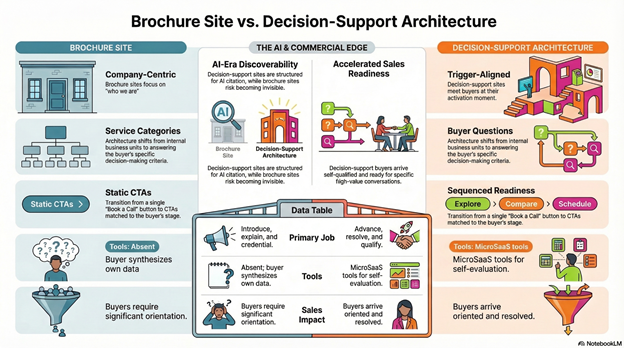
The brochure site emerged in the late 1990s and early 2000s as a direct translation of printed marketing collateral into digital form. Its primary jobs were introduction, explanation, and credentialing. It told buyers who the company was, what it did, why it was good at it, and how to get in touch. For a buyer discovering a company for the first time, with no prior context and no digital research infrastructure to turn to, that model was genuinely useful. The brochure site filled a real information gap.
The buyer visiting a B2B website today is a different person in a different situation.
They have likely already received an AI-synthesized overview of the solution category. They have read comparison content. They have seen the company mentioned in an AI-generated answer to a relevant question. They arrive with a preliminary orientation that the brochure site was designed to create. And they arrive with something else: a specific need that the brochure site was never designed to address.
They need help evaluating their own situation. They need a structured way to confirm that this company is the right fit for their specific circumstances. They need to answer the decision question they are carrying without having to book a sales call to get there. They need progress, not introduction.
The brochure site, confronted with that need, offers explanation. And explanation is the wrong response to a buyer who is past the explanation stage.
Three Forces Driving the Shift
The transition from brochure site to decision-support website is being driven by three structural forces that are each accelerating independently and reinforcing each other.
Force 1: AI Has Changed the Discovery Layer
For most of the digital era, the website was the primary discovery mechanism for B2B buyers. Buyers found companies through search engines, arrived at websites with limited prior context, and relied on those websites to build their foundational understanding of the company and its offer.
AI has disrupted that model at the discovery stage. A growing proportion of B2B buyers now begin their evaluation with a conversational AI system rather than a search engine. They ask questions and receive synthesized answers that include specific companies, frameworks, and resources. By the time they arrive at a company’s website, the foundational discovery work has already been done.
This changes the website’s job. It is no longer primarily a discovery asset. It is a decision asset. The buyer is not arriving to learn who the company is. They are arriving to determine whether the company is right for them. That is a fundamentally different job requiring a fundamentally different architecture.
Force 2: Buyers Have Less Patience for Re-Education
The information abundance of the AI era has changed buyer expectations. Buyers have access to better answers, faster, than at any previous point. That access has raised the standard for what a useful website interaction looks like.
A buyer who has received a high-quality AI-synthesized overview of a solution category and then arrives at a company website that re-explains the same category fundamentals is experiencing a regression. They are being asked to go backwards. They are being offered a lower quality of information than they already have.
The brochure site re-educates. The decision-support website advances. In an environment where buyers have already been educated, advancement is the only thing the website can offer that the buyer does not already have.
Force 3: Sales Teams Perform Better When the Website Creates Progress First
The commercial case for decision-support websites is perhaps most clearly visible at the sales team level. Sales teams that receive buyers who have already been through a structured self-evaluation experience run fundamentally better conversations than teams receiving buyers who have only consumed brochure-style content.
The difference is not marginal. A buyer who has completed a guided assessment, confirmed their own fit, identified their most significant challenge, and determined a specific next step arrives at the first sales conversation in a meaningfully more advanced state. The conversation can begin at the level of specifics rather than at the level of introduction. It runs shorter, reaches depth faster, and converts at a higher rate.
The website that creates that buyer state is not just a marketing asset. It is a sales acceleration tool. And the companies that understand that connection are building decision-support websites not because they are forward-thinking but because the commercial case is compelling.
What a Decision-Support Website Actually Is
A decision-support website is a buyer-progress architecture designed to help qualified prospects evaluate their situation, resolve their central decision question, confirm their fit, and determine their right next step, all before the first sales conversation begins.
It is not a brochure site with a quiz added. It is not a content-heavy site with a chatbot in the corner. It is a structurally different model built around five elements that correspond directly to the five lenses of the 5-LBT Framework.
Element 1: Trigger Alignment
A decision-support website meets buyers at their specific activation moment rather than at the company’s preferred starting point. Its homepage, service pages, and primary content assets are organized around the triggers that bring buyers into active evaluation, the specific events, pain spikes, and realizations that cause a buyer to move from passive awareness to active search.
When a website is trigger-aligned, a buyer who arrives in the middle of an active evaluation immediately recognizes that the company understands their situation. That recognition creates the trust foundation on which all subsequent progress is built.
Element 2: Question Resolution
A decision-support website is organized around the buyer’s decision questions rather than the company’s service categories. Its content architecture is built to answer the specific questions buyers carry when they arrive, clearly, specifically, and early in each page and article rather than buried in the third section of a service description.
Question resolution content does not just inform. It resolves. The buyer leaves each content interaction with a specific uncertainty addressed rather than with more information to process.
Element 3: Friction Reduction
A decision-support website is designed with the five friction sources, identity, question, process, commitment, and timing, actively identified and addressed. It has explicit fit criteria so buyers can confirm identity relevance. It has process transparency so buyers can envision the engagement. It has sequenced CTAs so buyers are never asked for more commitment than they are prepared to give. It has cost-of-delay content so timing uncertainty has a resolution path.
Element 4: Guided Evaluation
A decision-support website gives buyers tools to evaluate their own situation rather than asking them to synthesize the company’s content into a self-assessment on their own. Decision Support MicroSaaS tools are the primary mechanism for this element. Fit qualifiers, guided assessments, ROI estimators, and diagnostic tools give the buyer a structured, company-guided path through their own evaluation. That path is the most commercially significant design element of the decision-support model.
Element 5: Progress Confirmation
A decision-support website is designed so that buyers can confirm their own progress at each stage of the journey. They know when they have confirmed fit. They know when their central question has been resolved. They know what the right next step is and why it is right for their specific situation. The website does not leave the buyer to synthesize their own conclusion. It provides that conclusion through the structure of the experience itself.
The AI-Era Dimension of Decision-Support Websites
The decision-support website model has a specific and significant advantage in the AI era that goes beyond improving the buyer experience for human visitors.
AI systems evaluate content for its decision relevance and resolution quality. A website built around question resolution, explicit fit criteria, structured evaluation tools, and clear next-step logic is a website that AI systems can parse, summarize, and recommend with high confidence. The structural characteristics of a decision-support website are the same characteristics that make content AI-citable and AI-recommendable.
This means the decision-support website is not just optimized for the human buyer who arrives after AI-mediated discovery. It is optimized to be part of the AI-mediated discovery itself.
Betweener Engineering amplifies this further. By engineering AI systems to accurately represent the company’s positioning, framework, and offer upstream, Betweener Engineering ensures that the buyers AI sends are already partially oriented when they arrive at the decision-support website. The website receives buyers who are further along. The guided evaluation tools take those buyers the rest of the way. The sales team receives buyers who are genuinely ready.
Conversational Customer Acquisition connects the upstream and downstream elements. CCA is designed to win AI-mediated buyer conversations. The decision-support website is where those won conversations land. A company whose CCA is working but whose website is still a brochure site is losing a significant proportion of the value CCA creates at the landing stage. The decision-support website is what converts CCA-generated interest into sales-ready conversations at scale.
The Transition From Brochure to Decision Support
Most companies reading this article are not starting from zero. They have a website. They have content. They have some form of conversion architecture. The question is not whether to build a decision-support website from scratch. It is where to begin the transition.
The transition from brochure site to decision-support website does not require a full rebuild. It requires a series of structural additions, each of which improves buyer progress immediately and compounds over time.
The first addition is a guided assessment. One well-designed Decision Support MicroSaaS tool, built around the buyer’s most significant decision question, begins the transition from passive reading to active self-evaluation. It is the element most brochure sites lack entirely and the element that most directly produces measurable improvement in sales conversation quality.
The second addition is a friction audit. Using the five friction sources as a diagnostic framework, identifying which sources are operating at highest severity in the current website, and addressing the highest-severity source first. That audit consistently surfaces specific, addressable changes that do not require a full redesign but produce measurable improvement in buyer progress.
The third addition is a sequenced CTA architecture. Replacing the single uniform call-to-action with a readiness-matched structure that offers orientation-stage, evaluation-stage, and commitment-stage options on the appropriate pages. That change alone removes commitment friction from a significant proportion of qualified visitors who were previously leaving because the only available next step was premature.
Three additions. None of them require rebuilding the entire website. All of them begin shifting the architecture from explanation to decision support.
The Decision-Support Bridge
The Decision Cycle Compression Diagnostic is the most direct entry point into the decision-support website model. It surfaces where your current website is functioning as a brochure and where it is creating genuine buyer progress, and gives you a prioritized roadmap for the transition.
See where your buying cycle stalls. The Decision Cycle Compression Diagnostic maps your buyer journey against the five 5-LBT lenses and tells you exactly where progress is being lost. Start your free diagnostic at dccd.theblackfridayagency.com
Conclusion
The future of websites is not a design trend. It is a commercial necessity produced by a structural shift in how buyers move through the market.
The buyer visiting a B2B website today does not need to be introduced to the company. They need help evaluating whether the company is right for them. The brochure site cannot provide that help. It was not built for that job. It was built for a buyer who needed introduction, education, and persuasion, and it served that buyer reasonably well for two decades.
That buyer has changed. The information environment has changed. The discovery layer has changed. And the commercial cost of continuing to serve a changed buyer with an unchanged website is measured in sales cycles that are longer than they need to be, conversions that are lower than they should be, and sales conversations that start too far back to be as productive as they could be.
The decision-support website is not a luxury for companies with large marketing budgets. It is the standard that the current buyer journey requires. And the companies that build it, or begin the transition toward it, will find that the commercial return is visible faster than most expect.
See where your buying cycle stalls. The Decision Cycle Compression Diagnostic maps your buyer journey against the five 5-LBT lenses and tells you exactly where progress is being lost. Start your free diagnostic at dccd.theblackfridayagency.com
FAQs
What is a decision-support website?
A decision-support website is a buyer-progress architecture designed to help qualified prospects evaluate their situation, resolve their central decision question, confirm their fit, and determine their right next step before the first sales conversation begins. It differs from a brochure site in that it is organized around the buyer's decision questions and evaluation needs rather than the company's service structure and credentials.
Why is the brochure site model failing in the AI era?
The brochure site was built for a buyer who needed introduction, education, and persuasion. Today's B2B buyer typically arrives having already received AI-synthesized overviews of the solution landscape. They are past the introduction stage. The brochure site offers explanation to a buyer who needs evaluation support, which is the wrong response to where that buyer actually is.
What are the five structural elements of a decision-support website?
The five elements, drawn from the 5-LBT Framework, are: trigger alignment, organizing content around the buyer's activation moment; question resolution, answering the buyer's decision questions clearly and early; friction reduction, addressing the five friction sources that slow qualified buyers; guided evaluation, providing Decision Support MicroSaaS tools for structured self-assessment; and progress confirmation, ensuring the buyer knows their own forward direction at each stage.
What are the three forces driving the shift from brochure to decision support?
The three forces are: AI has changed the discovery layer so websites are no longer primarily discovery assets; buyers have less patience for re-education in an environment of information abundance; and sales teams perform measurably better when the website creates buyer progress before the first conversation begins.
How does the decision-support website model perform in AI-mediated discovery?
A decision-support website is structured for AI citation and recommendation in the same ways it is structured for buyer progress: clear question resolution, explicit definitions, organized frameworks, and genuine decision utility. AI systems evaluate content for decision relevance and resolution quality. A decision-support website, built around those qualities, is more likely to be cited and recommended than a brochure site built around company explanation.
How does the transition from brochure site to decision-support website begin?
The transition begins with three structural additions rather than a full rebuild: a guided assessment tool that moves the most important buyer decision question from the sales call into the self-service experience; a friction audit that identifies the highest-severity friction sources in the current website; and a sequenced CTA architecture that replaces the single uniform call-to-action with readiness-matched options.
What is the connection between the decision-support website and the Decision Cycle Compression System?
The decision-support website is the operational expression of the Decision Cycle Compression System. The system defines the architecture: trigger alignment, question resolution, friction reduction, guided evaluation, and progress confirmation. The website is where that architecture is built and deployed. A decision-support website is, by definition, a Decision Cycle Compression System in active operation.